

A busy parent in Lancaster, Ohio, may start with a simple goal, straighter teeth without metal braces. Then the choices multiply: Invisalign, Spark, ClearCorrect, and social-media ads for mail-order aligners. The lowest advertised price can look appealing, but the important question isn't only which tray is made from better plastic. It's how much professional oversight the patient's specific teeth and bite require.
For patients searching for a dentist near me, a cosmetic dentist near me, or an Invisalign consultation in Amanda, Lancaster, Circleville, or Carroll, Ohio, the practical choice comes down to diagnosis, treatment design, daily wear, refinements, and follow-up care. Invisalign has a long commercial history, but other in-office systems can also be appropriate, while remote treatment may suit only carefully limited cosmetic cases.
Table of Contents
- Choosing Between Invisalign and Other Clear Aligners
- How Clear Aligners Actually Move Teeth
- Invisalign Compared to Other Aligner Options
- Understanding Aligner Treatment Costs
- Which Aligner Path Fits Which Patient
- Why In-Office Invisalign Oversight Matters
- What to Expect at Amanda Family Dental
- Taking the Next Step Toward a Straighter Smile
Choosing Between Invisalign and Other Clear Aligners
A teenager in Circleville may care most about keeping treatment discreet at school. An adult in Amanda may want to close a small gap before an important event, while a patient in Carroll may be comparing a local dental visit with a lower-priced online kit. The advertisements look similar. The clinical decisions are not.
Clear aligners are not interchangeable solutions for every bite problem. They are removable trays programmed to move teeth in stages. Success depends on whether the plan fits the patient's anatomy, gum health, bite, and ability to follow instructions. The brand matters, but the quality of diagnosis and follow-up matters more.
What actually determines the choice behind the brand names
A useful comparison starts with the patient's treatment needs, not the logo on the box:
- What is the actual problem? Mild crowding and spacing differ from extraction cases, deep bites, crossbites, or significant rotations.
- Who examines the patient? A dentist or orthodontist can check for cavities, gum disease, bone support, jaw relationships, and existing restorations before treatment begins.
- Who monitors tracking? Teeth may not move exactly as the digital plan predicts. In-office checks let the provider identify problems early.
- What happens if the plan needs adjustment? Attachments, interproximal reduction, replacement trays, and refinements may be necessary.
- What does the quoted fee include? Ask whether scans, visits, refinements, retainers, and treatment changes are covered.
The clear-aligner category has grown into a substantial global dental market. Industry estimates place its value at approximately USD 5.1 billion to USD 5.5 billion in 2025 to 2026, with forecasts ranging from roughly USD 10.4 billion to USD 56.8 billion by 2031 to 2033. One forecast reported that North America represented 54.6% of global revenue in 2025, according to the clear-aligners market analysis from Global Market Insights. Patients are comparing different models of diagnosis and care, not a familiar product with an alternative.
Practical rule: The more complicated the movement, the more valuable direct clinical supervision becomes.
A patient with a small, straightforward cosmetic concern may have different needs from someone whose bite, restorations, or gum health complicate tooth movement. The next comparisons examine treatment mechanics, care models, costs, candidacy, and the experience at a local dental office.
How Clear Aligners Actually Move Teeth
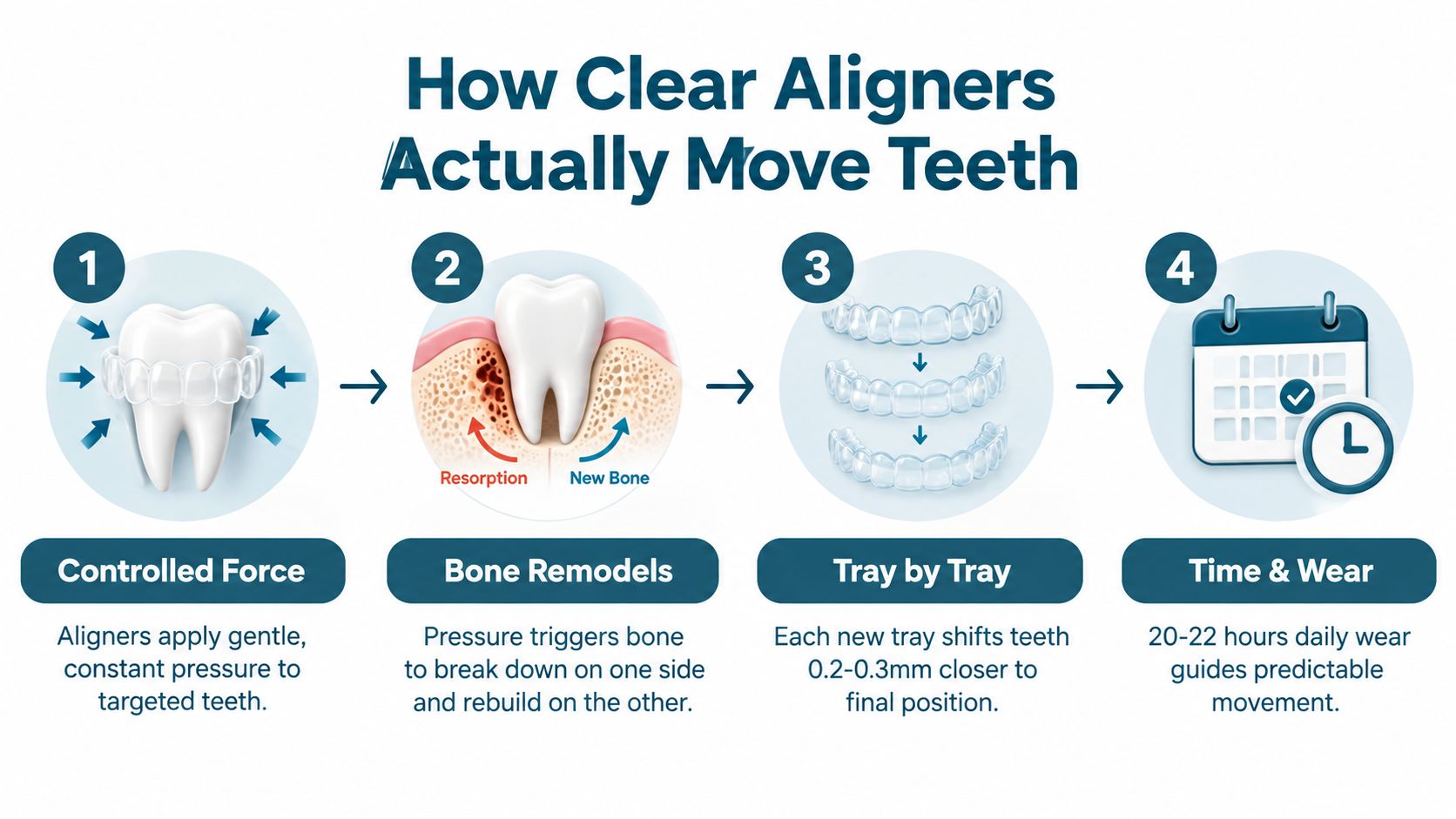
Teeth move when a controlled force is applied consistently. The surrounding bone responds to that pressure by remodeling, allowing the tooth root to shift gradually through the supporting tissues. The process isn't instant, and a tray can't force a tooth into a position that the treatment plan hasn't properly designed.
A clear-aligner sequence follows a straightforward pattern:
- The provider records the starting position. Digital scans, photographs, and dental examinations help map the teeth and bite.
- Software creates staged movements. Each tray is shaped to apply pressure to selected areas.
- The patient wears the tray consistently. The aligner can only guide movement while it's seated over the teeth.
- The provider checks the response. If a tooth doesn't track as planned, the treatment can be modified.
Why the tray is only part of the system
Invisalign uses SmartTrack material, custom fabrication based on digital scans such as iTero scans, precision-cut edges, and bonded attachments. Attachments are small composite features placed on selected teeth to give the aligner additional grip. They can help with movements such as rotation, extrusion, and torque, where a flat tray alone may have limited control.
Other clear-aligner systems use the same basic principle, but their materials, planning software, manufacturing processes, and clinical tools can differ. The important distinction isn't that one brand can move teeth while another cannot. It's whether the chosen system and provider can create and monitor the force needed for the specific movement.
Patients can review a plain-language explanation of the process through Amanda Family Dental's guide to how Invisalign works. A staged replacement schedule is also central to treatment. FDA-cleared clear aligners are described as being worn for approximately one to two weeks per stage, with the next tray replacing the previous one after that stage, as outlined in clear-aligner instructions from South Milwaukee Family Dental.
A patient should expect responsibility, too. Clear aligners work best when worn 20 to 22 hours per day, removed for eating, brushing, and flossing, according to an FDA 510(k) summary discussed in guidance from Clarksburg Dental Center. That daily habit affects every aligner brand.
The following video offers another visual explanation of the treatment concept:
Invisalign Compared to Other Aligner Options
An Ohio patient with mild crowding may do well with several clear-aligner systems. A patient with gum disease, a deep bite, or teeth that need rotation requires closer clinical oversight. The deciding issue is the treatment model, not the brand name on the tray.
In-office aligners such as Invisalign, Spark, and ClearCorrect are planned through a dental or orthodontic office. The provider examines the patient, reviews the bite and supporting tissues, plans tooth movement, checks progress, and changes the approach when teeth do not track as expected. Direct-to-consumer treatment usually relies on photographs, impressions, or remote scans, with limited routine in-person examination. That model may be convenient, but it gives the provider fewer chances to assess gum health, tooth roots, bite contacts, and unexpected movement directly.
| Criteria | Invisalign, In-Office | Other In-Office Brands | Direct-to-Consumer |
|---|---|---|---|
| Diagnosis and oversight | Dentist or orthodontist examines, plans, and monitors treatment | Dentist or orthodontist examines, plans, and monitors treatment | Limited or remote evaluation, depending on the provider model |
| Complex movements | Attachments and auxiliaries may support rotations, extrusion, torque, and bite correction | Capabilities vary by system and provider | Less suitable when movements need detailed supervision |
| Scans and planning | Digital scans and treatment-planning software are commonly used | Digital scans and planning tools vary by office | Patient-submitted records may be used |
| Attachments | Available when clinically indicated | May be available, depending on the system | Often limited compared with supervised in-office care |
| Refinements | Planned through the treating office when tracking needs correction | Policies vary by provider and brand | Coverage and access to revisions vary |
| Follow-up | In-person checks and direct communication with the treating office | In-person checks and direct communication with the treating office | Remote communication may be the main support channel |
| Best fit | Mild to moderate alignment and selected complex cases after evaluation | Mild to moderate cases and selected complex cases after evaluation | Limited cosmetic changes for carefully selected patients |
What the evidence says about predictability
Clear aligners, including Invisalign, are useful for mild-to-moderate alignment and crowding. Results are less predictable for vertical control, buccolingual inclination, final occlusal contacts, anterior-posterior correction, and relapse control, as discussed in the evidence-based dentistry review published through PMC.
Attachment design affects performance, but no attachment type works best for every movement. A 2025 systematic review found pooled canine-derotation accuracy of 61.2% with conventional attachments and 71.5% with optimized attachments. For anterior extrusion, accuracy was 57.5% and 62.4%, respectively. The differences were generally not statistically significant, and neither approach fully matched planned ClinCheck movement, according to the systematic review indexed by PubMed.
For an Ohio patient, that distinction matters. A remote tray program may suit a carefully selected cosmetic case. In-office Invisalign care is the safer recommendation when diagnosis, attachments, bite control, or treatment changes require regular professional review. Compare the provider's examination and monitoring plan before comparing brand names.
Understanding Aligner Treatment Costs
Aligner pricing varies because treatment isn't just a box of plastic trays. The total fee can reflect examination, digital records, planning, attachments, interproximal reduction, monitoring visits, refinements, replacement trays, and retainers. A complicated bite or extraction case requires a different level of planning from a small cosmetic correction.
What changes the final fee
A consultation should clarify:
- Case complexity: Crowding, spacing, rotations, deep bites, and crossbites may require different planning.
- Treatment length: More stages and more monitoring can affect the total cost.
- Additional procedures: Extractions, fillings, periodontal care, or interproximal reduction may be separate from the aligner fee.
- Refinement policy: Patients should ask how adjustments are handled if teeth don't track.
- Retention: Retainers may be included, limited, or charged separately.
Patients can review treatment-fee questions through Amanda Family Dental's Invisalign treatment cost resource. The office should explain whether dental insurance contributes to orthodontic care and whether payment arrangements are available.
| Treatment Type | Typical Ohio Price Range | What's Included | Common Hidden Costs |
|---|---|---|---|
| Invisalign through an in-office provider | Varies by diagnosis and treatment plan | Examination, planning, aligners, monitoring, and office-managed refinements may be included | Additional dental treatment, replacement trays, or retainers if excluded |
| Other in-office aligners | Varies by diagnosis and provider | Office evaluation, brand-specific trays, and follow-up based on the practice policy | Refinements, attachments, extra visits, or retention if excluded |
| Direct-to-consumer aligners | Advertised pricing varies by company and plan | Remote records and trays may be included | In-person corrections, replacement trays, revisions, retainers, and treatment for dental disease |
A low advertised price can leave important questions unanswered. A USD 1,895 mail-order quote may not include retainers, revisions, or an in-person solution if a tooth fails to track, according to the treatment-cost comparison described in the provided clinical brief. That quote shouldn't be treated as the final cost without reading the complete terms.
Insurance benefits also differ by plan. Orthodontic coverage may have a lifetime maximum, exclusions, age restrictions, or requirements for preauthorization. HSA and FSA funds may help with eligible treatment expenses, but patients should confirm rules with the plan administrator. The cheapest initial payment isn't necessarily the least expensive path if the treatment needs correction later.
Which Aligner Path Fits Which Patient
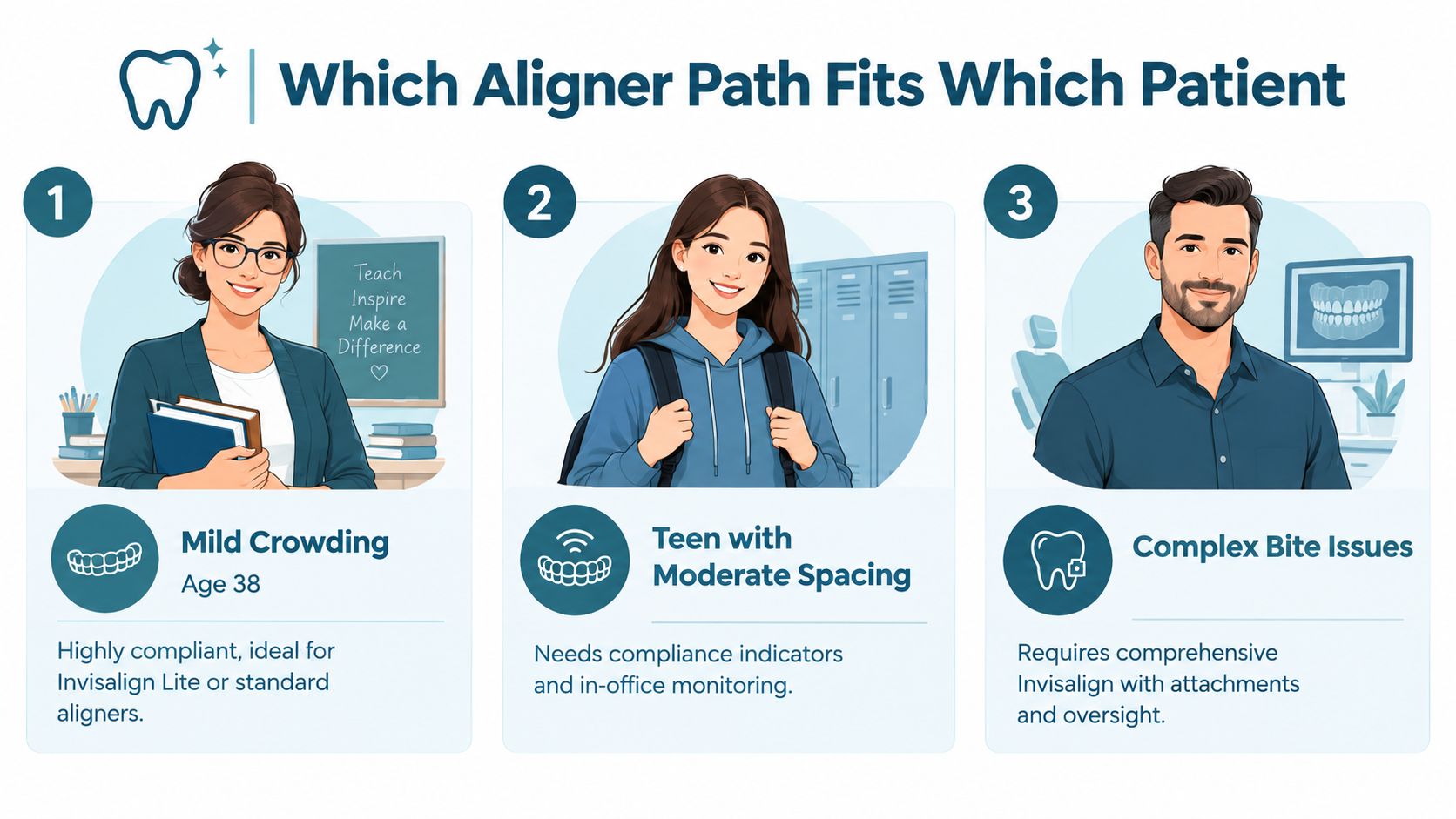
A 38-year-old teacher in Amanda with mild crowding, healthy gums, and a dependable routine may do well with several in-office aligner systems. Invisalign Lite or another professionally supervised option can suit a limited goal, provided the patient wears the trays consistently and the bite is appropriate for aligner treatment.
For this patient, the clinical plan matters more than the logo on the tray. Accurate records, realistic movement goals, and a clear process for replacement trays matter even more for someone who travels often. Ask who handles urgent questions and what happens if a tray is lost away from home.
Three practical profiles
A 16-year-old in Circleville with a crossbite, a rotated premolar, and a history of losing retainers needs closer support. In-office Invisalign with attachments, compliance checks, and parent involvement is the more sensible choice than a mail-order kit. Regular review can catch poor tracking before it affects later stages.
A 52-year-old in Circleville with bridgework and periodontal history needs an examination before any trays are planned. Existing restorations, gum support, and the condition of the remaining teeth can change the treatment sequence. This patient needs coordinated dental planning, not a generic set of trays created without a full evaluation.
A patient in Lancaster or Carroll who has limited manual dexterity, smokes, brushes irregularly, or often forgets retainers may need coaching and closer follow-up. Clear aligners come out for eating and cleaning, so the result depends heavily on daily habits between appointments.
Complex cases deserve a more cautious discussion. A 2026 systematic review found consistent differences between planned and achieved tooth movements in first-premolar extraction cases. A separate 2026 meta-analysis of deep-bite correction found a mean overbite reduction of 1.79 millimeters, described as clinically meaningful but modest, with minimal skeletal effects, according to the review and meta-analysis reported through Taylor & Francis.
Decision point: Extraction, a deep bite, major expansion, or posterior control calls for a consultation focused on predictability, not simply the lowest monthly payment.
Families should ask how pediatric treatment will be monitored. A 2026 review of Invisalign First reported overall maxillary expansion predictability of 65%, including 58% at permanent first molars, as summarized in the clinical comparison reported by PR Newswire. Clear aligners can still suit children, but growth, expansion goals, and compliance require direct evaluation.
Patients comparing adult teeth-straightening options should judge each path by the level of clinical oversight it provides, not by brand name alone.
Why In-Office Invisalign Oversight Matters
An Ohio patient with mild crowding may do well with a limited aligner plan. A patient with an uneven bite, rotated teeth, gum concerns, or poor tray wear needs something different: a dentist who can examine the teeth, monitor progress, and change the plan when movement falls behind. The meaningful choice is clinical oversight, not the brand printed on the aligner.
In-office care gives the provider tools that mail-order treatment may not manage well:
- Attachments: Bonded features add control for rotation, extrusion, and torque.
- Precision cuts: The aligner edge can be shaped around tooth and gum anatomy.
- Interproximal reduction: When appropriate, the provider can create carefully planned space.
- Refinements: New scans and trays can address incomplete tracking.
- Bite monitoring: The provider can check whether the front and back teeth contact properly.
The value of early correction
At a routine check-in, the dentist can examine tray fit, tooth tracking, bite contacts, attachment condition, and oral hygiene. If a gap develops between the tray and a tooth, the office can determine whether the patient needs more wear, an adjustment, a new scan, or a revised sequence.
That decision matters because teeth move in three dimensions. A front tooth can appear straighter while its root position or bite contact remains off. The systematic review discussed earlier found that optimized attachments still did not fully reproduce planned ClinCheck movement. Monitoring therefore belongs in the treatment plan, not as an optional extra.
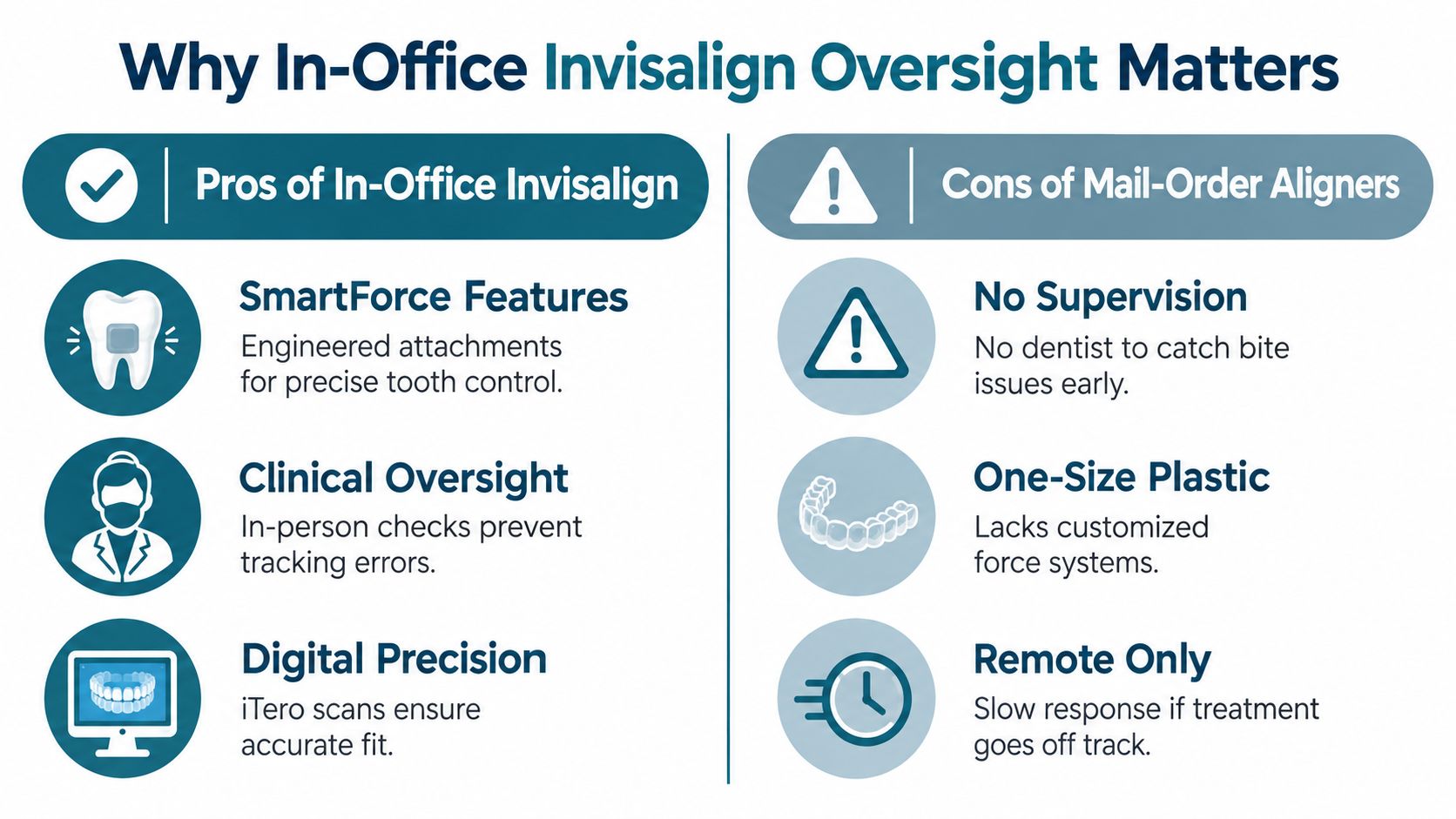
A less supervised option may suit a carefully selected, limited cosmetic case. It is a poor fit for untreated decay, gum disease, complex bite changes, significant rotations, extraction spaces, or uncertain compliance. If treatment goes off course, the patient may need more appointments, new trays, additional dental care, and extra time.
Alternative aligner systems can perform efficiently under professional supervision. The comparison discussed earlier reported one system completing cases in 17.3 months versus 23.0 months for Invisalign, using 49 aligners versus 82 and requiring fewer total visits. That result supports a practical recommendation: compare the monitoring model, treatment goals, and provider involvement. Invisalign is not automatically the right choice, and a lower-cost aligner system is not automatically adequate.
What to Expect at Amanda Family Dental
Treatment starts with a consultation, not a purchase. The dentist evaluates the patient's goals, tooth alignment, bite, gum health, jaw relationship, existing restorations, and overall dental condition. A new patient exam may include digital X-rays when clinically appropriate, photographs, and a digital scan rather than traditional goopy impressions.
The scan helps create a staged treatment plan. ClinCheck can show projected tooth movement, but it's a planning tool, not a guarantee that every tooth will move exactly as displayed. The provider still needs to judge whether the movement is biologically and mechanically reasonable.
From scan to active treatment
Patients generally move through a sequence of steps:
- Consultation: The office confirms whether clear aligners fit the patient's dental and orthodontic needs.
- Digital records: Scans and other records document the starting condition.
- Treatment planning: The provider maps the desired movements and explains attachments, space creation, or other procedures.
- Active wear: Patients wear trays according to the prescribed schedule and follow cleaning instructions.
- Retention: After active treatment, retainers help maintain the new alignment.
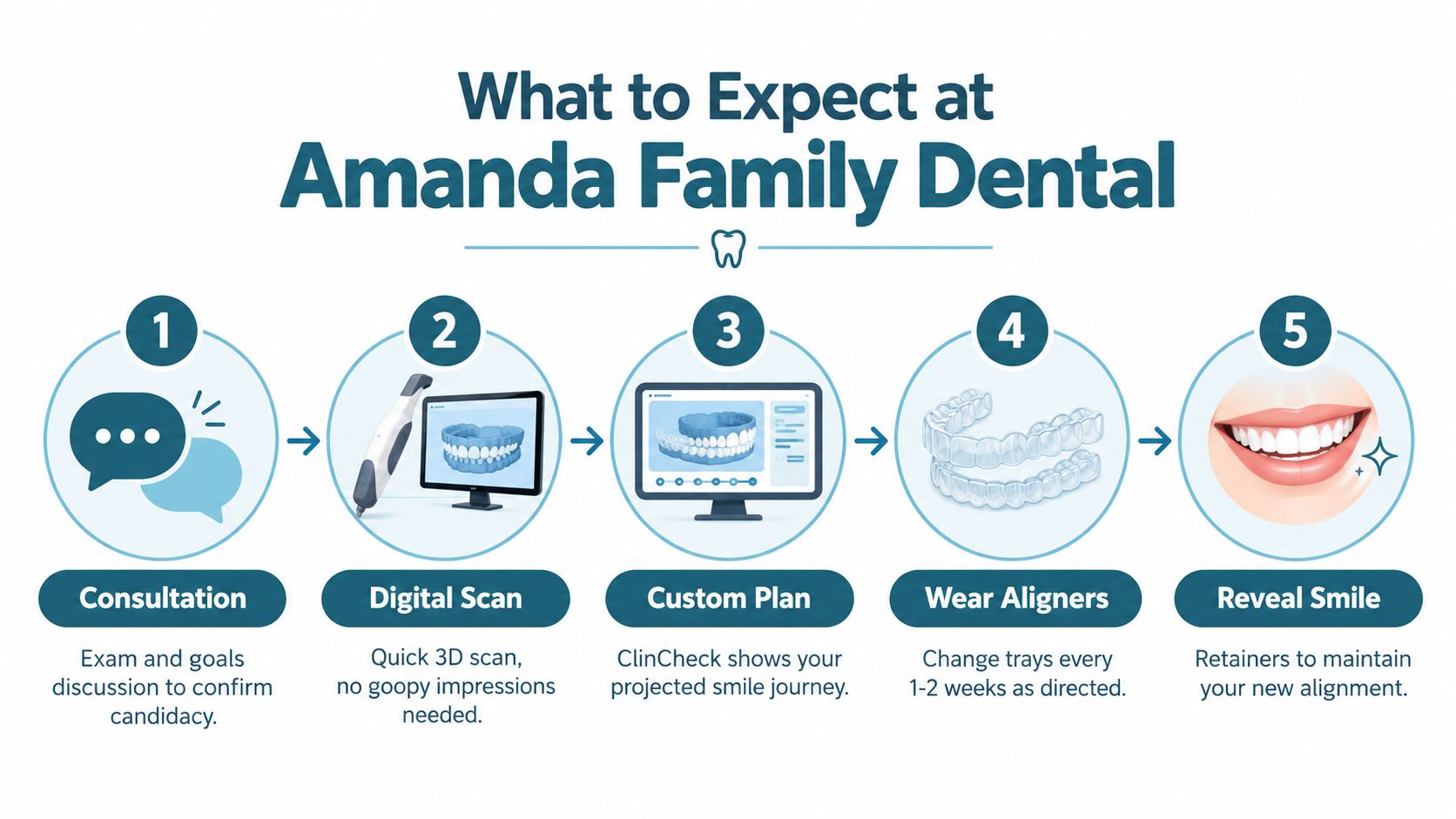
Clear aligners are commonly replaced after approximately one to two weeks per stage, while wear should remain at 20 to 22 hours daily, based on the FDA-cleared clear-aligner guidance cited earlier. Treatment duration depends on the case. Some plans may take several months, while more involved treatment can take longer, and the provider should give a case-specific estimate rather than promise a universal timeline.
Check-ins are scheduled according to the treatment plan. During those visits, the provider can evaluate tracking, make adjustments, order refinement trays, and address practical issues such as a cracked or lost aligner. Local follow-up can be especially useful for patients from Amanda, Lancaster, Circleville, and Carroll who want direct access to a dental team rather than waiting for remote support.
Patients evaluating the practice's online information can also consult dental SEO best practices from Digital Skyrocket to understand how dental practices organize service and patient-education content online. That resource is separate from the clinical decision itself, but it can help readers distinguish useful treatment information from thin marketing pages.
Amanda Family Dental offers Invisalign clear aligner treatment alongside preventive cleanings and exams, restorative dentistry, cosmetic dentistry, digital X-rays, dental implants, tooth extractions, and emergency dental services. Those broader services matter because aligner treatment should begin with healthy teeth and gums, not bypass problems that need attention first.
Taking the Next Step Toward a Straighter Smile
The Invisalign versus aligners decision should rest on three filters:
- How complex is the case? Mild crowding may allow several suitable options. Extraction spaces, deep bites, crossbites, expansion, and major rotations call for closer planning.
- How much hands-on monitoring is appropriate? In-office visits allow a dentist to identify tracking, gum, restoration, and bite concerns before they become larger problems.
- What does the total treatment plan include? The monthly payment matters less than the full cost of scans, attachments, refinements, replacement trays, retainers, and any necessary dental care.
Patients in Amanda, Lancaster, Circleville, and Carroll, Ohio, can request a personalized consultation through Amanda Family Dental. A proper assessment should include digital records, a discussion of treatment goals, a realistic timeline, and a transparent cost review that explains insurance benefits and available payment options before treatment begins.
A patient searching for a dentist in Amanda, OH, dentist in Lancaster, OH, dentist in Circleville, OH, or dentist in Carroll, OH shouldn't choose an aligner system from an advertisement alone. Schedule the consultation, bring questions about attachments, refinements, monitoring, and retainers, and let the clinical exam determine which path fits the smile and bite.
Amanda Family Dental provides doctor-supervised Invisalign care, digital scans, personalized treatment planning, and dental services for patients throughout Amanda and nearby Ohio communities. Visit Amanda Family Dental to request an appointment, discuss Invisalign versus other aligners, and arrange a consultation that addresses the patient's goals, treatment needs, and expected costs.