

The tongue finds the sharp hole before the mind catches up. Food tastes different, the tooth feels exposed, and the first thought is often, “What is the safest tooth filling fell out temporary fix?” Stay calm. A missing filling is a common dental problem, and it's usually manageable with sensible protection and prompt follow-up.
Amanda Family Dental serves families looking for a dentist in Amanda, OH, as well as patients traveling from Lancaster, Circleville, and Carroll, Ohio. The immediate priorities are straightforward: stabilize the tooth at home, choose a safe temporary barrier, understand why a painless tooth still needs attention, and decide whether care should happen today, tomorrow, or during a routine appointment.
Table of Contents
- You Just Lost a Filling and Need a Plan
- Your First 30 Minutes After a Filling Falls Out
- Choosing the Right At-Home Stopgap for Your Tooth
- Why a Missing Filling Still Matters When It Doesn't Hurt
- Knowing When to Call an Emergency Dentist Right Away
- Your Next Step Toward a Lasting Repair
You Just Lost a Filling and Need a Plan
A filling can come loose during a meal, brushing, or sleep. The restoration may remain in your mouth or break into pieces. If you find it, place it in a clean container and bring it to Amanda Family Dental. Never force it back into the tooth, because the tooth may have changed shape and pressure can damage the remaining structure.
The open area can expose sensitive material, trap food, and make chewing uncomfortable. A painless tooth still needs an examination. The Dental Health Foundation on temporary fillings advises contacting a dentist promptly, keeping the area clean, avoiding chewing on that side, and seeking urgent help for severe pain, swelling, or signs of infection.
Practical rule: A temporary covering protects the tooth while you arrange care. The missing restoration still needs professional replacement.
This problem is common. Historical U.S. oral-health reporting cited by the CDC's national dental statistics found that about 90 million adults had an average of 18 teeth that were filled or needed filling. That history helps explain why pharmacies sell temporary dental repair materials and why dentists recommend prompt follow-up.
A large evidence review cited by NASA's dental filling loss review recorded 330 lost fillings across 20,961 filling-years, an incidence of about 0.0157 lost fillings per filling-year, or roughly 1.57% per year. The review also notes best-practice guidance recommending replacement within 2–3 weeks to lower the risk of caries progression, pulpitis, periodontitis, and abscess formation.
Use that timeframe to arrange care, not to postpone a call. Amanda Family Dental can assess the tooth, advise whether you can safely wait, and set up the lasting repair. A temporary measure buys time for proper treatment; it never completes that treatment.
Your First 30 Minutes After a Filling Falls Out
The first half hour should focus on cleaning, comfort, protection, and a call to the dental office. The following sequence keeps the tooth safer without turning a temporary fix into a risky home procedure.
Inspect without reinserting
Find the filling if possible and look at the tooth in good light. A small mirror or phone camera can help identify a sharp edge, a visible crack, or a large open cavity. Don't poke the area with a fingernail, toothpick, or tool, and don't try to cement the old filling back in.
Rinse gently
Rinse with warm salt water to clear loose food and debris. A gentle rinse is enough. Aggressive swishing can irritate exposed dentin and make sensitivity worse, so the liquid should move around the mouth without force.
Control sensitivity
Avoid very hot, cold, sweet, or acidic foods and drinks. If pain develops, over-the-counter ibuprofen can reduce pain and swelling, while acetaminophen can provide pain relief when used according to the product label and a patient's medical guidance. A cold compress on the outside of the cheek for 15 minutes at a time can also offer temporary relief, as described by Healthline's guidance for a lost filling.
Cover the exposed area
An over-the-counter temporary filling kit or dental cement is the preferred short-term barrier when the cavity walls are intact. Clean the area gently, dry it as well as possible, and apply the material exactly as the package directs. If no kit is available, a small amount of sugar-free gum or dental wax may reduce food contact and tongue irritation for a short period.
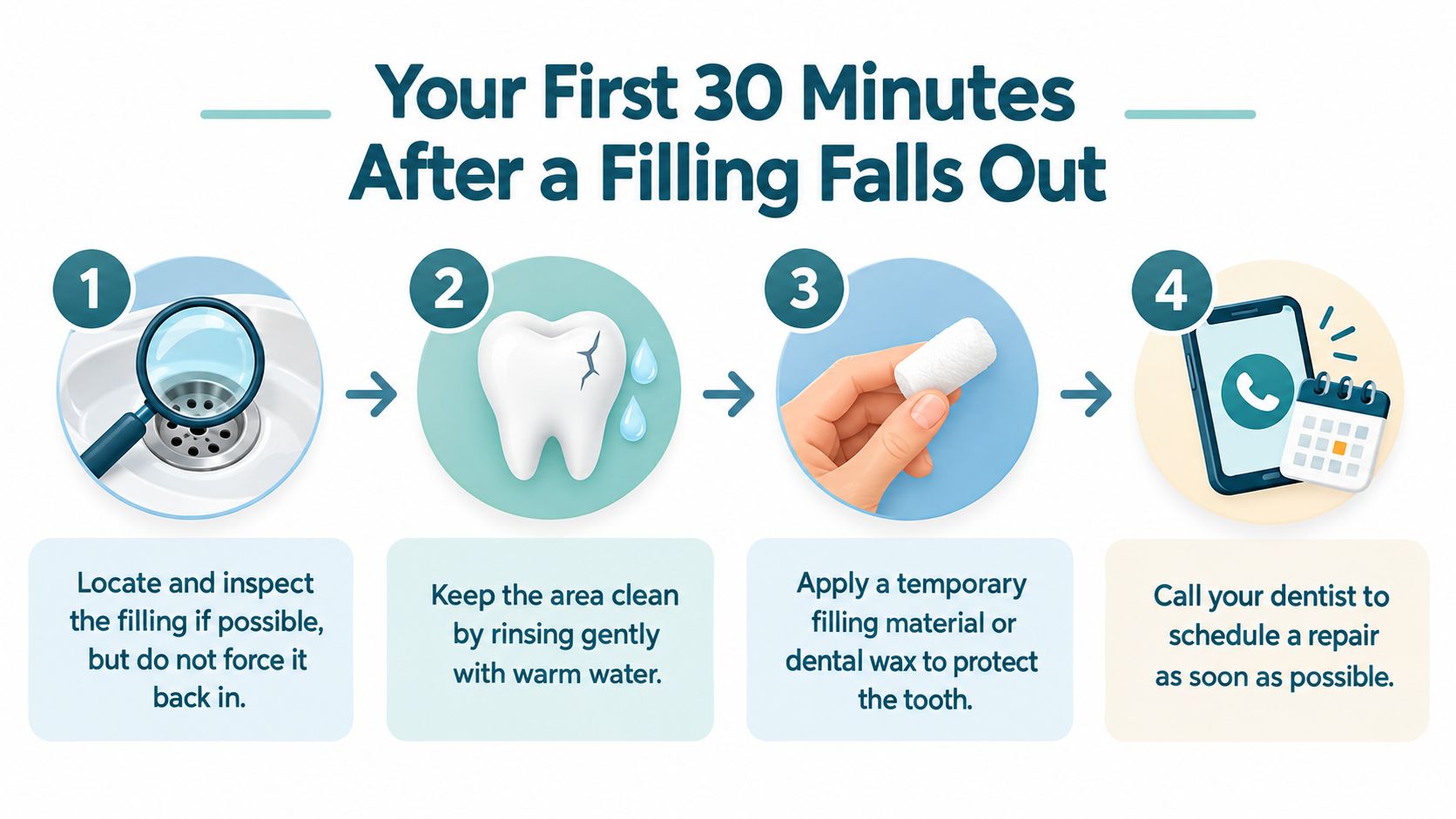
The temporary material should remain undisturbed while it sets. Chew on the opposite side and avoid sticky or hard foods. Household glue, including superglue, is unsafe in the mouth and can damage tissue. A broken tooth wall, uncontrolled bleeding, swelling, severe pain, or a bad taste with worsening symptoms warrants prompt dental contact rather than further DIY treatment.
For broader preparation around dental procedures and healing, readers may also find this resource on recovering from a root canal useful. A lost filling doesn't automatically mean a root canal is needed, but persistent symptoms require an examination.
Choosing the Right At-Home Stopgap for Your Tooth
The best temporary option depends on what remains of the tooth. A pharmacy kit provides the most purposeful coverage, wax improves comfort around a sharp edge, and sugar-free gum is only an emergency fallback.
| Option | Durability | Comfort | Ease of Use | Best For |
|---|---|---|---|---|
| OTC temporary filling kit or dental cement | Short term only, often days rather than a lasting repair | Good when placed correctly | Moderate, because the tooth must be cleaned and dried | A visible cavity with intact walls |
| Dental wax | Very short term and may need replacement after eating | Excellent for protecting the tongue or cheek | Easy | A sharp edge or small irritating area |
| Sugar-free gum | Brief stopgap only | Fair, depending on location and pressure | Easiest | No dental product available until care can be arranged |
Temporary materials aren't equivalent to definitive fillings. A peer-reviewed comparison indexed by PubMed's study of temporary filling materials found that the resin-based material Bioplic had the strongest marginal seal and the lowest water sorption, solubility, and mass loss among the materials tested. Those properties matter because water uptake and dissolution can contribute to leakage and early breakdown.
Match the material to the problem
A large visible cavity with pain calls for an OTC cement kit if the tooth can be cleaned and dried safely. Press the material into the opening according to package directions, remove excess, and keep pressure off the tooth until a dentist can assess it.
A sharp edge without a large opening is better suited to dental wax. Wax creates a smooth cushion over the edge, which can prevent the tongue or cheek from being scraped. It won't rebuild the tooth or reliably seal a deep cavity.
If nothing else is available, sugar-free gum can cover the opening briefly. It must not contain sugar, and it shouldn't be treated as a seal against decay. Sticky candy, household glue, and attempts to reshape or reinsert the old filling are poor choices.
Amanda Family Dental also provides guidance for a broken tooth temporary fix when a lost filling is accompanied by a chipped or fractured tooth. Mouth irritation from wax or gum can resemble other sores, so patients with persistent ulcers should review the signs to see a doctor for ulcers rather than assuming every sore spot comes from the filling.
Why a Missing Filling Still Matters When It Doesn't Hurt
No pain doesn't prove that the tooth is safe. The missing restoration leaves a path for saliva, bacteria, and food debris to reach exposed tooth structure. Food can pack into the opening, and temperature or chewing pressure can begin irritating the deeper part of the tooth before a noticeable ache appears.
The enamel walls around a large filling may also have less support after the restoration is gone. Biting on that side can place pressure on weakened edges, increasing the chance of a chip or fracture. The exact cause of failure matters, too. Decay, a crack, or wear beneath the old filling may still be present even if the patient feels normal.
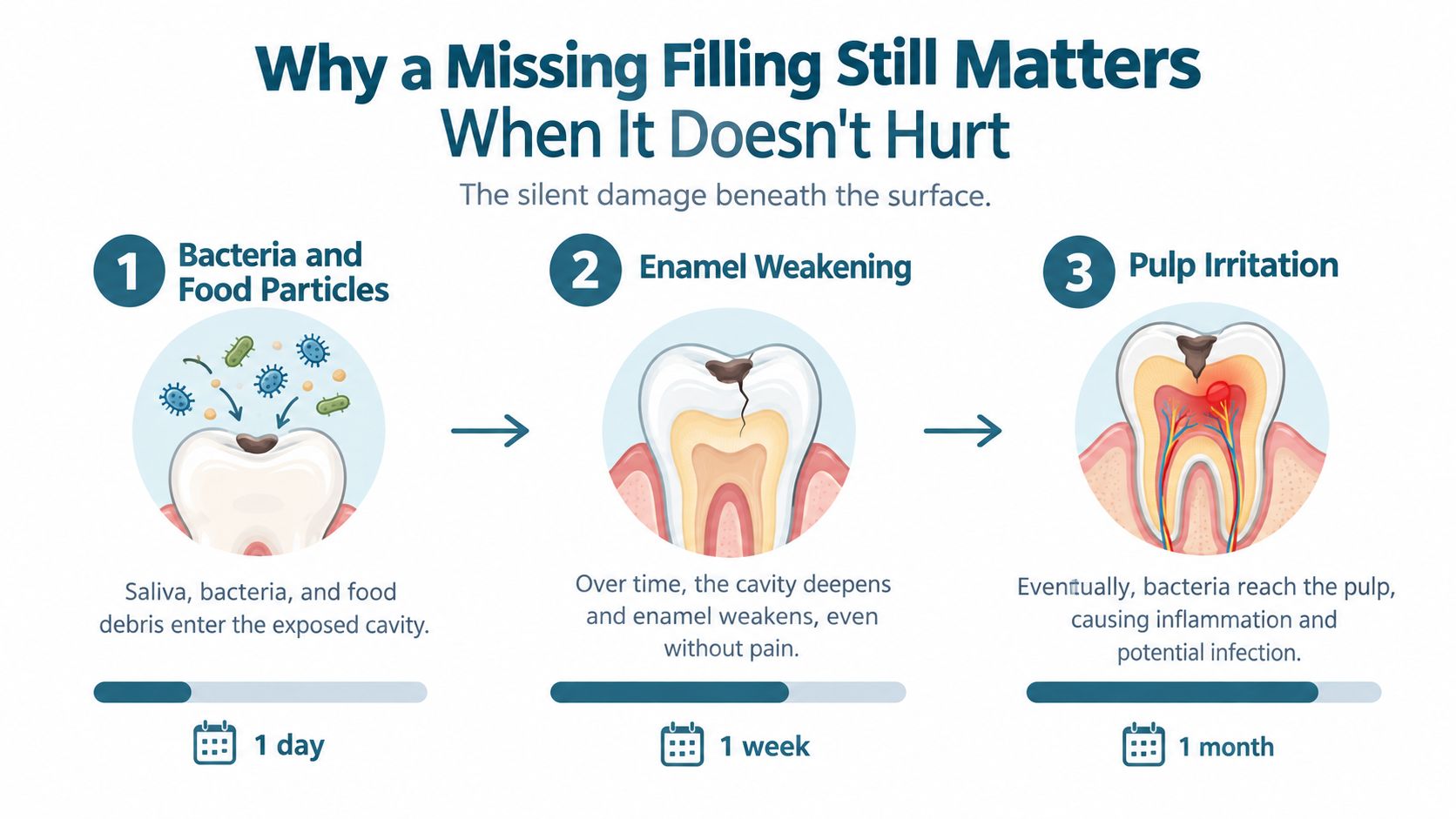
The quiet window is the safest time to arrange care. Pain can be a late signal, not an early warning.
Three easy-to-miss signs deserve attention:
- Lingering sensitivity: A brief reaction to cold can be less concerning than sensitivity that continues after the drink or food is gone.
- A jagged edge: A rough area catching the tongue may indicate a fractured tooth wall, not just a missing filling.
- Food packing: Repeated food trapping keeps bacteria and pressure against the exposed area.
A replacement filling may be appropriate if enough healthy tooth remains. If the tooth is cracked or weakened, the dentist may recommend a stronger restoration, such as an inlay, onlay, or crown. If the inner tissue has become inflamed or infected, root canal treatment may be needed before the tooth can be restored.
Patients comparing repair choices can review how long fillings last as general background, but an individual tooth requires an examination. The practical recommendation is simple: protect the opening, stop chewing there, and arrange an appointment even when the tooth doesn't hurt.
Knowing When to Call an Emergency Dentist Right Away
A lost filling doesn't always require an emergency visit, but certain symptoms change the situation. The underlying problem, such as infection, a fracture, or severe inflammation, determines urgency more than the missing piece itself.
| Urgency Level | Symptoms | Action |
|---|---|---|
| Same-day care | Severe throbbing, facial swelling, fever, bleeding that won't stop, or visible exposed nerve tissue | Contact an emergency dentist or dental office immediately |
| Next-day call | Sharp sensitivity, mild aching, or a small lost piece without swelling or severe pain | Call promptly and request the earliest suitable appointment |
| Routine but prompt care | Minor roughness with no sensitivity or swelling | Protect the tooth and arrange a dental visit soon |
Same-day symptoms should not be managed by repeatedly adding home material. Swelling, fever, persistent bleeding, and severe throbbing can signal a problem that needs examination and treatment. Difficulty swallowing or breathing is especially serious and requires immediate medical attention.
For evening or weekend calls, the patient should state that a filling fell out, identify the tooth if possible, describe pain or sensitivity, and mention swelling, fever, bleeding, a crack, or a bad taste. That information helps the team determine whether the patient needs urgent evaluation or a short-term appointment.
Amanda Family Dental offers emergency dental care for urgent dental problems and can help route patients from Amanda, Lancaster, Circleville, and Carroll, Ohio, to the appropriate level of care. Patients researching how emergency dental triage is commonly described may also review this guide to an emergency dentist near me Santa Ana, although local patients should contact a nearby office for direct guidance.
Mild symptoms still deserve a next-day call because a temporary patch can loosen, food can enter the cavity, and the tooth can become more sensitive. A rough edge with no sensitivity may wait briefly, but it shouldn't disappear from the dental schedule.
Your Next Step Toward a Lasting Repair
The safest plan today is uncomplicated. Rinse gently, protect the opening with dental cement or wax, use an over-the-counter pain reliever only as directed, avoid chewing on the affected side, and call a dentist according to the symptom level above.
At the appointment, the dentist will examine the tooth and may take a dental X-ray to check for decay, cracks, or deeper involvement. Treatment may include a new composite filling, an inlay, or a crown, depending on how much healthy tooth structure remains. If the tooth can't be restored, a tooth extraction may be discussed, followed by replacement options such as dental implants or dentures.
Amanda Family Dental provides new patient exams, digital X-rays, cleaning and exams, restorative dentistry, composite fillings, crowns, root canals, tooth extraction, and dental implants. Patients searching for a dentist near me, a cosmetic dentist near me, or dental implants near me can receive a personalized plan that addresses comfort, function, and appearance in one local setting.
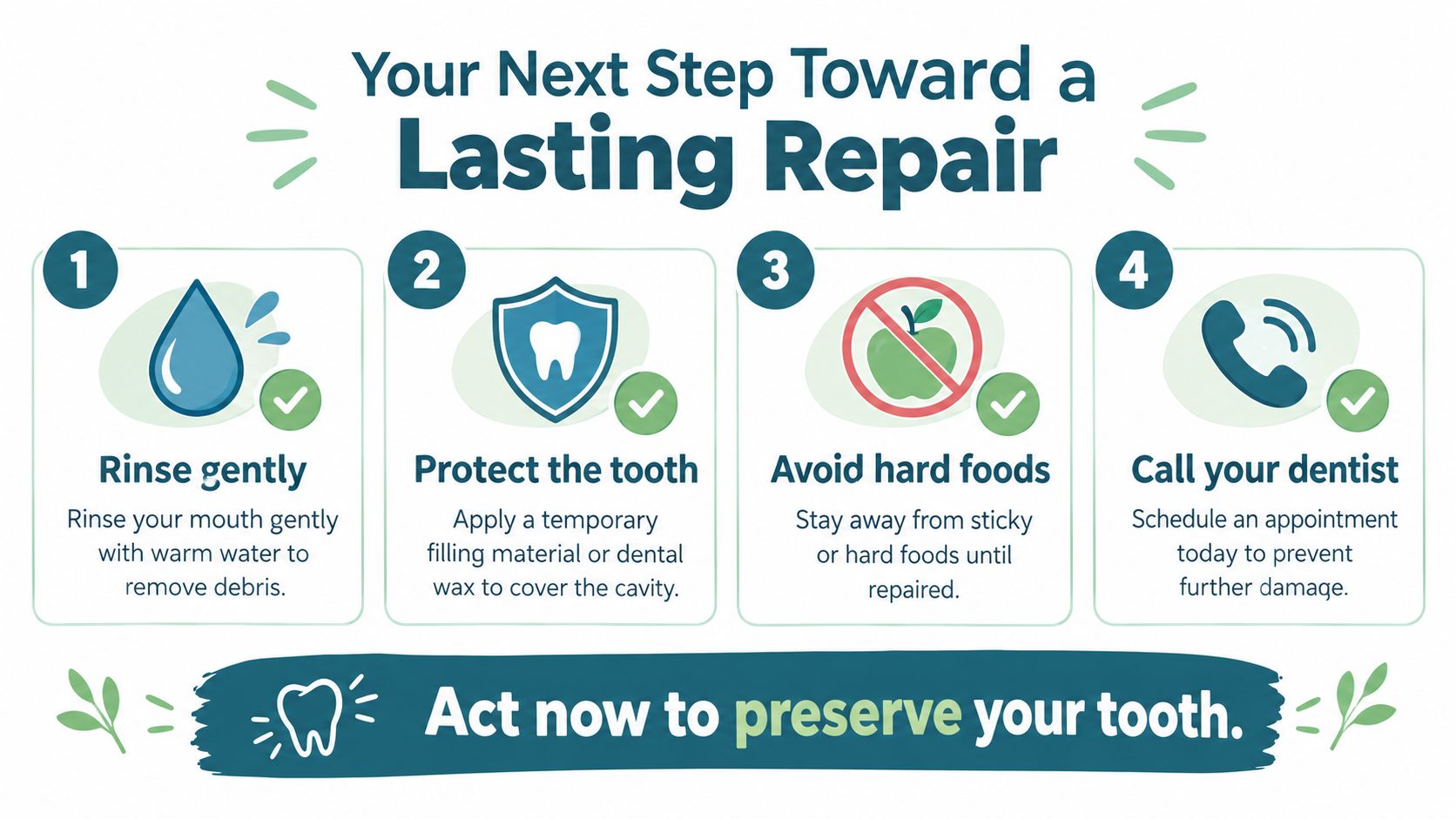
Waiting rarely improves a missing filling. Early evaluation gives the dentist more options and helps prevent a manageable repair from becoming a more involved procedure.
Call or schedule with Amanda Family Dental for guidance after a filling falls out, temporary protection, and a lasting repair plan. The team serves patients in Amanda, Lancaster, Circleville, and Carroll, Ohio, with emergency dental services, restorative care, and comfort-focused treatment.