

A dental emergency rarely starts at a convenient time. It often begins with a sharp toothache at night, a broken tooth during dinner, or a child coming inside after a fall with a mouth full of blood and tears. In that moment, most families in Amanda, Lancaster, Circleville, and Carroll, Ohio aren't asking for a long explanation. They need to know what to do first, where to go, and what can wait.
That confusion is common. Many people head to the emergency room for non-traumatic dental problems, even though most ERs can usually provide temporary pain relief rather than definitive dental treatment, as explained in this guidance on emergency dental triage. For problems like severe tooth pain, a cracked tooth, a lost crown, or swelling around a tooth, an emergency dentist is often the right first call.
For local families searching for a dentist in Amanda, OH, this guide is meant to lower the panic and replace it with clear next steps. Fast action matters, but the right action matters just as much.
Table of Contents
- Your Guide to Navigating a Dental Emergency in Amanda OH
- Immediate First-Aid for Common Dental Emergencies
- What Counts as a Dental Emergency
- Your Emergency Visit at Amanda Family Dental
- Navigating Payment and Insurance for Urgent Care
- Aftercare and Preventing Future Dental Emergencies
Your Guide to Navigating a Dental Emergency in Amanda OH
A common local scenario looks like this. A parent in Lancaster hears that familiar sentence from the next room: “Something's wrong with my tooth.” An adult in Circleville wakes up with throbbing pressure on one side of the jaw. Someone in Carroll bites down and feels a back tooth crack. The pain is immediate, but the decision isn't.
The first question is usually whether the problem belongs at the ER, an urgent care clinic, or a dental office. That hesitation can cost time, especially when the issue involves infection, trauma, or a tooth that may still be saved.
The most important first step
An emergency dentist focuses on the source of the problem inside the tooth, gum, bite, or jaw. That matters because dental pain often has a very specific cause, such as decay, an abscess, a fractured tooth, or a failed filling. A medical ER can be essential for major swelling, uncontrolled bleeding, or serious facial trauma, but isolated dental pain usually needs dental treatment.
Practical rule: If the problem started in the tooth, gum, or bite, a dental office is usually the best first call. If there's trouble breathing, severe facial swelling, heavy bleeding that won't stop, or major trauma, emergency medical care may be necessary.
This is also a public health issue, not a rare event. In 2018, the United States had more than 2 million dental-related emergency department visits, equal to 615.5 visits per 100,000 people, according to the AHRQ emergency department sample summary. That volume shows how often people end up seeking urgent help for dental pain and infection.
Calm decisions help protect the tooth
In an emergency, small actions matter. Keeping a broken tooth fragment. Avoiding chewing on the injured side. Protecting a knocked-out tooth from drying out. Calling quickly instead of waiting overnight to “see if it settles down.”
For families across Amanda, OH and nearby communities, the goal isn't to diagnose everything at home. The goal is to recognize what's urgent, stabilize the situation, and get the right care without delay.
Immediate First-Aid for Common Dental Emergencies
The first few minutes after a dental injury or sudden pain episode can make treatment simpler and sometimes make the difference between saving and losing a tooth.

Knocked-out tooth
This is the clearest true race against time in dentistry. For a knocked-out permanent tooth, the chance of saving it worsens sharply after the first 30 to 60 minutes, based on this emergency dental care review.
What to do right away:
- Pick up the tooth by the crown only. Don't touch the root.
- If it's dirty, rinse it gently. Don't scrub it.
- Try to place it back into the socket in the correct direction if that can be done gently.
- If it won't go back in, keep it moist in milk, saliva, or a tooth-preservation product such as Save-a-Tooth.
- Seek emergency dental care immediately.
A knocked-out permanent tooth should be treated like a time-sensitive injury, not something to watch for a few hours.
Severe toothache or swelling
A strong toothache often means inflammation inside the tooth, deep decay, infection, or a crack. Home care should focus on limiting irritation until the tooth can be examined.
Helpful steps include:
- Rinse gently with warm water. This clears debris and helps the area feel cleaner.
- Keep food away from that side. Chewing can increase pain and worsen a fracture.
- Use a cold compress on the outside of the face if there's visible swelling.
- Don't place aspirin directly on the gums or tooth. That can irritate soft tissue.
Swelling near a tooth deserves prompt attention because infections don't usually resolve on their own.
A short video can help some patients visualize what counts as urgent dental pain and trauma:
Broken or chipped tooth
Not every chip is a true emergency, but a large break, pain with air or temperature, or bleeding from the area should be treated promptly.
A practical checklist:
- Save any pieces if they can be found.
- Rinse the mouth gently with warm water.
- Cover a sharp edge with dental wax if available.
- Avoid biting with that tooth.
A broken tooth may expose the inner part of the tooth, which is why discomfort can increase quickly after the initial injury.
Lost filling or crown
This often feels minor at first and then becomes miserable by evening. Once the tooth is exposed, cold air, pressure, and sweets can trigger sharp pain.
Patients can usually help themselves by:
- Keeping the area clean
- Avoiding sticky or hard foods
- Saving the crown if it came off in one piece
- Chewing on the opposite side
If the exposed tooth is painful or the crown won't stay in place, that moves the problem into urgent territory.
What Counts as a Dental Emergency
It is 9:30 at night. Your tooth has been hurting for hours, your cheek looks a little puffy, and you are stuck on the same question every worried patient asks. Do I wait until morning, call a dentist now, or go to the ER?
A simple rule helps. Start by asking two questions: Is this affecting your breathing, swallowing, or ability to control bleeding? Is it getting worse quickly? Those answers usually point you in the right direction.
When to call right away
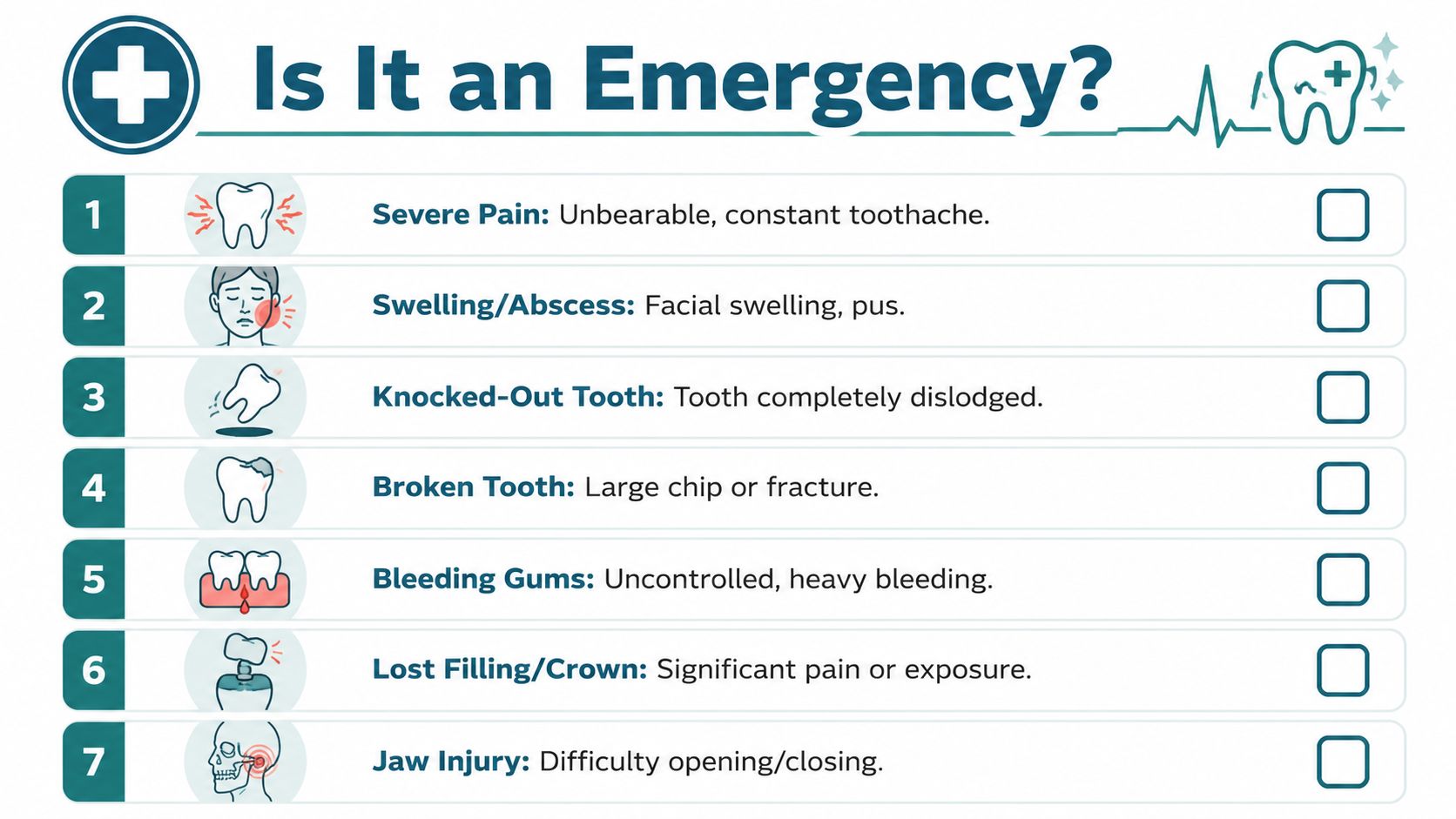
Call a dentist as soon as possible if you have severe tooth pain, swelling near a tooth or gum, a permanent tooth that has been knocked out, a large fracture, or a jaw injury. These problems often need same-day guidance because delay can make treatment harder and the discomfort stronger.
A useful way to sort this out is to picture the mouth like any other part of the body. A small paper cut and a deep cut are both injuries, but they do not need the same response. Dental problems work the same way. A minor chip can sometimes wait. Spreading swelling, strong pain, heavy bleeding, or trauma should not.
| Dental Emergency Triage Guide | |
|---|---|
| Symptom | Action to Take |
| Knocked-out permanent tooth | Call immediately and protect the tooth as described above |
| Severe, constant tooth pain | Call immediately for same-day guidance |
| Facial swelling near a tooth or gum | Call immediately because infection may be involved |
| Heavy bleeding that doesn't stop | Seek urgent evaluation right away |
| Large broken tooth with pain or sharp exposure | Call immediately |
| Jaw injury or trouble opening and closing | Call immediately and seek urgent evaluation |
Facial swelling deserves special attention. If the swelling is growing, extends toward the eye or neck, or comes with fever, you may need urgent medical evaluation in addition to dental care. If you are dealing with pressure or pain that may be infection-related, our page about an abscessed tooth and headache explains why those symptoms should not be brushed off.
When the ER makes more sense
The emergency room is the right choice if you have trouble breathing, trouble swallowing, uncontrolled bleeding, major facial trauma, or a suspected broken jaw. The ER can manage medical risk and stabilize serious injuries.
For many other dental problems, a dentist is usually the better first call because the office can diagnose the tooth, gum, or restoration causing the problem and begin treatment aimed at the source. Some practices also use support systems behind the scenes to respond to urgent calls efficiently. Readers who want a look at that operational side of care can learn more about dental virtual assistants.
When next-day care is usually reasonable
Some problems still need attention, but they are often stable enough for the next available appointment if symptoms are mild and not changing.
Examples include:
- Small chip without pain
- Lost filling without significant sensitivity
- Dull tooth discomfort that isn't worsening
- Loose crown that isn't causing pain
- Food stuck between teeth causing irritation
The key is watching the direction of the problem. Stable and mild can often wait briefly. Pain that intensifies, swelling that grows, or symptoms that keep you from sleeping should be treated as urgent. That decision framework helps patients avoid two common mistakes: waiting too long on a problem that is building pressure, or heading to the ER for an issue a dentist can usually treat more directly.
Your Emergency Visit at Amanda Family Dental
Once the call is made, most patients start worrying about a different question. What's going to happen when they get there?
That uncertainty often causes more stress than the treatment itself. A dental emergency visit is usually more straightforward than people expect.

What happens on the call
The front desk will usually need a simple picture of the problem. What hurts. When it started. Whether there's swelling, bleeding, trauma, or a tooth that's out of place. If a patient has a broken crown, lost filling, or knocked-out tooth, saying that clearly helps the team triage the situation faster.
This is one reason some dental offices use systems and support tools behind the scenes to manage urgent communication efficiently. For readers curious about how practices organize patient calls, appointment flow, and follow-up support, dental virtual assistants offer a useful overview of that operational side of care.
What happens in the chair
The visit usually begins with a focused exam and digital X-rays if needed. The purpose is not to create a long, complicated treatment plan on the spot. It's to identify the cause of the emergency and stabilize it.
That may mean:
- Relieving pressure inside a painful tooth
- Repairing a broken area
- Addressing an infected tooth
- Recommending root canal treatment
- Performing a gentle extraction if the tooth can't be saved
Amanda Family Dental provides emergency dental services for urgent problems such as tooth pain, broken teeth, infected teeth, and abscess symptoms, with treatment options that can include root canals, extractions, and repair of damaged teeth when appropriate.
The first goal in emergency dentistry is usually pain control and stabilization. Definitive long-term repair may happen the same day or in a follow-up visit, depending on the condition.
Research on emergency dental workflows shows that treatment acceptance is about 93.3%, while follow-up adherence is about 40.1%, according to this review of same-day treatment and follow-up data. That gap matters. A patient may feel much better after the emergency visit, but the tooth often still needs final care.
This is why patients are usually sent home with clear instructions, a next-step plan, and a reminder that relief and resolution aren't always the same thing.
Navigating Payment and Insurance for Urgent Care
A painful tooth can be scary. The cost question can make it worse. Some patients delay calling because they assume emergency dental care will be out of reach.
Why cost shouldn't delay a call
The better approach is to ask first and sort out details with the office. Dental teams deal with insurance questions every day, and many urgent visits begin with a focused exam and immediate care plan rather than a full course of treatment all at once.
Patients who are reviewing coverage options on their own may find comparison resources helpful, including this guide to the top 7 dental insurance companies of 2026. It can help families understand how plans may differ in waiting periods, networks, and common benefit structures.
How patients can prepare
A few practical steps can reduce stress before the appointment:
- Bring insurance information if coverage is available.
- Ask for a breakdown of immediate versus future treatment. Emergency care often happens in stages.
- Discuss financing early if the visit may involve more than one procedure.
- Look into membership options if traditional insurance isn't in place.
For patients who want to review flexible options ahead of time, Amanda Family Dental provides information on financing and payment solutions, including an in-house membership approach for patients without insurance.
A delayed call often turns a manageable problem into a more painful and more complex one. Financial questions are real, but they're usually easier to handle once the diagnosis is clear.
Aftercare and Preventing Future Dental Emergencies
Emergency treatment doesn't end when the numbness wears off. What happens in the next day or two often affects comfort, healing, and whether the problem returns.
Aftercare basics
The exact instructions depend on the treatment, but several habits help after many emergency visits:
- Follow eating instructions carefully. A newly treated tooth or fresh extraction site needs protection.
- Keep the area clean without disturbing it. Gentle brushing and rinsing matter.
- Take prescribed or recommended medications exactly as directed.
- Don't ignore return symptoms. Increased swelling, worsening pain, or a change in bite should prompt a call.

A patient who has had a crown recemented has different instructions than someone who had drainage for an abscess or treatment for a cracked molar. That's why the written aftercare sheet matters. It should be kept and followed closely.
How prevention changes the picture
Many dental emergencies start as smaller problems that didn't hurt yet. A cavity becomes a deep infection. A weak filling turns into a fracture. A minor gum problem progresses until chewing becomes painful.
Routine care helps catch those issues while they're still easier to treat. Cleanings, exams, and dental X-rays don't just support a healthy smile. They reduce the odds of a weekend crisis, a missed day of work, or a child needing urgent treatment after a preventable problem worsens.
For families in Amanda, Lancaster, Circleville, and Carroll, Ohio, that long-term relationship matters. The emergency visit handles the crisis. Preventive care lowers the chance of repeating it.
If urgent tooth pain, swelling, a broken tooth, or another dental injury needs attention, Amanda Family Dental can help patients take the next step with clear guidance and treatment options. Families in Amanda, OH and nearby communities can contact the office to request emergency dental care or schedule a new patient exam for ongoing prevention.