

A child's first orthodontic check-up should happen by age 7, and that visit is usually a screening, not a promise that braces need to start right away. In children who need early care, interceptive treatment has shown measurable changes such as an average 3.5 mm reduction in overjet, 2.1 mm improvement in overbite, and 2.8 degrees reduction in ANB angle.
Many parents in Amanda, Lancaster, Circleville, and Carroll notice the same small changes at home. A new front tooth comes in behind a baby tooth. The top teeth seem to stick out. A child keeps breathing through the mouth at night, or the bite looks a little off in school photos. Those moments raise a fair question. Is this something to watch, or something to act on now?
Early orthodontic intervention can feel confusing because it sits in the space between routine dental care and traditional braces. Parents searching for a dentist near me often want a straight answer, a calm explanation, and a plan that protects a child's long-term health without rushing into treatment. That's where a thoughtful evaluation can help. The goal isn't to push every child into appliances. The goal is to catch the children who may benefit from early guidance while growth is still on their side.
Table of Contents
- Your Child's Smile Journey Begins in Amanda OH
- Understanding Interceptive Orthodontics
- Signs Your Child Could Benefit from Early Treatment
- Early Orthodontic Solutions at Amanda Family Dental
- The Lifelong Benefits of Early Orthodontic Care
- What to Expect at Your Child's Evaluation in Amanda
- Common Questions from Parents in Our Community
Your Child's Smile Journey Begins in Amanda OH
The moment many parents notice something
A child is laughing at the kitchen table, and suddenly you see it. One front tooth is coming in behind another. Or your child chews on one side, sleeps with an open mouth, or keeps their lips apart even when resting. Families in Amanda, Lancaster, Circleville, and Carroll often notice these small changes during ordinary moments, then wonder whether they are part of normal growth or an early sign that something needs attention.
That question matters because a child's smile develops alongside the rest of the body. Teeth do not grow in isolation. Jaw growth, breathing patterns, thumb sucking, tongue posture, and the way the lips rest all work together, much like parts of the same blueprint. For parents who like to compare broader stages of growth, these Ocodile childhood development resources offer helpful context for the many changes that happen during the early school years.
A quick screening can be useful even when nothing looks dramatic.
Many orthodontic concerns begin unnoticed. A bite can shift little by little. A narrow upper jaw may show up first as crowding, mouth breathing, or speech and chewing habits that seem unrelated at first glance. That is one reason a trusted family dental office may also look at function, not only tooth position. At Amanda Family Dental, concerns involving oral habits and facial development may also lead to discussion of myofunctional therapy for breathing, tongue posture, and oral habits.
Why age 7 matters without causing alarm
Age 7 works like a checkpoint, not a commitment to braces.
By this age, enough permanent teeth are usually coming in for a dentist to spot patterns in how the bite and jaws are developing. Some children need no treatment at all. Some benefit from observation over time. A smaller group may do better with early guidance while growth is still easier to direct.
For families in Amanda, OH, and nearby communities, that can be reassuring. The goal of an early orthodontic visit is to replace guesswork with clarity. Sometimes the right answer is treatment. Sometimes the right answer is watchful waiting. Either way, parents leave with a better understanding of how their child's smile, bite, habits, and breathing may shape long-term oral health.
Understanding Interceptive Orthodontics
A parent may notice a child chewing on one side, sleeping with an open mouth, or watching a new tooth come in at an odd angle and wonder whether all of those things are connected. Sometimes they are. Interceptive orthodontics looks at that bigger picture while a child is still growing, so small problems do not have as much chance to shape the bite, jaw growth, or oral habits over time.
What early orthodontic intervention really means
Interceptive orthodontics is treatment used during childhood to guide growth and development. A simple comparison helps here. It works like adjusting the track while the train is still moving slowly, rather than waiting until it has gone far off course.
This often happens during the mixed dentition stage, when baby teeth and permanent teeth are both present. At that point, a dentist may be able to spot how the jaws are fitting together, whether enough room is developing for incoming teeth, and whether habits such as thumb sucking, low tongue posture, or mouth breathing may be affecting the way the mouth is growing.
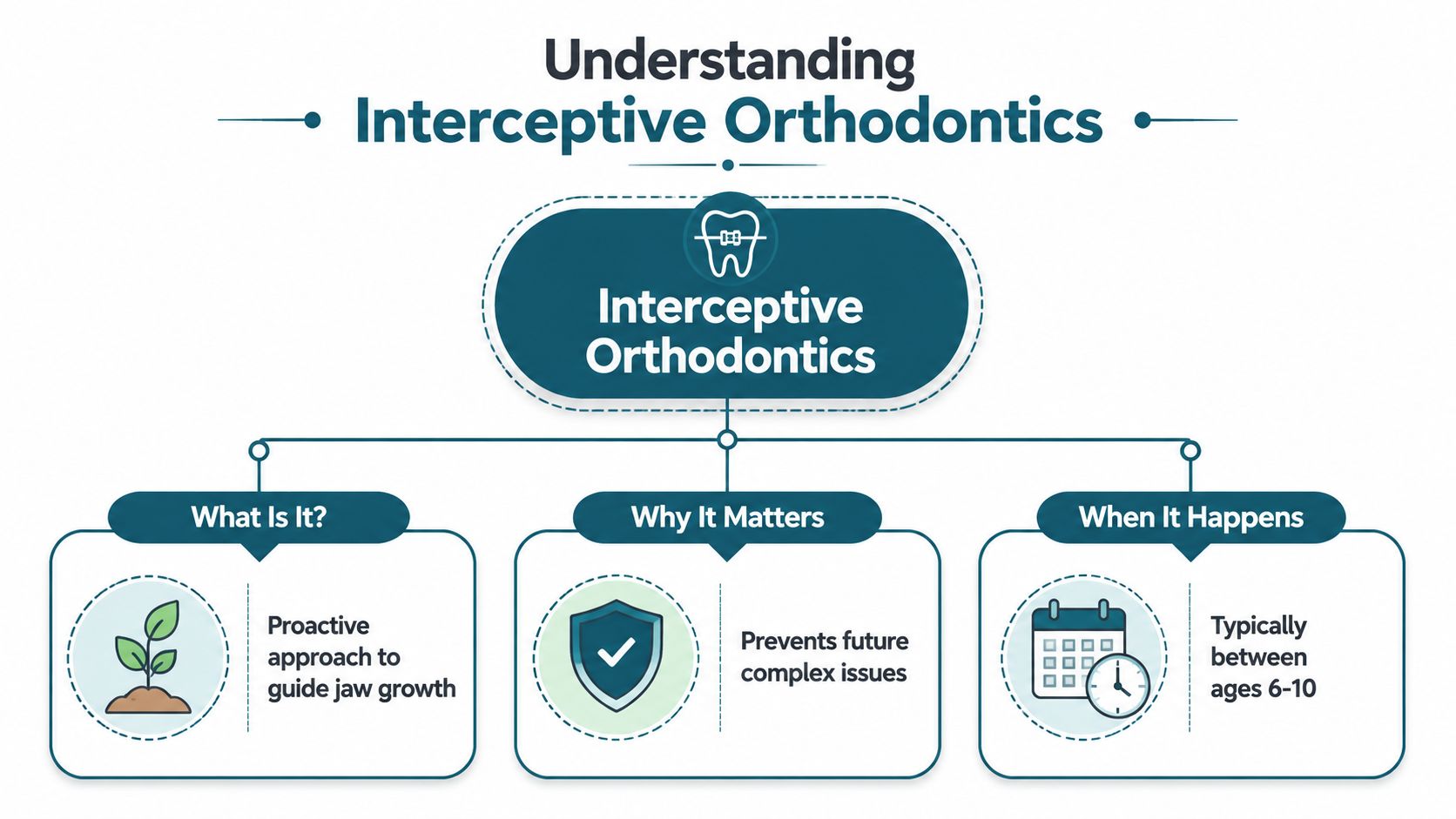
You may also hear the term Phase 1 treatment. For parents, that usually means a focused round of care while some baby teeth are still in place. The goal is not to do everything early. The goal is to help with a specific developmental problem at the time when growth can still be guided.
How Phase 1 differs from later braces
Phase 1 treatment has a narrower purpose than full orthodontic treatment in the teen years. A child might need help correcting a crossbite, making space for permanent teeth, reducing the effect of a sucking habit, or improving how the jaws come together.
That is why early orthodontic care is about more than straightening visible teeth. Bite development is tied to function. How a child breathes, rests the tongue, swallows, and uses the lips can all play a role in how the dental arches form. Families who want help with those patterns can learn more about myofunctional therapy for breathing, tongue posture, and oral habits.
Some children who have Phase 1 treatment will still need braces later. Some will need a shorter or simpler second phase. Some only need monitoring after the early issue is corrected.
The best way to understand interceptive orthodontics is to see it as selective guidance during growth. For the right child, it can support a healthier bite, better function, and a more stable path for the teeth and jaws as they develop.
Signs Your Child Could Benefit from Early Treatment
A common moment in family dentistry goes like this. A parent notices a permanent tooth coming in sideways, or sees that their child always sleeps with an open mouth, and wonders, "Is this just an awkward stage, or something we should check now?"
That question matters because early orthodontic concerns are not always obvious. Some signs show up in the teeth. Others show up in breathing, habits, chewing, or the way the jaws meet. Looking at the whole picture helps a child get the right care at the right time.
What parents can spot at home
Parents are often the first to notice small changes. You do not need orthodontic training to catch patterns that deserve a closer look.
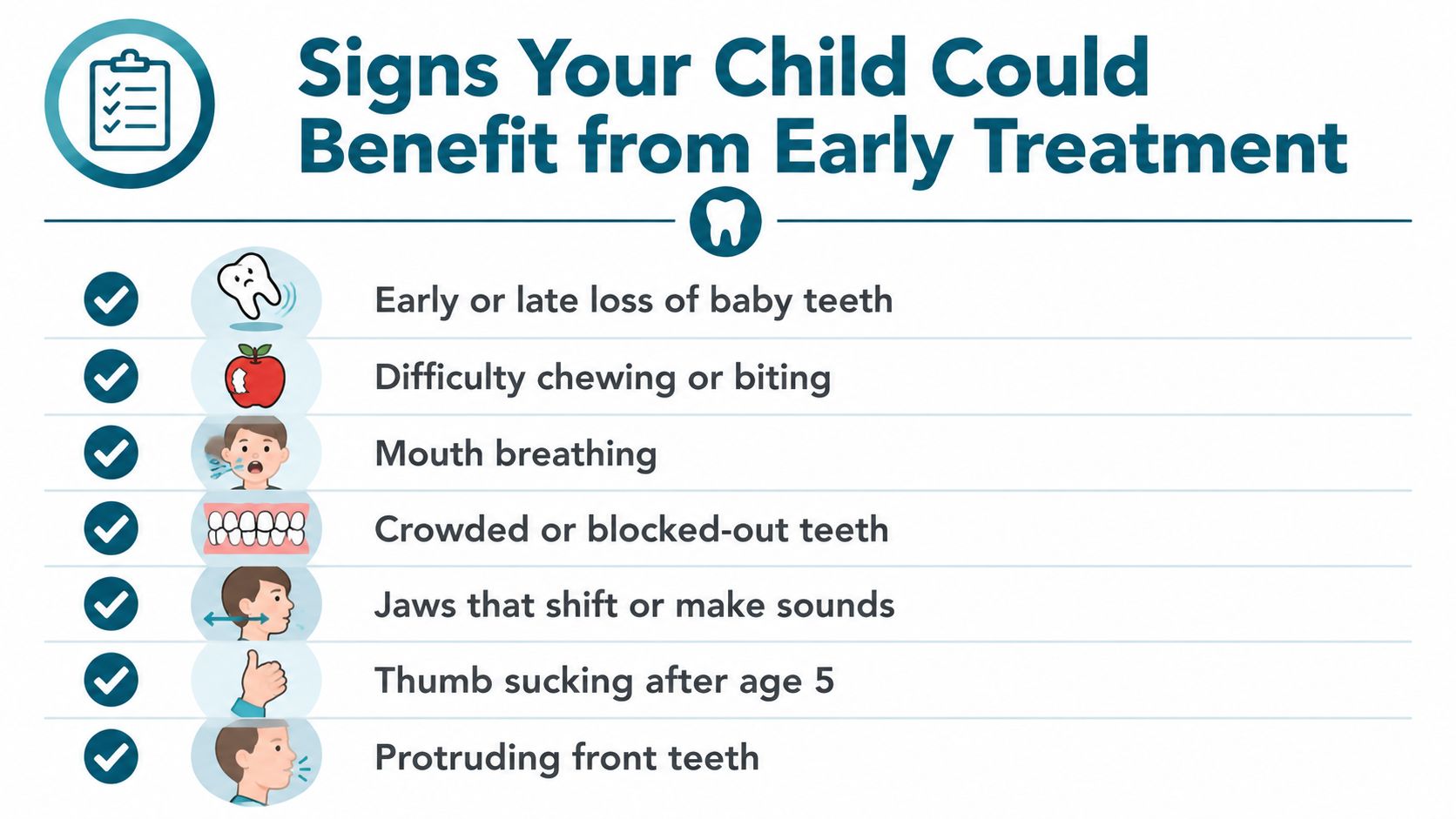
A screening may make sense if your child has any of these signs:
- Early or late loss of baby teeth. Teeth act like placeholders. If one leaves too soon or stays too long, the permanent teeth may lose their path or space.
- Crowded or blocked-out teeth. A tooth that erupts behind, in front of, or far to the side of the others can be a sign that space is tight or jaw growth needs monitoring.
- Front teeth that stick out noticeably. Protruding front teeth can be easier to bump during play and may point to a bite relationship that should be evaluated.
- Bites that do not fit together well. Crossbites, open bites, or a bite that shifts as a child closes can affect comfort and growth over time.
- Difficulty chewing or biting. Some children avoid certain foods, chew on one side, or say their bite feels strange.
Sometimes parents also ask whether clear aligners are ever part of treatment for older kids or teens. Our guide on how Invisalign works for tooth movement and bite correction can help explain that option, although younger children who need early treatment often need a different approach.
When habits and breathing deserve a closer look
Teeth are only part of the story. The mouth is part of a growing system that includes the tongue, lips, airway, and jaw muscles. If one part is off, the bite can develop around that pattern, much like a young tree growing around the stake that guides it.
These signs are worth mentioning during an evaluation:
- Mouth breathing. A child who often rests with lips apart or breathes through the mouth may have oral posture patterns that influence facial and dental development.
- Thumb sucking after age 5. Ongoing sucking habits can change the shape of the bite and the position of the front teeth.
- Speech or swallowing concerns. These do not always mean orthodontic treatment is needed, but they can overlap with tongue posture and bite development.
- Jaw sounds or shifting. If the jaw slides to one side when closing, that may point to a functional bite issue rather than a simple alignment concern.
For families in Lancaster, OH, Circleville, OH, or Carroll, OH, that nuance matters. A child can have teeth that look a little crooked and still be fine to watch for now. Another child may have a less visible issue, such as a crossbite, mouth breathing, or a persistent habit, that is better addressed during growth.
The goal is not to rush every child into treatment. The goal is to notice patterns early enough that a trusted family dentist can tell the difference between normal development and a problem that could affect comfort, breathing, function, or the way the smile grows.
Early Orthodontic Solutions at Amanda Family Dental
Common tools used in Phase 1 care
Once a child is evaluated, treatment options depend on the actual problem being found. Early orthodontic intervention isn't one device or one standard plan. It's a set of tools used carefully and selectively.
Some common options include:
- Palatal expanders. These appliances can help widen the upper jaw when a child has a narrow arch or certain types of crossbite.
- Space maintainers. If a baby tooth is lost too early, this type of appliance can help preserve room for the permanent tooth that's supposed to come in later.
- Habit appliances. These may be used when thumb sucking or similar habits continue to influence the bite.
- Guided monitoring of eruption. Sometimes the right move is not an appliance at all. Timed observation, or in selected cases managing baby tooth retention, may help permanent teeth erupt into a healthier path.
- Myofunctional support. When mouth breathing, tongue posture, or swallowing patterns seem connected to the bite, therapy aimed at oral function can be part of a broader plan.
One available local option is Amanda Family Dental, which offers family dental care, pediatric evaluations, Invisalign, and myofunctional therapy in a setting that can support both routine dental care and growth-related concerns.
Common Issues and Potential Early Treatments
| Problem | Signs Parents Can See | Potential Early Treatment |
|---|---|---|
| Crossbite | One or more upper teeth bite inside the lower teeth | Palatal expansion or other bite-guiding appliance |
| Crowding or limited space | Permanent teeth erupting behind or overlapping others | Space guidance, monitoring, or selected appliance therapy |
| Early baby tooth loss | A visible gap long before the permanent tooth is expected | Space maintainer |
| Thumb sucking habit | Front teeth or bite shape changing over time | Habit appliance and behavior support |
| Mouth breathing or poor oral posture | Lips often apart, open-mouth rest posture, noisy sleep concerns | Functional evaluation and myofunctional therapy |
| Mild to moderate developing alignment issues | Teeth coming in unevenly but growth still active | Monitoring, early aligner planning, or appliance-based guidance |
Parents sometimes ask whether clear aligners can ever be part of the conversation. In selected mild to moderate alignment cases, families may also want to learn how Invisalign works as part of a broader discussion about age, growth stage, and whether a child or teen is a good candidate.
Not every early orthodontic plan uses braces. Some plans use appliances, some use therapy focused on habits and function, and some use time and monitoring as the most appropriate tool.
A child's bite doesn't develop in isolation. Breathing patterns, tongue posture, swallowing habits, and early tooth loss can all influence the way the arches and jaws grow. That's why the best early treatment conversations often include more than the question, “Are the teeth straight?”
The Lifelong Benefits of Early Orthodontic Care
Why timing can change the whole treatment picture
Parents often want to know whether starting early is worth it. For the right child, it can be.
Clinical research has shown that interceptive treatment can produce measurable changes, not just temporary cosmetic ones. In treated children, overjet decreased by an average of 3.5 mm, overbite improved by 2.1 mm, and the ANB angle was reduced by 2.8 degrees, with statistically significant differences versus controls (clinical study on measurable dental and skeletal changes). Those findings matter because they show that selected early care can influence both tooth position and jaw relationship while a child is still growing.
Benefits that go beyond straight teeth
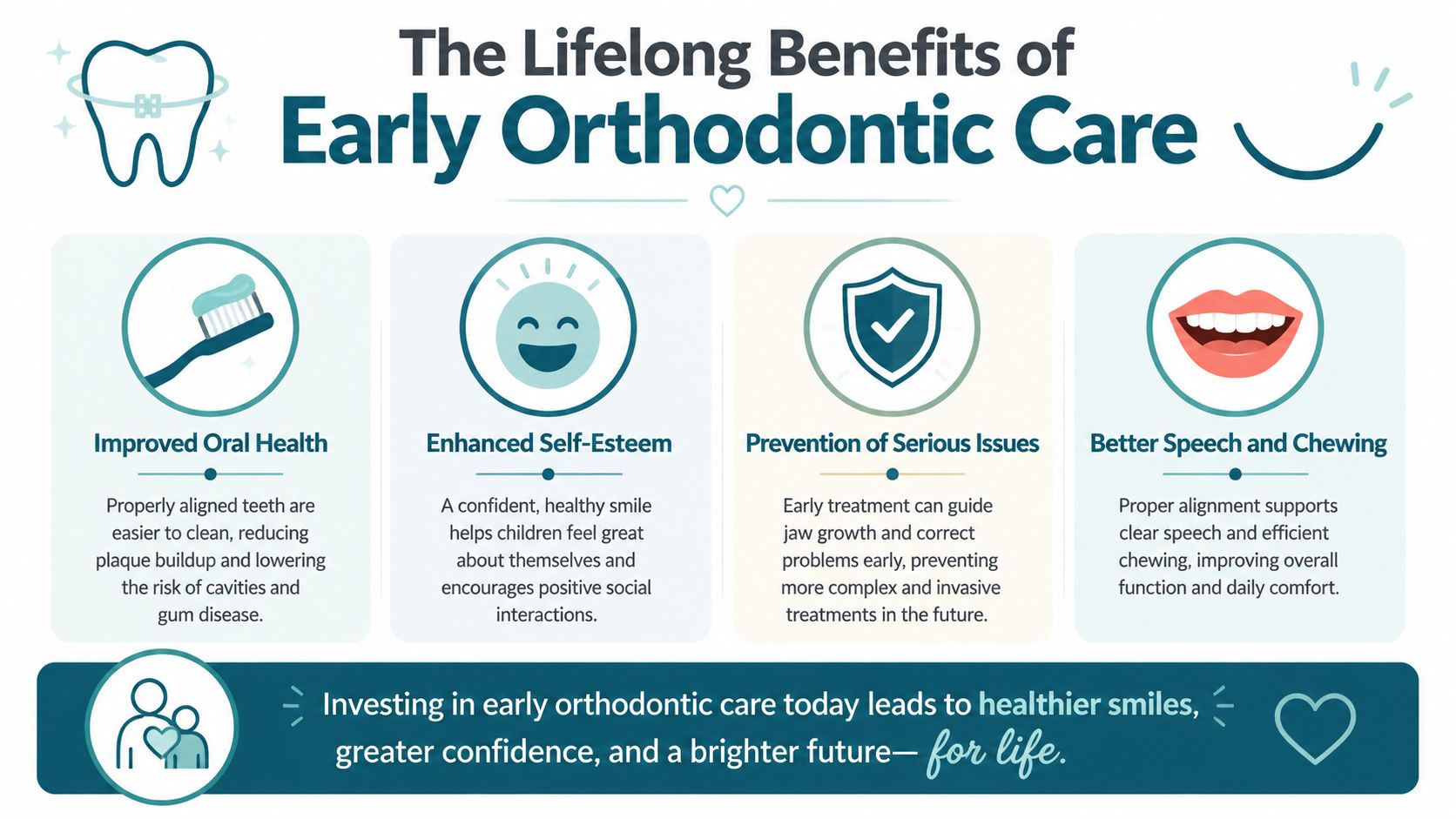
The long-term value of early care often shows up in several areas at once:
- Healthier oral development. Teeth that fit together better are often easier to clean and monitor as a child grows.
- Improved function. Chewing, biting, and speech-related patterns may improve when a bite problem is addressed early.
- Reduced treatment complexity later. Some children still need later orthodontic care, but the later phase may be more straightforward after early guidance.
- Support for confidence. Children are often very aware of visible bite problems, especially front teeth that protrude or a smile that looks very different from peers.
- Attention to habits and airway-related patterns. When early care includes breathing and oral posture concerns, the benefit can extend beyond alignment alone.
A parent doesn't need to think of early orthodontic care as “just braces sooner.” A better frame is this. It's a chance to remove obstacles from healthy growth while those patterns are still forming.
For families comparing options, that can mean fewer surprises later, a clearer plan, and a better understanding of whether a child needs active treatment now or careful follow-up.
What to Expect at Your Child's Evaluation in Amanda
A calm first visit for children and parents
For many children, the hardest part of an orthodontic evaluation is not the exam itself. It's not knowing what will happen.
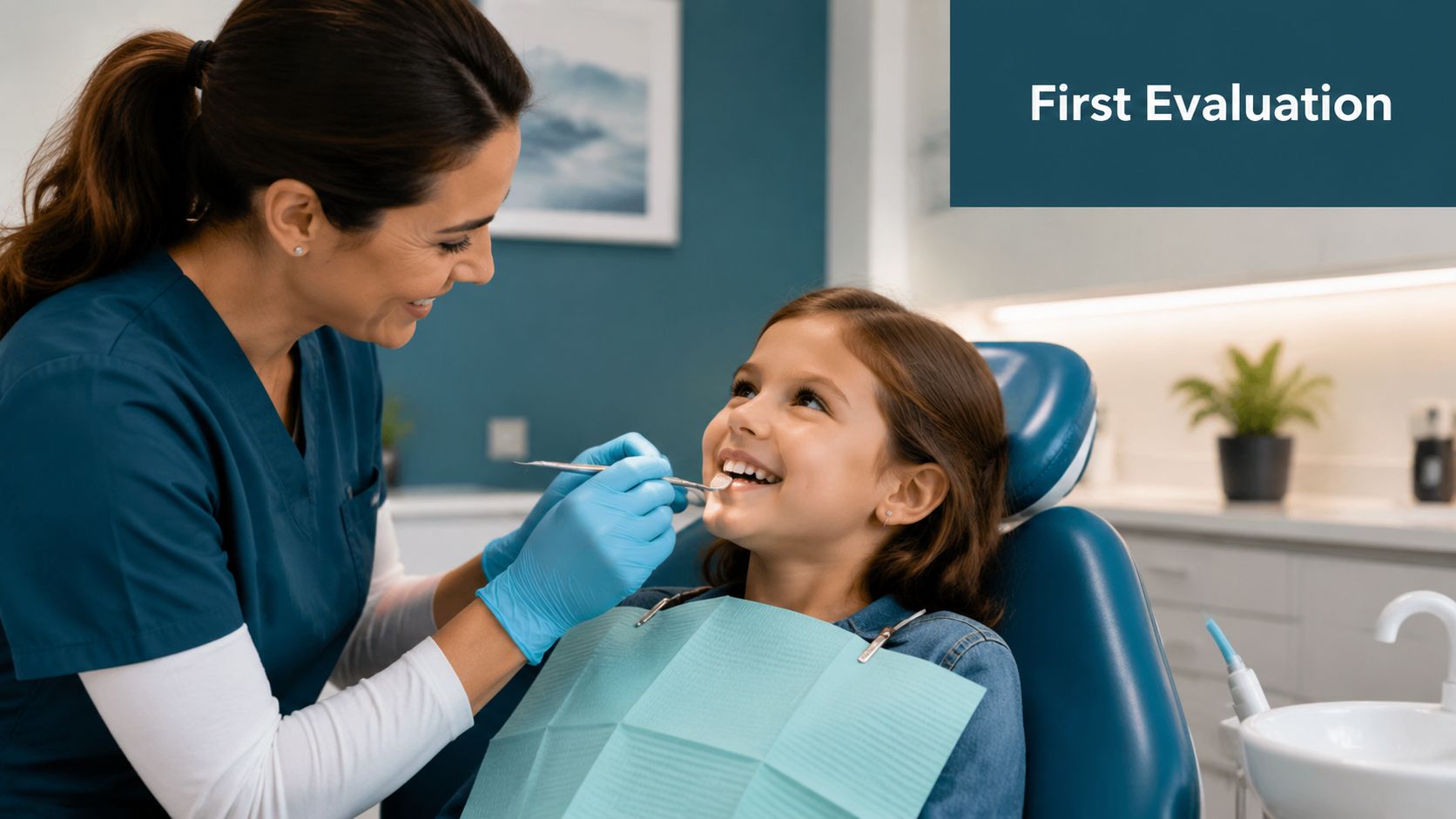
A thoughtful first visit usually begins with the basics. The team reviews the child's dental history, asks about habits like thumb sucking or mouth breathing, and looks at how the teeth and jaws are developing together. A parent may be asked simple questions such as whether the child snores, chews unevenly, or has had baby teeth come out very early.
The clinical exam then looks at alignment, spacing, bite fit, jaw movement, and eruption patterns. Digital X-rays may be used when needed to check tooth position under the gums and to see whether permanent teeth are following a healthy path. For children, this kind of visit is often more educational than dramatic.
Families who want a preview of child-focused care can review pediatric dental services before the appointment.
What happens after the exam
Most parents appreciate hearing that there are usually only a few possible outcomes.
- No treatment needed now. The child is developing normally and can continue with routine dental care.
- Monitor growth and eruption. The child may not need action today, but should be rechecked as more teeth come in.
- Start targeted early treatment. A specific issue may benefit from intervention while growth is still active.
That conversation should be clear and free of jargon. Parents should leave understanding not only what is recommended, but why. If the concern involves habits, breathing, or oral posture, the plan may include guidance beyond tooth movement alone.
This short video can also help families feel more comfortable before the first visit:
A good evaluation answers two different questions at once. What is happening with the teeth today, and what is likely to happen if nothing changes?
For families searching online for a dentist near me, emergency dentist, or even services like cleaning and exams, dental x-rays, and new patient exams, this kind of visit can be a useful starting point. It doesn't lock a child into treatment. It gives the family a roadmap.
Common Questions from Parents in Our Community
A question we hear often sounds like this: “My child is only seven or eight. Are we starting too early?”
In many cases, the answer is no. Early orthodontic treatment is not about putting every child into braces. It is about checking whether a child's teeth, jaws, breathing patterns, and oral habits are developing in a healthy direction while growth can still be guided.
Will early treatment prevent braces later
Sometimes it can reduce the amount of treatment needed later. Sometimes it can make later treatment simpler. And sometimes the right plan is to watch and wait.
That uncertainty can be frustrating for parents, so it helps to picture early care as guiding a young tree while it is still growing, rather than trying to correct the shape after the trunk has hardened. If a child has a crossbite, crowding that is already affecting eruption, a jaw growth concern, or habits that are changing the bite, early treatment may help create better conditions for the permanent teeth. As noted earlier, age 7 is often a useful time for an orthodontic screening, but the need for treatment depends on the child, not the birthday.
Some children who have Phase 1 treatment still need braces or aligners as teens. That does not mean the early phase failed. It may have helped protect jaw development, improve function, support better breathing, or prevent a bigger problem from becoming harder to treat.
Why start with a family dental home
Parents are not only choosing where to straighten teeth. They are choosing who will help them understand the whole picture.
A family dental office often knows the child's history already. That includes how the teeth have been erupting, whether thumb sucking or tongue posture has been affecting the bite, whether enlarged tonsils or mouth breathing have been part of the story, and how comfortable the child feels during visits. Those details matter because early orthodontic questions often connect to daily function, not just appearance.
That broader view can make decisions clearer. A child with crowded teeth may also have a narrow palate. A child who snores, breathes through the mouth, or has trouble keeping lips closed at rest may need more than a conversation about future braces. Looking at bite development alongside habits and airway patterns helps families understand what problem is being treated and why timing matters.
Cost is another common concern. The honest answer is still the same. It depends on the child's needs, whether treatment is done in phases, and how insurance or membership benefits apply. A consultation gives the clearest answer because the fee follows the diagnosis, not a standard package.
Families in Amanda, Lancaster, Circleville, and Carroll who have questions about a child's bite, habits, breathing patterns, or developing smile can schedule a visit with Amanda Family Dental. A screening can help determine whether a child needs early orthodontic intervention now or careful monitoring as they grow.