

Waking up tired after a night with CPAP can feel defeating. For many people in Amanda, Lancaster, Circleville, and Carroll, the problem is not a lack of effort, it's that the mask, tubing, or pressure settings never quite fit daily life. Sleep apnea options besides CPAP exist, and some are already part of mainstream medical and dental care, including oral appliance therapy, positional therapy, surgery, and implanted nerve stimulation.
A local dental team can help sort through those choices in a way that feels practical, not overwhelming. At Amanda Family Dental, the focus is on matching the right airway support to the person, especially when comfort, travel, or long-term use matter as much as the diagnosis itself.
| Option | How it helps | Best fit | Main trade-off |
|---|---|---|---|
| Oral appliance therapy | Moves the jaw forward to open space behind the tongue | Mild-to-moderate OSA, CPAP intolerance | Less airway support than CPAP |
| Positional therapy | Keeps the sleeper off the back | Positional sleep apnea | Not a fit for every case |
| Surgery | Changes airway anatomy | Structural obstruction | Invasive recovery |
| Hypoglossal nerve stimulation | Stimulates tongue movement during sleep | Selected patients with specific anatomy | Implant, cost, and candidacy limits |
| Drug or exercise therapy | Supports airway function through medication or muscle training | Selected patients | Variable response |
Table of Contents
- Introduction to Sleep Apnea and CPAP Alternatives
- Understanding Sleep Apnea and CPAP Challenges
- Non CPAP Treatment Options Overview
- Comparing Key Non CPAP Treatments
- Oral Appliance Therapy at Amanda Family Dental
- Selecting the Right Sleep Apnea Therapy
- Getting Started at Amanda Family Dental
Introduction to Sleep Apnea and CPAP Alternatives
A patient from Carroll may come in saying the CPAP machine is on the nightstand more often than on the face. Another patient in Lancaster might describe a different problem, the machine works, but the mask leaks, the hose tangles, and sleep still feels broken. That's where sleep apnea options besides CPAP start to matter in a real, everyday way.
The goal isn't to replace one inconvenience with another. It's to find a treatment that people can use consistently, and that starts with understanding which alternatives are established and which ones fit a specific airway pattern. Oral appliance therapy is one of the most recognized non-CPAP paths, and it's especially relevant when a patient needs something quieter, smaller, and easier to live with than a mask.
A community dental office can help patients move from frustration to a plan that feels manageable. For many families in Amanda, OH, that means a conversation about airway support, comfort, and whether a dental approach, medical referral, or combined path makes the most sense.
Practical rule: if CPAP is sitting unused, the next step should be a candid look at why, not another night of forcing a treatment that never became part of normal life.
Understanding Sleep Apnea and CPAP Challenges
Obstructive sleep apnea happens when the airway narrows or closes during sleep. That can lead to loud snoring, gasping, broken rest, and the kind of morning fatigue that makes ordinary tasks feel harder than they should. In many patients, the issue is not sleepiness, it's poor sleep quality night after night.
CPAP remains a strong airway-opening therapy, but it isn't easy for everyone to live with. Masks can feel bulky, tubing can interrupt movement, and noise or pressure can make sleep feel more mechanical than restorative. For some people, the challenge is not refusing treatment, it's tolerating treatment long enough to make it part of real life.
Why positional therapy helps some patients
Some sleep apnea patterns worsen when a person sleeps on the back. Henry Ford Health notes that specialized pillows or wearable devices can help keep patients off their backs and can reduce the need for CPAP in some cases. That makes positional therapy worth discussing for people who notice worse snoring or breathing problems in certain sleep positions. Henry Ford Health on sleep apnea alternatives to CPAP
In practice, that matters because not every airway collapse is the same. A patient in Circleville who sleeps better on the side may be a very different candidate than someone whose airway collapses in multiple positions. The right option depends on pattern, not just preference.
What makes alternatives worth exploring
Alternatives are not a downgrade. They're often the more realistic path for patients who cannot tolerate CPAP or who need a therapy that blends more naturally into travel, shared bedrooms, or active daily routines. A good plan respects both the diagnosis and the person living with it.
Non CPAP Treatment Options Overview
A patient who cannot tolerate CPAP still has several legitimate paths to better sleep and better breathing. Each option works differently, which is why the best choice depends on where the airway is narrowing, how severe the apnea is, and how much daily use the person can realistically manage.
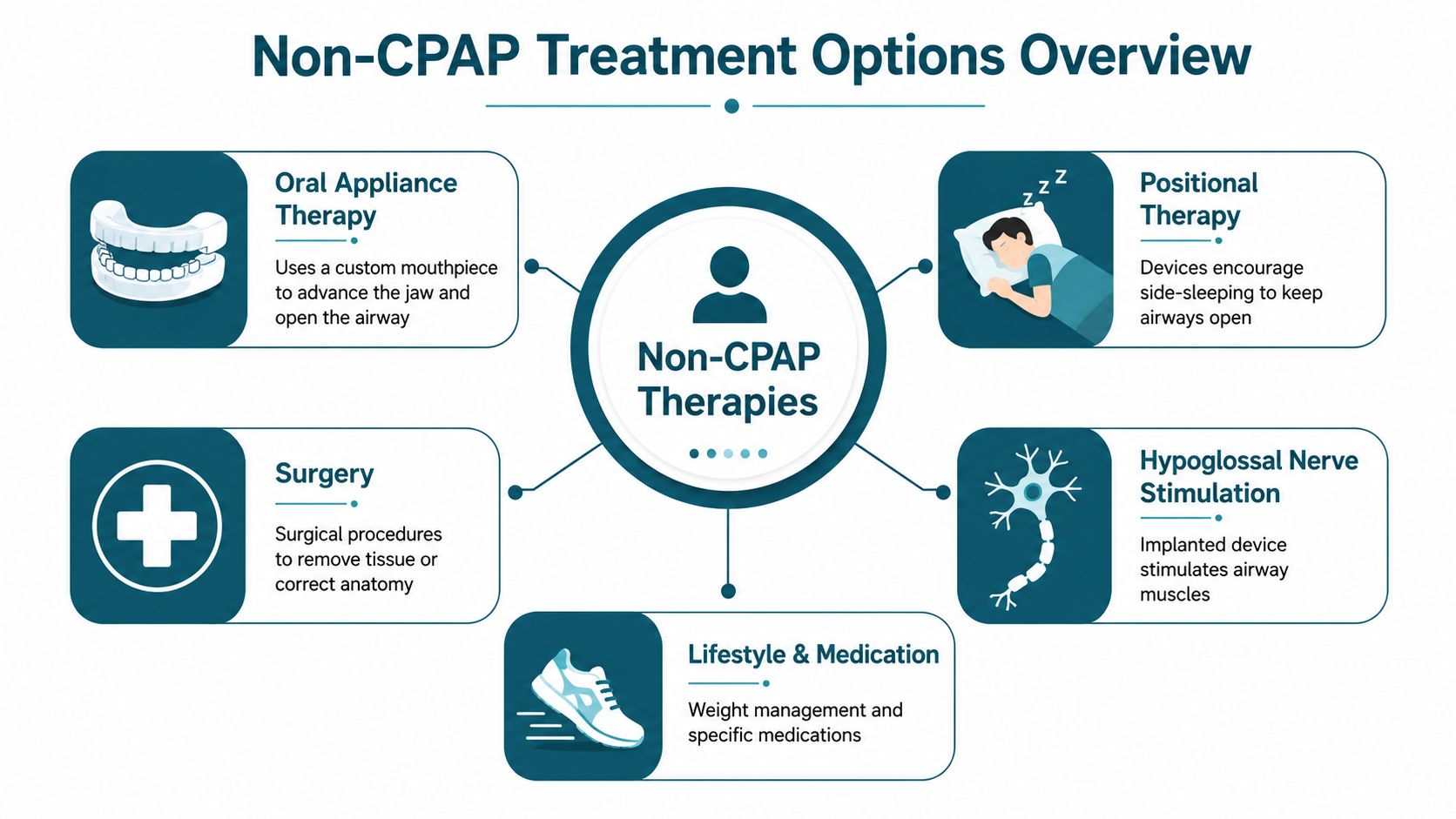
Several established pathways exist outside CPAP, and the most commonly used alternative in the literature is mandibular advancement device therapy. A custom oral appliance moves the lower jaw forward and changes airway shape mechanically, which is why this approach fits naturally into dental care while still serving a medical purpose for selected sleep apnea patients. Mandibular advancement device overview
The main categories
Oral appliance therapy advances the jaw or helps stabilize the tongue. It is compact, silent, and portable, which is one reason many patients prefer it when CPAP feels too disruptive. The American Thoracic Society describes it as an evidence-based option for selected patients, especially those with mild-to-moderate disease or CPAP intolerance. ATS patient resource on other therapies for sleep apnea
Positional therapy focuses on sleep posture. It often uses pillows or wearable devices to keep a patient off the back, and it can be useful when airway collapse is worse in that position.
Surgery changes the airway anatomy directly. The specific procedure depends on where collapse occurs, and the trade-off is that surgery is invasive and recovery matters.
Hypoglossal nerve stimulation uses an implanted device to stimulate the tongue nerve during sleep. Harvard Health describes it as a chest-implanted system that monitors breathing and activates when airway collapse occurs, which makes it highly specific for selected patients. Harvard Health on options beyond CPAP
Drug treatment and orofacial exercise also appear in the evidence base as established alternatives. They may fit certain patients, but they do not work the same way for everyone. In our practice, myofunctional work can be part of the discussion, especially when tongue posture and muscle function are part of the airway problem, and patients often want to understand whether exercises can support a broader plan, such as myofunctional therapy for sleep apnea.
For patients comparing approaches in a work-heavy life, sleep apnea solutions for executives can be a useful way to see how comfort, consistency, and daily routines shape real-world results. At Amanda Family Dental, those same practical concerns guide how we talk through oral appliance therapy, referral timing, and the next step for Amanda OH patients who need a local starting point.
Some alternatives work by improving how the airway is held open, while others change body position or airway anatomy. The right choice depends on where collapse happens and how much interruption a patient can realistically tolerate.
Comparing Key Non CPAP Treatments
The main mistake patients make is assuming every non-CPAP option does the same job in the same way. They do not. Some are built for comfort and daily use, while others are meant for patients whose airway problem calls for a more direct fix. The comparison has to include how each therapy works, who it suits, and what the trade-offs look like in real life.
A useful benchmark is the Winx oral-negative-pressure device, which may provide successful therapy for about 30% to 40% of obstructive sleep apnea patients. That tells us some alternatives work well for a meaningful subset of people, but not for everyone. The same review also marks Inspire as FDA-approved in 2014, and eXciteOSA as receiving FDA approval in 2021, both of which were important milestones in device-based care. Medical literature review on non-CPAP milestones
Effectiveness versus convenience
Oral appliance therapy often sits near the center of the decision tree. It gives less airway support than CPAP, but it is compact, quiet, and portable, which makes it easier for many patients to use night after night. That convenience matters when a treatment only helps if a patient can wear it.
Positional therapy can work very well for the right pattern, but it only helps when apnea worsens on the back. A side-sleeping device does not solve every kind of obstruction.
Surgery can address the anatomy directly, yet it also brings the clearest recovery burden. It fits best when the structure of the airway points to a surgical fix.
Hypoglossal nerve stimulation works very differently from mask-based therapy. Harvard Health describes it as a chest-implanted system that monitors breathing and stimulates the tongue nerve when collapse happens, so it targets a specific mechanism rather than treating every type of sleep apnea. Harvard Health on options beyond CPAP
A practical comparison for patients
| Treatment | Main strength | Main limitation | Typical fit |
|---|---|---|---|
| Oral appliance therapy | Easier to wear and travel with | Less airway support than CPAP | Mild-to-moderate OSA, CPAP intolerance |
| Positional therapy | Simple and noninvasive | Only works for positional apnea | Back-sleeping pattern |
| Surgery | Can correct anatomy directly | Invasive and recovery-based | Structural obstruction |
| Hypoglossal nerve stimulation | High specificity for selected patients | Implant, cost, and candidacy limits | Specific anatomy and severity profiles |
| Drug or exercise therapy | Can support airway function in certain cases | Response varies | Selected patients |
For patients in Amanda, OH, the question is often which treatment fits a busy week, not which one sounds most advanced. A device that stays on the nightstand will not help much, even if it looks good on paper.
At Amanda Family Dental, that practical side matters. If a patient is considering oral appliance therapy and also deals with clenching or grinding, teeth grinding solutions can come into the conversation because bite forces and appliance wear may overlap. For some people, that is the point where a dental team can help sort through comfort, fit, and the next referral step without making the process harder than it needs to be.
Oral Appliance Therapy at Amanda Family Dental
Oral appliance therapy is one of the clearest non-CPAP paths for patients who want something quiet, custom, and easier to carry than a machine. The appliance, usually a mandibular advancement device, moves the lower jaw forward to open the airway and reduce collapse during sleep. That makes it a dental solution with a sleep medicine purpose.
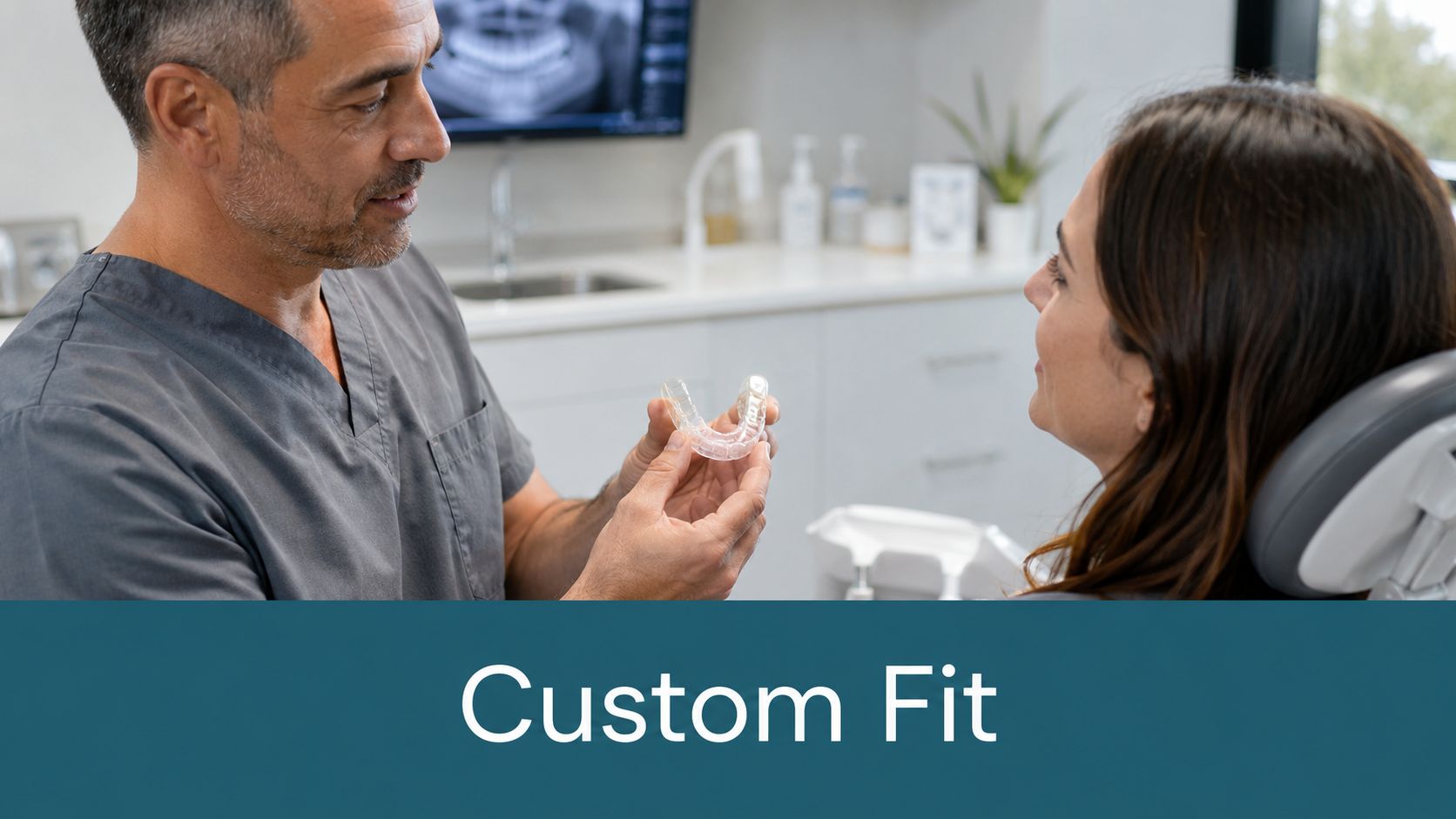
At Amanda Family Dental, the process starts with a careful exam and a discussion about symptoms, sleep study findings, and overall oral health. A custom appliance is then designed to fit the mouth securely, with jaw positioning adjusted for comfort and airway support. For patients who also struggle with clenching or grinding, teeth grinding solutions may come up in the same conversation because bite forces and appliance wear can overlap.
The American Thoracic Society notes that oral appliance therapy is an evidence-based alternative for selected sleep apnea patients, and that it often brings higher convenience and adherence potential even though CPAP provides stronger airway support. That trade-off is why it works well for many people with mild-to-moderate OSA or CPAP intolerance. ATS patient resource on other therapies for sleep apnea
After the appliance is fitted, follow-up matters. The device may need fine-tuning, because jaw position, comfort, and symptom relief have to line up together. Later in the process, one of the most common benefits is simple, the patient can travel, sleep, and speak to a partner without the bulk and noise of a mask.
Amanda Family Dental is one local option for patients who want a dental-led conversation about oral appliances, especially when the goal is to keep treatment close to home in Amanda, Lancaster, Circleville, and Carroll.
Selecting the Right Sleep Apnea Therapy
The right therapy depends on the pattern of collapse, how severe the apnea is, and how much intrusion the patient can realistically accept. A mild case that worsens only on the back can point toward positional therapy. A patient with jaw-related airway narrowing may be a stronger candidate for oral appliance therapy.
What points toward each option
Oral appliance therapy usually fits patients who want a compact, noninvasive, dental-based solution and who have mild-to-moderate disease or CPAP intolerance. It is often the most practical middle ground between doing nothing and using a mask every night.
Positional therapy makes sense when back-sleeping is a major trigger. If side-sleeping consistently improves symptoms, that clue matters.
Hypoglossal nerve stimulation is narrower in scope. Harvard Health describes it as a chest-implanted system that monitors breathing and stimulates the tongue nerve when airway collapse occurs, which is why it suits selected patients with anatomy that matches the device's target. It is specific, but it is also invasive and expensive. Harvard Health on options beyond CPAP
Surgery can be helpful when structural obstruction is obvious. In those cases, changing anatomy may solve a problem that a removable device cannot fully address.
A simple decision rule
If the treatment is effective but impossible to use, it probably won't succeed long term. If the treatment is comfortable but too weak for the airway problem, it won't solve the diagnosis either. The best therapy lands in the middle, where the airway needs and the patient's life can meet.
Clinical takeaway: the best sleep apnea plan is the one that the patient can still use after the first difficult week, not the one that looks strongest in theory.
Getting Started at Amanda Family Dental
Patients in Amanda, OH, and nearby communities can start with a visit that reviews symptoms, oral health, and sleep study details. A personalized plan can then point toward oral appliance therapy, a medical referral, or another appropriate path. For a first step close to home, visit dentist in Amanda and ask about sleep apnea care.
Amanda Family Dental can help patients move from confusion to a clear next step, whether that means a custom oral appliance or a referral-based plan. For those searching for a dentist near me who can discuss sleep apnea options besides CPAP with practical, local guidance, the office is ready to help.
Amanda Family Dental offers thoughtful, patient-focused care for people who want a realistic path beyond CPAP, including oral appliance therapy and coordinated next steps when a referral is needed. If sleep apnea has made nights harder in Amanda, Lancaster, Circleville, or Carroll, schedule a visit through Amanda Family Dental and ask about a treatment plan that fits daily life.