

Waking up with a tight jaw, a dull headache, or teeth that feel oddly sensitive can be frustrating. Many people don't realize those symptoms may point to bruxism, which is the habit of clenching or grinding the teeth during the day or while sleeping. It's common, it can damage teeth over time, and in many cases it can be managed with the right mix of protection, habit changes, and targeted dental care.
For families and adults searching for a dentist in Amanda, OH, or nearby care in Lancaster, OH, Circleville, OH, and Carroll, OH, practical help matters more than theory. Teeth grinding solutions work best when treatment matches the cause. Some patients mainly need tooth protection. Others need bite evaluation, restorative repair, stress-related support, or care that also addresses jaw muscle overuse.
Table of Contents
- Your Local Guide to Teeth Grinding Solutions
- Understanding Bruxism Signs Causes and Risks
- At-Home Strategies and Lifestyle Adjustments
- Professional Teeth Grinding Solutions at Amanda Family Dental
- Your First Visit What to Expect for Bruxism Care
- Frequently Asked Questions About Teeth Grinding
Your Local Guide to Teeth Grinding Solutions
Teeth grinding doesn't always sound dramatic. For many patients, it starts as sore jaw muscles in the morning, tension near the temples, or a partner noticing grinding sounds at night. Others find out only after a routine exam shows flattened chewing edges, tiny enamel fractures, or dental work that's taking more force than it should.
This isn't a rare problem. A systematic review and meta-analysis on bruxism prevalence in children and adolescents found global prevalence of bruxism at 22.22%, with sleep bruxism at 20.99% and awake bruxism at 23.29%. That same review reported that when sleep bruxism was measured with polysomnography, estimated prevalence rose to 43.42%, which shows how much diagnosis can depend on how the condition is measured.
For patients, the practical point is simple. Teeth grinding is common, and it doesn't look the same in every person.
What effective treatment usually looks like
The right plan often combines more than one approach:
- Protection for the teeth through a custom night guard or splint
- Evaluation of contributing factors such as stress, sleep issues, medication effects, or bite strain
- Repair of damage when grinding has already worn, chipped, or fractured teeth
- Monitoring over time so the treatment changes if symptoms keep going
Practical rule: A solution that protects enamel may still not reduce the grinding habit itself. That's why the most useful plans address both damage control and the likely trigger.
People searching for a dentist near me, an emergency dentist, or help for jaw pain often want one clear answer. In reality, effective teeth grinding solutions are more customized than that. A patient with worn enamel may need a different plan than someone with facial muscle fatigue, repeated crown damage, or clenching that happens mostly during the workday.
For communities in Amanda, Lancaster, Circleville, and Carroll, local care matters because follow-up matters. Bruxism treatment usually isn't one visit and done. It's a process of identifying the pattern, protecting the teeth, and checking whether symptoms are improving in daily life.
Understanding Bruxism Signs Causes and Risks
Bruxism means clenching or grinding the teeth, and it can happen while awake or asleep. Some people press their teeth together without much side-to-side movement. Others grind hard enough to make noise, wear down enamel, or trigger jaw soreness by morning. Because many episodes happen unconsciously, patients often notice the effects before they notice the habit.

Why teeth grinding is so often missed
The condition is easy to overlook because the symptoms can seem unrelated. A patient may think the issue is a “bad pillow” or stress headache, while the teeth and jaw are absorbing repeated pressure at night.
The American Dental Association information on teeth grinding reported in 2021 that more than 70% of dentists saw an increase in patients with signs of teeth grinding and clenching. The same source notes that chronic bruxism can contribute to jaw pain, headaches, worn enamel, and fractured teeth.
Common signs patients notice
A few warning signs show up again and again in practice:
- Morning jaw soreness that improves as the day goes on
- Headaches near the temples after sleep or long periods of clenching
- Tooth sensitivity when enamel has been worn down
- Flattened, chipped, or cracked teeth from repeated force
- Facial muscle fatigue or tenderness around the jaw joints
- Broken fillings or damaged crowns when restorations take repeated overload
Jaw pain often overlaps with muscle tension, joint irritation, and bite habits. For readers who want a plain-language look at how these problems connect, these expert insights on Boston jaw pain are a useful companion resource.
What can trigger bruxism
There usually isn't one single cause. Several factors may contribute at the same time.
| Trigger area | How it may show up |
|---|---|
| Stress and tension | Daytime clenching, muscle tightness, jaw fatigue |
| Sleep-related issues | Nighttime grinding, disrupted sleep, morning symptoms |
| Bite strain | Uneven force on certain teeth or restorations |
| Substance or medication factors | Increased clenching tendency in some patients |
Some patients also grind more during periods of anxiety, poor sleep, increased caffeine use, alcohol use, smoking, or medication changes. Others have wear patterns that suggest the bite needs a closer look. The risk of ignoring those signals is that minor wear can become fractured enamel, damaged restorations, chronic discomfort, and in some cases a tooth that eventually needs more extensive restorative care or even tooth extraction.
At-Home Strategies and Lifestyle Adjustments
Home care can help, especially when symptoms are mild or just starting. It won't replace a diagnosis, but it can reduce strain and make professional treatment work better. The most useful changes are the ones patients can repeat consistently, not the ones that sound impressive for two days and disappear.
Simple changes that can reduce strain
A few habits are worth trying right away:
- Check the jaw position during the day. Lips together, teeth apart, and the tongue resting gently up can reduce unconscious clenching.
- Reduce common triggers in the evening. Some patients notice less nighttime tension when they cut back on caffeine, alcohol, and nicotine later in the day.
- Use a calming wind-down routine. Quiet stretching, slower breathing, and a regular bedtime can lower muscle tension before sleep.
- Choose softer foods during flare-ups. If the jaw feels overworked, a temporary break from hard, chewy foods can help irritated muscles settle down.
For people who want a broader consumer-friendly list, this guide to effective home remedies for bruxism offers practical ideas that can support daily symptom management.
What home care can and cannot do
Warm compresses on tight jaw muscles can be soothing. Gentle massage along the cheeks and temples may also help when facial muscles feel overactive. The key word is gentle. Aggressive stretching or constant chewing on gum usually makes the jaw work harder, not better.
A whole-body approach also matters. Amanda-area patients who are trying to improve sleep quality, stress load, and oral habits at the same time may find it helpful to look at the connection between the mouth and overall health in this article on oral health and overall wellness.
Home care is a support tool. It helps most when it lowers muscle strain and gives the dentist a clearer picture of what still needs treatment.
What it doesn't do well is protect already worn teeth from further damage if grinding is heavy at night. It also can't tell whether the underlying problem involves a sleep pattern, a bite issue, medication-related clenching, or a restoration that's taking too much force. If symptoms keep returning, if teeth are getting sensitive, or if something feels chipped or cracked, professional evaluation becomes the safer next step.
Professional Teeth Grinding Solutions at Amanda Family Dental
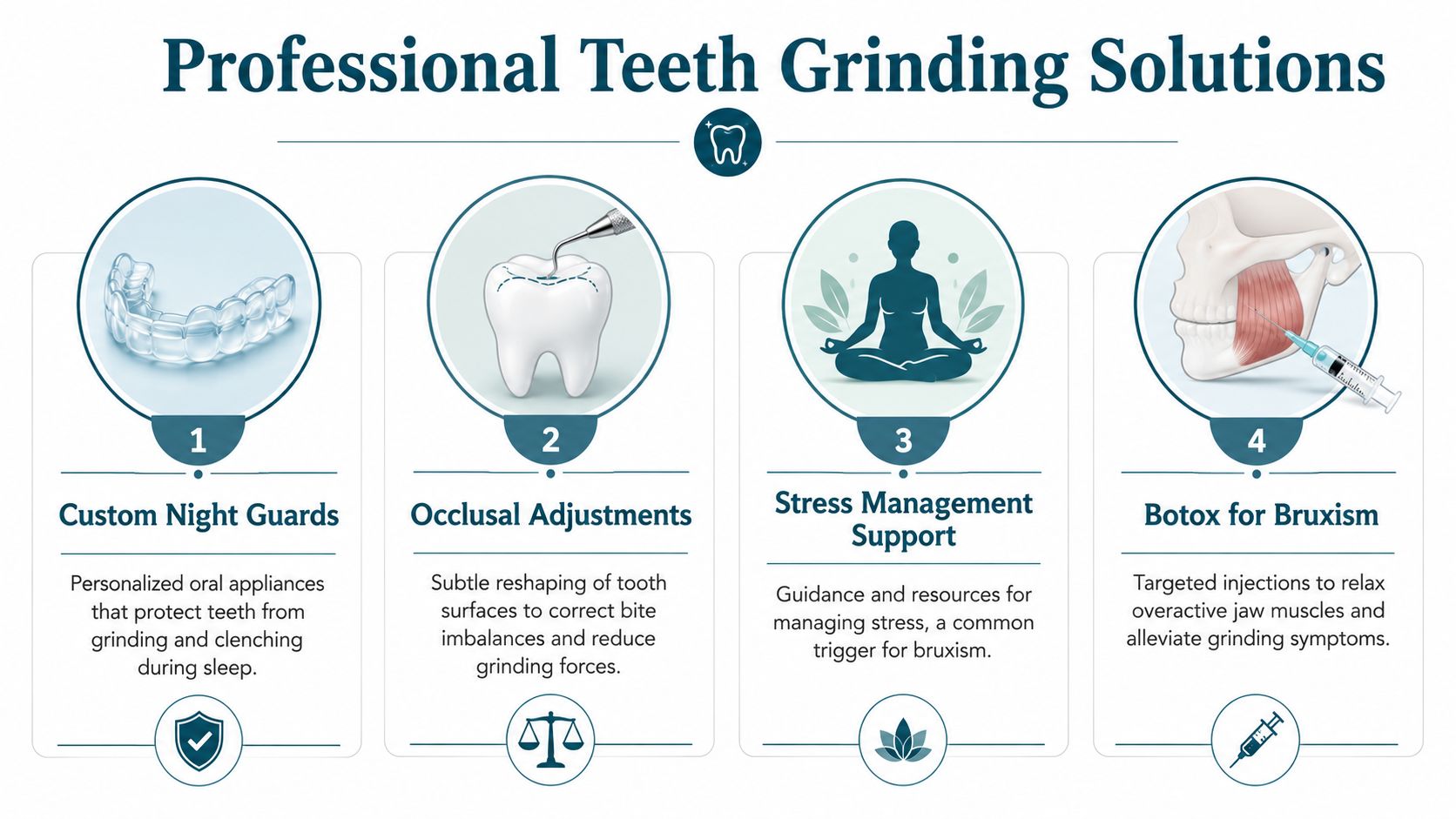
Most long-term teeth grinding solutions fall into two categories. The first protects teeth from damage. The second tries to reduce the forces, triggers, or muscle activity contributing to the habit. Good care often uses both.
When a custom night guard makes sense
The Mayo Clinic guidance on bruxism diagnosis and treatment states that the most reliable first-line dental solution for sleep bruxism is a custom-fitted occlusal splint or night guard. It also notes that the appliance doesn't stop the grinding action itself, but it does protect teeth from wear and can reduce jaw muscle pain by distributing force more evenly.
That trade-off matters. A custom guard is often the right tool when the immediate problem is damage. It creates separation between the arches, cushions contact, and helps preserve enamel, fillings, crowns, and other restorations.
Compared with store-bought guards, a professionally made appliance is designed around the patient's actual bite. That typically means a better fit, less bulk, and more predictable protection.
Options beyond basic protection
A guard is often the starting point, not the finish line.
Some patients also need:
- Restorative dentistry to repair chipped teeth, worn edges, fractured fillings, or damaged crowns
- Bite evaluation when certain teeth are taking repeated overload
- Cosmetic or alignment planning in cases where tooth position contributes to uneven force
- Muscle-focused care when jaw tension stays high even after a guard is in place
For patients exploring a broader airway and habit-based approach, myofunctional therapy services may be part of the discussion when tongue posture, oral muscle habits, and breathing patterns appear relevant to ongoing clenching or grinding.
Protection works best when the dentist also asks why the teeth are being overloaded in the first place.
Botox is another option that may be considered in some bruxism cases involving overactive jaw muscles. The role of Botox isn't to rebuild enamel or correct every cause of grinding. Its value is more targeted. It may help reduce the intensity of muscle contraction in selected patients whose symptoms are strongly tied to jaw muscle overuse.
How treatment choices differ by patient
Not every patient needs advanced treatment. Some do well with a night guard and habit changes. Others need restorative work because the grinding has already left visible damage. A patient who wakes with muscle pain may need a different plan than someone whose main problem is broken dental work.
One local option for patients in Amanda, Lancaster, Circleville, and Carroll is Amanda Family Dental, which offers custom night guards along with restorative dentistry, Invisalign, Botox, myofunctional therapy, and sleep-focused comfort options as part of a broader bruxism care plan.
A practical way to think about professional care is this:
| Patient situation | Often useful approach |
|---|---|
| Worn or chipped teeth | Custom guard plus evaluation for repair |
| Morning muscle pain | Guard, trigger review, muscle-focused care |
| Repeated dental work damage | Protective appliance and bite assessment |
| Persistent grinding despite a guard | Consider behavioral, muscle, or sleep-related options |
What usually doesn't work well is relying on one generic solution for every case. Heavy grinding can overwhelm a soft over-the-counter appliance. Cosmetic repair without force management may fail again. Stress advice alone won't protect a cracked tooth. The strongest treatment plans match the symptom pattern, tooth wear, muscle findings, and day-to-day habits of the individual patient.
Your First Visit What to Expect for Bruxism Care
Most patients feel better once they know what the visit will involve. Bruxism care usually starts with listening, looking for wear patterns, and figuring out whether the problem shows up more during the day, at night, or both.

A major review of bruxism prevalence estimated global prevalence at 22.22% in children and adolescents, and found sleep bruxism prevalence of 31% in North America in pooled regional analysis. That's one reason dentists are very familiar with the signs, even when patients aren't sure what they've been experiencing.
Starting with a clear conversation
The appointment commonly begins with simple questions. When does the jaw hurt. Are headaches showing up in the morning. Has a partner heard grinding at night. Do the teeth feel more sensitive lately. Has any filling, crown, or tooth chipped recently.
Those details help separate likely sleep bruxism from daytime clenching. They also help identify whether the main goal is damage prevention, pain reduction, restorative repair, or a mix of all three.
The exam and diagnostic process
The dentist then checks for visible and functional clues, including:
- Wear patterns on the biting surfaces
- Small cracks or fractures in enamel or restorations
- Tender jaw muscles or signs of joint irritation
- Changes in bite contact that may concentrate force
- Digital X-rays when needed to evaluate tooth structure and surrounding support
Some patients also ask about comfort options because they've avoided treatment due to dental anxiety. In those situations, learning more about sleep dentistry options can be helpful before the visit.
For patients who want a brief visual explanation of dental care and comfort-focused treatment, this short video can help set expectations.
Building a treatment plan that fits real life
After the exam, the plan should feel practical, not overwhelming. A patient with active tooth wear may move first to a custom guard. Someone with visible damage might also need restorative dentistry. Another person may need monitoring, self-care changes, and follow-up before deciding on a larger treatment step.
The right first visit doesn't rush to one answer. It identifies the pattern, protects what's at risk, and gives the patient a realistic next step.
For people looking for a dentist in Lancaster, OH, a dentist in Circleville, OH, or care close to Amanda, OH and Carroll, OH, that kind of visit matters. It turns vague symptoms into a clear diagnosis and a workable plan.
Frequently Asked Questions About Teeth Grinding
Can teeth grinding go away on its own
Sometimes mild grinding or clenching settles down, especially if it's tied to a temporary stress period. But if there's jaw pain, chipped teeth, sensitivity, or dental work that keeps breaking, it's safer not to wait and hope. Once enamel wears away, the body doesn't replace it.
Why not just buy a store night guard
Store guards can provide a layer between the teeth, but they're not shaped specifically for the patient's bite. That means they may feel bulky, fit unevenly, or offer less predictable force distribution. For patients with heavier grinding, a custom-fitted appliance is usually the more dependable mechanical solution.
What helps with daytime clenching
Daytime clenching improves when patients build awareness. Keeping the teeth apart unless chewing, relaxing the face and shoulders, and noticing stressful moments that trigger jaw tightening can all help. Small reminders on a phone or desk can be useful because many people don't realize they're clenching until the muscles already feel tired.
Are there options beyond guards
Yes. Some cases need restorative repair, bite evaluation, or muscle-focused treatment. There are also behavioral approaches. The Sleep Foundation overview of bruxism tips describes emerging biofeedback therapies that use sensors to detect clenching and deliver a cue to interrupt it, with the goal of retraining neuromuscular patterns rather than only protecting teeth from damage.
When is it time to schedule an appointment
It's time to call if any of these are happening:
- Pain is recurring and morning jaw soreness keeps coming back
- Teeth look different with flattening, chipping, or new sensitivity
- Dental work is failing and fillings or crowns feel stressed
- Sleep partners hear grinding or notice repeated nighttime clenching
A good evaluation can tell whether the problem is mostly mechanical, muscular, behavioral, or connected to a broader sleep pattern. That clarity saves time and often prevents more damage.
If teeth grinding is causing jaw soreness, headaches, chipped teeth, or broken dental work, the next step is a professional evaluation. Amanda Family Dental provides exams, digital X-rays, custom treatment planning, and practical options for patients in Amanda, Lancaster, Circleville, and Carroll, Ohio who want relief and long-term protection for their smile.