
Waking up tired after a full night in bed can feel confusing. A person may snore loudly, wake with a dry mouth, struggle through the afternoon, and still wonder why sleep never feels restorative. For many adults and children, the issue isn't just poor sleep habits. It can be related to how the tongue, lips, and throat muscles function during sleep.
That's one reason myofunctional therapy for sleep apnea has gained attention. It offers a gentle, structured way to train the muscles that help keep the airway more stable at night. Instead of relying only on equipment or focusing only on anatomy, this approach works on function. That difference matters.
Families searching for a dentist near me, a dentist in Amanda, OH, or a dentist in Lancaster, OH often expect help with cleanings, exams, or dental pain. They may not realize that dental care can also play a role in breathing, sleep quality, and daily comfort. In communities such as Amanda, Lancaster, Circleville, and Carroll, Ohio, sleep-related concerns often overlap with mouth breathing, clenching, tongue posture, and jaw position.
Table of Contents
- A Better Night's Sleep in Amanda OH Is Possible
- What Is Myofunctional Therapy
- How Myofunctional Therapy Improves Sleep Apnea
- Your Treatment Journey at Amanda Family Dental
- Who Is a Good Candidate for This Therapy
- A Key Part of Your Overall Sleep Health Plan
- Frequently Asked Questions About Myofunctional Therapy
A Better Night's Sleep in Amanda OH Is Possible
A common story sounds like this. Someone falls asleep exhausted, starts snoring within minutes, wakes up several times without fully knowing why, then gets out of bed feeling as if sleep never happened. If a CPAP machine has already been tried, the frustration can grow. Some people do well with it. Others struggle with the mask, the airflow, the noise, or maintaining consistency.
Sleep apnea can turn the whole day upside down. Morning headaches, irritability, brain fog, dry mouth, and low energy can affect work, family time, and overall health. The hardest part is that many people assume this is just how life feels now.
Practical rule: When snoring, mouth breathing, and exhaustion show up together, it's worth looking at airway function, not just sleep duration.
There's a different way to think about care. Instead of asking only how to force the airway open at night, it can help to ask why the airway becomes less stable in the first place. In some cases, the answer includes weak or poorly coordinated oral and throat muscles, a low tongue posture, and habitual mouth breathing.
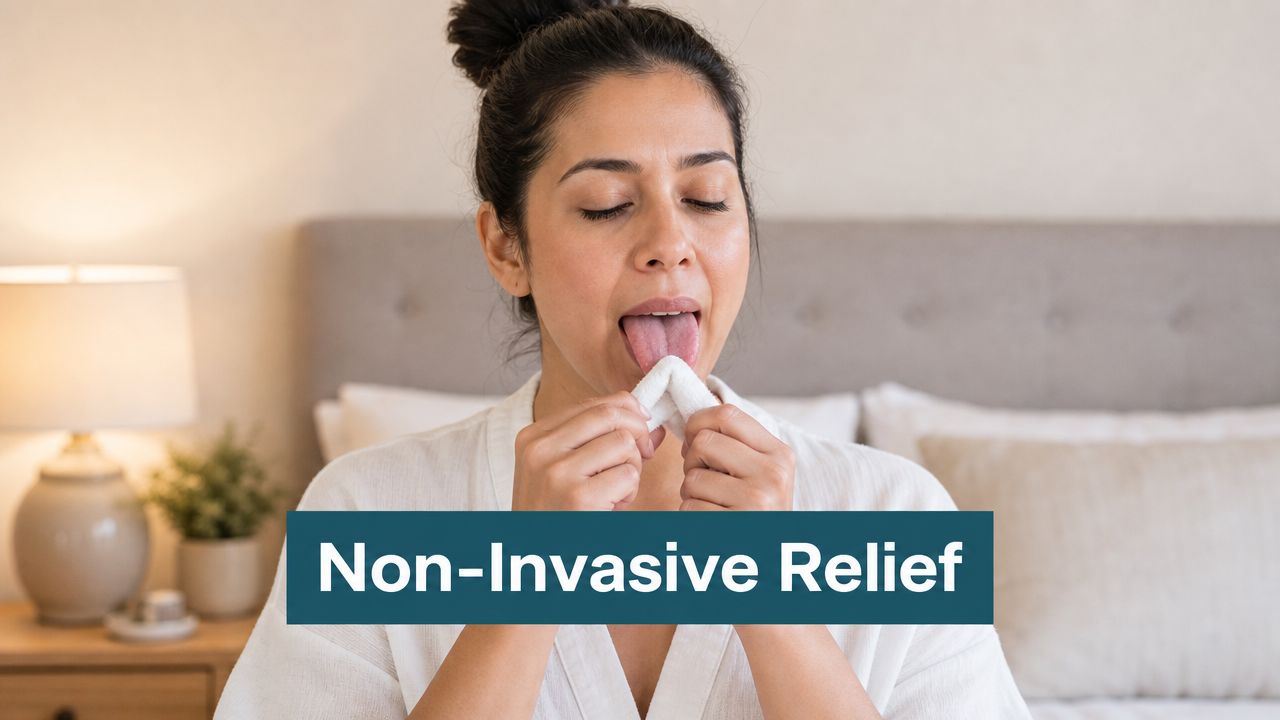
That's where myofunctional therapy enters the conversation. It's a non-invasive approach that helps train the muscles of the mouth and throat to work more effectively. For patients in Amanda, Lancaster, Circleville, and Carroll, Ohio, that can feel more proactive than merely addressing symptoms night after night.
Dr. Alyssa Jenkins and the dental team at Amanda Family Dental provide care that connects oral health with whole-body wellness. That includes looking beyond teeth alone to evaluate patterns that may affect breathing, sleep quality, and comfort. For local families searching for a dentist in Circleville, OH or a dentist in Carroll, OH, that broader view can make the next step feel much clearer.
What Is Myofunctional Therapy
Orofacial myofunctional therapy is a guided program of exercises for the muscles of the face, tongue, lips, and throat. The simplest way to understand it is this. It's like physical therapy for the parts of the body that influence breathing, swallowing, and oral posture.
Physical therapy for the muscles that support breathing
When a knee is weak or not moving well, physical therapy helps retrain strength, position, and coordination. Myofunctional therapy works the same way, just in a different part of the body. The focus is on helping the tongue rest where it should, helping the lips seal comfortably, and helping breathing happen through the nose instead of the mouth when possible.
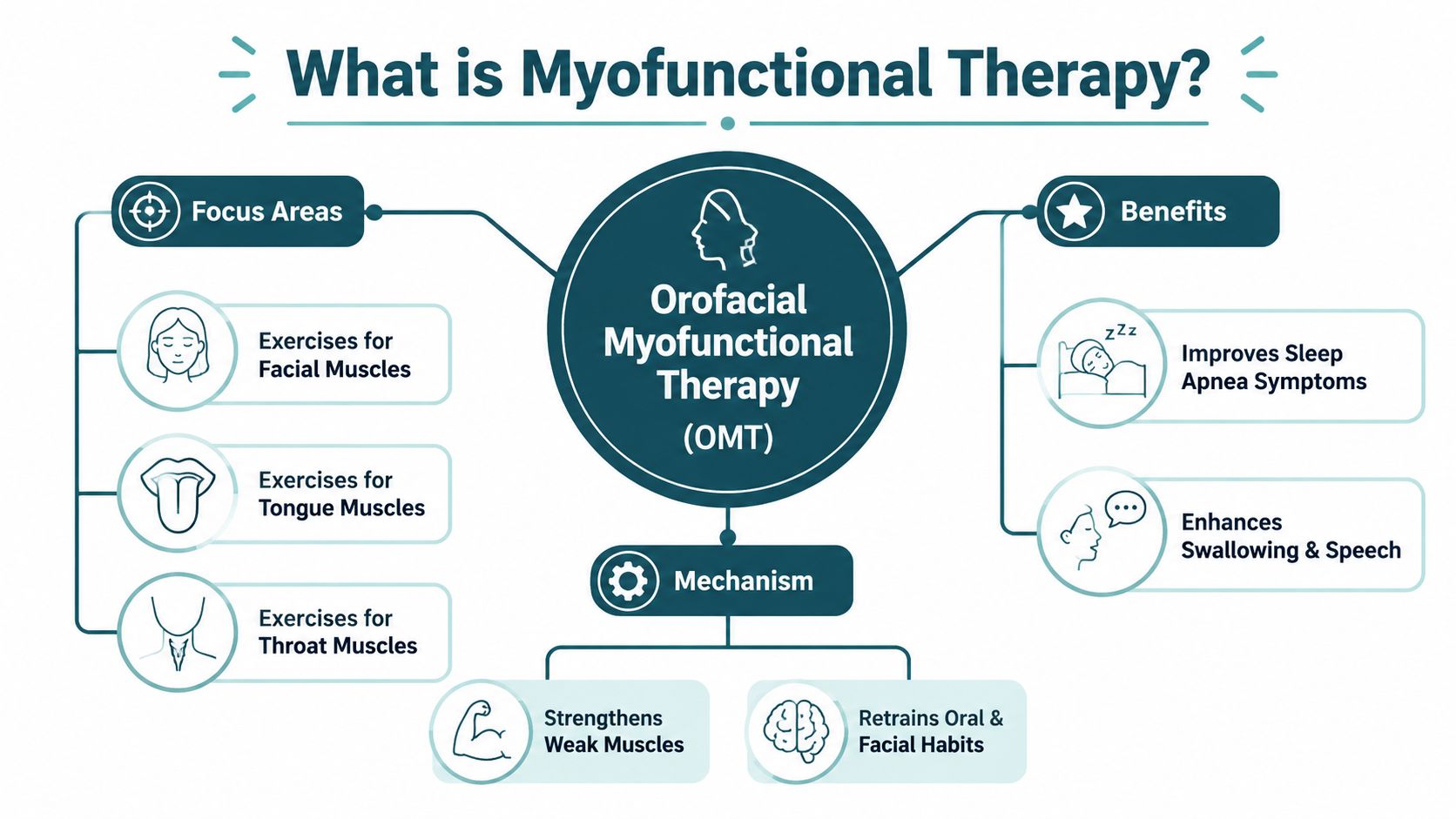
Some people hear “exercises for the tongue” and assume the idea must be random or overly simple. It isn't. The exercises are targeted. They're designed to improve how muscles behave at rest and during sleep, when poor tone and poor posture can contribute to airway narrowing.
Why these habits affect sleep
The importance of a healthy resting posture is often underestimated. Ideally, the tongue rests up against the palate, the lips stay together without strain, and the body relies on nasal breathing. When the tongue sits low in the mouth and the lips tend to stay open, the airway may be less supported during sleep.
Mouth breathing can also create a cycle that keeps problems going. A person wakes with dryness, breathes through the mouth more often, and may never build the muscle habits that support a steadier airway. Myofunctional therapy aims to interrupt that cycle.
A few common targets include:
- Tongue posture: encouraging the tongue to rest in a more supportive position
- Lip seal: making it easier to keep the lips together without tension
- Nasal breathing habits: reducing the tendency to default to mouth breathing
- Muscle coordination: improving how the face, tongue, and throat work together
Better function during the day can support better airway behavior at night.
This is one reason the therapy appeals to patients who want a gentle, proactive approach. It doesn't involve surgery. It doesn't rely on a one-size-fits-all routine. It uses repeated, guided practice to build healthier patterns over time.
How Myofunctional Therapy Improves Sleep Apnea
Sleep apnea happens when breathing repeatedly becomes partially or fully blocked during sleep. In obstructive sleep apnea, the airway can narrow as muscles relax. If the tongue and throat tissues don't maintain enough support, airflow drops and sleep gets disrupted.
What changes during sleep
Myofunctional therapy targets the parts of that process that involve muscle tone and habit. It works on strengthening weak muscles, improving tongue position, and supporting nasal breathing. Those changes can help reduce the tendency of the airway to collapse during sleep.
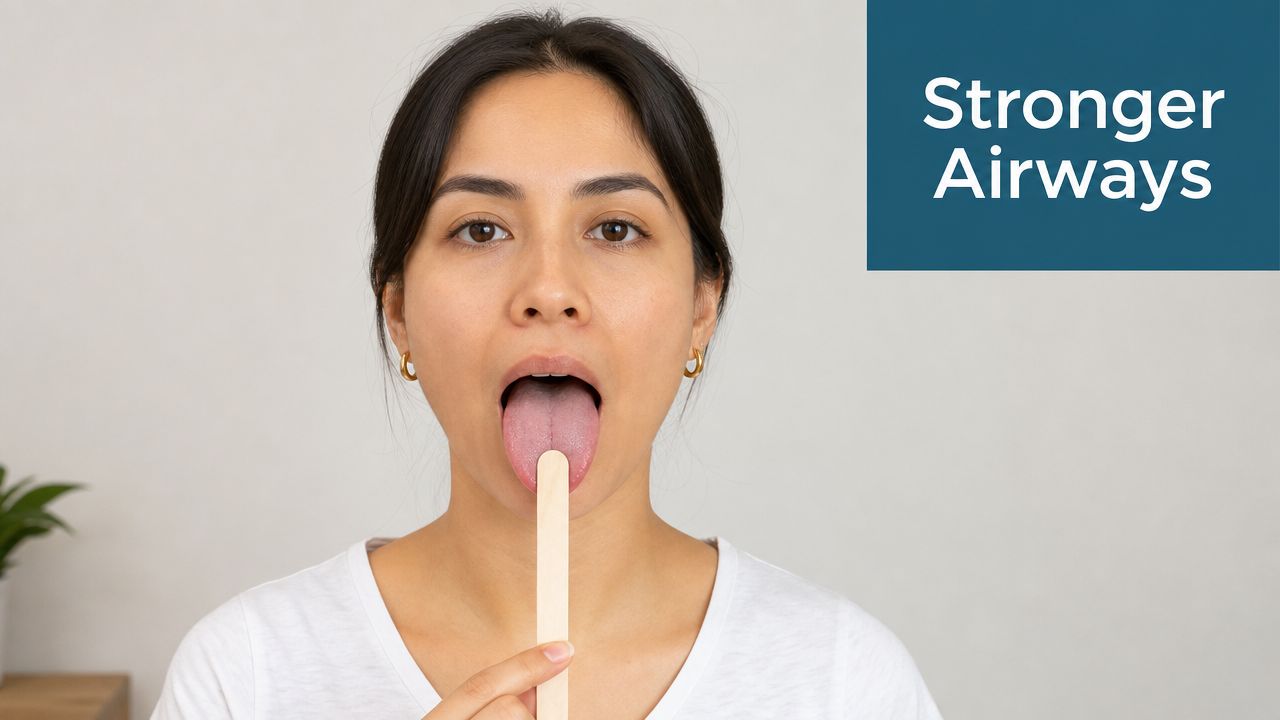
That doesn't mean the therapy removes every anatomical cause of obstruction. Enlarged tissues, jaw structure, weight-related factors, and nasal problems can still matter. But when muscle function is part of the picture, training those muscles can make a meaningful difference.
What the research shows
The strongest reason this therapy is taken seriously is that it has been studied. A systematic review and meta-analysis published in Sleep found that myofunctional therapy reduced the apnea-hypopnea index by about 50% in adults and 62% in children across nine adult and two pediatric studies, with adult mean AHI falling from 24.5 ± 14.3 events/hour to 12.3 ± 11.8 events/hour and lowest oxygen saturation improving by 4.19%. The same review also reported better snoring and sleepiness outcomes in many patients, according to the systematic review in Sleep.
For someone living with sleep apnea, that kind of change matters because AHI is the standard measure used to describe severity. In practical terms, a reduction of that size can mean less disrupted sleep and, in some cases, movement from a more severe category to a less severe one.
A later review covering nine randomized trials with 698 participants from studies published 2009–2020 also found that myofunctional therapy, used alone or added to care such as CPAP or nasal washing, reduced AHI versus control in both adults and children. That review also noted improvements in snoring intensity, oxygen saturation, and mouth-breathing reduction, while pointing out that protocols differed across studies and follow-up periods were often short in earlier research, as summarized in this review of randomized trials.
For readers who are also trying to achieve a peaceful night's sleep, it can help to think of therapy as one piece of a broader sleep-support plan rather than a stand-alone trick.
Why that matters in daily life
A lower AHI isn't just a number on a report. It can connect to quieter nights, less snoring, fewer awakenings, and better daytime alertness. Patients who also clench or grind sometimes benefit from a broader airway-focused discussion, including options related to teeth grinding solutions, because nighttime breathing and oral muscle habits often overlap.
This short video gives a useful visual sense of airway-focused care and why exercises can matter.
Your Treatment Journey at Amanda Family Dental
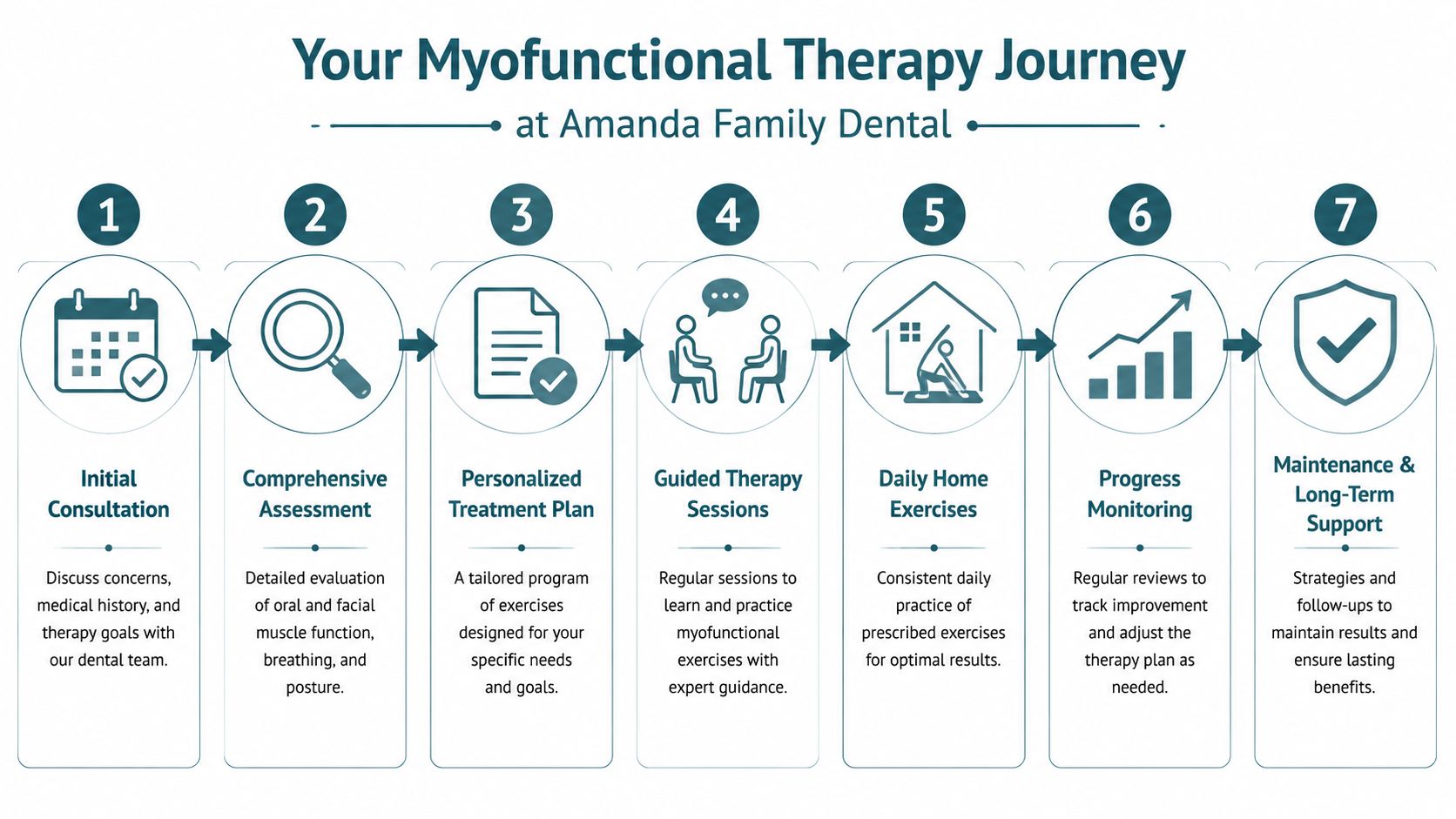
You wake up tired, your partner says the snoring was loud again, and you are ready for a plan that feels realistic. That is how many people begin myofunctional therapy. The process is steady, guided, and practical. Instead of asking your body to change overnight, it teaches the muscles of the tongue, lips, cheeks, and throat to work in a healthier pattern day after day.
The first visit and evaluation
The first appointment starts with listening. We talk through sleep quality, dry mouth, daytime fatigue, mouth breathing, snoring, tongue posture, swallowing habits, and any treatment you have already tried. Then the exam looks at how your mouth and facial muscles function at rest and in motion, because those small patterns can influence what happens once you fall asleep.
If you already have a sleep apnea diagnosis or are working with a physician, that information helps shape a safe, coordinated plan. Some patients also want to understand comfort-focused options that can make care easier, including sleep dentistry services for anxious or sensitive patients.
What the therapy routine looks like
Treatment usually follows a simple rhythm. You come in for supervised visits over several months, and you practice at home for a few minutes each day. The routine is gentle, but consistency matters. Myofunctional therapy works like physical therapy for the muscles that help support breathing, swallowing, and proper oral rest posture.
Home practice is short enough to fit into daily life, and office visits give you feedback so the exercises stay accurate. That matters because a small change in tongue position can change whether the right muscles are being trained.
Exercises often include:
- Tongue lifts: helping the tongue reach and rest against the palate
- Palate suction holds: building awareness of a stable tongue resting posture
- Lip seal exercises: helping the lips stay closed without strain
- Controlled swallowing practice: retraining swallowing patterns that may reinforce poor oral habits
Support, coaching, and follow-through
Good coaching keeps the therapy effective. A person can practice faithfully and still miss the goal if the tongue presses in the wrong spot or other muscles take over. Regular check-ins allow small corrections before those habits set in.
That is one reason local care can be so helpful. Amanda Family Dental offers myofunctional therapy as part of a broader sleep and airway care plan, so patients in Amanda, Lancaster, Circleville, and Carroll can work with a trusted nearby team. For many families, that makes it easier to stay consistent and to combine therapy with other dental or medical care instead of trying to manage every piece separately.
This approach gives patients an active role in their progress. It does not have to replace other treatments. It can strengthen them, support better long-term habits, and become a lasting part of whole-person sleep health.
Who Is a Good Candidate for This Therapy
Not every treatment fits every patient. Myofunctional therapy works best when muscle function, tongue posture, mouth breathing, or oral habits are part of the sleep apnea picture. It can also be useful when someone wants to strengthen results from another treatment instead of replacing it.
Situations where this therapy often fits well

Several groups often stand out as strong candidates:
- Adults with mild to moderate obstructive sleep apnea: These patients may benefit when airway instability is linked to oral muscle tone and breathing habits.
- People who can't tolerate CPAP well: If mask use feels difficult or inconsistent, myofunctional therapy may offer a practical complementary path.
- Patients already using an oral appliance: Better tongue posture and oral muscle coordination can support how an appliance functions at night.
- People with lingering symptoms after ENT treatment: Surgery may address anatomy, but breathing habits and muscle patterns can still need retraining.
- Children with mouth breathing or sleep-disordered breathing: In younger patients, function and habit patterns can be especially important to evaluate early.
Some children may also need assessment for oral restrictions that affect tongue movement. In those cases, information about tongue and lip ties in Amanda, OH can be relevant because mobility limitations can affect oral posture and breathing patterns.
When an evaluation matters most
A person might suspect they're a candidate because they snore, breathe through the mouth, or wake tired. That's a reasonable starting point, but candidacy still needs a proper assessment. The therapy is most useful when it's matched to the actual cause pattern, not guessed based on symptoms alone.
A good evaluation can also clarify when someone needs combined care. Some patients need therapy plus an oral appliance. Others need medical management first and muscle retraining second. That honesty helps patients avoid the frustration of trying a treatment that isn't fully matched to their needs.
A Key Part of Your Overall Sleep Health Plan
Myofunctional therapy doesn't have to compete with other treatments. In many cases, it works best as part of a combined plan. That's one of its biggest strengths.
Not an either or decision
A patient using CPAP may still benefit from therapy because stronger oral and throat muscle patterns can support airway stability. A patient wearing an oral appliance may also benefit because tongue posture and lip seal affect how well the airway stays supported during sleep. Someone recovering from ENT treatment may need help retraining nasal breathing and healthier oral rest posture after the anatomy has been addressed.
That makes the therapy less of a replacement and more of a foundation. It focuses on function, and function often influences how well other treatments hold up in daily life.
A full sleep health plan can also include simple environmental changes. For example, some people exploring nighttime breathing support also look into clean air for your bedroom when dryness, irritants, or congestion seem to worsen sleep comfort.
Small changes around the therapy can help
Progress is often stronger when daily habits support the same goals as the exercises. Helpful areas may include:
- Consistent nasal breathing practice: especially during calm daytime activities
- Attention to oral posture: keeping lips together and the tongue resting properly when not speaking
- Sleep environment adjustments: reducing factors that make sleep feel more fragmented
- Follow-up with the right providers: especially when apnea, jaw issues, or nasal concerns overlap
The most durable plan usually combines structure, repetition, and the right mix of therapies for that patient's airway.
For families searching for a dentist in Amanda, OH or a dentist near me, this kind of coordinated care can feel much more realistic than trying to solve sleep problems with a single tool alone.
Frequently Asked Questions About Myofunctional Therapy
Is myofunctional therapy painful
No. The exercises are gentle and non-invasive. Most patients describe them as practice-based rather than painful. The challenge usually comes from consistency and learning new muscle habits, not discomfort.
Does dental insurance cover myofunctional therapy
Coverage varies by plan. Some patients have benefits that may apply, and others may need to use payment options instead. The dental team can help review available benefits and explain financial details clearly before treatment begins.
How soon will results show up
Some people notice practical changes such as quieter snoring or less dry mouth earlier in the process. More meaningful sleep apnea changes usually depend on steady practice over several months, because retraining muscles and habits takes time.
Why not just use online exercises
Online exercises can be a starting point for awareness, but they can't replace a personalized plan. Technique matters. Timing matters. Muscle compensation matters. A trained provider can spot whether the tongue is positioned correctly, whether swallowing patterns are interfering, and whether the exercises match the patient's actual needs.
For some people, body position during sleep also affects comfort and airway symptoms. Resources on proper body pillow positioning can be a useful addition to a broader sleep setup, especially when side sleeping is part of the plan.
For patients in Amanda, Lancaster, Circleville, and Carroll, Ohio who are dealing with snoring, mouth breathing, daytime fatigue, or diagnosed sleep apnea, the next step is a professional evaluation. Amanda Family Dental provides care that connects dental health, airway function, and everyday comfort, with personalized guidance on whether myofunctional therapy may fit into a larger sleep health plan.