

For most adults and children over 2, yes: fluoride toothpaste containing about 1,000–1,500 ppm, used twice a day, is the recommended choice, with the amount adjusted by age and adult supervision for young children. But isn't the more useful question how much belongs on the brush, rather than whether fluoride belongs in the bathroom?
For families seeking a dentist in Amanda, OH, that distinction can take much of the worry out of toothpaste shopping. Patients from Lancaster, Circleville, and Carroll, Ohio, deserve practical guidance that considers their children's habits, their water source, and their own history of cavities, not a blanket answer based on a product label.
Table of Contents
- The Short Answer Most Patients Are Looking For
- How Fluoride Toothpaste Actually Protects Your Teeth
- Safe Amounts of Fluoride Toothpaste by Age
- Real Concerns About Fluoride and What They Actually Mean
- Fluoride-Free Alternatives and When They Make Sense
- How to Decide What to Put on Your Family's Brushes
- Talk It Over with a Local Dentist Near You
The Short Answer Most Patients Are Looking For
A parent stands in the toothpaste aisle comparing a familiar fluoride formula with a fluoride-free tube. Later, at the bathroom sink, a child loads the brush with far more paste than necessary. The second decision matters just as much as the first.
For most families, standard fluoride toothpaste is the sensible starting point. The evidence supports its cavity-prevention benefit, while the main childhood concern involves excessive swallowing during tooth development, not ordinary brushing and spitting. CDC guidance on fluoride use and cavity prevention supports regular fluoride toothpaste use with careful control of the amount children receive.
A Better Question Than Fluoride or No Fluoride
A useful recommendation considers the person holding the brush. An adult who spits reliably and has recurring decay needs a different conversation from a toddler who swallows toothpaste.
The decision rests on a few practical questions:
- Protection: What does fluoride do at the tooth surface?
- Amount: How much paste is appropriate for the child's age?
- Exposure: Does the family need to account for swallowed toothpaste, drinking water, or supplements?
- Preference: If fluoride-free toothpaste is preferred, what prevention plan will accompany it?
Those questions make room for an informed choice without pretending that every formula offers the same protection.
Practical rule: Choose the prevention plan first, then choose the toothpaste that fits it.
A Local Conversation, Not a Product Argument
The local practice offers conventional fluoride care and fluoride-free choices. Families don't need to hide a preference for either approach or arrive prepared to defend it.
For someone searching for a dentist near me, a useful appointment should replace uncertainty with a clear home routine. That includes checking the toothpaste already in use, discussing swallowing habits, and deciding whether additional preventive care belongs in the plan. Toothpaste selection shouldn't become a source of guilt, but it shouldn't rely on packaging claims alone, either.
How Fluoride Toothpaste Actually Protects Your Teeth
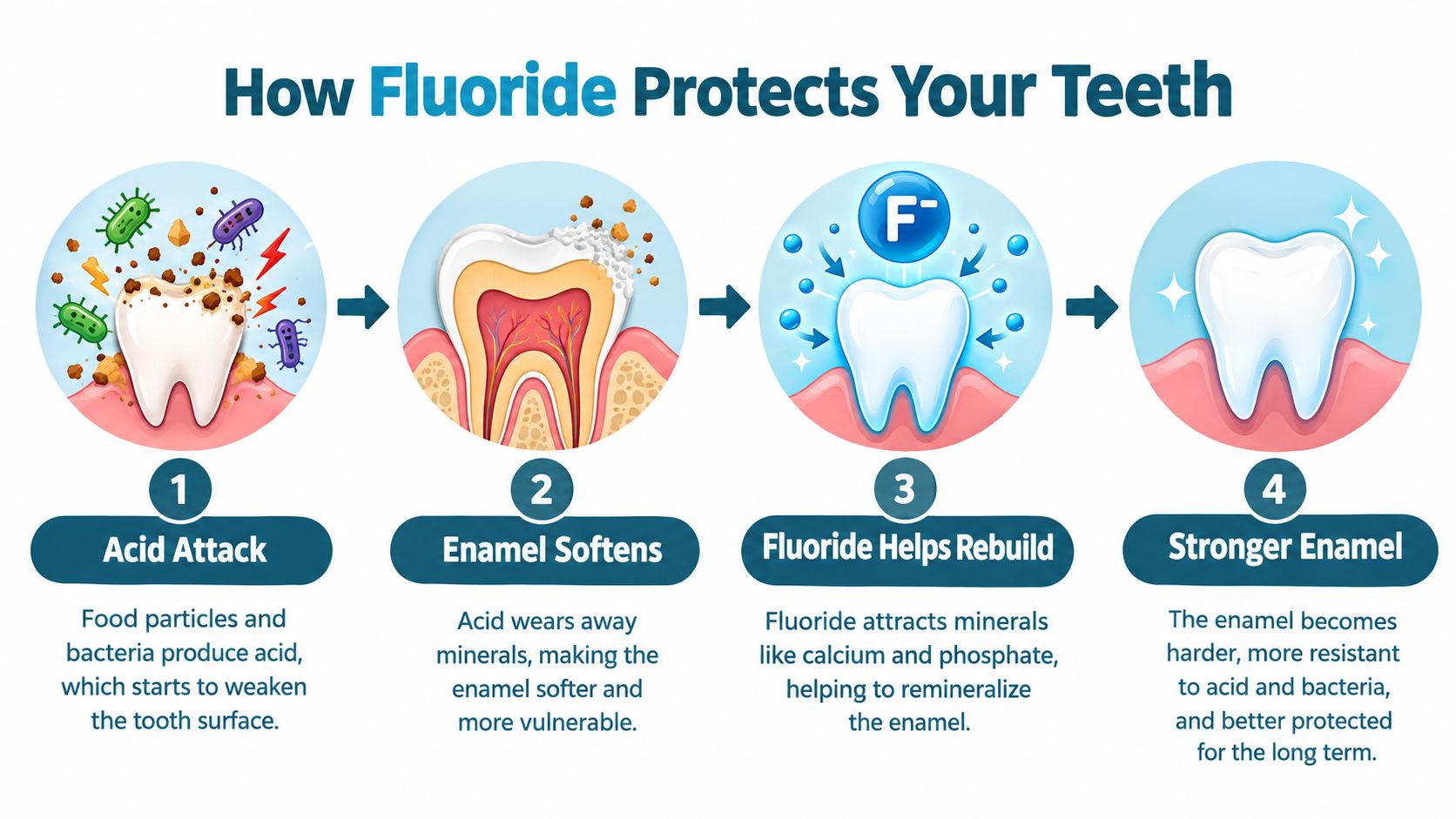
Enamel protection involves an ongoing balance between mineral loss and mineral replacement. During an acid attack, minerals can dissolve from the tooth surface; fluoride helps favor repair of early weakened areas. Its benefit comes primarily from repeated contact with the teeth, rather than from swallowing it, as explained in the Cochrane review of fluoride toothpaste concentrations.
A useful comparison is maintaining a wall before small surface defects become larger problems. Fluoride supports that early maintenance by promoting remineralization, reducing mineral dissolution during acid exposure, and potentially inhibiting bacterial acid production.
The process is easier to understand when shown at the tooth surface.
Why the Concentration Matters
The fluoride number on the package isn't arbitrary. In children and adolescents, toothpastes containing at least 1,000 ppm showed a statistically significant preventive effect compared with placebo, while products containing 500 ppm or less did not demonstrate that advantage in the Cochrane concentration analysis.
That analysis also estimated greater caries prevention with stronger formulations, increasing from 23% at approximately 1,000–1,250 ppm to 36% at approximately 2,400–2,800 ppm, according to the same review. Those findings aren't a reason to buy the strongest product available without guidance. They're a reason to match the formulation to cavity risk.
Keeping the Benefit Where It Belongs
After brushing, adults and children who can spit should spit out excess paste rather than swallow it. Extensive immediate rinsing isn't helpful when the aim is to leave fluoride available at the tooth surface.
Professional treatment is a separate decision from daily toothpaste selection. The practice's explanation of fluoride treatment benefits provides context for discussing an office-based approach alongside home care.
Higher-strength products belong in a professionally directed plan, particularly for children. More aggressive brushing isn't a substitute for the right formulation, and a stronger tube isn't automatically the right choice for every household.
Safe Amounts of Fluoride Toothpaste by Age
The simplest improvement many families can make is letting an adult dispense the toothpaste. A child's enthusiasm for a full brush doesn't establish the appropriate amount, and a small brush head doesn't prevent overloading.
Brushing should begin when the first tooth appears. For children younger than 3, the CDC recommends no more than a rice-grain-sized smear; from ages 3–6, the limit is a pea-sized amount, approximately 0.25 grams, according to its guidance on children's toothpaste use. That guidance also recommends consulting a dentist or physician about fluoride toothpaste for children younger than 2.
Fluoride Toothpaste Dosing by Age
The quantities below follow the CDC guidance linked above. Older children and adults should follow their product instructions and any individualized dental recommendation rather than assuming that covering the whole brush improves protection.
| Age | Amount | Supervision | Key Habit |
|---|---|---|---|
| Under 2 | Rice-grain-sized smear, with professional guidance | Adult dispenses and assists | Begin with the first tooth and discuss fluoride use |
| Age 2 to under 3 | No more than a rice-grain-sized smear | Adult controls the paste | Encourage spitting as the child learns |
| Ages 3–6 | No more than a pea, approximately 0.25 grams | Adult supervises brushing | Spit out excess paste |
| Older children and adults | Follow product and dental instructions | Assistance when needed | Avoid swallowing toothpaste |
Supervision Means More Than Watching
An adult should control the tube, apply the appropriate amount, and help the child brush. Encouraging spitting matters, but so does preventing a child from eating toothpaste directly from the container.
- Before brushing: The caregiver applies the paste instead of handing over an open tube.
- During brushing: The adult helps the child keep the routine focused on cleaning teeth.
- After brushing: The caregiver encourages spitting and puts the toothpaste away.
The practice's guide to preventing cavities in children can support that conversation at home.
A pediatric or new patient exam is also an appropriate time to discuss the family's water source and any supplements. Bringing the actual toothpaste, or a clear photograph of its label, makes that discussion more useful than relying on whether the packaging says children's, natural, or gentle. Families in Amanda and nearby communities can leave with instructions that fit the child's current abilities.
Real Concerns About Fluoride and What They Actually Mean
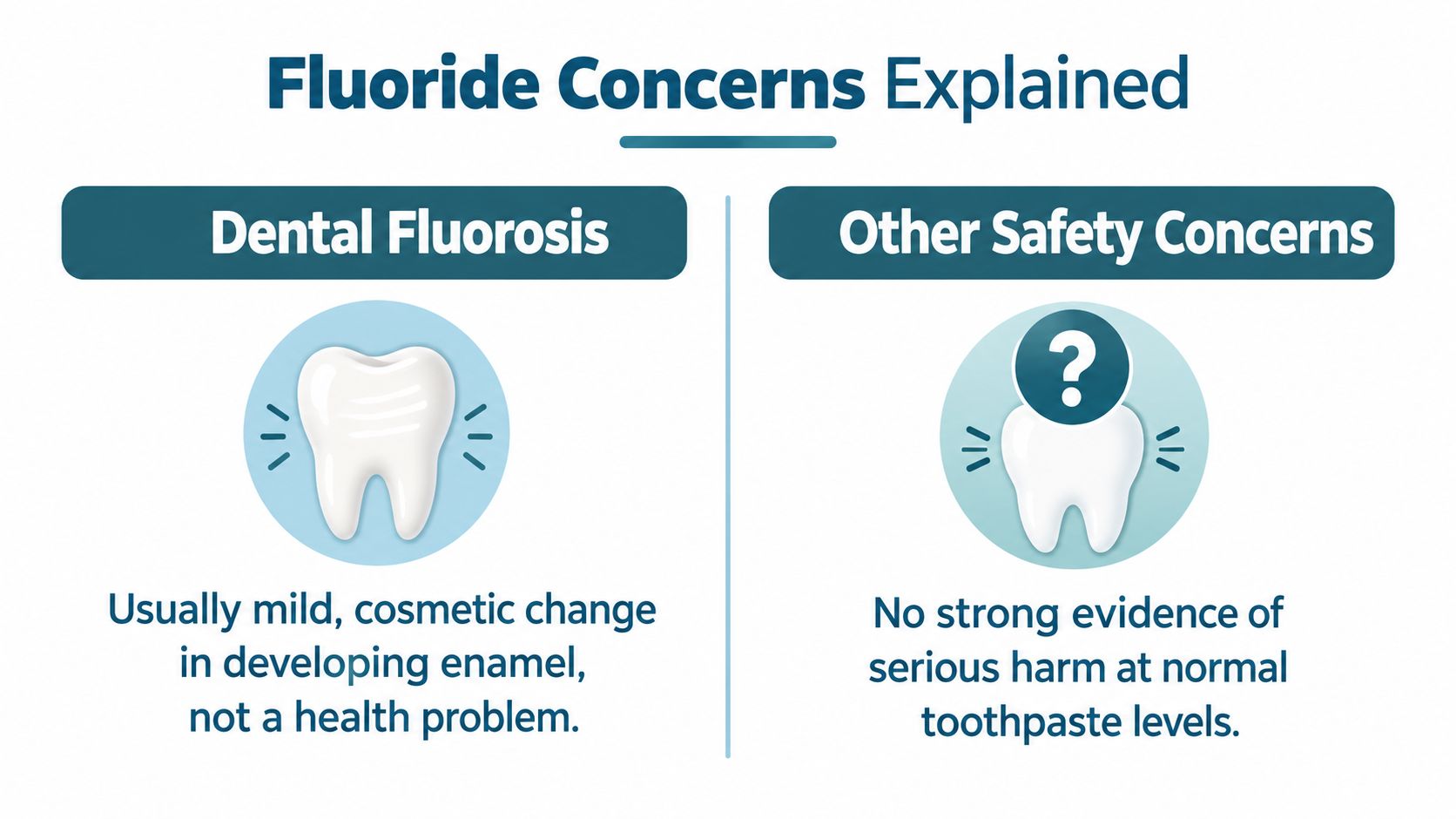
A worried parent deserves an explanation, not dismissal. Dental fluorosis and acute excessive ingestion are different concerns, and neither should be confused with routine brushing followed by spitting.
Dental fluorosis is a developmental change in enamel associated with excessive fluoride ingestion while teeth are forming. The practical safety measures are therefore aimed at controlling swallowed toothpaste in young children, rather than treating all contact with fluoride as dangerous.
The visual below summarizes the distinction, but individual exposure still matters.
Dose Controls Are a Safety Measure
The small amounts recommended for children aren't arbitrary compromises. They aim to preserve topical protection while limiting ingestion, consistent with CDC guidance on fluoride products.
The earlier CDC recommendations also report that a pea-sized amount used fewer than twice daily in children under 6 sharply reduces toothpaste's importance as a fluorosis risk factor. That observation should not be interpreted as advice to abandon the recommended twice-daily brushing routine. Caregivers should control the amount and discuss unusual exposure concerns with the child's dentist.
Concern about swallowing should lead to better dosing and supervision, not an automatic conclusion that fluoride toothpaste is unsuitable.
An acute ingestion of a large amount of toothpaste is not the same situation as an ordinary brushing session. A suspected excessive ingestion calls for prompt professional advice rather than reassurance based on normal-use recommendations.
Water Exposure Needs Its Own Conversation
Drinking water, foods, supplements, and swallowed toothpaste all contribute to total fluoride exposure. A family using well water may have different questions from a family receiving a community water supply; neither situation should be judged by assumptions alone.
For background on the water side of the discussion, Water Filter Advisor's resource on understanding fluoride contaminants can help families identify questions to raise about their supply. It shouldn't replace dental guidance about toothpaste or a child's overall prevention plan.
Unusual exposure calls for individualized advice. A recommendation copied from another household may overlook the very factor that matters most for a particular child.
Fluoride-Free Alternatives and When They Make Sense
Fluoride-free toothpaste is a legitimate preference to discuss. It isn't, however, a reason to promise the same cavity protection without examining the product and the rest of the prevention plan.
The central trade-off is straightforward: removing fluoride toothpaste removes an established source of topical fluoride benefit unless another evidence-based fluoride source is included. A different ingredient may deserve consideration, but a different ingredient name alone doesn't establish equivalent protection.
A product discussion should feel comfortable rather than confrontational.
Comparing Alternatives Without Overpromising
Fluoride-free products may feature hydroxyapatite, xylitol, baking soda, or essential oils. Those ingredients shouldn't be treated as interchangeable, and their presence doesn't justify a blanket claim that the toothpaste replaces fluoride's established anticavity effect.
| Ingredient or approach | Useful question for the dental visit |
|---|---|
| Hydroxyapatite | What evidence supports this particular formulation and the proposed routine? |
| Xylitol | What role does it play in the product, beyond the fluoride-free label? |
| Baking soda | How does this formulation fit the patient's cleaning needs? |
| Essential oils | Are the ingredients appropriate for the patient's preferences and tolerance? |
| Professional fluoride care | Would a separate topical fluoride source fit the prevention plan? |
The practice's overview of hydroxyapatite toothpaste provides a starting point for a formulation-specific conversation. Hydroxyapatite isn't fluoride, so it shouldn't be described as another topical fluoride source.
Preference Still Needs a Prevention Plan
Families may ask about fluoride-free toothpaste because a young child swallows paste, because of specific medical considerations, or because they prefer a whole-body routine. None of those reasons should end the clinical discussion. A child who swallows everything still needs an age-appropriate cavity-prevention plan, not an automatic switch based on the word natural.
The practice offers fluoride-free choices and mercury-free fillings alongside conventional care. These are separate decisions: a preference about filling materials doesn't determine the most suitable toothpaste.
A professionally applied fluoride treatment may remain an option for someone who declines daily fluoride toothpaste but accepts another fluoride source. For someone avoiding fluoride altogether, the discussion should be candid about what protection is being declined and how follow-up will be handled.
Respecting a preference doesn't require overstating the evidence. A workable plan should be informed, consistent, and reviewed when the patient's circumstances change.
How to Decide What to Put on Your Family's Brushes
The answer to “should you use fluoride toothpaste?” becomes more useful when it starts with the household rather than the toothpaste shelf. The deciding factors are age and spitting ability, water exposure, cavity risk, and family preference.
The following checklist organizes those factors without implying that every family needs the same product.
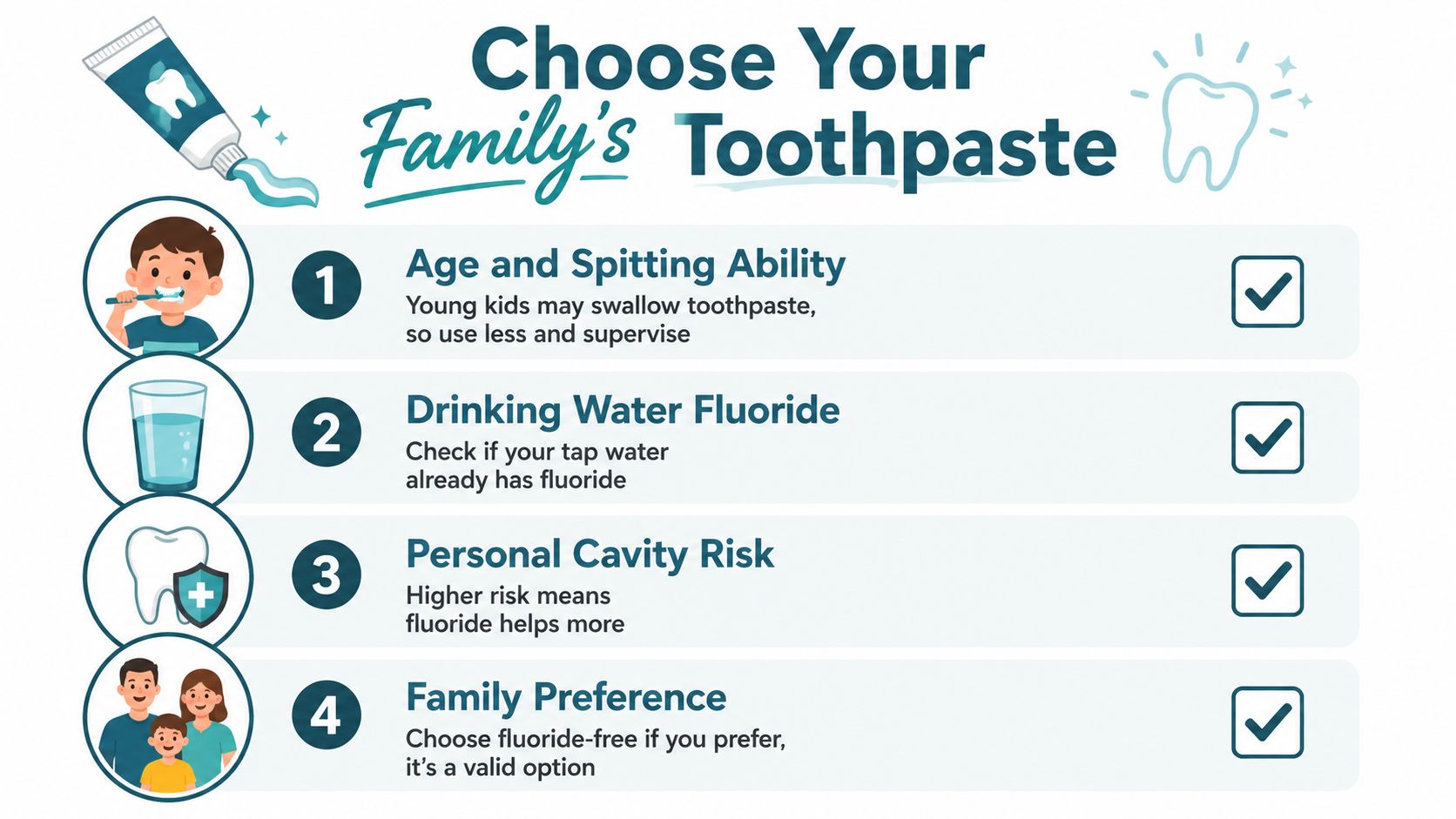
Matching the Plan to the Person
For a child who can't reliably spit, caregivers should use the age-specific dosing guidance above and seek individualized advice when appropriate. The earlier distinction matters: a child who has reached the second birthday still uses a smear until the next dosing age bracket, not a pea by default.
For an older child or adult with recurring decay, the conversation should focus on whether standard toothpaste provides enough support. Prescription products may contain 5,000 ppm fluoride, according to the American Dental Association's overview of topical and systemic fluoride, and require professional direction.
That same ADA resource estimates an intake associated with maximal caries reduction without adverse effects of approximately 0.05 mg/kg/day, with a reported range of 0.02–0.10 mg/kg/day for children older than 6 months, and recommends supervised brushing to control the amount and reduce swallowing. Those figures provide clinical context, not a home target for measuring swallowed toothpaste.
A family's goal is a repeatable routine with an appropriate product, not a daily calculation of how much fluoride a child should ingest.
Making the Recommendation Usable
A useful plan should answer who dispenses the paste, which product is appropriate, and when reassessment is needed. Families choosing fluoride-free care should leave knowing whether the plan includes a separate fluoride treatment or avoids fluoride entirely.
The accompanying video offers another format for considering the topic before an appointment.
The dentist's role is to explain the trade-offs clearly and make a recommendation the household can follow. Product preference matters, but it shouldn't obscure a child's swallowing behavior or an adult's ongoing cavity problems.
Talk It Over with a Local Dentist Near You
A toothpaste question is a reasonable reason to start a dental conversation. It can also open a discussion about concerns that deserve an examination, including tooth pain, existing decay, or uncertainty about a child's brushing routine.
For patients seeking a dentist in Lancaster, OH, a dentist in Circleville, OH, or a dentist in Carroll, OH, the Amanda office offers family dental care close to those communities. New patient exams, digital X-rays when appropriate, and personalized treatment planning provide a setting for decisions that can't be made from a toothpaste label.
What to Bring to the Appointment
- The current toothpaste: A tube or label photograph helps identify the formulation.
- Water and supplement information: Details help the clinician discuss overall exposure.
- Specific concerns: Swallowing, prior cavities, discomfort, and fluoride-free preferences all deserve attention.
The practice provides preventive cleaning and exams, pediatric dentistry, restorative dentistry, and cosmetic options such as teeth whitening. Myofunctional therapy and sleep dentistry are also available for appropriate patient needs.
Prevention and Treatment Are Different Decisions
Toothpaste selection shouldn't delay an assessment of pain. A patient searching for an emergency dentist or asking about a tooth extraction needs an examination, not a stronger toothpaste recommendation.
Likewise, searches for dental implants near me or a cosmetic dentist near me involve treatment goals beyond home prevention. The appointment should identify the immediate concern, discuss relevant treatment options, and establish a manageable long-term routine.
Amanda Family Dental offers family dental care, fluoride treatments, and fluoride-free choices with personalized guidance about what belongs on each family member's brush. Families in Amanda, Lancaster, Circleville, and Carroll can visit Amanda Family Dental to request an appointment or consultation and bring their toothpaste questions to the dental chair.