

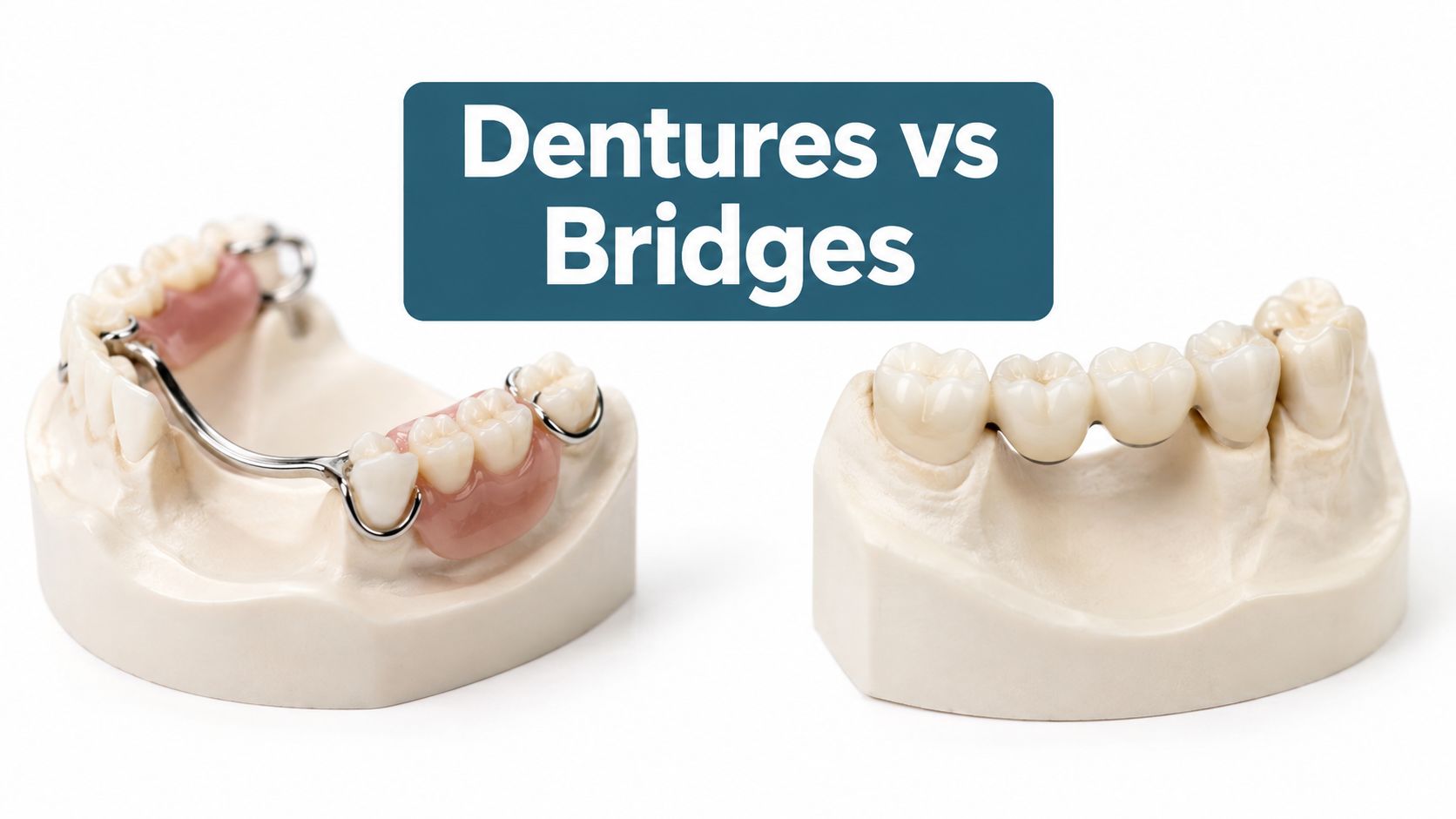
A missing tooth can turn an ordinary meal into a calculation: which side feels comfortable to chew on, whether a partial denture will stay put, or how much treatment will cost. If a denture has become loose or a tooth supporting a bridge is damaged, the choice may feel even less straightforward.
For people looking for a dentist in Amanda, OH, or nearby Lancaster, Circleville, and Carroll, the right answer depends on more than whether a restoration is fixed or removable. The number of missing teeth, the health of neighboring teeth, daily cleaning habits, and plans for future treatment all matter. This guide to dentures vs bridges lays out those trade-offs so patients can have a more informed conversation with Amanda Family Dental.
Table of Contents
- Why Patients Compare Dentures and Bridges
- Side-by-Side Comparison at a Glance
- Pros and Cons You Should Weigh Honestly
- What the Procedure Actually Looks Like
- Maintenance, Lifespan, and the Long-Term Cost Picture
- Which Option Fits Your Situation
- When Implants Change the Conversation
- Planning Your Visit at Amanda Family Dental
Why Patients Compare Dentures and Bridges
The comparison often starts after a tooth extraction, when a patient is deciding what to do about the gap. It can also come up when a partial denture feels loose, a tooth under an existing bridge develops a problem, or a treatment plan raises questions about cost. In each case, the choice affects daily routines, not just the appearance of a smile.
A fixed dental bridge replaces a gap with an artificial tooth, called a pontic, supported by crowns on neighboring teeth or by dental implants. A bridge is fixed in place, so the patient doesn't take it out for cleaning. A conventional tooth-supported bridge relies on suitable teeth beside the gap, while an implant-supported bridge uses implants for support.
A removable partial denture replaces some missing teeth. It usually has a gum-colored base, replacement teeth, and components that rest on or attach to remaining teeth. A complete denture is also removable, but replaces all teeth in an arch. These are distinct options, not interchangeable versions of the same appliance.
There are other designs, too. A resin-bonded bridge is attached more conservatively than a conventional full-coverage bridge, but has different performance. An implant-retained overdenture is removable yet supported by implants. Treating every bridge as identical, or every denture as the same, can lead to a poor comparison.
What the choice really involves
The practical question is not which option feels better on the day it's fitted. A bridge may feel stable, but cleaning beneath it takes care and supporting teeth become part of the treatment. A denture can be removed for cleaning and may preserve healthy neighboring teeth, but it can move while eating or speaking and may need adjustments as the mouth changes.
The number and location of missing teeth help narrow the options. So do the strength of nearby teeth, gum health, hand dexterity, comfort with a removable appliance, and the patient's willingness to attend maintenance visits. Plans for future dental implants also matter, especially when a patient wants to avoid preparing sound teeth now.
A useful decision is the one a patient can maintain comfortably, not simply the one that looks easiest on a treatment estimate.
A lower starting cost doesn't settle the question of long-term burden. Repairs, adjustments, hygiene time, and problems affecting supporting teeth can all change the overall experience. Patients in Amanda, Lancaster, Circleville, and Carroll are better served by comparing those responsibilities alongside appearance, comfort, and function.
Side-by-Side Comparison at a Glance
The table gives a starting point, not a diagnosis. Suitability depends on an examination of the gap, remaining teeth, gums, bite, and the patient's goals.
| Criterion | Fixed Bridge | Removable Partial or Full Denture |
|---|---|---|
| Teeth replaced | Usually one or more teeth in a gap | Several missing teeth or a full arch |
| Fixed or removable | Fixed in place | Removed for cleaning and maintenance |
| Typical candidacy | Often suits a shorter gap with strong, suitable support | Often suits multiple missing teeth or a preference to avoid preparing neighboring teeth |
| Chewing and speech | Stays in place; cleaning under it requires care | Can move, and adaptation may affect eating or speech |
| Daily maintenance | Brush and clean carefully around and beneath the bridge | Remove and clean as directed; keep remaining teeth clean |
| Effect on neighboring teeth | Conventional bridges use neighboring teeth as supports; implant-supported bridges do not rely on those teeth in the same way | May rest on or attach to remaining teeth, but doesn't generally require preparing them for full-coverage crowns |
| Longevity | Depends on design, support, fit, and hygiene | Depends on design, fit, tissue changes, maintenance, and repairs |
| Cost | Varies with design and supporting teeth or implants | Varies with the number of teeth, design, materials, and adjustments |
A bridge can be convenient for someone who doesn't want a removable appliance, but its fixed design doesn't eliminate cleaning. The tissue and teeth around the restoration still need regular care.
A denture can replace a wider span without crowning neighboring teeth. That flexibility comes with daily removal and cleaning, and the fit may need attention over time. A dentist in Amanda, Lancaster, Circleville, or Carroll can compare the specific designs being considered rather than treating the table as a substitute for an exam.
Pros and Cons You Should Weigh Honestly
A bridge's main advantage is stability. It stays in place during meals and conversation, and many patients find a fixed restoration simpler to live with than a removable one. The trade-off is that a conventional bridge incorporates supporting teeth into the treatment. If an abutment tooth develops decay, a pulpal problem, gum inflammation, or a fracture, the bridge and the supporting tooth can both be affected. Benchmarks for conventional fixed bridges don't apply equally to every bridge design, so the type matters.
A partial denture usually avoids full-coverage preparation of healthy neighboring teeth. It can be adjusted or replaced as the mouth changes, which may be useful when a patient has lost several teeth or is considering other treatment later. But it is removable, can move during eating or speech, and requires careful cleaning. Poor fit or hygiene can affect the gums and teeth the denture rests on.
Complete dentures replace a full arch without relying on natural teeth for support. They can restore the appearance of a full set of teeth, but retention and comfort depend on fit and the tissues beneath them. As those tissues and the jaw change, a denture may need adjustment or relining.
Practical rule: Choose a fixed bridge for its secure feel only if the supporting teeth are suitable and the patient can clean around it consistently.
The patient's priorities should guide the discussion. Is a fixed feel more important than easy access for cleaning? Is preserving neighboring teeth more important than avoiding a removable appliance? Is flexibility for future treatment worth the adjustments that may come with a denture? Those answers often make the decision clearer than a generic pros-and-cons list.
What the Procedure Actually Looks Like
A bridge treatment begins with an exam and imaging to assess the gap, gums, bite, and potential supporting teeth. For a conventional bridge, the dentist numbs the area and shapes the supporting teeth so the crowns can hold the restoration. The team then records the shape of the teeth, either with a digital scan or conventional impressions, and may place a temporary bridge while the final restoration is made.
At a later appointment, the dentist checks how the finished bridge fits and meets the bite before cementing it in place. The number of visits and the schedule depend on the case and the type of restoration. Patients who want to understand the crown-related steps can review what happens during a dental crown procedure.
A partial or complete denture follows a different path. The dentist takes impressions and records how the upper and lower teeth meet. A wax try-in lets the patient and dentist assess tooth position and the planned appearance before the final denture is made. The final fitting checks comfort and function, and follow-up can address sore spots or areas that need adjustment.
The appointment sequence can change when implants or immediate dentures are involved. An immediate denture, for example, is planned around an extraction rather than made only after the mouth has healed. Patients should ask which visits are expected in their particular plan and when the restoration will be ready to use.
Amanda Family Dental can discuss restorative options as part of a personalized plan. The exact process depends on the patient's examination, the support available, and the type of bridge or denture being considered.
Maintenance, Lifespan, and the Long-Term Cost Picture
A bridge asks for precision every day. It stays put, which many patients like, but the space under the artificial tooth still collects plaque. If arthritis, shoulder pain, poor vision, or a rushed routine makes floss threaders and water flossers unrealistic, that convenience can turn into recurrent decay on the support teeth. A removable denture asks for a different discipline: take it out, clean it, store it as directed, and do not sleep in it unless your dentist tells you to.
The published numbers are benchmarks rather than promises. The systematic review of tooth-supported bridges followed 579 conventional, tooth-supported fixed bridges for up to 25 years and estimated survival at 96.4% after five years and 92.9% after ten years; it also reported that, at ten years, 95.4% remained free of loss of retention, 98.1% of abutment teeth remained caries-free, and 93% had avoided endodontic complications. Strong outcomes depend on the abutment teeth staying healthy, so preparation is not the end of the cost. Resin-bonded bridges preserve more enamel, but published reviews describe a different risk pattern, especially debonding, so do not let anyone quote conventional bridge survival for a resin-bonded design.
The review of removable partial-denture complications and survival reported retention loss, repairs, fractures, and relining among common complications, with five-year survival of 75% in the lower jaw and 82% in the upper jaw for tooth-supported partial dentures, 55% in both jaws at ten years, lower five-year survival for extension-base designs at 60% in the lower jaw and 65% in the upper jaw, and roughly 40% to 41% after ten years. That is why I tell patients in Amanda, Lancaster, Circleville, and Carroll to judge the appliance they can maintain on a tired Tuesday night, not the one that sounds best in the consult room.
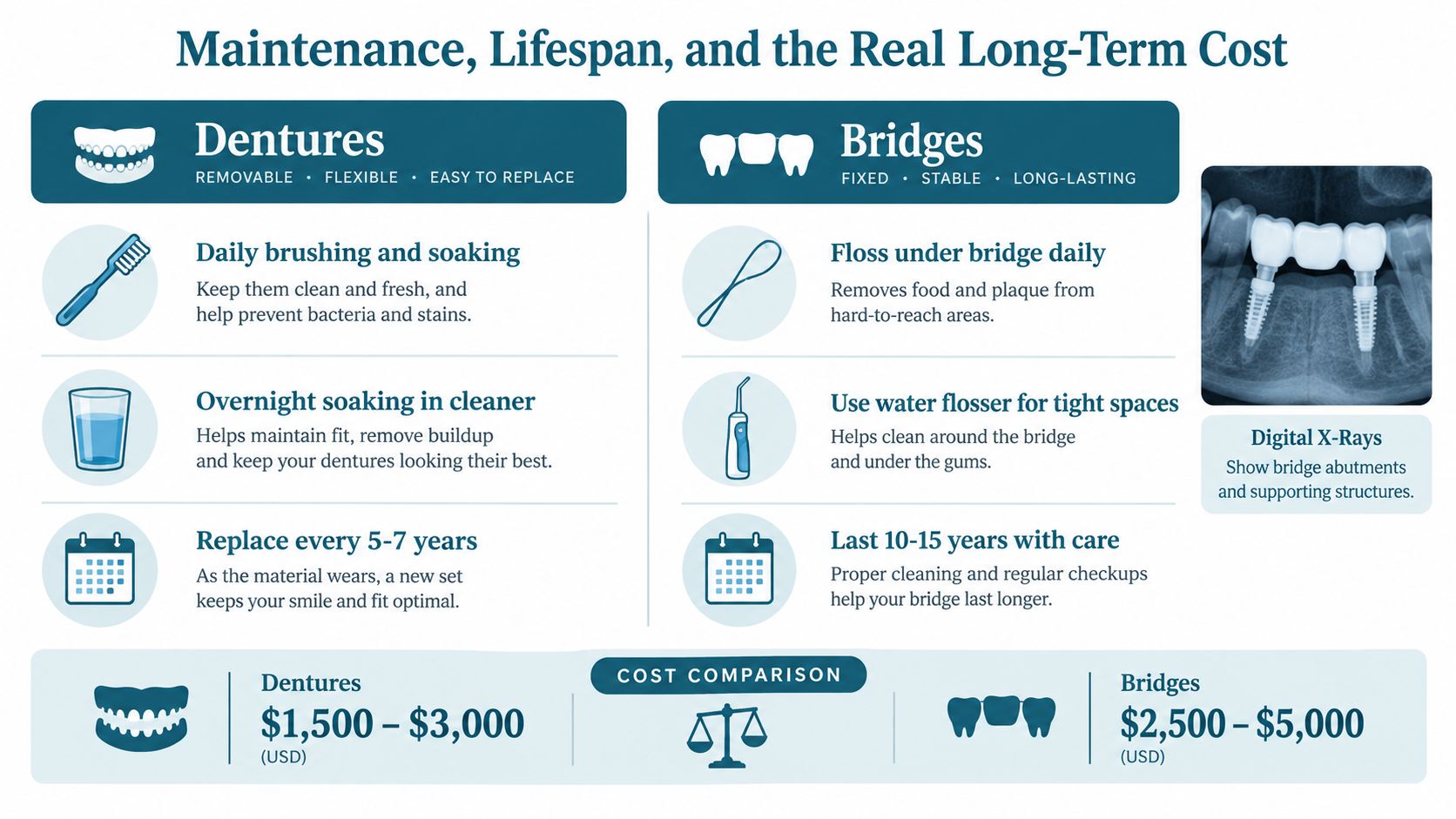
A lower upfront fee can be the more expensive choice if it loads two healthy teeth, invites repeat cementation or repair visits, or removes enamel you might want preserved for an implant later. Ask for the full plan in writing: expected adjustments, relines, repair fees, replacement timing, and what happens to the supporting teeth if one fails. Then compare that against your budget using payment and financing options for dental procedures.
Which Option Fits Your Situation
A single missing tooth with strong teeth on both sides may suit a conventional bridge if those neighboring teeth are healthy and appropriate for support. If the adjacent teeth are sound and the patient wants to avoid preparing them, an implant may also be worth discussing. A bridge isn't automatically the right choice just because the gap is small.
Several missing teeth or recently extracted teeth often call for a broader conversation. A partial denture can replace more than one tooth without requiring full-coverage crowns on the neighbors, and it may offer flexibility while the patient considers later treatment. If a patient has a strong gag reflex, difficulty handling a removable appliance, or a preference for a fixed restoration, those concerns belong in the plan from the start.
For full-arch tooth loss, a complete denture is one option. Patients who want greater stability can ask whether an implant-retained overdenture is appropriate, based on their bone, health, goals, and ability to maintain the appliance.
A future implant plan can influence today's choice. For some patients, a partial denture can replace teeth while preserving healthy neighboring teeth rather than preparing them for a conventional bridge. That doesn't guarantee an implant will be suitable later, but it avoids making the bridge decision without discussing the longer-term plan.
A budget-led decision should still account for maintenance. A lower initial expense may not mean less follow-up, adjustment, or repair over time. The right comparison uses a treatment plan specific to the patient, not a starting price detached from the expected care.
The final recommendation requires an exam and dental X-rays. Patients looking for a dentist near me in Amanda, Lancaster, Circleville, or Carroll can ask for a clear explanation of why each option fits the condition of their teeth and their day-to-day priorities.
When Implants Change the Conversation
“Dentures or bridges” isn't always the full set of choices. A single dental implant may replace a missing tooth without using neighboring teeth as bridge supports, when the patient's oral health and treatment goals make that approach suitable. For patients missing a full arch, implant-supported removable overdentures can offer another option; implant-supported fixed restorations are distinct again.
The evidence doesn't support a one-size-fits-all ranking. A review comparing implant-supported fixed restorations with removable overdentures found mixed results: fixed options generally scored better for mandibular stability, chewing, appearance, and speech, while removable options scored better for ease of cleaning. Some studies found no meaningful difference in fit, retention, function, or quality of life. The comparative review of fixed and removable implant restorations reinforces that personal priorities matter alongside clinical suitability.
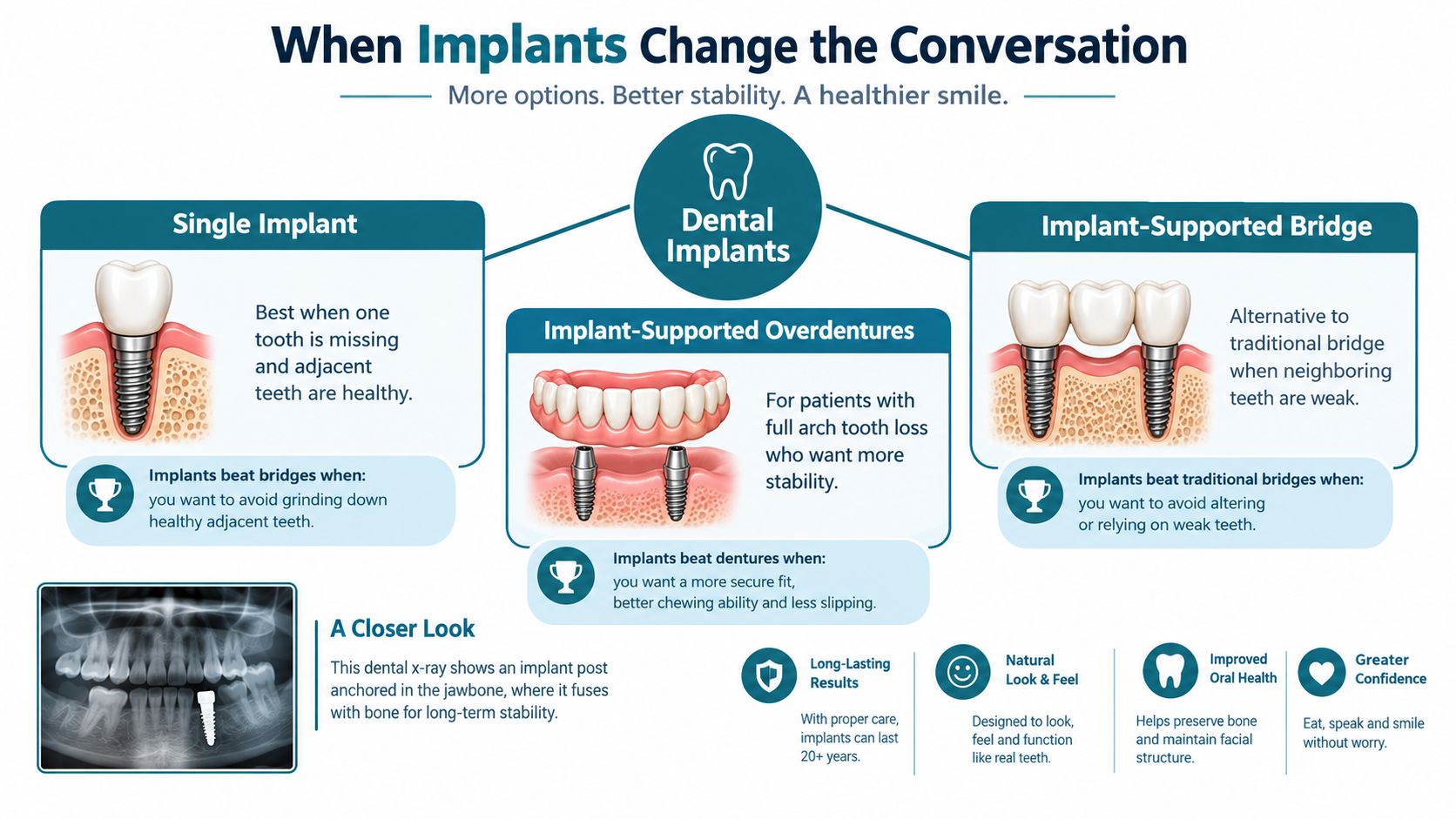
Implants aren't the right answer for every patient. Healing time, bone volume, medical history, cost, and the patient's preferences can make a bridge or partial denture a more practical permanent or interim choice. A consultation should consider implants alongside bridges and dentures, not treat them as a separate decision for later.
For another plain-language perspective on choosing among replacement options, see this guide to which tooth replacement suits you from Paul L. Gregory, DDS. Patients can also review what to expect with dental implants and bring questions about implant candidacy to the same appointment as their bridge or denture consultation.
Planning Your Visit at Amanda Family Dental
The first visit should clarify what's missing, what remains healthy, and which options fit the patient's goals. At Amanda Family Dental, a new-patient exam and digital X-rays can help assess the gap, supporting teeth, gums, and bite. Patients can discuss comfort, appearance, cleaning, budget, and whether they're considering implants now or later.
The treatment plan should identify the proposed restoration and explain its practical demands. A bridge plan should address the condition of the teeth that would support it and how to clean around the finished restoration. A denture plan should cover insertion, removal, cleaning, and what follow-up may be needed if the fit causes discomfort.
Patients who feel nervous can ask about the practice's comfort-focused care, including sleep dentistry. The office also offers mercury-free fillings, fluoride-free choices, and digital X-rays for patients who want to discuss those options. Same-day care may be available when the schedule allows, but treatment timing depends on the patient's needs and the appointment.
Whether someone is searching for a dentist in Amanda, OH, a dentist in Lancaster, OH, a dentist in Circleville, OH, or a dentist in Carroll, OH, the next step is a conversation based on an exam, not a guess based on a general comparison. Patients can request a consultation, bring questions about cost and maintenance, and ask for a second opinion before choosing a bridge, denture, or implant option.
For help comparing dentures, bridges, and dental implants, schedule a consultation with Amanda Family Dental. Patients from Amanda, Lancaster, Circleville, and Carroll can contact the office to discuss missing teeth, review a personalized treatment plan, and decide which option fits their oral health and daily routine.