

A child complains about a sensitive tooth after breakfast. An adult notices bleeding near a receding gumline or feels a rough spot that wasn't there before. These moments often lead families to search for a dentist near me, a dentist in Amanda, OH, or a trusted dental office serving Lancaster, Circleville, and Carroll.
Fluoride treatment benefits patients by strengthening the tooth surfaces that face daily acid exposure. Professional fluoride care isn't a replacement for brushing, flossing, cleaning and exams, or dental x-rays. It's an added layer of protection that can help children, teens, adults, and older patients preserve comfort, function, and confidence. Amanda Family Dental provides personalized preventive guidance alongside restorative dentistry, cosmetic dentistry, dental implants, tooth extraction, and emergency dental services.
Table of Contents
- The Daily Battle for Your Enamel
- How Fluoride Rebuilds and Protects Teeth
- Measurable Benefits for Children and Adults
- Professional Applications Versus At-Home Care
- Addressing Safety and Common Misconceptions
- What to Expect During Your Preventive Visit
- Protecting Your Smile with Amanda Family Dental
The Daily Battle for Your Enamel
A morning cup of coffee, a piece of fruit, a sandwich, and an evening snack may seem harmless individually. Throughout the day, however, acids from foods and drinks interact with plaque bacteria. Those acids pull minerals from enamel, the hard outer layer that protects each tooth.
A parent in Amanda might notice the pattern when a child begins developing repeated small cavities despite regular brushing. An adult in Lancaster may face a different version of the same problem after gum recession exposes softer root surfaces. Someone in Circleville or Carroll may have additional challenges from dry mouth, braces, crowns, bridges, or difficulty cleaning around dental work.
The earliest stage of tooth decay often doesn't cause pain. Enamel can lose minerals before a visible cavity forms, which is why a person may feel perfectly well while a vulnerable area is developing. A helpful explanation of this process appears in this guide to what causes tooth decay.
Prevention works before pain begins
Restorative care, including fillings, crowns, root canals, tooth extraction, dentures, and dental implants, can repair or replace damaged teeth. Those services matter when disease has already progressed, but preventive care aims to reduce the chance that a small problem becomes a painful emergency.
Fluoride belongs in that preventive conversation because it supports enamel during repeated acid attacks. It helps the tooth recover from early mineral loss and makes the surface more resistant to future damage. The benefit is cumulative in a practical sense, because each protective habit supports the next one.
Practical rule: A comfortable smile still needs preventive attention. Tooth pain is often a late warning, not the beginning of the problem.
Amanda Family Dental serves families seeking a dentist near me in Amanda, OH, as well as patients traveling from Lancaster, Circleville, and Carroll. A new patient exam can identify risk factors, explain available options, and create a plan focused on keeping natural teeth healthy for as long as possible.
How Fluoride Rebuilds and Protects Teeth
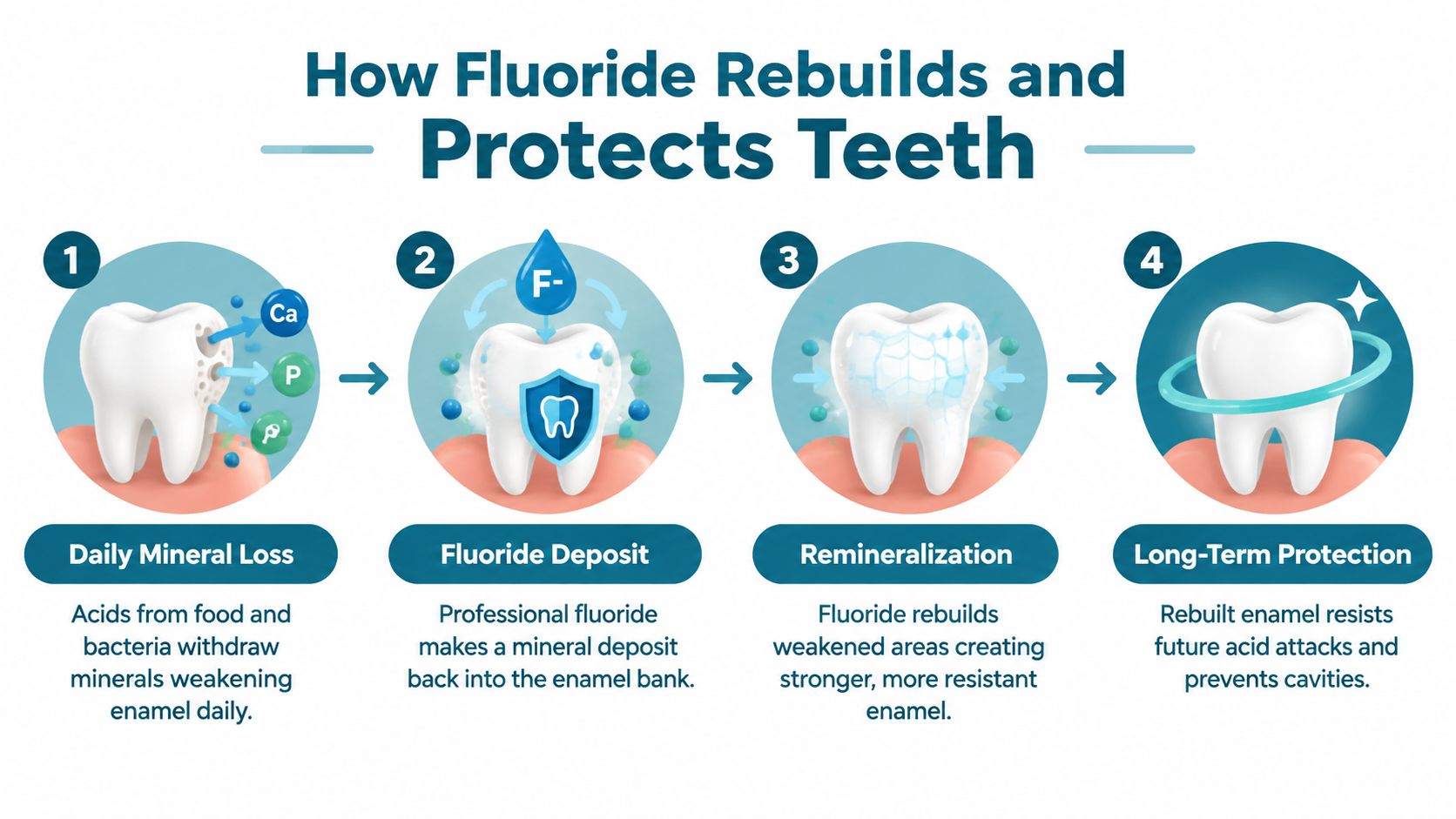
A simple way to understand fluoride is to think of enamel as a mineral bank. Every day, acids make withdrawals. Saliva makes deposits, but saliva may not fully replace what repeated acid exposure removes. Fluoride helps direct minerals back toward weakened areas and improves the tooth's ability to withstand later withdrawals.
The process is local and practical:
- Acid exposure removes minerals. Plaque bacteria and dietary acids weaken enamel by drawing out calcium and phosphate.
- Fluoride gathers at the tooth surface. Topical fluoride stays close to enamel, where it can influence the repair process.
- Early weak areas receive support. Fluoride enhances remineralization, reduces demineralization, and slows or arrests lesion progression.
- The repaired surface becomes more resistant. Stronger enamel is better prepared for the next acid challenge.
Why topical exposure matters
The main clinical action of professional fluoride is topical, meaning it works directly on tooth surfaces rather than needing to circulate through the body. This distinction helps explain why varnish is painted onto enamel during a dental appointment.
Fluoride doesn't sit on teeth as a permanent coating. It supports mineral exchange at the surface and helps enamel tolerate acid more effectively. The treatment works best as part of a broader routine that includes fluoride toothpaste, plaque control, dietary awareness, and regular professional examinations.
Patients interested in other enamel-supporting ingredients can also review the benefits of hydroxyapatite toothpaste. A dentist can discuss how product selection fits a patient's cavity history, sensitivity, preferences, and overall preventive plan.
The concentration and delivery method should match the patient. Children, adults with frequent decay, and patients with exposed root surfaces may not need the same product or schedule. An individualized recommendation is more useful than assuming every person benefits from identical fluoride exposure.
Measurable Benefits for Children and Adults
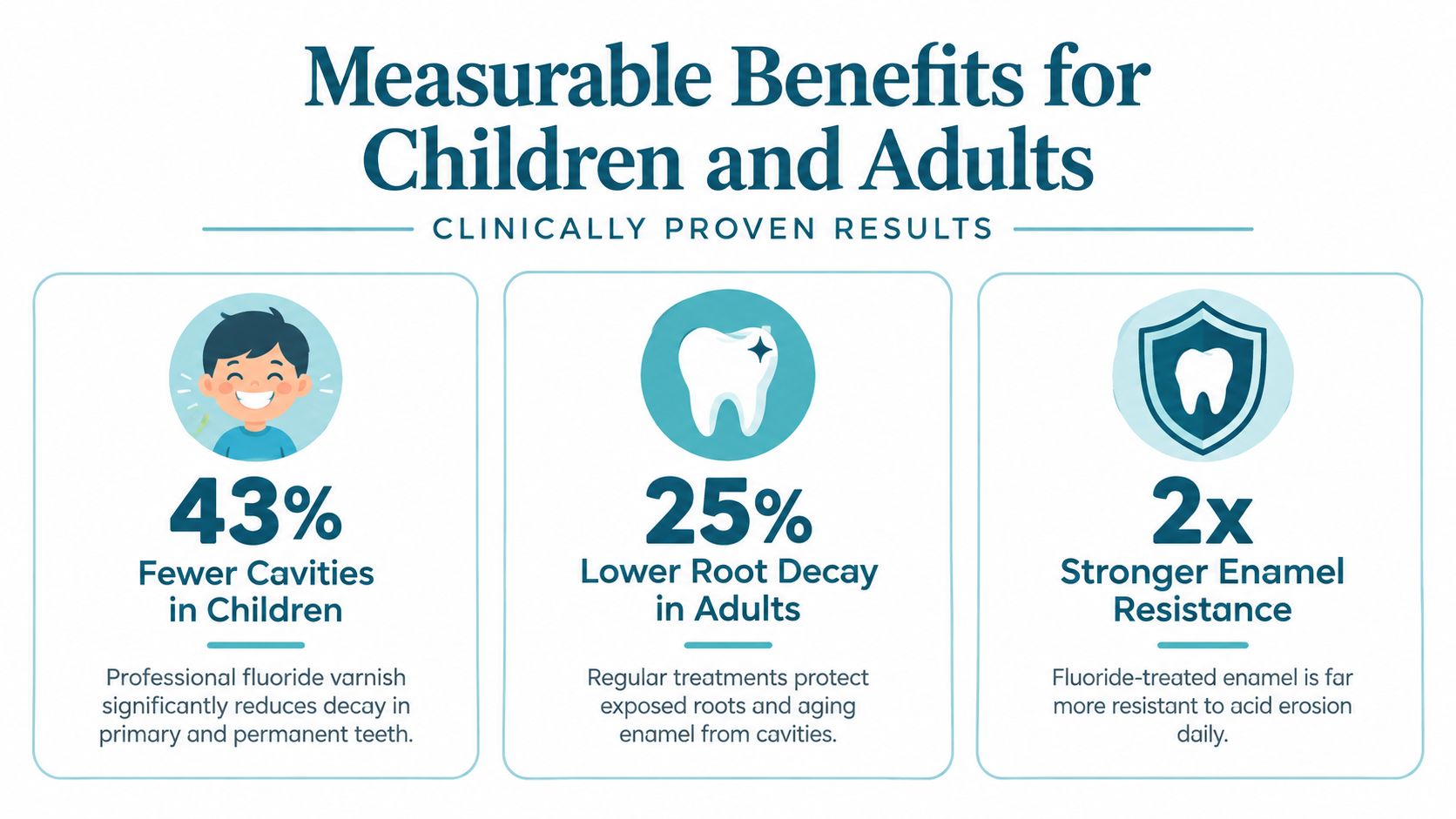
The fluoride treatment benefits are supported by clinical evidence, not just a theory about stronger teeth. Community water fluoridation began as a major public-health milestone in 1945, when Grand Rapids, Michigan, started fluoridating its water supply. Clinical studies conducted from 1976 to 1987 reported caries reductions of 30% to 60% in primary teeth and 15% to 35% in permanent teeth at fluoride levels of 0.7 to 1.2 parts per million, as summarized by the Linus Pauling Institute at Oregon State University.
Later reviews covering studies from 1990 to 2010 found average reductions of 30% to 59% in primary teeth and 40% to 49% in permanent teeth across multiple countries, reinforcing fluoride's role in preventive dentistry. These findings describe population and study-level outcomes, not a guarantee for every individual. Personal risk still depends on hygiene, diet, saliva, previous decay, medications, and access to routine care.
What professional varnish adds
Professionally applied fluoride can provide targeted support when a patient's risk is higher than average. CDC guidance summarizes studies in which semiannual applications reduced caries experience by an average of 26% in the permanent teeth of children living in nonfluoridated areas, as reported in the CDC review of school-based and community fluoride programs.
Systematic-review evidence has reported prevented fractions of 43% for permanent teeth and 37% for primary teeth with fluoride varnish. A 2025 meta-analysis involving more than 13,000 children reported a caries event rate of 21.7% in the varnish group compared with 27.9% among controls, with a relative risk of 0.79, equal to 59 fewer events per 1,000 participants, according to the same CDC-cited evidence summary.
Adults need protection too
Adult enamel remains vulnerable. Root recession can expose root surfaces, while dry mouth can reduce the saliva that normally helps neutralize acids. Crowns, bridges, orthodontic appliances, and areas that are difficult to clean can also create places where plaque remains longer.
Evidence syntheses find that 2.26% fluoride varnish applied at least twice yearly may benefit patients up to age 18 with moderate certainty, and may help prevent adult root caries with lower-certainty evidence, according to the clinical evidence review in the NCBI Bookshelf. That evidence supports thoughtful use, not automatic treatment for every patient.
Routine varnish may offer limited or no additional benefit for preschool children who already use fluoride toothpaste consistently, according to a 2025 review summarized by PubMed. Risk assessment matters. A child with frequent new lesions and an adult with exposed roots may have more to gain than a low-risk patient with excellent daily plaque control.
Professional Applications Versus At-Home Care
Daily toothpaste and professional fluoride serve different purposes. Toothpaste delivers repeated, small topical exposures during home brushing. A dental office can apply a concentrated varnish or another professionally selected product directly to areas that need added support.
The most commonly studied varnish concentration is 5% sodium fluoride, containing 22,600 parts per million fluoride. One review reports that this formulation can reduce dental caries development by about 37% in children and adolescents, as detailed in this review of fluoride varnish evidence.
| Delivery Method | Concentration Level | Best Used For |
|---|---|---|
| Fluoride toothpaste | Product-specific | Daily home protection and routine brushing |
| Fluoride varnish | 2.26%, commonly studied as 5% sodium fluoride with 22,600 ppm fluoride | Targeted professional prevention for patients with elevated risk |
| Fluoride gel | 1.23% for patients age 6 and older under professional guidance | Office-based topical treatment when clinically appropriate |
| Prescription home-use gel or paste | 0.5% | Dentist-directed home care for selected higher-risk patients |
| Fluoride mouthrinse | 0.09% | Additional home support for patients age 6 and older when recommended |
The American Dental Association topical fluoride guideline states that children younger than 6 should receive only 2.26% fluoride varnish. People age 6 and older may also use the gel, prescription home-use gel or paste, or mouthrinse options listed above when a dental professional recommends them.
Fluoride-free choices still deserve an honest discussion
Some patients prefer fluoride-free products because of personal, ingredient-related, or overall wellness concerns. A patient-centered conversation can acknowledge those preferences without suggesting that all options provide identical cavity protection. The decision should account for previous decay, current enamel condition, saliva flow, diet, age, and the ability to maintain consistent home care.
Professional fluoride also works alongside, rather than against, daily brushing. Combining fluoride toothpaste with another topical fluoride can provide additive benefit, particularly for patients with higher baseline risk, orthodontic appliances, or limited ability to maintain perfect plaque control. For patients who need a different approach to active decay, silver diamine fluoride treatment may be discussed as part of a personalized plan.
Addressing Safety and Common Misconceptions
Fluoride questions deserve clear answers rather than dismissal. The most important distinction is between topical fluoride treatment and swallowing fluoride products. Varnish is placed on tooth surfaces in a controlled clinical setting, where the goal is local enamel protection.
Professional guidance also determines which formulation is appropriate for a patient's age and risk level. Children younger than 6 should receive only 2.26% fluoride varnish, according to the American Dental Association guideline cited earlier. Patients shouldn't use prescription-strength products solely because a higher concentration sounds more protective.
More fluoride isn't automatically better
A higher exposure isn't automatically a better preventive plan. The benefit depends on where fluoride is applied, how often it's used, whether the patient can follow instructions, and how much cavity risk exists in the first place.
Dental professionals consider factors such as:
- Previous decay: Repeated cavities may justify added professional protection.
- Exposed root surfaces: Recession can make root areas more vulnerable.
- Dry mouth: Reduced saliva can make natural enamel repair less effective.
- Age and development: Children need age-appropriate products and supervision.
- Existing treatment: Braces, crowns, bridges, and fillings can affect plaque control.
A balanced plan protects both enamel and peace of mind. Patients should receive enough information to make a confident decision, not pressure to accept a treatment without understanding its purpose.
The evidence also supports using fluoride as one part of comprehensive care. Fluoride can lower decay risk, but it can't remove plaque, repair a broken filling, replace a missing tooth, or diagnose an abscess. Cleaning and exams, dental x-rays when indicated, dietary guidance, and timely restorative treatment remain important.
Patients who have concerns about fluoride exposure, product ingredients, or a child's swallowing habits can raise those questions during a new patient exam. A conversation about individual risk is more useful than relying on broad internet claims that ignore the patient's actual mouth.
What to Expect During Your Preventive Visit
A preventive fluoride appointment is usually straightforward. Patients seeking a dentist in Amanda, OH, or traveling from Lancaster, Circleville, or Carroll can expect the visit to begin with a review of health history, medications, home-care habits, sensitivity, and previous dental concerns.
The visit follows a practical sequence
- Conversation and assessment: The dental team asks about tooth pain, dry mouth, bleeding gums, recent dental work, and any concern about fluoride products.
- Cleaning and exam: Plaque and buildup are addressed while the dentist evaluates enamel, gums, fillings, crowns, and areas that may be difficult to clean.
- Dental x-rays when indicated: Digital images can help identify problems that aren't visible during a surface examination.
- Risk-based recommendation: The dentist explains whether varnish or another preventive option fits the patient's needs.
- Application: Fluoride varnish is brushed onto selected tooth surfaces. The process is quick and doesn't require drilling or anesthesia.
- Simple aftercare: The office provides instructions for eating, drinking, brushing, and other routine activities after treatment.
Comfort remains part of prevention
Patients with dental anxiety can tell the team before care begins. Amanda Family Dental offers comfort-focused care, and sleep dentistry may be considered when appropriate. A calm explanation, a pause when needed, and a clear treatment plan can make preventive visits easier for children and adults.
Fluoride application doesn't replace treatment for active pain. A toothache, swelling, a broken tooth, or a lost filling may require an emergency dentist evaluation instead of waiting for a routine visit. The office can assess whether the concern involves decay, infection, trauma, or another condition and then discuss options such as a filling, crown, root canal, tooth extraction, or replacement with a dental implant.
A preventive visit also creates an opportunity to discuss related goals. Patients may ask about teeth whitening, veneers, Invisalign, cosmetic dentistry, dentures, or dental implants near me when appearance or function has changed. The right sequence usually begins with disease control and a stable foundation.
Protecting Your Smile with Amanda Family Dental
Fluoride treatment benefits extend beyond childhood. A young patient may need help protecting newly developing teeth, while an adult may need support around exposed roots, dry mouth, braces, crowns, or a history of recurring decay. The central question isn't whether every patient needs the same treatment. It's whether the patient's enamel and daily risk justify an added layer of protection.
Preventive care also reduces uncertainty. A cleaning and exam can identify early changes before they become a toothache. Digital x-rays can support a more complete evaluation when needed. A personalized plan may include home fluoride toothpaste, professional varnish, dietary adjustments, improved interdental cleaning, restorative care, or monitoring without additional treatment.
For families in Amanda, OH, local access makes it easier to keep preventive care on the calendar. Patients from Lancaster, Circleville, and Carroll can also seek care through the same community-focused practice for pediatric dentistry, emergency dental services, composite fillings, crowns, root canals, tooth replacement, cosmetic dentistry, and dental implants.
A preventive plan should fit real life
A patient's plan should reflect comfort, budget, health history, and personal preferences. Amanda Family Dental discusses flexible options, including the Power Plan Membership, for patients who want a structured approach to ongoing care. Patients can also ask about fluoride-free choices while receiving a clear explanation of how those choices may affect cavity prevention.
Those looking for a cosmetic dentist near me may begin with preventive care before considering professional whitening, veneers, or Invisalign. Those searching for dental implants near me may need an examination to evaluate gum health, bone support, and the condition of neighboring teeth. Every pathway starts with understanding the current state of the mouth.
Amanda Family Dental offers preventive examinations, professional fluoride care, and personalized treatment planning for children and adults in Amanda, Lancaster, Circleville, and Carroll. Patients can contact the office to schedule a cleaning and exam, request a fluoride consultation, or discuss tooth pain, missing teeth, cosmetic concerns, and urgent dental needs.
Amanda Family Dental provides dental care, including cleaning and exams, digital x-rays, professional fluoride applications, restorative treatments, cosmetic dentistry, and dental implants. Families in Amanda, Lancaster, Circleville, and Carroll can visit Amanda Family Dental to schedule an appointment or request a consultation focused on stronger enamel and long-term oral health.