

Standing in the toothpaste aisle can feel oddly complicated. One tube says fluoride, another says whitening, and now there's hydroxyapatite, a newer option that sounds scientific enough to make any parent pause and wonder what belongs in the bathroom at home. For families looking for a dentist near me in Amanda, OH, or nearby Lancaster, Circleville, and Carroll, that question matters because toothpaste isn't just about fresh breath, it's part of daily dental care.
Amanda Family Dental sees this kind of decision all the time. Some patients want a fluoride-free option for a child who still swallows toothpaste. Others are trying to calm sensitivity, support early enamel wear, or choose between a mineral-based routine and a more traditional fluoride approach. The right answer depends on risk, comfort, and goals, not on marketing.
Table of Contents
- Why Patients Are Asking About Hydroxyapatite Toothpaste
- What Hydroxyapatite Actually Does Inside Your Teeth
- The Evidence-Based Benefits You Can Expect
- How Hydroxyapatite Compares to Fluoride Toothpaste
- Who Benefits Most and Who Should Be Cautious
- Practical Tips for Using Hydroxyapatite Toothpaste
- When to See Your Dentist About Tooth Sensitivity or Decay
- Choosing the Right Toothpaste With Amanda Family Dental
Why Patients Are Asking About Hydroxyapatite Toothpaste
A parent in Lancaster picks up a toothpaste for a child who hates the taste of fluoride. A patient in Circleville looks for something gentler because cold water makes teeth zing. Someone in Carroll wants a fluoride-free option but still wants something that feels evidence-based, not trendy. That's the reason hydroxyapatite keeps showing up in conversations, it feels like a practical answer to everyday dental problems.
Hydroxyapatite is the mineral that already makes up most of tooth enamel, so the idea behind it is simple. Instead of trying to coat teeth with something completely foreign, the toothpaste uses a form of the same mineral teeth already contain. For readers comparing hydroxyapatite toothpaste benefits with the usual fluoride options, that familiarity is part of the appeal.
The ingredient has also moved into mainstream oral care because the research base has grown. A 2025 systematic review and meta-analysis found HAP oral-care products outperformed placebo for caries prevention, with a pooled odds ratio of 2.51, and in situ studies favored HAP for lesion depth and bacterial loads as well as remineralization trends PubMed review. That doesn't make it magic, and it doesn't replace a dental exam, but it does mean it belongs in a serious conversation.
For families in Amanda, OH, the key question is not whether hydroxyapatite sounds modern. The question is whether it fits a child's swallowing habits, an adult's sensitivity, or a patient's cavity history. One useful overview of fluoride-free options for children is available in Amanda Family Dental's guide on fluoride-free toothpaste for kids, and it helps put this ingredient in a family context.
Practical rule: a toothpaste should match the person using it, not just the label on the box.
What Hydroxyapatite Actually Does Inside Your Teeth
Teeth look solid, but enamel is always under small repair stress. Sugar, acids, and daily brushing wear at the outer surface, and over time tiny weak spots appear. Think of enamel like a brick wall, where the bricks are mineral and the mortar holds everything together. When acid starts dissolving that mortar, the wall gets porous.
Hydroxyapatite works by supplying more of the same mineral teeth are built from. Nano- and microcrystalline particles can attach to the surface, settle into tiny defects, and help smooth the enamel again. That matters because a rougher surface gives bacteria more places to hang on, while a smoother one is easier to keep clean.
Remineralization and dentin coverage
The first job is remineralization, which means rebuilding weakened enamel before a cavity becomes more established. The second job is occlusion, which means sealing exposed dentin tubules. That's why the same ingredient can matter for both early decay and sensitivity.
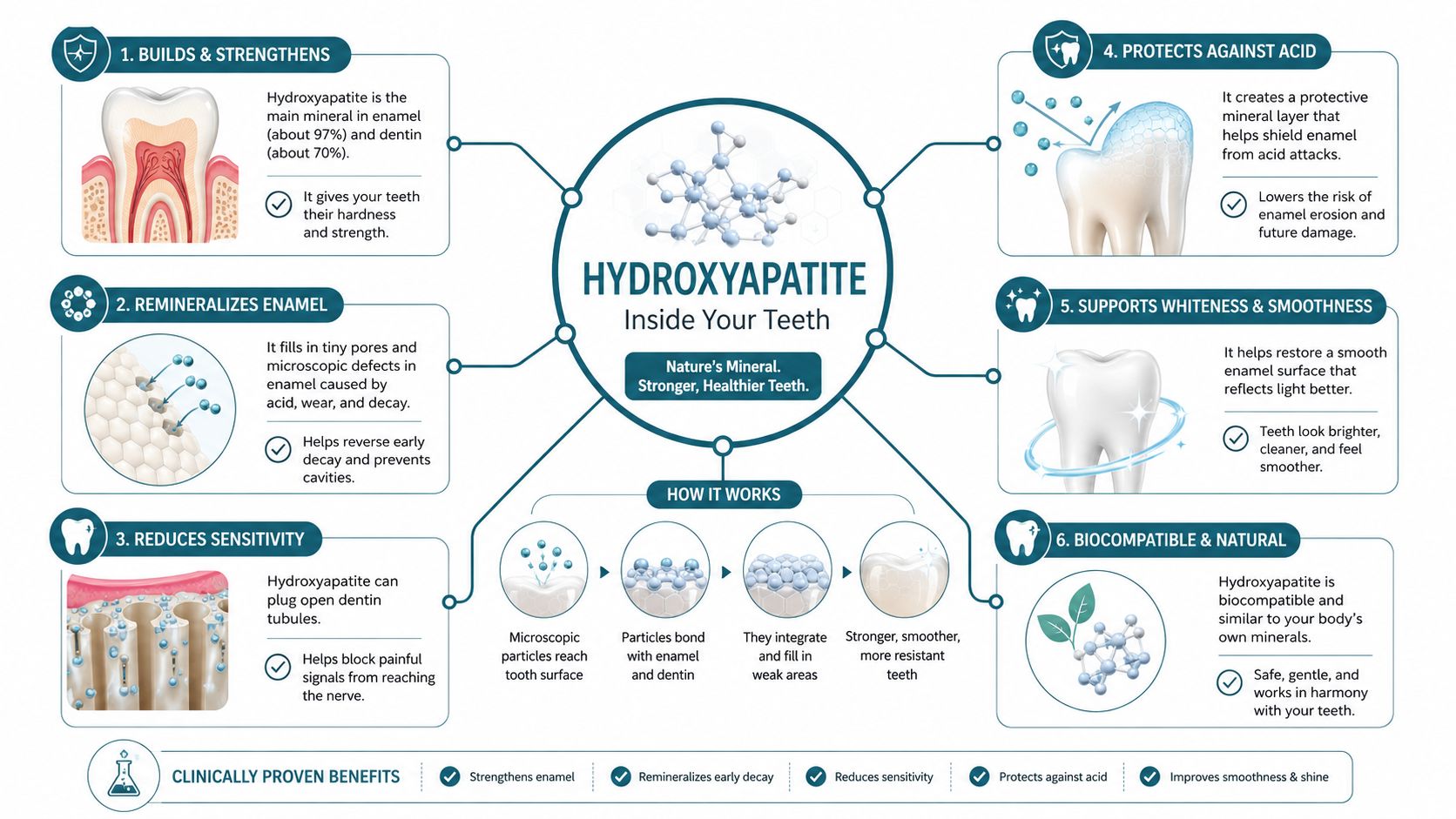
The clinical picture fits that mechanism. In a meta-analysis of in-situ studies, HAP was associated with a 65% overall reduction in bacterial loads and a 1.15 µm mean change in lesion depth, plus a 2.8% mean change favoring remineralization PMC review on HAP and sensitivity/whitening. Those numbers don't mean every tooth gets “repaired” in the same way, but they do show why the ingredient gets attention in preventive dentistry.
Hydroxyapatite is best understood as a mineral repair aid. It helps teeth re-uptake what they've lost, instead of simply masking the problem.
For anyone who likes the plain-language version, a good place to connect the science to everyday decay risk is Amanda Family Dental's article on what causes tooth decay. Once the mechanism makes sense, product claims are easier to judge.
The Evidence-Based Benefits You Can Expect
Hydroxyapatite toothpaste earns its reputation in a few specific areas, not every area. The strongest case is for early enamel support, sensitivity relief, and prevention in children. A 2025 systematic review and meta-analysis found HAP oral-care products significantly outperformed placebo for caries prevention, with a pooled odds ratio of 2.51 across included clinical trials. That means the ingredient has real anti-caries evidence behind it, even if it is not a blanket replacement for every fluoride toothpaste on the shelf.
What the studies measured
Long-term clinical trials matter more than short demo studies. In adults, one double-blind trial found 89.29% of adults using hydroxyapatite toothpaste and 87.36% using 1,450 ppm fluoride toothpaste had no increase in DMFS in the per-protocol analysis, while the intention-to-treat analysis showed 90.43% versus 88.42%, respectively, and the authors concluded HAP was non-inferior for the primary DMFS endpoint PMC adult and child trial. In children, a 1-year randomized clinical trial of microcrystalline HAP also met the prespecified non-inferiority margin, with the reported upper limit at 9.8% for ICDAS increase difference same trial.
For families in Amanda, Lancaster, Circleville, and Carroll, that kind of evidence helps with a practical question. If a child is at lower decay risk, or if a family wants a fluoride-free option for daily brushing, hydroxyapatite can fit the routine without feeling like a fringe choice. If decay risk is higher, fluoride still deserves a serious look because the evidence base around it is larger and longer.
That matters because it puts HAP in the category of legitimate preventive ingredients, not just a whitening trend. Earlier evidence cited in the review also described 10% microcrystalline HAP as comparable to fluoride toothpaste in preventing progression of caries lesions measured by ICDAS.
Whitening and sensitivity, without harsh bleaching
Hydroxyapatite's cosmetic side is different from peroxide whitening. Regular use can help teeth look brighter by depositing a white opaque layer and removing extrinsic stains with minimal abrasion, rather than oxidizing tooth color PMC whitening review. Reviews also report that nano-hydroxyapatite can reduce dentin hypersensitivity by occluding exposed tubules and improving enamel surface smoothness PMC sensitivity review.
The practical takeaway is straightforward. HAP can help with visible stain buildup, sensitivity, and early enamel wear, but it is not an instant whitening strip and it does not treat active decay on its own.
How Hydroxyapatite Compares to Fluoride Toothpaste
A parent in Amanda may be choosing toothpaste for a child who still swallows a little foam. An adult in Lancaster may be trying to calm cold sensitivity. A family in Circleville or Carroll may just want a routine that fits their risks without overcomplicating the shelf at home. A fair comparison starts with respect for both ingredients.
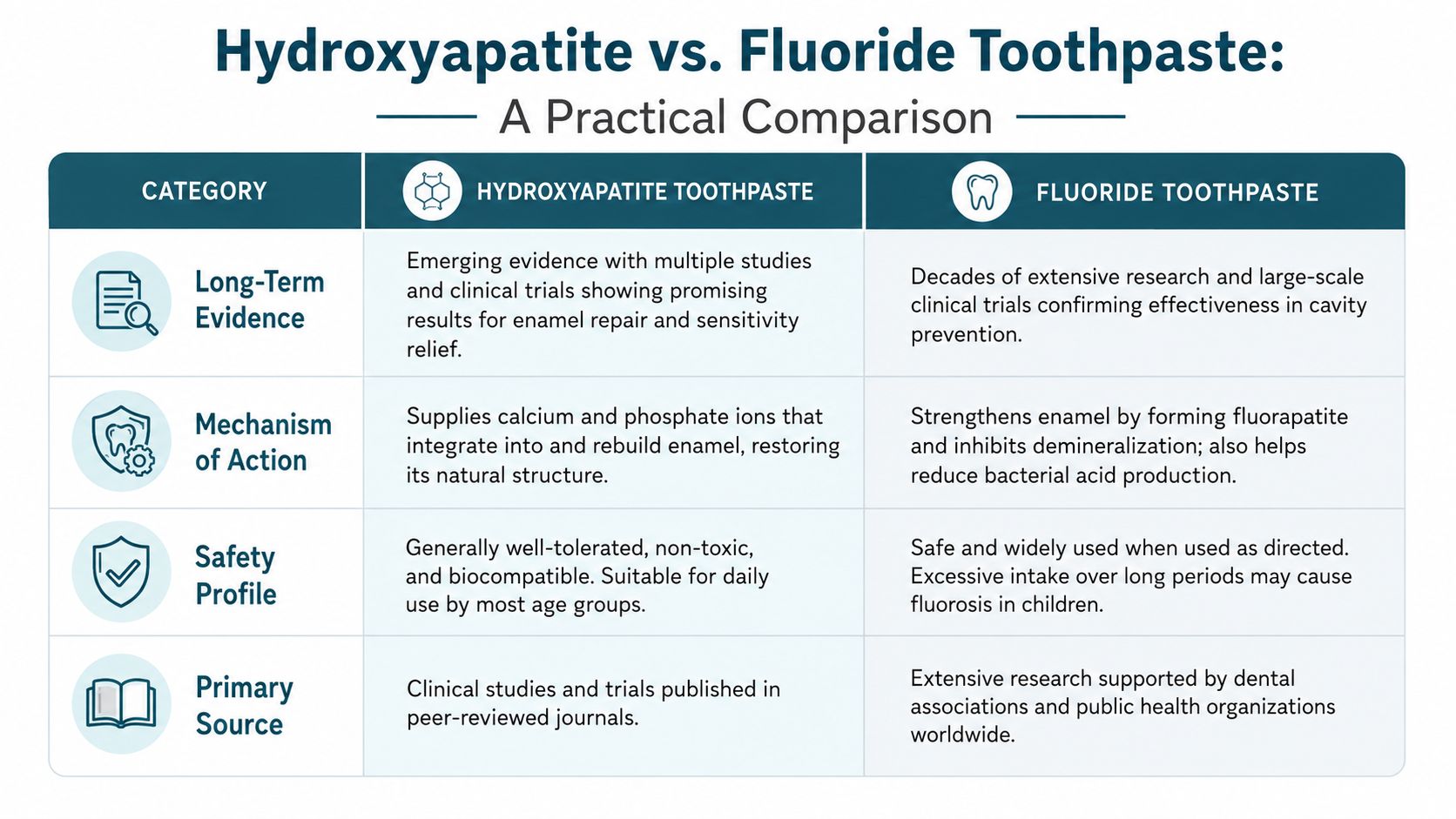
Fluoride has a much larger and longer evidence base, and that matters. Hydroxyapatite has a smaller evidence base, but the clinical data now show it can hold up well in specific settings, including adult and pediatric prevention PMC trial and the 2025 systematic review PubMed review.
Where the differences show up
The main difference is mechanism. Fluoride helps teeth resist acid attack by changing the surface chemistry of enamel. Hydroxyapatite works more like structural patching, depositing a mineral layer that resembles what the tooth already has. For some patients, that feels more natural. For others, the bigger question is what fits their routine and risk level.
Safety is another practical factor. Families with young children often care about what happens if toothpaste is swallowed. Hydroxyapatite is frequently chosen as a fluoride-free option because it fits that use case, especially when fluorosis is a concern or a child is still learning to spit. The strongest clinical summaries also frame it as useful for children, early childhood caries, and dentin hypersensitivity, while noting that the evidence base is still smaller than fluoride's PMC clinical summary.
The right choice often comes down to patient profile:
- Hydroxyapatite fits well when someone wants a fluoride-free routine, has sensitivity, or wants extra support for early enamel wear.
- Fluoride still fits well when a patient has a long history of decay or needs a familiar preventive standard.
- A combined plan can make sense when a dentist wants prevention at home but still needs a customized in-office strategy.
That's why the question is rarely “which one wins?” It is usually “which one matches this child, this adult, or this family's risk level?” For many households in Amanda, Lancaster, Circleville, and Carroll, that is a more useful question than brand loyalty.
Who Benefits Most and Who Should Be Cautious
A family choosing toothpaste often starts with a simple question. Will this help with everyday prevention, or does the mouth need a different kind of care right now? Hydroxyapatite fits best in the first group. It is a gentle option for people who want support for enamel, especially if they are dealing with sensitivity, early wear, or a routine that has to work well for children who are still learning to spit.
That makes it a reasonable choice for some children, adults with dentin sensitivity, patients with a history of fluorosis, and families looking for a lower-toxicity option that is safer to swallow. It also draws interest from people with dry mouth, because less saliva means teeth lose some of their natural buffering and protection. For those patients, a toothpaste that helps mineral stay on the surface can make sense as part of a broader home-care plan.
Good fit versus caution zone
A simple way to sort it is this:
- Good fit: early enamel changes, mild sensitivity, family members who prefer fluoride-free care, or children who may swallow toothpaste.
- Use caution: active cavities, frequent new decay, or situations where a full restorative plan is already needed.
That caution matters because hydroxyapatite is preventive, not curative. It can support enamel and help reduce the stress on a sensitive surface, but it cannot remove decay, repair a broken filling, or treat an infection. Patients with ongoing cavity problems, orthodontic challenges, or structural damage still need a dental exam and likely restorative care.
The research also points to an important distinction. Hydroxyapatite is often discussed as a risk-based choice, not as a universal substitute for fluoride in every mouth or at every decay-risk level PMC clinical summary. That is the honest way to frame it. It can help many people, but the right preventive tool depends on the person in the chair, not on a one-size-fits-all rule.
For families in Amanda, Lancaster, Circleville, and Carroll, that question is usually more useful than asking which toothpaste is better in the abstract. A child who still swallows toothpaste, an adult with sensitive roots, and a patient with recurring cavities do not need the same plan. Hydroxyapatite may fit one household member well and still leave another better served by fluoride or by a combined plan.
For patients already noticing discomfort, Amanda Family Dental's guide to tooth sensitivity treatment can help separate mild sensitivity from something that needs a closer look.
If a tooth hurts only with cold water and settles quickly, toothpaste may help. If the pain lingers, a dentist needs to find the cause.
Practical Tips for Using Hydroxyapatite Toothpaste
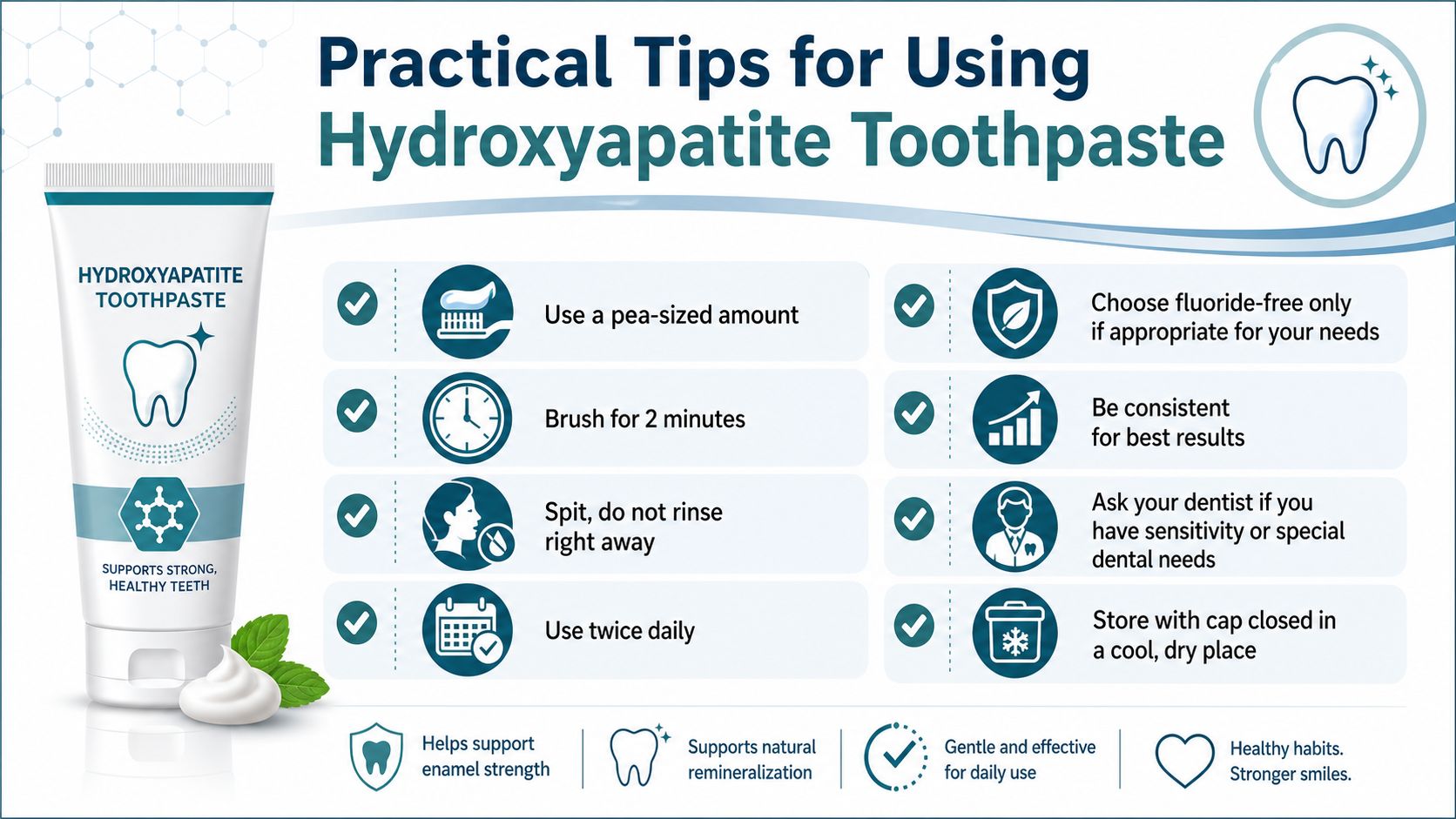
The routine doesn't need to be complicated. Brush twice a day for two minutes, use a pea-sized amount for older children and adults, and let the toothpaste sit on the teeth instead of rinsing aggressively right away. That gives the mineral more time to stay in contact with enamel.
Reading the label without getting lost
A shopper doesn't need chemistry training to choose well. Look for terms like nano-hydroxyapatite or microcrystalline hydroxyapatite. Some products combine HAP with fluoride, and that can be useful for patients who want both forms of support in one routine.
Pairing matters too. Less frequent snacking, drinking water between meals, and keeping sticky sweets out of constant rotation all support remineralization. For flossing, a practical option like individually wrapped floss picks can make it easier for families to stay consistent at home and while traveling.
A few common questions come up often:
- Mouthwash: It can fit into the routine, but timing matters so the toothpaste doesn't get washed away immediately.
- Whitening strips: They may work for stain removal, but they can add sensitivity, so pairing them with HAP makes more sense when a dentist has checked the teeth first.
- Electric brushes: They're fine if used gently. The brush matters less than consistency and technique.
The home routine still works best alongside cleanings and exams. A toothpaste can support daily repair, but it doesn't replace professional cleaning and exams, dental x-rays, or periodic assessment of enamel wear.
When to See Your Dentist About Tooth Sensitivity or Decay
A little sensitivity doesn't always mean something serious, but some symptoms deserve a faster visit. If pain lingers longer than a few seconds, if a tooth hurts without an obvious trigger, or if there's a visible chip, dark spot, bleeding gum, or swelling, a dentist should take a look. Those signs can point to decay, recession, a cracked tooth, or bite problems.
Amanda Family Dental uses new patient exams, digital x-rays, and a personalized treatment plan to sort out what's going on. That matters because hydroxyapatite may help with early enamel concerns, but it won't treat active cavities or infection. The right next step depends on what the tooth is doing.
A simple decision rule
If symptoms are mild, brief, and tied to cold or brushing, a preventive toothpaste may help as part of the plan. If symptoms are persistent, worsening, or visible, the issue needs an exam first. That's the cleanest way to decide between hydroxyapatite, fluoride, or a combination.
Good hygiene details matter here too. If a toothbrush has been sitting in a shared bathroom cup or getting swapped around, sanitation matters. The article on Group A Streptococcus prevention tips is a useful reminder that a toothbrush should stay as clean as the mouth it serves.
Hydroxyapatite is preventive support, not an emergency fix. Pain, swelling, or broken teeth deserve a visit, not a wait-and-see approach.
Choosing the Right Toothpaste With Amanda Family Dental
A good toothpaste plan starts with the whole picture, not a single ingredient. During a consultation, Amanda Family Dental can review cavity history, diet, brushing habits, sensitivity, whitening goals, and whether a fluoride-free or combined approach makes the most sense. That kind of conversation is especially helpful for families in Amanda, Lancaster, Circleville, and Carroll who want a local dentist in Amanda, OH they can trust for both prevention and treatment.
The office also offers options like fluoride-free choices, mercury-free fillings, digital x-rays, and total health screening, so the recommendation can match the person, not just the product label. Hydroxyapatite can fit into that conversation as an in-office varnish or a daily home-care choice, depending on the situation. It can also sit alongside other services when a patient needs restorative dentistry, dental implants near me, cosmetic dentistry, or help from an emergency dentist.
A practical local plan usually looks like this:
- Assess risk. Review cavities, sensitivity, dry mouth, and whitening goals.
- Match the ingredient. Choose hydroxyapatite, fluoride, or both when appropriate.
- Follow through. Keep up with cleanings, exams, and any restorative care that's needed.
For patients comparing routine care and treatment needs, Amanda Family Dental also supports services like tooth extraction, crowns, fillings, and cosmetic options, so toothpaste advice can fit into a real treatment path instead of floating in isolation. That's what makes the conversation useful for a cosmetic dentist near me or a dentist in Lancaster, OH, dentist in Circleville, OH, or dentist in Carroll, OH.
Amanda Family Dental helps families choose the right preventive routine, whether that means hydroxyapatite toothpaste, fluoride, or a combination that fits the person in the chair. Schedule an appointment or request a consultation at Amanda Family Dental to get a toothpaste recommendation that matches your risks, your goals, and your home routine.