

Juvéderm under-eye treatment is often priced by syringe, and a complete treatment commonly falls in the $1,000 to $2,000 range for both eyes. Some patients see quotes as low as $600 to $1,400 overall, while others pay more because cost changes with syringe count, injector skill, product choice, and the complexity of the under-eye area.
A lot of people start searching for answers after noticing the same thing in the mirror every morning. They don't necessarily look older. They just look tired, even after a full night of sleep. Under-eye hollows and shadowing can create that effect fast, and it's one of the reasons Juvéderm has become such a common non-surgical option for patients who want a softer, more rested appearance.
For patients in Amanda, Lancaster, Circleville, and Carroll, OH, the biggest question usually isn't whether filler can help. It's whether the price makes sense, what that price includes, and how to tell the difference between a fair quote and a risky bargain. That's where a careful, anatomy-based approach matters.
Table of Contents
- Brighten Your Look with a Trusted Cosmetic Dentist in Amanda OH
- Why Do I Have Dark Circles and How Does Juvéderm Help
- What Really Goes Into the Cost of Under-Eye Fillers
- Juvéderm vs Other Options for Tired Eyes
- What to Expect During Your Visit in Amanda OH
- Flexible Payment and Membership Plan Options
- Your Questions About Juvéderm Answered
Brighten Your Look with a Trusted Cosmetic Dentist in Amanda OH
A common story sounds like this. Someone from Lancaster gets ready for work, covers the under-eye area with concealer, and still feels like the face looks worn out by mid-morning. Another patient from Circleville may say friends keep asking if sleep has been rough lately, even when it hasn't. In many of these cases, the issue isn't only skin color. It's the hollow under the eye that creates a shadow.
That distinction matters because Juvéderm treats volume loss, not every cause of darkness. When a tear trough is the main problem, filler can soften the transition between the lower eyelid and the cheek, which helps the face look more refreshed without surgery.
Why patients ask about price first
The cost question comes up early because online pricing can look scattered. A useful benchmark is the brand's own treatment range of $600 to $1,400 overall, while independent guides commonly report $1,000 to $2,000 for both eyes. Those same guides note that tear trough correction is often priced by syringe, and many patients need 1 to 2 syringes, which is why the final number changes with anatomy, location, and injector approach (Juvéderm pricing information).
Patients usually feel more comfortable when pricing is discussed as a treatment plan, not as a teaser number. A quote built around a careful exam is more useful than a low headline price that doesn't explain how much product is needed.
Practical rule: For under-eye filler, the fee isn't just about the product in the syringe. It reflects planning, restraint, and placement in one of the most delicate areas of the face.
Why the fee can vary so much
The under-eye area doesn't reward shortcuts. Small differences in depth, skin thickness, puffiness, and asymmetry can change whether someone is a good candidate for filler at all. That's one reason patients often value a consultation that looks at the whole face, not just the hollow itself.
For readers who are also exploring broader appearance goals, a cosmetic dentistry smile makeover can be part of the conversation when facial balance, smile design, and soft-tissue aesthetics all matter together.
A thoughtful injector will also discuss what filler won't fix. If under-eye bags, loose skin, or pigment are the main issue, Juvéderm may help only partially or may not be the right choice. Honest treatment planning protects both the result and the budget.
Why Do I Have Dark Circles and How Does Juvéderm Help
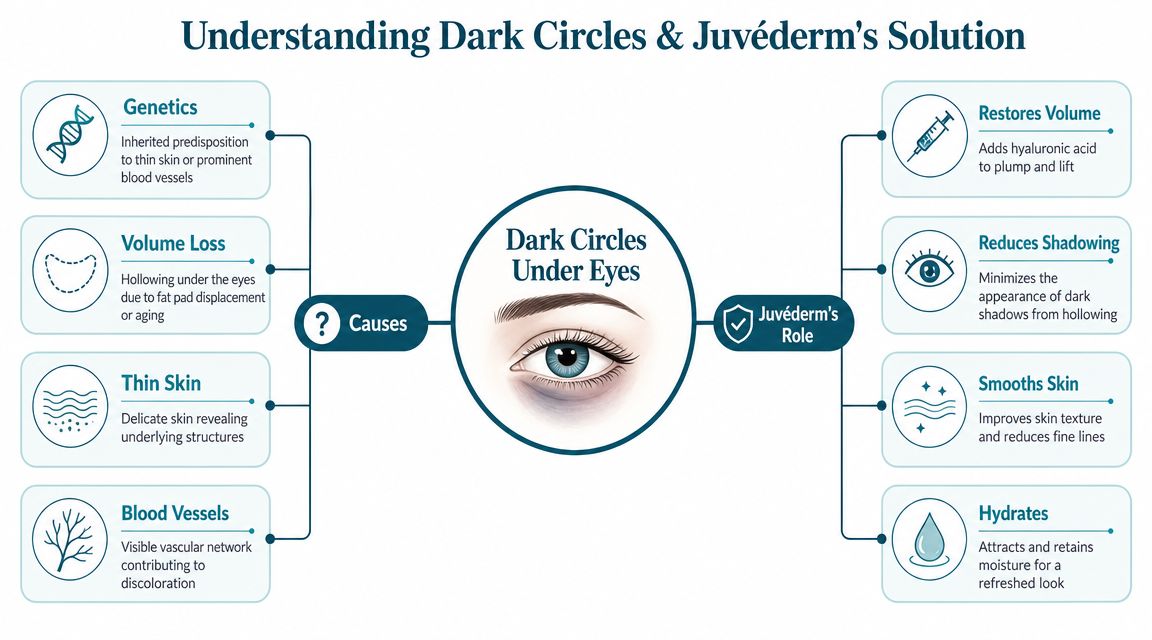
Some dark circles come from pigment. Some come from visible vessels under thin skin. Some come from a hollow that casts a shadow. That's why two people can use the same eye cream and get very different results.
Not all dark circles mean the same thing
When patients say they have “dark circles,” they're often describing more than one issue at once. Genetics can make the skin thinner or the hollow deeper. Aging can reduce support under the eye, so the area looks sunken. In other cases, the shadow is the bigger issue than actual discoloration.
Patients who want to better identify different facial dark spots can find that guide helpful because it separates pigment concerns from structural ones. That distinction matters before any injectable treatment is planned.
How Juvéderm works in the tear trough
Juvéderm is a hyaluronic acid filler. In simple terms, that gel acts a bit like a soft cushion that also attracts water. When it's placed carefully in the right layer, it can restore a small amount of support and reduce the hollowed look that creates under-eye shadowing.
Published guidance notes that the under-eye region is a high-risk, low-volume treatment area, which is why providers often charge more for precision and conservative placement. That same guidance identifies Juvéderm Volbella as the FDA-approved Juvéderm option for tear troughs and notes that results typically last about 9 to 12 months (under-eye Juvéderm guidance from Michele Green, MD).
A careful plan matters because under-filling and over-filling are both problems here. Too little may not improve the shadow enough. Too much can create puffiness or an unnatural surface change.
| Concern | What filler may help with | What may need another approach |
|---|---|---|
| Hollow tear trough | Restoring subtle support | Not always enough if bags are prominent |
| Shadowing from volume loss | Softening the light-to-dark transition | Won't treat every pigment issue |
| Fine texture concerns | Sometimes modest improvement | Skin quality may need separate care |
Good under-eye filler should make someone look less tired, not look “done.”
What Really Goes Into the Cost of Under-Eye Fillers
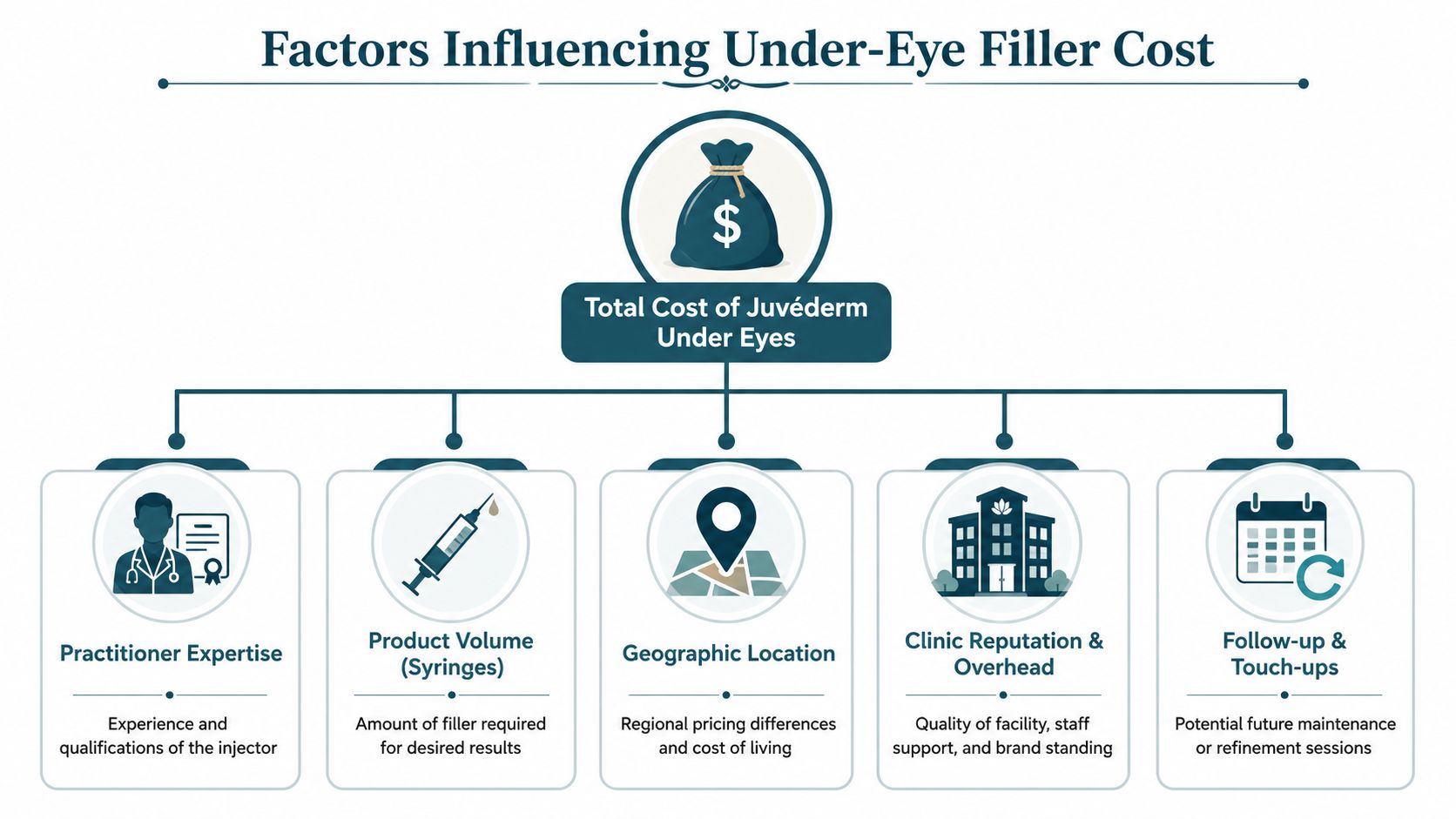
Patients often assume the bill is mostly about brand name. It usually isn't. The largest cost variable is how much product is needed, followed closely by the judgment required to use it safely.
Early in the pricing conversation, many people see the national average for hyaluronic acid dermal fillers at $715 per treatment and assume that's what under-eye filler should cost. That figure is a helpful baseline, but under-eye treatment is commonly billed by syringe and often requires more than one syringe, so real-world U.S. pricing often lands at $850 to $1,400 per syringe or $1,000 to $2,000 total for both eyes (American Society of Plastic Surgeons filler cost information).
The biggest driver is how much product is needed
The first question isn't “What does one syringe cost?” It's “How much filler makes sense for this face?” Someone with mild hollowing may need less than someone with a deeper tear trough or more visible transition between the lid and cheek.
That's why online comparisons can be frustrating. A low per-syringe quote may sound attractive, but it doesn't say whether that amount is enough to create a balanced result.
A short overview can also help patients visualize how filler works and why under-eye treatment requires restraint:
What patients are actually paying for
The product matters. So does the person placing it. Under-eye filler is one of the areas where injector judgment has a direct effect on safety, symmetry, and whether the final look stays natural.
Patients are usually paying for several things at once:
- Assessment of candidacy. Not every dark circle should be treated with filler.
- Conservative dosing. In the under-eye area, “more” often isn't better.
- Precise placement. Millimeters matter around the tear trough.
- Follow-up planning. Small refinements may be part of a careful treatment path.
A fair under-eye filler quote should answer three questions clearly: what product is being used, how much may be needed, and what follow-up is included.
What a low quote may leave out
A headline number can leave out consultation fees, follow-up visits, or the possibility that a second syringe is needed for proper balance. It can also overlook the value of saying no when filler isn't the right fix.
For patients searching by terms like cosmetic dentist near me or dentist near me in Amanda, OH, Carroll, OH, or nearby communities, the better approach is to compare treatment plans rather than comparing teaser prices alone. That makes the Juvederm under eyes cost easier to judge in context.
Juvéderm vs Other Options for Tired Eyes
Not every tired-eye treatment works the same way. Some improve hydration on the surface. Some restore structure. Some remove or reposition tissue. The right choice depends on what's causing the concern in the first place.

Where filler fits
Juvéderm sits in the middle ground between creams and surgery. Creams can help the skin look better temporarily, especially if dryness makes the area look more creased or dull. Surgery can address significant bags or excess skin, but it's a different level of commitment, recovery, and cost discussion.
Market comparisons from a 2026 pricing guide show how wide under-eye filler pricing can be across regions, listing the United States at $800 to $2,500, the United Kingdom at $500 to $1,500, and Turkey at $200 to $600 for under-eye filler procedures. The same guide notes that a typical 1.0 mL U.S. treatment may cost $600 to $1,200, while 2.0 mL deeper-hollow treatments may rise to $1,200 to $2,200, which shows how anatomy changes the price even before brand preference enters the conversation (2026 under-eye filler pricing guide).
A simple comparison
| Option | Best use case | Downtime | Cost position |
|---|---|---|---|
| Juvéderm | Hollowing and shadowing from volume loss | Minimal | Mid-range |
| Other HA fillers | Similar structural concerns | Minimal | Similar range |
| Topical creams | Dryness or mild surface dullness | None | Lower |
| Surgical options | Prominent bags or loose skin | More significant | Higher |
Some patients also explore skin-supportive treatments that don't add volume. For example, this overview of the benefits of red light for under-eye circles is useful for understanding where light-based options may fit, especially when the concern is more about skin appearance than tear-trough hollowing.
For facial lines elsewhere, patients may also compare filler with wrinkle-relaxing treatments such as Botox for smile lines. They do different jobs. Filler restores volume. Neuromodulators reduce muscle-driven lines.
Juvéderm tends to make the most sense when the main complaint is, “The under-eye area looks sunken and casts a shadow.” It makes less sense when the main issue is loose skin, puffiness, or pronounced fat pads.
What to Expect During Your Visit in Amanda OH
A typical under-eye filler visit starts with a practical question. “Will this help my face look less tired, or am I treating the wrong problem?” That is the right place to start, especially for patients in Amanda and Lancaster who want a clear plan before they spend money on a cosmetic treatment.
The consultation comes first
The first appointment is usually an evaluation, not a rushed injection visit. The under-eye area is assessed at rest and in motion, with attention to hollowing, skin thickness, facial balance, asymmetry, and whether puffiness or loose skin is playing a larger role than volume loss.
Some patients arrive expecting Juvéderm and leave with different advice. In my experience, that is a good consultation. Under the eyes, a cautious “not yet” is sometimes better care than filler on the same day.

Price clarity matters here. Online pricing often starts with a per-syringe number, but the spend can depend on whether one or two syringes are appropriate, whether treatment should be staged over time, and whether follow-up is included in the quote. Patients should know those details before deciding.
Treatment day and aftercare
If treatment is appropriate, the visit is usually straightforward and conservative. The plan is reviewed again, comfort steps are discussed, and the product is placed carefully because the under-eye area is less forgiving than many other parts of the face.
Some swelling or bruising can happen. That does not mean the treatment went poorly. It means the area needs time to settle, and final results are judged after healing, not in the first day or two.
A visit often includes:
- A detailed facial assessment to confirm that filler is the right option.
- A treatment plan based on anatomy, symmetry, and how subtle the result should be.
- Comfort measures to make the appointment easier.
- Aftercare and follow-up instructions so the area can be reassessed once it settles.
Patients usually feel more comfortable when the discussion is honest. Filler can soften hollows and shadowing. It cannot correct every cause of tired-looking eyes.
For patients who like to budget cosmetic care in advance, the practice may also discuss options such as an in-house membership plan for treatment savings and simpler payment planning.
Flexible Payment and Membership Plan Options
Cost matters, and patients are right to ask direct questions. Cosmetic treatment should feel planned, not vague. That's especially true with under-eye filler, where the final fee depends on individual anatomy and whether treatment is staged conservatively.
Planning the investment clearly
A useful consultation should spell out what the quote includes. Patients shouldn't have to guess whether the number reflects one syringe, two syringes, or a follow-up visit. Clear financial conversations reduce pressure and help people make decisions at their own pace.
That's also why many patients prefer to ask about payment before scheduling treatment day. It gives them time to think through priorities without feeling rushed.
Ways patients often manage cost
Practices may offer several paths to make cosmetic care easier to budget:
- Direct payment options that let patients pay at the time of service.
- Financing arrangements when patients prefer to spread out the cost.
- Membership savings for people who want ongoing care under one plan.
For patients interested in an in-house option, the Power Plan Membership is one way to explore savings on eligible care and simplify budgeting for treatment over time.
The most practical next step is still a consultation. That's where the plan can be matched to the face, and where the cost can be matched to the actual treatment rather than an estimate pulled from a generic online range.
Your Questions About Juvéderm Answered
Does under-eye filler hurt
Patients usually say under-eye filler is more uncomfortable in anticipation than in the chair.
The skin under the eyes is sensitive, so comfort matters. A careful injector uses small amounts, moves slowly, and watches tissue response closely instead of rushing through the appointment. In my experience, patients feel more at ease once they understand that treatment is being placed conservatively and with a specific goal, not just adding filler to the area.
Who is a good candidate
Good candidates usually have a hollow or shadowed tear trough that makes them look tired, even when they feel rested. Patients with prominent bags, loose skin, or darkness caused mainly by pigment often need a different plan. A consultation matters because the best treatment depends on the cause.
That distinction protects patients from spending money on a filler treatment that may not address their underlying concern.
Why can a dentist offer facial injectables
Dentists with advanced facial injectable training spend their careers working in the head and neck region, including muscles, nerves, blood supply, and facial balance. That foundation supports cosmetic treatment when the provider also has the right hands-on training, good judgment, and a conservative approach to case selection.
The key is a combination of anatomy knowledge, patient selection, and technique.
For patients in Amanda, Lancaster, and nearby communities, that can make a cosmetic visit feel more accessible. Many people do not realize a local family dental office may be a practical place to ask about under-eye filler, especially if they value a medical setting, clear communication, and a provider who already focuses on facial anatomy every day.
What side effects should patients know about
Swelling, bruising, tenderness, and temporary unevenness are common early concerns after filler. The under-eye area can also hold fluid longer than other parts of the face, which is one reason conservative treatment matters so much here.
Some patients are not good candidates, and saying no is part of safe care. Careful screening, detailed aftercare, and follow-up support all help reduce avoidable problems and set realistic expectations from the start.
Patients in Amanda, Lancaster, Circleville, and Carroll, OH who want a clearer answer on Juvéderm pricing and candidacy can schedule a consultation with Amanda Family Dental. A personalized visit can determine whether under-eye filler fits the concern, what treatment may involve, and what the full cost is likely to be before any procedure is planned.