

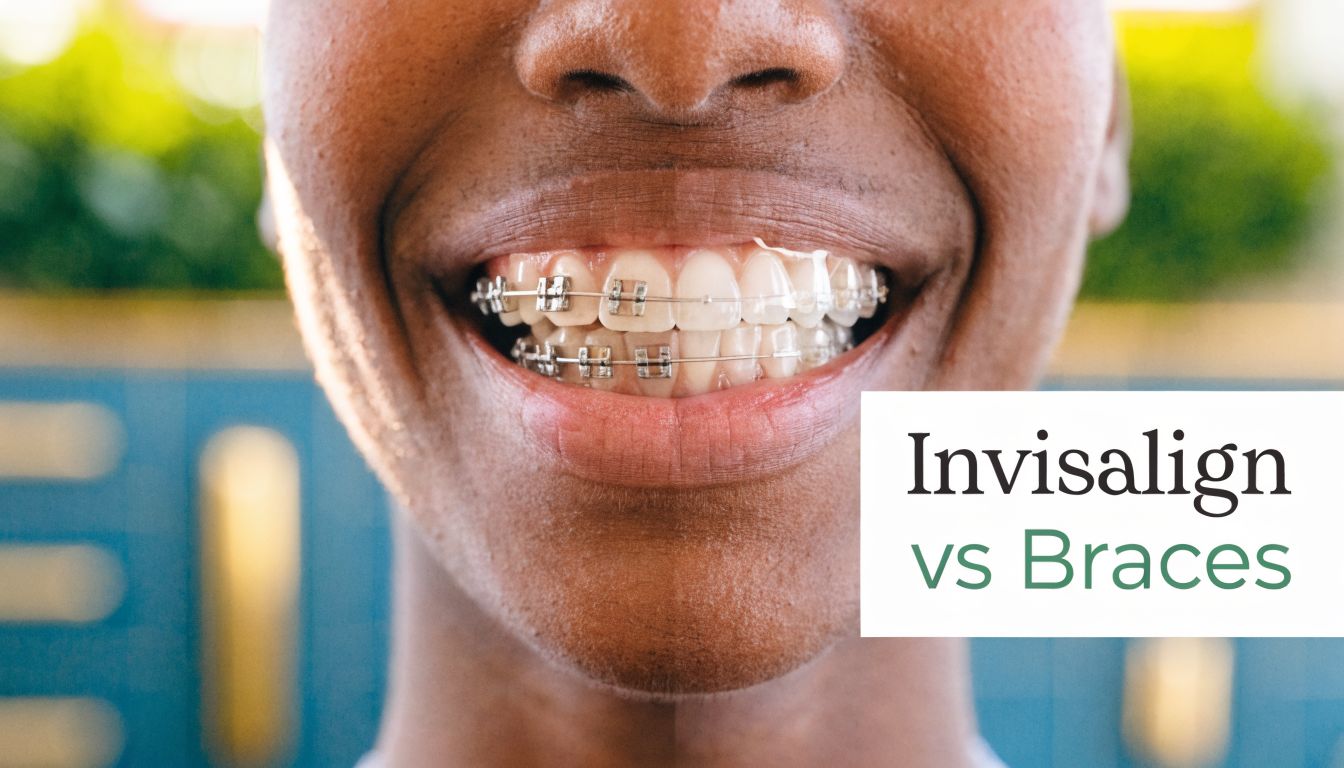
A lot of adults start looking into teeth straightening in quiet moments. It might be after seeing a work photo, catching a reflection during a video call, or noticing that crowded teeth are getting harder to clean well. The question usually isn’t whether a straighter smile would help. It’s whether treatment will fit real adult life.
That’s why invisalign vs braces for adults is such a common comparison. Adults often want something that supports confidence, oral health, and daily convenience at the same time. They also want honest answers about appearance, comfort, maintenance, cost, and what happens after treatment ends.
For patients in Amanda, Lancaster, Circleville, and Carroll, Ohio, the best choice usually comes down to two things. First, what kind of tooth movement is needed. Second, what kind of routine the patient can realistically follow.
Table of Contents
- Your Guide to Adult Orthodontics in Amanda OH
- Understanding Your Smile Straightening Options
- Invisalign vs Traditional Braces A Detailed Comparison for Adults
- Navigating the Cost of Orthodontic Treatment
- Your Treatment Journey at Amanda Family Dental
- Maintaining Your Beautiful Results for Life
- Frequently Asked Questions About Adult Orthodontics
Your Guide to Adult Orthodontics in Amanda OH
A lot of adult orthodontic cases in our office start with a familiar moment. Someone is getting ready for work, looking at a photo, or trying to floss around crowded teeth and realizing the same thing. The smile they have learned to live with is starting to affect daily comfort, confidence, or both.
I hear the same practical questions from adults in Amanda every week. Will treatment be obvious at work? Will aligners be hard to keep up with? Will braces or Invisalign fit around meetings, family dinners, travel, and regular home care?
Those are reasonable concerns. Adult orthodontic treatment has to fit real life, not an ideal schedule.
At Amanda Family Dental, the decision is bigger than choosing clear aligners or brackets. The full process matters. It starts with an exam and digital planning, continues with a treatment approach that matches the bite and daily routine, and ends with a retention plan that protects the result years from now. Adults usually do best when they understand that whole path from the beginning.
For patients comparing Invisalign treatment options in Amanda, the question is not which option sounds newer or less noticeable. The better question is which option fits the tooth movement needed, the level of follow through expected, and the kind of result that can be maintained long term.
Practical rule: Adult orthodontics works best when the treatment plan matches both the bite problem and the patient's day-to-day habits.
What adults are usually trying to solve
Adult patients rarely come in with one goal only. Some want a straighter smile before a wedding, job change, or family photos. Others are tired of overlapping teeth that hold plaque, make flossing difficult, or create uneven wear. In many cases, appearance and function are tied together.
Three priorities come up often in our office:
- A professional appearance: Adults often want treatment that feels comfortable in conversations, meetings, and social settings.
- A routine they can maintain: Daily cleaning, follow up visits, and wear time have to be realistic or treatment gets off track.
- Results that last: Straight teeth are only part of the goal. Stable bite alignment and a clear retainer plan matter just as much.
That is why a local, practitioner-guided plan helps. Adults need more than a basic feature comparison. They need to know what the first visit looks like, how decisions are made, what responsibilities come with each option, and how Amanda Family Dental will help protect the result after active treatment ends.
Understanding Your Smile Straightening Options
Straightening teeth isn’t only about making a smile look more even. In dental terms, the underlying issue is often malocclusion, which means the teeth or bite don’t line up the way they should. That can show up as crowding, gaps, teeth that overlap, or upper and lower teeth that don’t meet correctly.
When teeth sit out of position, a few practical problems can follow. Brushing and flossing may take more effort. Some spots become easier to miss. Certain teeth may take extra force during chewing, which can contribute to wear over time. For many adults, that’s when cosmetic concern becomes a health concern too.
Two tools with the same goal
Adults usually compare two main treatment paths.
Traditional braces use brackets attached to the teeth and a wire system that applies steady pressure. Because braces stay in place all the time, they’re very dependable for movements that need close control.
Invisalign uses a series of clear plastic aligners made to fit the teeth closely. Each set is designed to move the teeth gradually. Because the trays are removable, they appeal to adults who want fewer interruptions with eating, brushing, and social events.
Crooked teeth and bite problems can affect more than appearance. They can change how easy it is to clean, chew, and maintain long-term dental health.
Why adults need a personalized recommendation
Neither option is automatically better for everyone. A person with mild crowding and strong daily habits may do very well with aligners. A person with more complex bite issues or significant rotations may need braces for better control.
A proper evaluation usually looks at:
- Tooth position: Mild spacing and crowding often allow more flexibility in treatment choice.
- Bite relationship: If the bite itself needs more involved correction, braces may offer advantages.
- Existing dental work: Crowns, veneers, implants, and restorations can influence planning.
- Lifestyle habits: Removable treatment only works when it’s worn consistently.
That’s why the best conversations around invisalign vs braces for adults are grounded in real-life fit. Both systems can lead to a healthier smile. They get there in different ways.
Invisalign vs Traditional Braces A Detailed Comparison for Adults
A lot of adult patients come in after a work meeting, a school pickup, or a quick lunch break and ask the same thing. Which option will fit real life better, not just look better on paper?
That is the right question. At Amanda Family Dental, the better choice usually comes down to how your teeth need to move, how much visibility matters to you, and how confident you are that you will follow the plan every day from your digital scan to your retainer phase.
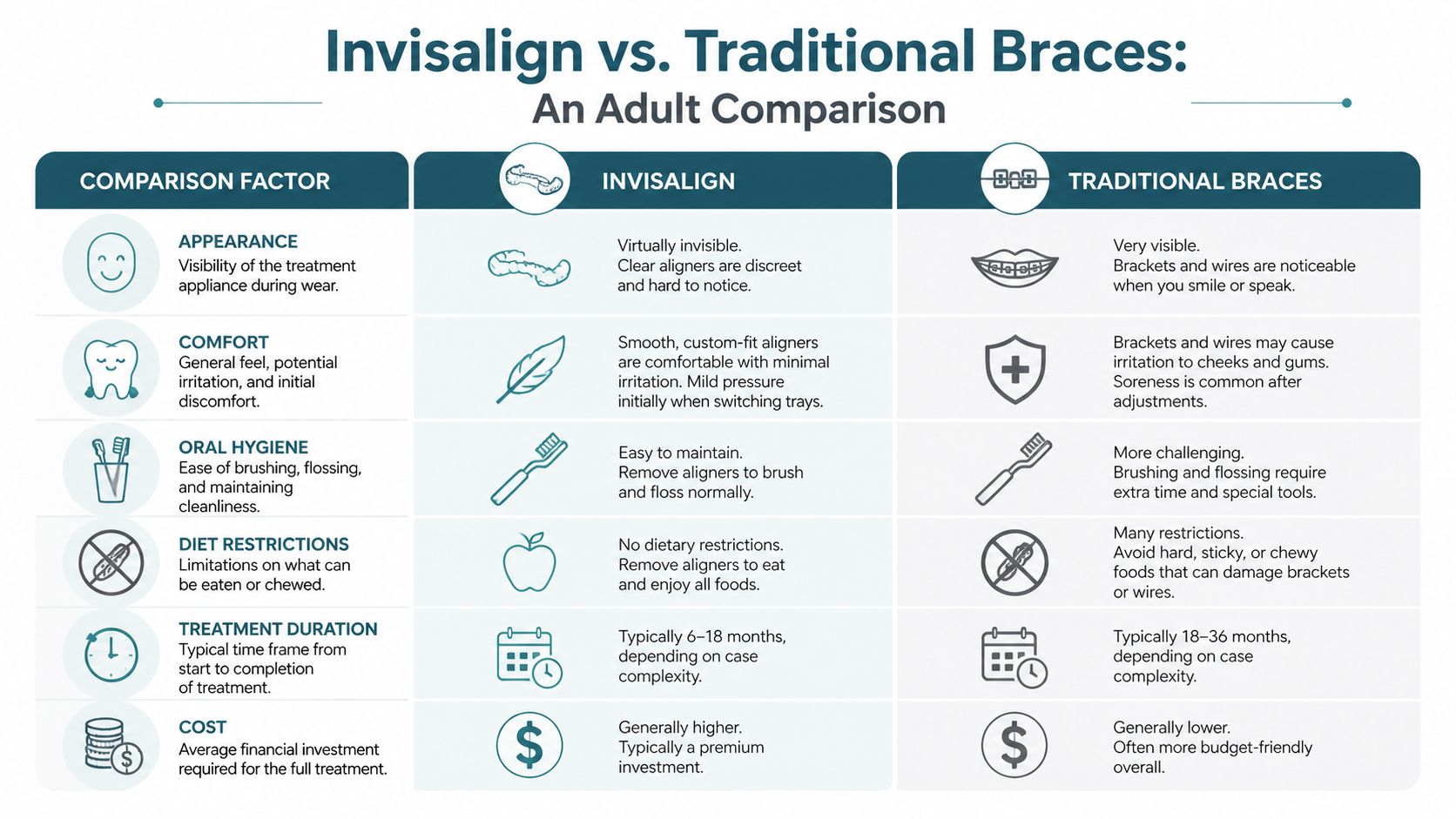
Quick comparison table
| Factor | Invisalign | Traditional Braces |
|---|---|---|
| Appearance | Clear aligners are hard to notice | Brackets and wires are visible |
| Removal | Removable for meals and brushing | Fixed in place |
| Eating | No food restrictions during meals | Some hard and sticky foods are usually avoided |
| Cleaning | Easier to brush and floss normally | Cleaning takes more time and technique |
| Comfort | Smooth trays, less cheek and lip rubbing | Brackets and wires can cause sore spots |
| Best fit | Often a strong choice for mild to moderate adult cases | Often better for complex movement and bite correction |
| Follow-through | Depends on wearing trays as prescribed | Works full-time because it stays on |
| Retention planning | Often transitions easily into clear retainers | Also needs long-term retainer wear |
If you want a clearer picture of the tray process itself, review how Invisalign works step by step.
What adult patients usually care about first
Appearance matters. So does convenience. Adults often want treatment that fits work conversations, dinners out, family photos, and daily routines without drawing much attention.
Invisalign is usually the easier fit for that goal. The trays are discreet, and you remove them to eat and brush. For adults who speak with clients, attend events, or do not want braces to be obvious, that difference can carry real weight over many months of treatment.
Braces ask for less day-to-day decision-making. They stay on, keep working, and do not depend on remembering to put trays back in after coffee or dinner. Some adults prefer that. It removes one common point of failure.
Comfort, hygiene, and daily friction
Both options can move teeth well. They feel different to live with.
Clear aligners tend to feel smoother because there are no brackets or wire ends rubbing against the cheeks. Adults also like being able to brush and floss normally. That matters more than many people expect, especially for patients who already manage crowns, fillings, or gum sensitivity.
Braces require more effort at home. Food traps more easily around the hardware. Cleaning takes patience, and missed areas can show up later as inflamed gums or chalky spots on the enamel. In practice, adults who keep excellent home care can do well with braces, but the routine is less forgiving.
A few practical trade-offs come up again and again in consultations:
- Coffee and wine habits: Invisalign trays should be removed for anything other than water. Braces stay on, but they can collect stain around brackets more easily.
- Meals and snacks: Invisalign lets you eat what you want during meals. Braces usually mean skipping popcorn, sticky candy, and foods that can bend wires or break brackets.
- Speech and social comfort: Some adults notice a short adjustment period with trays. Braces are more visible right away, which can matter in professional or public-facing settings.
- Travel and busy schedules: Invisalign needs consistency and a case for storage. Braces need fewer decisions, but broken brackets or poking wires can create surprise visits.
Treatment control and case complexity
Clinical planning holds paramount importance.
For straightforward spacing, mild crowding, and many moderate adult cases, Invisalign can be an excellent option. With a digital scan and a well-built sequence, treatment can be efficient and very predictable. Adults often appreciate seeing the plan before starting because it makes the process feel concrete.
Braces still have an advantage in certain cases. Significant rotations, larger bite discrepancies, and movements that need tighter control are often easier to manage with fixed appliances. If a case calls for that level of control, saying so early is part of giving an honest recommendation.
I often tell patients this plainly. If your habits make removable treatment a poor fit, or if your bite correction is more involved, braces may give you a steadier path to the result you want.
What success really depends on
For adults, success is not just about getting teeth straight. It is about finishing treatment on time, protecting the gums and enamel during the process, and having a realistic retention plan afterward.
Invisalign works best for adults who will wear the trays as directed every day. Braces work best for adults who want a system that keeps working without relying on memory or discipline. Neither option wins by default.
The best choice is the one that fits your teeth, your schedule, and your follow-through. At Amanda Family Dental, that recommendation is built around the full journey, starting with digital records and continuing through active treatment, refinement if needed, and long-term retainer planning so the result lasts.
Navigating the Cost of Orthodontic Treatment
Cost matters because orthodontic treatment is planned, not impulsive. Adults want to know what they’re budgeting for, what insurance may help with, and whether the extra convenience of aligners is worth the difference.
The broad ranges do overlap. Traditional braces generally range from $3,000 to $7,000, while Invisalign generally ranges from $3,500 to $8,500, according to adult orthodontic pricing comparisons. Those numbers don’t mean every adult case lands in the middle of the range. They show that one option isn’t always dramatically more expensive than the other.
What affects the final price
The final fee usually depends less on the label and more on the treatment demands.
A few factors shape the total:
- Case complexity: More difficult movement generally requires more planning and more active treatment.
- Treatment length: Longer cases usually involve more visits, more adjustments, or more aligner stages.
- Type of appliance: Clear aligner systems and fixed braces have different lab and material workflows.
- Location and office approach: Fees can vary by region, technology used, and what’s included in the care plan.
For some adults, Invisalign’s convenience is worth paying somewhat more. For others, braces offer a better value because the case is complex enough that fixed treatment is the stronger clinical choice anyway.
Insurance and payment planning
Orthodontic benefits vary widely by plan, and adult coverage can be more limited than pediatric coverage. Still, many patients are pleasantly surprised to learn that insurance may contribute to either option if the plan includes orthodontic treatment.
A practical first step is to ask for a benefits review before making assumptions. It also helps to ask whether retainers, refinements, or follow-up visits are included in the quoted fee.
For patients comparing options, reviewing adult smile treatment cost considerations can help frame the financial discussion around value, not just the initial number.
Worth remembering: The least expensive option on day one isn’t always the best value if it doesn’t fit the case well or doesn’t fit the patient’s routine well enough to finish successfully.
Flexible payment arrangements can also make treatment easier to start without waiting for the “perfect” time.
Your Treatment Journey at Amanda Family Dental
Starting orthodontic treatment feels easier when the steps are clear. Most adults don’t want surprises. They want to know what the first appointment looks like, how decisions are made, and what day-to-day treatment will involve.

What happens at the first visit
The process usually starts with a full exam, a conversation about goals, and updated records. That may include digital X-rays and iTero scanning, which gives a detailed 3D view of the teeth without messy traditional impressions. For adults who’ve delayed treatment because they expected a cumbersome process, this often makes the experience feel much more approachable.
The consultation should also address the reason the patient wants treatment now. Some adults are focused on smile appearance before whitening or veneers. Others are trying to improve cleaning access around crowded lower teeth. Those details matter because good planning starts with the patient’s actual priorities, not a generic recommendation.
From planning to active treatment
Once the records are complete, Dr. Alyssa Jenkins can map out the most appropriate path. If aligners are the right fit, treatment is planned around staged tooth movement and wear consistency. If braces are the stronger option, the discussion turns to bracket placement, expected maintenance, and how to keep the bite moving in the right direction over time.
Patients usually feel more confident when they know what the routine will be:
- Initial records and diagnosis: Photos, digital imaging, bite analysis, and discussion of goals.
- Custom treatment plan: Appliance selection based on tooth movement, bite needs, and lifestyle fit.
- Active treatment visits: Check-ins to track progress, adjust plans, and handle any concerns.
- Finishing phase: Final detailing, bite refinement, and planning for retention.
Treatment works best when the patient understands the routine before it starts. Adults tend to do very well when expectations are clear and realistic.
One advantage of a modern dental practice is that orthodontic planning can also fit into broader care. If a patient needs a crown replaced, wants cosmetic whitening after alignment, or has a restoration that affects tooth movement, those details can be coordinated rather than handled in isolation.
For adults in Amanda, Lancaster, Circleville, and Carroll, that kind of connected planning often makes the process feel less overwhelming and more worthwhile.
Maintaining Your Beautiful Results for Life
A lot of adults reach the day their attachments come off or their braces are removed and assume the hard part is over. Keeping your teeth in their new position is part of the treatment plan, not an extra step at the end.

At Amanda Family Dental, we talk about retention before active treatment is finished. Adults have jobs, family routines, travel plans, and existing dental work to manage. A retainer plan has to fit real life or it usually gets ignored. Teeth can shift after orthodontic treatment, especially early on, so the goal is to make retention realistic enough that patients follow through.
Why retainers matter
Your teeth are not held in place by appearance alone. The bone, gums, and supporting fibers need time to settle around the corrected positions. During that period, even small lapses in retainer wear can allow movement that patients notice quickly.
That is why retention instructions need to be specific. At the end of treatment, we review when to wear the retainer, how to clean it, where to store it, and what to do if it starts to feel tight. Adults usually do well with clear guidance because they want to protect the time and money they already invested.
A good retention plan also considers the details of the case. Someone who finished Invisalign may prefer a clear removable retainer for nightly wear. Someone with a higher risk of lower front teeth shifting may benefit from a bonded fixed retainer, sometimes combined with a removable retainer for added support.
Common retainer options
Most adults choose between removable retainers and fixed retainers, and each has real trade-offs.
A removable clear retainer is discreet and easy to wear at home or overnight. It also needs discipline. If it stays in a napkin at a restaurant or gets skipped for a few nights, teeth can begin to move.
A fixed retainer is bonded behind certain teeth and stays in place all the time. It removes the daily habit problem, but it takes more attention when flossing and needs periodic checks to make sure it is still intact.
A straight smile has two parts. Active treatment gets the teeth into position. Retention helps keep them there.
Long-term success usually comes from planning ahead, not from hoping the result will hold on its own. At Amanda Family Dental, retention is part of the full adult journey from digital records and treatment design to final fit, follow-up, and replacement planning if a retainer wears out or is lost. That kind of follow-through gives adults in Amanda confidence that their result was built to last.
Frequently Asked Questions About Adult Orthodontics
Adults usually ask smart, practical questions near the end of the decision process. These are often the questions that determine whether they schedule a consultation or keep postponing treatment.
Am I too old for Invisalign or braces
No. Teeth can be moved in adulthood, and age by itself doesn’t rule out treatment. Adult cases may require thoughtful planning around restorations, bone support, and bite stability, but healthy adults can absolutely be candidates.
What if I already have crowns, veneers, or implants
That doesn’t automatically prevent treatment. It does mean the plan needs to account for those restorations carefully. Implants don’t move like natural teeth, so they can affect how the case is sequenced. Crowns and veneers also need careful handling during planning and appliance placement.
Will treatment affect speech
There can be a short adjustment period with either option. Invisalign may create a slight temporary lisp for some adults at first, especially during the early days of wear. Braces can also feel different against the lips and cheeks until the mouth adapts. Most adults adjust with regular speaking.
Which option is easier for busy adults
It depends on what “easier” means. Invisalign is often easier for meals, brushing, and professional appearance. Braces are often easier from a compliance standpoint because they’re always on and don’t rely on daily discipline in the same way.
Are braces better if the case is more difficult
Often, yes. Fixed brackets and wires can offer stronger control for severe crowding, major bite issues, and more intricate movement. That doesn’t mean aligners are weak. It means some problems still respond better to fixed mechanics.
Quick Guide Invisalign vs Braces for Adult Lifestyles
| Factor | Invisalign | Traditional Braces |
|---|---|---|
| Work appearance | More discreet for meetings and public-facing roles | More visible during treatment |
| Eating out | Removed for meals | Food choices are more limited |
| Daily hygiene | Easier to brush and floss normally | Requires extra cleaning effort |
| Discipline needed | High, because trays must be worn consistently | Lower, because treatment is fixed |
| Complex bite correction | Good for selected adult cases | Often the stronger choice |
| Comfort in the mouth | Smooth plastic feel | More chance of cheek or lip irritation |
Adults comparing invisalign vs braces for adults usually don’t need a perfect option. They need the right option for their teeth, bite, schedule, and goals. A personalized evaluation can make that decision much clearer and remove a lot of guesswork.
If you're looking for a trusted dentist in Amanda, OH, Amanda Family Dental helps adults from Amanda, Lancaster, Circleville, and Carroll, Ohio explore clear, practical orthodontic options with personalized care. Whether you're interested in Invisalign, cosmetic dentistry, cleaning and exams, digital x-rays, teeth whitening, restorative dentistry, or a new patient exam, the team can help you take the next step with confidence. Schedule a consultation to find out which treatment fits your smile and your life.