

TL;DR: Six Month Smiles typically costs $3,000 to $5,500, and the exact price depends on how much tooth movement is needed. A consultation is the first step to get a personalized quote, and flexible financing can help fit treatment into a local household budget.
A lot of adults start looking into smile straightening the same way. A wedding is on the calendar. Family photos are coming up. A job change makes confidence matter a little more than it used to. The teeth are healthy enough, but the front ones look crowded, uneven, or spaced in a way that keeps showing up in every mirror and every picture.
For many people in Amanda, Lancaster, Circleville, and Carroll, Ohio, the biggest questions aren't only about appearance. They're about time, visibility, and whether the cost will feel manageable. Traditional braces can sound like a long commitment. Clear aligners can be a strong option for some cases, but not everyone needs full-arch treatment just to improve the teeth that show when they smile.
That’s where Six Month Smiles often comes into the conversation. It’s designed for cosmetic alignment of the front teeth, and for the right patient, it can be a practical middle ground between doing nothing and committing to a more extensive orthodontic plan.
Table of Contents
- Your Guide to a Straighter Smile in Amanda OH
- What Are Six Month Smiles and How Do They Work
- Breaking Down the National and Local Six Month Smile Cost
- What Factors Influence Your Final Treatment Price
- Six Month Smiles vs Invisalign Braces and Veneers
- Making Your New Smile Affordable in Fairfield County
- Your Six Month Smiles Questions Answered
Your Guide to a Straighter Smile in Amanda OH
A common situation looks like this. Someone has lived with slightly crooked front teeth for years, but the problem starts to feel bigger when a milestone gets closer. Graduation photos, a reunion, engagement pictures, or even just wanting to feel more at ease during everyday conversations can push smile concerns from the background to the front of the mind.

For that person, the goal usually isn't a dramatic orthodontic overhaul. It’s a cleaner, straighter look in the teeth that show when smiling. They want something more subtle than metal braces, and they want to know the total cost before making a decision.
Why this treatment gets attention
Six Month Smiles appeals to adults because it lines up with real-life priorities.
- Appearance matters: The brackets are clear and the wires are tooth-colored, so the look is less noticeable than traditional metal braces.
- Time matters: Patients who don't need full bite correction often want a shorter cosmetic treatment.
- Budget matters: Many people start by searching six month smile cost because they need straightforward numbers, not vague promises.
A good cosmetic orthodontic plan should match the person’s actual goal. If the goal is front-tooth alignment, the treatment should be built around that, not around a one-size-fits-all idea of braces.
Why local patients ask better questions now
People across Amanda, Lancaster, Circleville, and Carroll tend to approach cosmetic dentistry carefully. They want to know whether treatment is worth it, whether it will interrupt daily life, and whether there are hidden charges waiting later. Those are smart questions.
A practical consultation should sort out three things early. First, whether Six Month Smiles is the right tool. Second, what work needs to happen before braces go on. Third, what the full financial picture looks like from start to finish.
That last part matters more than many people expect. A treatment can sound affordable at the start and still feel stressful if the planning is vague. Clear communication is often what turns a maybe into a yes.
What Are Six Month Smiles and How Do They Work
Six Month Smiles is a short-term cosmetic orthodontic system. It’s designed to straighten the front teeth that show in the smile, not to fully rebuild the bite or handle every kind of orthodontic problem.
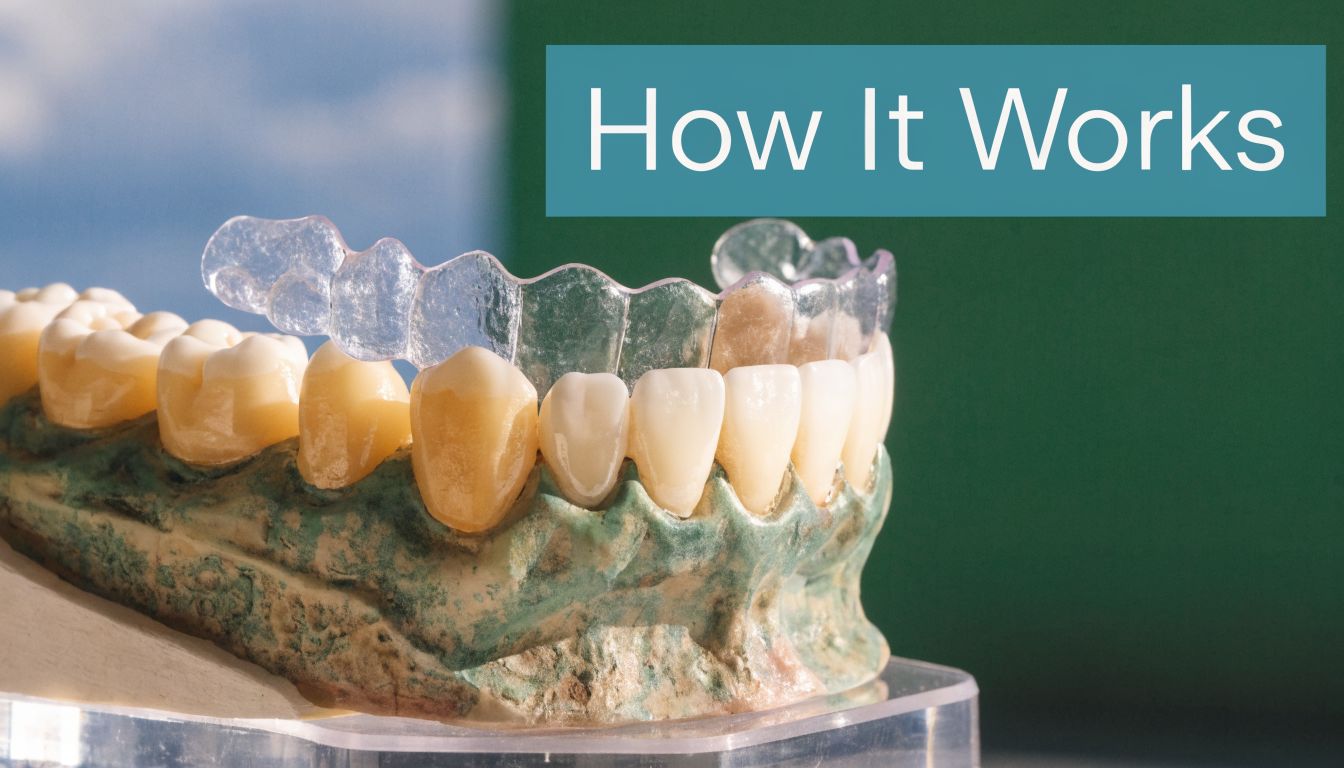
According to Jorgensen Orthodontics’ overview of how Six Month Smiles works, the system uses clear ceramic brackets and tooth-colored nickel-titanium archwires to move the anterior teeth visible in the smile zone, with alignment achieved in an average of 4 to 9 months.
What the system focuses on
This treatment is usually best for mild to moderate cosmetic concerns in the front teeth. That can include spacing, minor crowding, and visible rotations that make a smile look uneven.
It’s not meant to solve every orthodontic issue. If someone has a more involved bite problem, back-tooth concerns, or needs broader tooth movement, another option is often a better fit. That’s one of the most important trade-offs to understand before choosing the fastest-looking path.
Patients often like the simplicity of this approach because the goal is easy to see. The treatment targets the teeth most visible when talking, smiling, and being photographed.
Why treatment can move faster
Six Month Smiles doesn't work because teeth suddenly move by magic. It works faster because the scope is narrower. The system concentrates on cosmetic alignment in the smile zone instead of trying to reposition the entire mouth.
That focused plan can make the process feel more manageable for adults who want meaningful improvement without a long orthodontic timeline. It also helps explain why candidacy matters so much. A treatment that’s ideal for one person can be the wrong match for another.
A short visual can help make the concept easier to picture:
Clinical reality: Six Month Smiles works best when the main concern is cosmetic straightening of the front teeth. It doesn't replace comprehensive orthodontics when the bite itself needs correction.
Patients who tend to be happiest with this option usually have a clear priority. They want their smile to look straighter and more polished, and they understand that cosmetic alignment and full orthodontic correction aren't the same thing.
Breaking Down the National and Local Six Month Smile Cost
The straightforward cost is often the first detail sought. The typical six month smile cost ranges from $3,000 to $5,500, according to Hodges Orthodontics’ discussion of Six Month Smiles vs Invisalign. That same source notes that traditional braces often cost $3,000 to $7,000, and that the shorter treatment time can reduce cost by cutting down on office visits.
That national range is helpful, but it still doesn't answer what a local patient will pay. The answer depends on what the treatment plan includes and how straightforward the case is.
What the fee usually covers
When patients hear one total number, they often wonder what’s inside it. A proper quote for cosmetic orthodontic treatment should be clear about what is included and what could be separate.
A full treatment fee commonly covers items such as:
- Diagnostic planning: The exam, photos, and any needed imaging used to decide whether the case is appropriate for Six Month Smiles.
- Brackets and wires: The clear ceramic brackets and tooth-colored wires that do the actual work.
- Adjustment visits: Scheduled follow-up appointments to monitor progress and make changes as the teeth move.
- Finishing steps: The final phase where the smile is refined and prepared for retention.
- Retention planning: A retainer plan to help maintain the result once active movement is complete.
Some offices bundle these items together. Others present a lower starting price and then add separate fees later. That’s why patients should ask whether the quote is all-inclusive or only covers active treatment.
Why local planning matters
A local treatment plan should also account for practical details outside the braces themselves. If a patient needs a cleaning, cavity treatment, or another small step before orthodontics begins, that changes the total cost of getting to the finish line even if it doesn’t change the braces fee alone.
The timeline also matters financially. A shorter cosmetic case usually means fewer appointments than a longer traditional braces case. For busy families, that can make the treatment feel lighter both in scheduling and in the overall commitment.
| Cost question | Why it matters |
|---|---|
| What is the full treatment fee? | It helps avoid surprises later |
| Are follow-up visits included? | It clarifies whether adjustments are separate |
| Is retention discussed upfront? | It shows whether the quote reflects the full process |
| Is any pre-treatment dental work needed? | It affects the real total budget |
A personalized quote is still the only reliable local number. National averages help set expectations. The exam is what turns a broad range into a plan that fits the person sitting in the chair.
What Factors Influence Your Final Treatment Price
Two patients can both ask about six month smile cost and still receive different quotes. That isn’t a red flag. It usually means the treatment is being customized to the actual condition of the teeth instead of being sold as a flat package.
According to Sturgill Orthodontics’ review of Six Month Smiles costs and pros and cons, treatment complexity affects the final cost, and cases with more misalignment may require additional wires and refinement visits. That same source notes that flexible financing can bring the monthly cost to around $200 to $400.
The biggest cost drivers
The first major factor is how much movement the front teeth need. A small gap or a limited rotation is different from several teeth that are crowded and need more controlled repositioning.
Another factor is whether treatment stays simple from start to finish. Some cases need refinements to get the cosmetic result just right. Those extra steps can change the final fee in practices that don't bundle everything together.
A few practical variables often shape the estimate:
- Visible crowding or spacing: More movement generally means a more involved plan.
- Pre-treatment dental needs: Teeth and gums should be healthy before cosmetic orthodontics starts.
- Finishing refinements: Some smiles need extra detail work before braces come off.
What can change after the exam
The exam matters because front teeth don't move in isolation. The dentist has to check whether the surrounding oral health supports treatment and whether the smile goal matches what this system is designed to do.
For patients comparing cosmetic options, cost planning also works better when it includes alternatives. Someone who wants a faster surface-level cosmetic change may also compare braces-based treatment with porcelain veneers. A helpful reference point is this page on what veneers cost, since veneers solve a different problem and come with a different kind of investment.
Some smiles look like orthodontic cases at first glance, but the better solution may be restorative or cosmetic instead. The exam should sort that out before anyone talks about the "best" price.
The strongest treatment plans aren't built around the cheapest number. They’re built around fit. When the diagnosis is right, the quote makes sense. When the diagnosis is rushed, even a low quote can become expensive in the wrong way.
Six Month Smiles vs Invisalign Braces and Veneers
Choosing between cosmetic orthodontic options gets easier when the comparison is practical instead of promotional. Most adults aren't asking which treatment is trendy. They’re asking which one fits the smile they have, the result they want, and the budget they can live with.
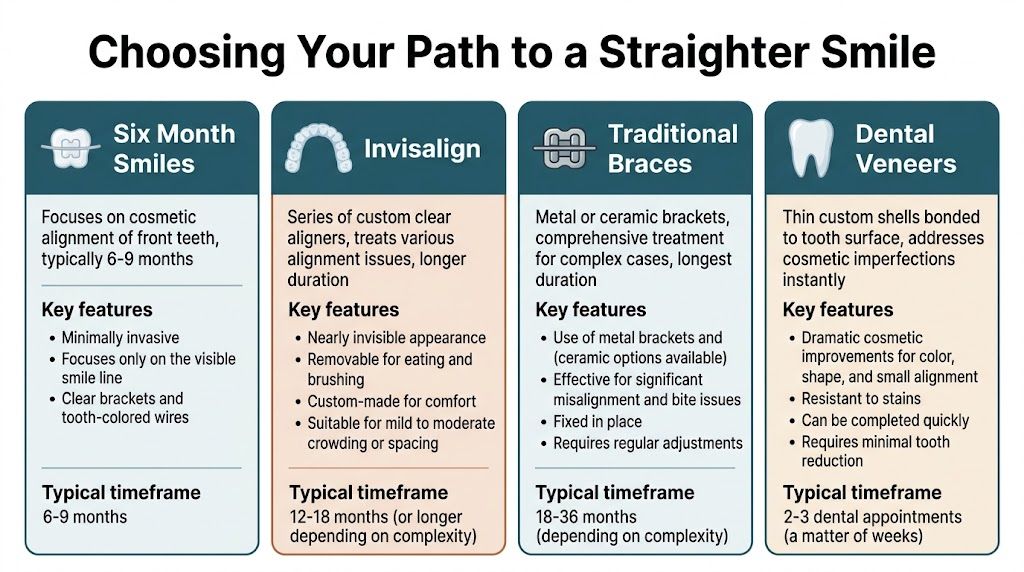
Treatment Comparison Finding Your Best Smile Solution
| Treatment | Average Cost | Treatment Time | Best For |
|---|---|---|---|
| Six Month Smiles | $3,000 to $5,500 | Cosmetic alignment of front teeth, often completed within the short-term range discussed earlier | Adults who want visible front-tooth improvement |
| Invisalign | Lower-end pricing may start at $1,800, with averages reported higher up to $9,500 | Varies by case | Patients who may need broader tooth movement and want removable aligners |
| Traditional braces | $3,000 to $7,000 | Longer comprehensive treatment | More involved orthodontic correction |
| Veneers | Varies by material, design, and number of teeth | Cosmetic transformation after treatment planning | Shape, color, and surface appearance concerns rather than tooth movement |
The biggest difference isn't just price. It’s the type of problem each option solves.
Six Month Smiles is often a cosmetic alignment tool. Traditional braces offer broader treatment options. Invisalign can be a better fit when a patient wants removable treatment and may need movement beyond the front teeth. Veneers don't move teeth at all. They change the appearance of the tooth surface.
How to think through the trade-offs
A patient deciding between these options should think in terms of goals, not labels.
If the concern is front teeth that look slightly crowded in photos, Six Month Smiles may be a direct fit. If the concern includes bite issues, tooth position throughout the arch, or the convenience of removable trays, it helps to understand how Invisalign works.
If the concern is shape, color, chips, or the appearance of individual teeth rather than actual alignment, veneers may deserve a closer look. They can create a fast cosmetic change, but they aren't orthodontics and shouldn't be treated as a substitute when tooth movement is the real need.
The right treatment often becomes obvious when the goal is stated clearly. "Straighter front teeth" points one way. "Healthier bite and full alignment" points another. "Whiter and reshaped teeth" points somewhere else.
People often feel relief once the comparison is framed this way. It turns a confusing list of products into a simpler question. What exactly needs to change for the smile to feel right?
Making Your New Smile Affordable in Fairfield County
Cost matters, but timing and payment structure matter too. Many patients can handle treatment much more comfortably when the plan is broken into predictable monthly payments instead of one large upfront expense.

For adults in Fairfield County, affordability often comes down to organization. A treatment that looks out of reach on day one may feel realistic once insurance, financing, and membership savings are reviewed together.
Common ways patients spread out the cost
Some practices offer financing options that divide treatment into monthly payments. Earlier in this article, the reported monthly range from a verified source was noted, and that can make cosmetic orthodontics easier to plan around than many people expect.
Other common ways patients reduce pressure on the budget include:
- Insurance coordination: Some plans may help with limited orthodontic treatment, depending on the policy.
- Flexible spending tools: HSA and FSA funds can be useful when eligible.
- Structured payment plans: Spreading treatment across monthly installments can keep planning simpler.
- Membership savings: Patients without traditional insurance often look for office membership plans that reduce preventive and treatment costs.
For households comparing options, an in-house savings plan can be especially valuable. Patients looking into membership-based budgeting can review the Power Plan Membership to see whether that approach fits their situation.
Why all-inclusive planning matters
The most helpful financial conversation isn't only about the braces. It’s about the entire path. That means asking whether diagnostics, follow-ups, and retention are discussed early, and whether any related dental care should be handled before treatment starts.
A transparent office usually makes the process feel calmer because the patient knows what is being paid for and when. That removes a lot of the uncertainty that causes people to postpone treatment for months or years.
A good cost conversation should leave the patient with answers to practical questions:
- What is included in the quote
- What might be separate
- What payment options are available
- What first step confirms candidacy
When those answers are clear, smile treatment stops feeling like a luxury category and starts feeling like something that can be planned responsibly.
Your Six Month Smiles Questions Answered
People usually reach the end of their research with a few practical concerns that still need a straight answer. These are the questions that most often shape whether someone books a consultation or keeps waiting.
Is it painful
Six Month Smiles uses gentle orthodontic forces, so most patients describe the process as pressure and soreness rather than sharp pain. That feeling is usually more noticeable when braces are first placed or adjusted.
The day-to-day reality is often manageable. Soft foods, a little patience, and good brushing habits usually carry people through the early adjustment period.
Will a retainer be needed
Yes. Retention matters after teeth move, especially when the goal is to preserve a cosmetic result. Without a retainer, teeth can shift.
This is one of the most common misunderstandings in smile straightening. Finishing treatment and protecting treatment are two different steps, and both matter.
Teeth can look beautifully straight at the end of active treatment. Keeping them there is the long-term job of retention.
Who is and isn't a good candidate
A good candidate usually wants cosmetic improvement in the front teeth and doesn't need broad bite correction. Healthy gums and teeth are important before any orthodontic movement begins.
Someone may not be a strong fit if the main issue involves the back teeth, a more complex bite, or dental conditions that should be treated first. That’s why an exam should never be skipped in favor of an online price guess.
Patients in Amanda, Lancaster, Circleville, and Carroll who are comparing cosmetic dentistry options often feel more confident once the decision is narrowed to one question. Is the goal to move teeth, reshape teeth, or fully correct the bite? Once that answer is clear, the treatment path usually becomes much simpler.
A straighter smile can feel more attainable than it seemed at the start. For the right case, Six Month Smiles offers a focused cosmetic option with a shorter timeline and a cost range that many adults can plan for responsibly.
Patients who want a personalized answer about six month smile cost, candidacy, and payment options can schedule a consultation with Amanda Family Dental. The team welcomes patients from Amanda, Lancaster, Circleville, and Carroll, Ohio, and provides clear treatment planning that helps families make confident decisions about cosmetic dentistry.