

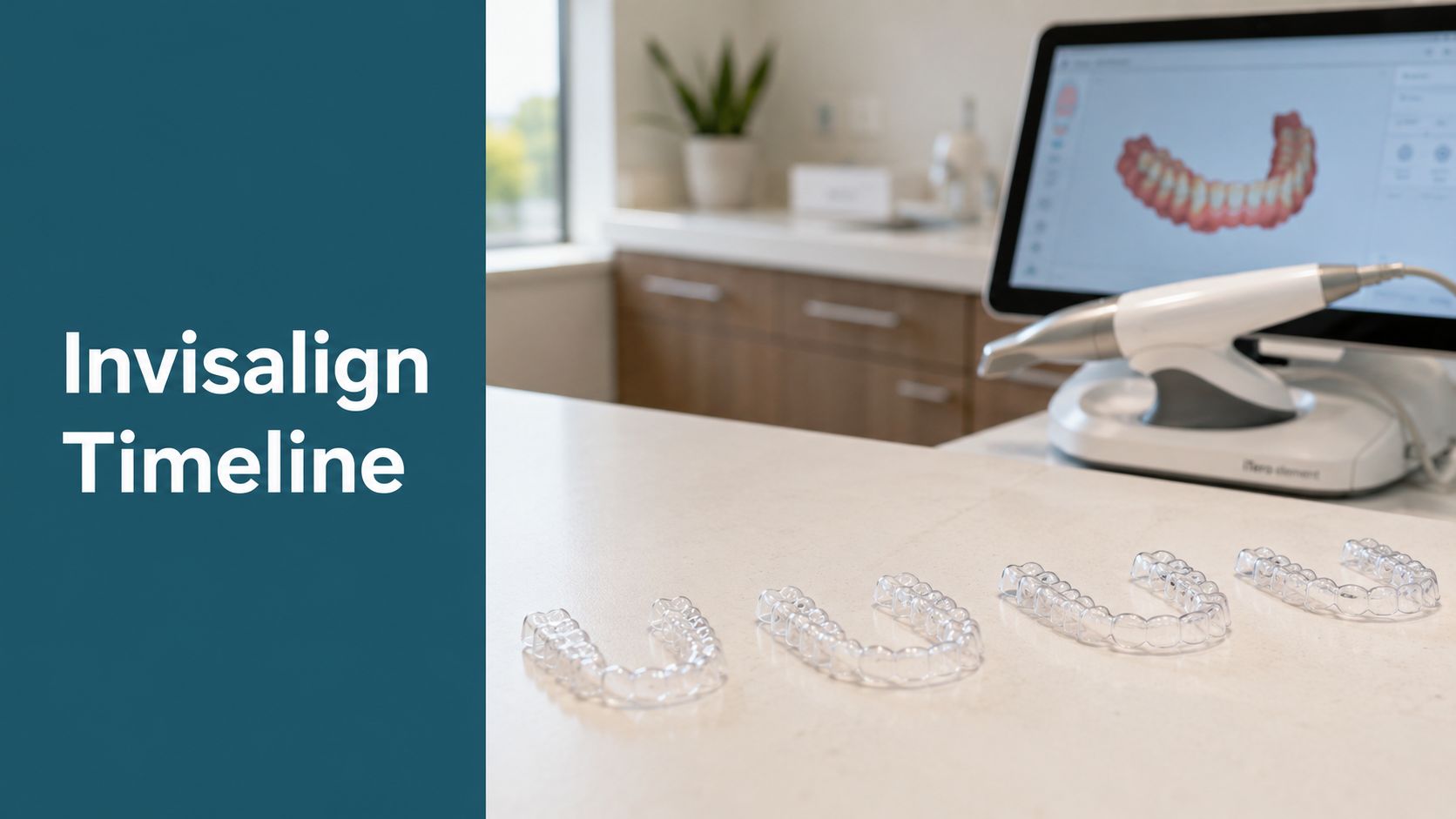
For most adults, the active phase of Invisalign treatment typically takes 12 to 18 months, but the exact timeline depends on that person's smile goals, bite, and how consistently the aligners are worn. Some mild cases can finish sooner, while more involved tooth movements may take longer.
A lot of people in Amanda, Lancaster, Circleville, and Carroll, Ohio start in the same place. They want straighter teeth, but they're not sure how long treatment will take, whether clear aligners will fit daily life, or how much effort the process really involves. That hesitation is normal.
The good news is that Invisalign usually follows a clear sequence. The consultation, digital scan, custom treatment plan, active aligner phase, progress checks, and retention phase each have a purpose. When patients understand that path from the beginning, the whole process feels much more manageable.
Table of Contents
- Your Guide to a Straighter Smile in the Amanda Area
- The First Step Your Personalized Invisalign Consultation
- How Long Does Invisalign Take for Different Cases
- Key Milestones on Your Invisalign Journey
- Factors That Can Speed Up or Slow Down Your Timeline
- Life After Invisalign The Critical Retention Phase
- Your Invisalign Questions Answered
Your Guide to a Straighter Smile in the Amanda Area
A straighter smile usually starts with a simple question. How long is this going to take? For adults who are balancing work, family, school events, and everyday life in Amanda, OH and nearby communities like Lancaster, OH, Circleville, OH, and Carroll, OH, that question matters.
Many people who look for a dentist near me, a cosmetic dentist near me, or a dentist in Amanda, OH are not only thinking about appearance. They're also thinking about comfort, bite function, cleaning crowded teeth more easily, and feeling more confident in photos, at work, or out with friends.
Why Invisalign appeals to busy adults
Invisalign tends to feel less intimidating than traditional braces because the aligners are clear, removable, and built around a digital plan. That makes the process easier to picture from the start. Instead of guessing what change might look like, patients can often see the planned movement before treatment begins.
That clarity matters. People often delay orthodontic care because they assume it will be slow, complicated, or hard to fit into daily life. In reality, many adult cases fit within a predictable treatment window when the case is well planned and the patient stays on schedule.
Practical rule: The Invisalign treatment timeline isn't one fixed number. It's a range shaped by case complexity, aligner wear, and follow-up care.
More than cosmetic improvement
Straightening teeth can support more than smile aesthetics. Depending on the problem being corrected, treatment may help with:
- Oral health: Straighter teeth are often easier to brush and floss well.
- Function: Better alignment can improve chewing and reduce uneven tooth wear.
- Confidence: Many patients feel more comfortable smiling and speaking.
- Planning future care: Aligned teeth can also make some restorative or cosmetic dentistry steps easier to coordinate later.
Someone searching for a dentist in Lancaster, OH or dentist in Circleville, OH may also be comparing offices based on convenience and services beyond Invisalign. That's smart. A full-service dental home can also help with routine cleaning and exams, dental x-rays, new patient exams, teeth whitening, restorative dentistry, tooth extraction needs, dental implants near me searches, and even an emergency dentist visit if something unexpected comes up during life, though not as part of aligner therapy itself.
The First Step Your Personalized Invisalign Consultation
The beginning of Invisalign is usually much simpler than people expect. The first visit is less about pressure and more about clarity. It's the appointment where a patient finds out whether clear aligners fit the smile they want and the bite issues that need correction.

What happens at the first visit
A personalized consultation usually begins with a new patient exam, a review of concerns, and digital x-rays if needed. The dentist checks tooth position, crowding, spacing, bite relationship, and gum health. That part matters because healthy teeth and gums create a better foundation for tooth movement.
Then comes one of the biggest upgrades in modern care. Instead of messy impression material, many offices now use a 3D digital scan to capture the shape of the teeth. This scan creates a precise model that helps guide the aligner plan and gives patients a much clearer picture of what treatment involves.
Patients who want a more detailed look at the mechanics can review how Invisalign works step by step as part of their research before starting care.
A good consultation should answer two questions clearly. Is Invisalign the right tool for this smile, and what kind of timeline is realistic?
Why digital planning can save time
The scan doesn't just improve comfort. It can also make the entire startup phase more efficient. According to this report on digital Invisalign workflow efficiency, a 2023 report by a major dental technology association noted that offices using fully digital workflows can reduce the interval between consultation and first aligner delivery from 2–3 weeks down to 7–10 days, compressing the start phase by roughly 50%.
That's a meaningful difference for someone eager to get started. It can also reduce the sense of downtime between saying yes to treatment and wearing the first tray.
The planning stage is also where the dentist maps out expected tooth movement and discusses whether a case may need attachments or later refinements. This helps the patient understand not only the likely endpoint, but also the shape of the journey.
A short look at the process can make that easier to picture:
How Long Does Invisalign Take for Different Cases
Not every smile needs the same amount of movement. A small front-tooth spacing issue is very different from correcting rotations, crowding, or a bite problem. That's why the Invisalign treatment timeline is usually discussed in ranges rather than one exact promise.
A simple way to think about timing
The broad pattern is straightforward. Mild cases can move faster. Moderate cases often fall into the most common adult range. Complex cases usually require more trays, more monitoring, and sometimes a refinement phase before the final result is complete.
Clinical data supports that middle range. An analysis of over 10,000 adult Invisalign patients found that 60–70% of non-surgical cases completed treatment within 12 to 18 months, while only about 15–20% required more than 24 months.
Adults with minor spacing or limited crowding may finish much sooner than that. More involved bite correction usually sits on the longer end of the spectrum.
Average Invisalign Treatment Timelines by Case Type
| Case Type | Description | Average Treatment Duration |
|---|---|---|
| Mild | Minor spacing, slight crowding, or limited movement focused on front teeth | 6–9 months |
| Moderate | Noticeable crowding or spacing, mild bite concerns, broader alignment changes | 12–18 months |
| Complex | Significant rotations, deeper bite correction, or larger movement across the arch | 12–24 months |
This table is a practical planning tool, not a diagnosis. The actual timeline still depends on the details of the bite, the way the teeth respond, and whether the aligners are worn as directed.
Patients comparing options for adult orthodontic care can also review teeth straightening options for adults to understand when clear aligners make the most sense.
Why adults sometimes take longer
Adults often ask whether age matters. It can. Verified background on adult aligner treatment notes that adult cases commonly average 12–18 months, while adolescent cases with similar crowding severity often report 12–16 months, suggesting adults may need 2–4 months longer when compliance is equal. That difference is tied to slower bone turnover and denser supporting tissues, as described in this overview of adult Invisalign treatment timing.
That doesn't mean adults are poor candidates. It means the movement may be a little slower, and that slower pace is often completely normal.
Key Milestones on Your Invisalign Journey
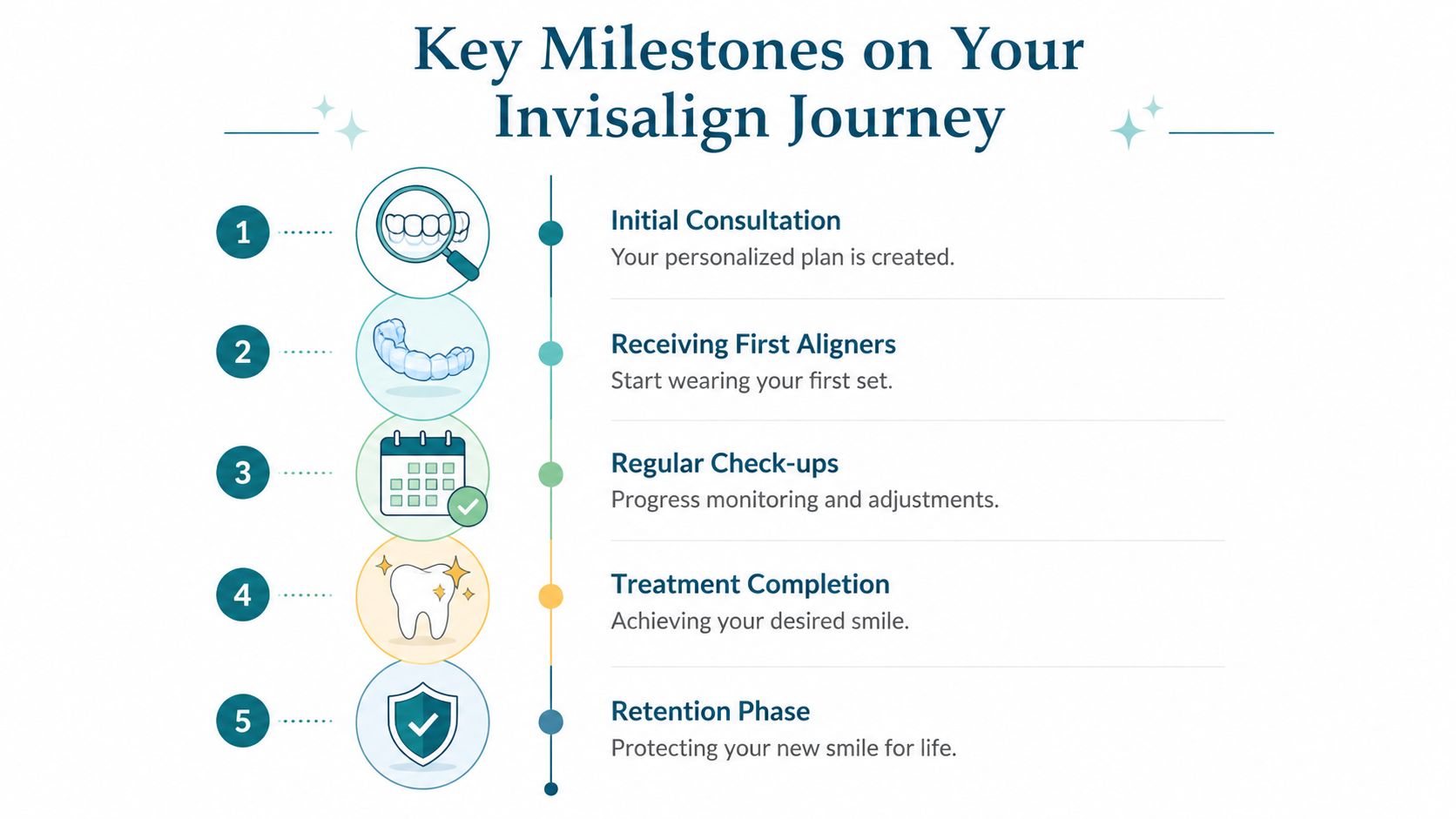
Many patients feel more comfortable once the process is attached to events, not just months on a calendar. Invisalign tends to feel less abstract when the journey is broken into milestones that mark visible progress.
What the phases feel like in real life
Clinically, Invisalign treatment often follows three phases: an initial alignment phase (months 1-3), a major-movements phase (months 4-12) for rotations and crowding, and a final-adjustments phase (months 13-18+) for subtle refinements.
In the first phase, patients usually notice pressure more than dramatic visual change. The aligners feel snug, speech may feel a little different for a short time, and daily habits start to shift around meals and brushing. This is the adjustment period.
The middle phase is often where the biggest smile changes become easier to see. Teeth that looked crowded or uneven begin to line up more clearly, and the bite starts moving toward the planned position.
Many patients don't notice change tray by tray. They notice it when comparing a current smile to a photo from the start.
Common treatment moments that surprise patients
A few common milestones catch patients off guard, even when treatment is going smoothly:
- Receiving the first aligners: This is when the plan becomes real. Patients learn how to insert, remove, clean, and store trays.
- Changing trays regularly: Most plans involve switching to a new set every 1 to 2 weeks, depending on the dentist's instructions and the case design.
- Routine progress visits: Check-ups typically happen every 6 to 8 weeks so the dentist can confirm that the teeth are tracking properly.
- Attachments: Some cases need small tooth-colored shapes bonded to certain teeth. These help the aligners grip better for tougher movements.
- Refinements: Near the end, some patients need another scan and a few additional trays to polish the final result.
Those refinements aren't a sign that treatment failed. Teeth are living structures, not machine parts. Sometimes they need a small course correction to reach the intended finish.
For patients in Amanda, OH or nearby communities, that milestone-based view often makes the treatment timeline feel far more approachable. Instead of one long unknown process, it becomes a sequence of manageable steps.
Factors That Can Speed Up or Slow Down Your Timeline
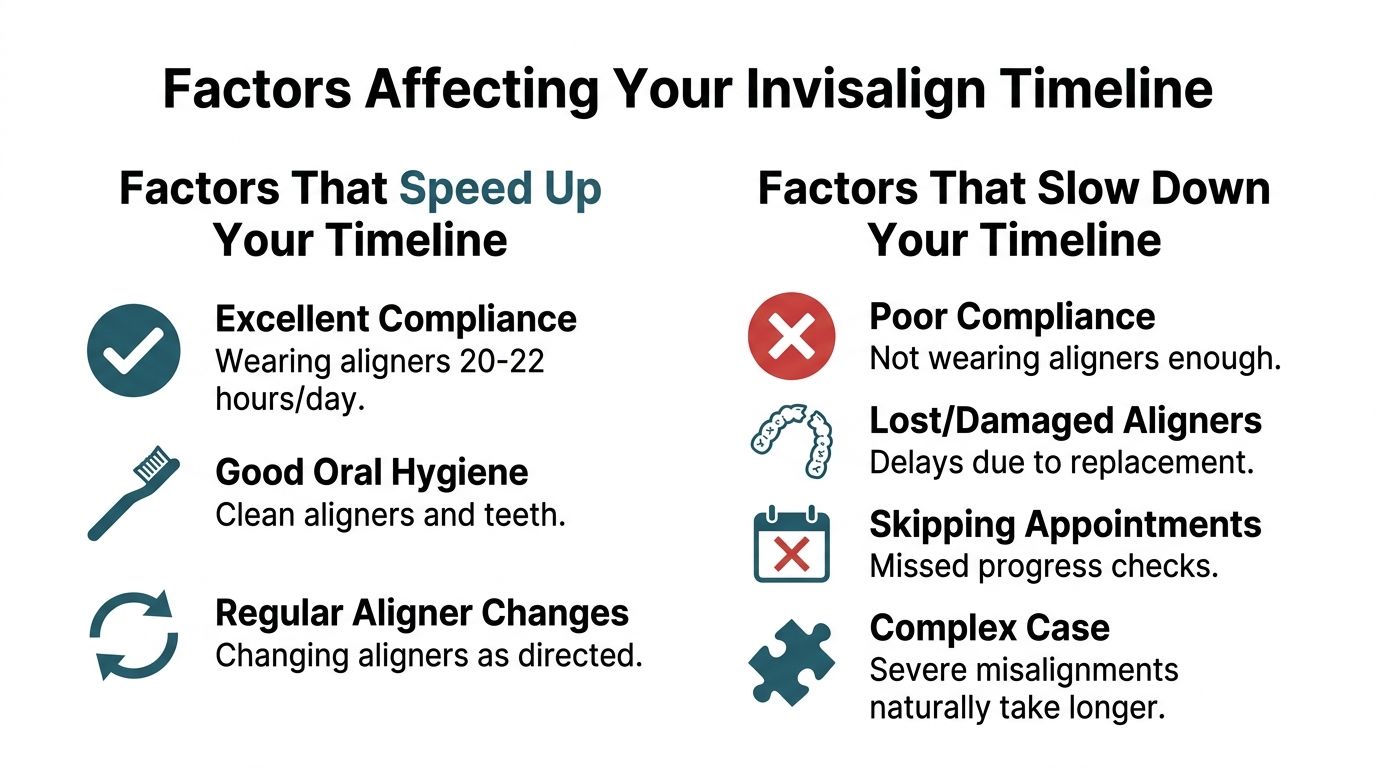
Some parts of Invisalign are set by biology and case complexity. One part is strongly shaped by the patient's daily habits. If there's a single factor that most often separates on-time treatment from delayed treatment, it's wear time.
The biggest factor is daily wear time
Aligners only work when they're in the mouth. The planned pressure on the teeth depends on consistent contact, not occasional use. Verified research on aligner mechanics shows that wearing aligners for less than 20 hours per day significantly reduces effective force levels and can extend treatment time by 20–40% compared to compliant patients.
That's why dentists emphasize the same daily target so often. The usual goal is 20–22 hours a day. Meals, brushing, and flossing fit into the small window when trays are out.
What helps and what gets in the way
The easiest way to stay on schedule is to think in terms of habits that help and habits that interfere.
- Wear them as directed: The trays should stay in for most of the day and night.
- Change them on schedule: Delays in switching trays can delay movement.
- Keep them clean: Clean aligners and good brushing habits support a smoother experience.
- Attend check-ups: Progress visits help catch tracking issues early.
The habits that commonly slow treatment are just as predictable.
- Leaving trays out too long: This is the most common reason patients fall behind.
- Losing or cracking trays: Replacements can interrupt the schedule.
- Skipping visits: Problems that could have been fixed early may take longer to correct later.
- Underestimating case difficulty: More complex bite and rotation problems naturally need more time.
Helpful mindset: Invisalign works best when it becomes part of a routine, not a decision that gets renegotiated every day.
Age and individual response also play a role, but they aren't things a patient can control. Daily consistency is.
Life After Invisalign The Critical Retention Phase
Finishing the last aligner feels like the end, but it's really the start of protecting the result. Teeth have a natural tendency to shift after active movement, especially early on, which is why the retention phase matters so much.

Why retention matters so much
Verified retention guidance recommends full-time retainer wear for the first 3–6 months, usually 20–22 hours per day, followed by nighttime-only wear for at least 1–2 years, and often longer for lower front teeth. Patients who want a broader overview of adult tooth movement and retention can review adult orthodontic care information.
The reason for that structure is simple. The bone and soft tissues around the teeth need time to stabilize in the new positions. If retainers are abandoned too early, the smile can begin to drift.
That risk isn't minor. This retention overview notes that patients who stop wearing retainers within the first year have a relapse rate as high as 40–60% in dental arch alignment, especially in the lower front teeth.
The last aligner finishes movement. The retainer protects the outcome.
For many patients, understanding this from the beginning changes expectations in a healthy way. The active phase may be measured in months, but the long-term success of the smile depends on what happens after the trays are done.
Your Invisalign Questions Answered
Will Invisalign hurt?
Most patients describe pressure more than pain, especially when starting a new tray. That pressure is a sign the aligner is working.
Can patients eat normally?
Yes. The aligners come out for meals, so there aren't the same food restrictions that many people associate with braces.
What if an aligner feels tight?
A snug fit is expected when switching trays. If a tray won't seat properly or feels very off, the dental office should check it.
Do attachments mean something is wrong?
No. Attachments are a normal part of many cases. They help the aligners move certain teeth more precisely.
Will every patient need refinements?
Not every patient will, but some do. Small finishing adjustments are common in orthodontics and can improve the final result.
Can Invisalign fit into a busy schedule?
Usually, yes. Because the aligners are removable and follow a planned sequence, many adults find the process easier to manage than they expected.
People searching for a dentist in Carroll, OH, a dentist in Lancaster, OH, or a dentist near me often want one clear next step. The best answer is a personalized consultation. That visit can evaluate tooth alignment, review smile goals, and determine whether Invisalign is the right choice alongside other services such as cosmetic dentistry, restorative dentistry, dental implants, routine dental care, or emergency dental services.
Amanda Family Dental provides personalized Invisalign consultations for patients in Amanda, OH, Lancaster, OH, Circleville, OH, and Carroll, OH. From new patient exams and digital x-rays to customized treatment planning and comfortable ongoing care, the team helps patients understand their options clearly and move forward with confidence. To schedule an appointment or request a consultation, visit Amanda Family Dental.