

A lot of adults in Amanda, Lancaster, Circleville, and Carroll look in the mirror and notice the same thing. A few teeth have shifted. A bite feels off. Smiling in photos takes more effort than it used to. They often assume orthodontics is something they missed as teenagers, not something that still fits into adult life.
That assumption doesn't hold up anymore. The American Association of Orthodontists says 1 in 3 orthodontic patients today are adults, a shift tied to less visible treatment choices and stronger interest in both health and appearance, according to the AAO's update on adult orthodontic care. For working adults, parents, and busy professionals, that matters. A straighter smile no longer has to mean a very obvious treatment path.
Many adults also aren't looking for a “perfect” smile. They want something more practical. They want teeth that are easier to clean, a bite that feels balanced, and options that won't draw unwanted attention at work or social events. That's where a thoughtful, local dental team can make the process feel a lot more manageable.
Table of Contents
- Your Guide to a More Confident Smile as an Adult
- Are You a Candidate for Adult Orthodontics
- Modern Orthodontic Options for Adults in Ohio
- The Health and Confidence Benefits of Treatment
- Your Orthodontic Journey at Amanda Family Dental
- Maintaining Your New Smile After Treatment
- Frequently Asked Questions About Adult Orthodontics
Your Guide to a More Confident Smile as an Adult
An adult considering orthodontics usually isn't starting from vanity alone. It often begins with a small daily annoyance. Food catches between crowded teeth. The front teeth look more uneven than they did a few years ago. A person smiles with lips closed during work meetings, family pictures, or community events around Amanda, OH.
That hesitation is common, especially for adults who worry they'll look “too old for braces” or that treatment will interrupt a full schedule. In reality, adult orthodontics has become part of ordinary dental care. It fits around jobs, parenting, and day-to-day life much better than many people expect.
A common situation adults recognize
A patient might have had braces years ago and stopped wearing a retainer. Another may have never had orthodontics at all, but now notices crowding getting worse. Someone else may be less concerned about straightness and more concerned that the bite no longer feels comfortable while chewing.
Many adults delay treatment because they think the concern is too minor to matter. Small alignment issues can still affect comfort, cleaning, and confidence.
Adults also tend to ask better questions than teens. They want to know how visible treatment will be, how long it may take, and whether the result will help function, not just appearance. Those are the right questions.
A local decision, not just a cosmetic one
For many households in Lancaster, Circleville, Carroll, and Amanda, choosing orthodontic care is part of a broader plan for long-term dental health. A better-aligned bite can support routine dental care like cleanings and exams, restorative dentistry, and cosmetic dentistry.
That local connection matters because adult treatment works best when it fits real life. Appointment scheduling, communication, and a personalized plan all shape whether someone feels comfortable starting. Adults don't need pressure. They need clear information and a practical path forward.
Are You a Candidate for Adult Orthodontics
You may be a candidate if you keep noticing the same small problem in everyday life. A front tooth catches your lip in photos before a meeting. Floss shreds in one tight spot every night. Your bite feels a little off when you chew, even if no one else would notice.
That pattern matters.
Adults often assume orthodontics only makes sense for severe crowding or a very obvious bite problem. In reality, many adult evaluations start with a simpler question. Are your teeth and bite making daily life harder than they should?
A healthy orthodontic plan also depends on the foundation underneath it. Teeth can be moved at almost any adult age if the gums and bone are in good condition. If gum disease, untreated decay, or worn dental work is part of the picture, those issues may need attention first so treatment is safer and more predictable.
Signs that may point to treatment
Several common concerns can point to adult orthodontic treatment:
- Crowded teeth can trap plaque and make brushing or flossing more frustrating.
- Spaces between teeth may affect appearance, but they can also change how teeth contact each other when you bite.
- A deep overbite can place extra pressure on certain teeth and sometimes contributes to wear.
- An underbite or crossbite may make chewing feel uneven.
- Crooked front teeth often bother adults most because they show during conversations, video calls, and photos.
- Shifting after past braces is common, especially after years without a retainer.
- Teeth that look fine but do not meet well can still deserve an orthodontic evaluation.
Bite problems work a bit like misaligned tires on a car. You may still get where you need to go, but parts wear down unevenly over time. The goal of an exam is to see whether the problem is mainly cosmetic, mainly functional, or a mix of both.
When it makes sense to schedule an evaluation
An evaluation is a good next step if any of these situations sound familiar:
- You avoid smiling fully at work or in photos because one area of your teeth draws your attention.
- Cleaning certain teeth is consistently difficult because they overlap, rotate, or sit too tightly together.
- Your bite feels unbalanced and one side seems to do more of the chewing.
- You had braces years ago and have noticed gradual shifting.
- You are planning other dental treatment such as crowns, veneers, or implants and want to know whether tooth position should be addressed first.
Adults usually ask practical questions right away. How visible will treatment be at work? How long might it take? Can it fit alongside cosmetic or restorative plans already on the calendar? Those are exactly the right questions to bring to a consultation, and they are part of how we help patients sort through teeth straightening options for adults at Amanda Family Dental.
Some adults will be ready for aligners or braces soon after the exam. Others need gum treatment, a cavity repaired, or a broader plan that combines orthodontics with cosmetic or restorative care. That does not mean treatment is off the table. It means the plan should match your mouth, your timeline, and the way you want to look and function during treatment.
Modern Orthodontic Options for Adults in Ohio
You may be sitting at your desk in a meeting, wondering whether orthodontic treatment can improve your smile without drawing attention at work. That is a common adult concern. The good news is that today's options give you more than one way to straighten teeth, and the best choice depends on how your teeth fit together, how visible you want treatment to be, and how treatment fits with the rest of your dental plans.
What adults usually compare first
Adults rarely ask only, “What works?” They usually ask, “What will this look like during the workday?” “How much will it change meals and brushing?” and “Can I do this before veneers, crowns, or an implant?”
Those are smart questions.
Modern orthodontics uses digital scans and treatment planning to make care more precise and more comfortable than many adults expect. As Melbourne Orthodontics explains in its overview of adult orthodontic technology, tools such as 3D printing are used to create customized aligners and appliances. In plain terms, that means your treatment is designed for your teeth, not pulled from a one-size-fits-all template.
If you are comparing teeth straightening options for adults, these are usually the deciding factors:
- Appearance. How noticeable will the appliance be in professional and social settings?
- Flexibility. Can you remove it for meals, coffee, and brushing?
- Control. Does the treatment depend heavily on wearing trays consistently, or is it fixed in place?
- Complexity of the case. Is the goal a small cosmetic change, a bite correction, or both?
- Coordination with other dental work. Will tooth movement need to happen before cosmetic or restorative treatment?
Comparing the main treatment choices
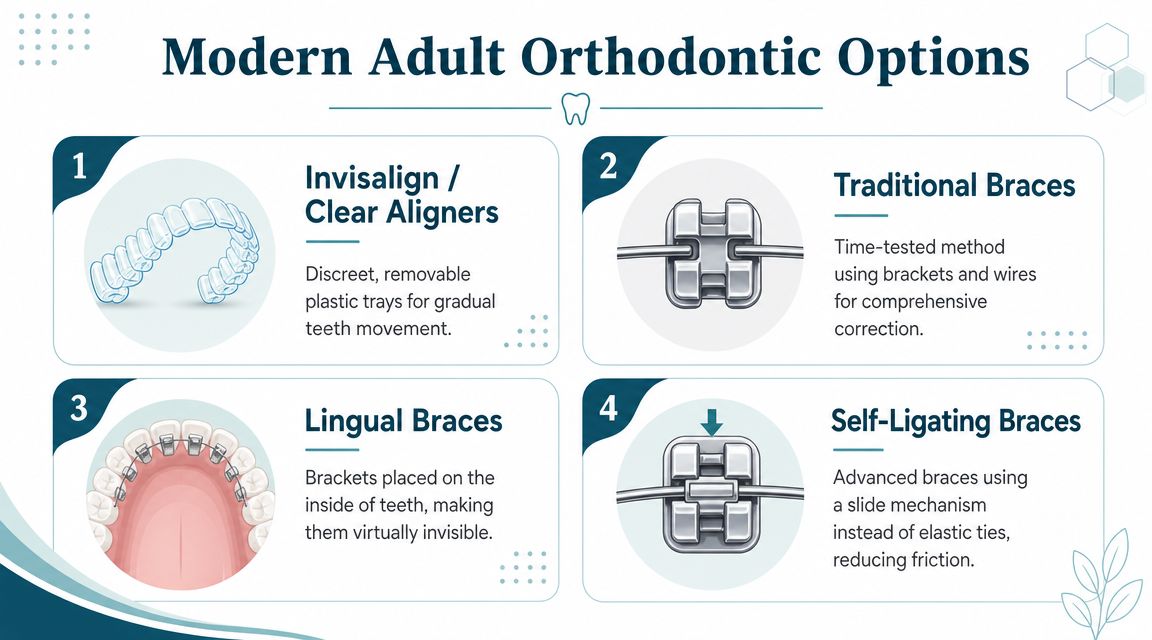
Clear aligners are often the first option adults ask about, especially if they want a subtle appearance. They use a series of clear trays to move teeth in stages. You take them out to eat and brush, which many adults like because daily routines feel more normal. The tradeoff is responsibility. Aligners only work well if you wear them as instructed.
Ceramic braces move teeth the same basic way as traditional braces, but the brackets are less noticeable because they blend in more with the teeth. Adults who need fixed treatment often like ceramic braces because they offer more visual discretion without asking the patient to remember trays.
Traditional metal braces are still a reliable option for many alignment and bite concerns. They are more visible, but they are effective and constantly working because they stay on the teeth. For some adults, especially those with more involved tooth movement, that fixed design can be a practical advantage.
Lingual braces attach to the back surfaces of the teeth, so they are much harder to see from the front. Adults in public-facing roles sometimes ask about them for that reason. They can be a strong choice, although they may take more adjustment at first because the tongue notices them right away.
| Treatment | Best For | Visibility | Avg. Treatment Time |
|---|---|---|---|
| Clear aligners | Adults who want removable, discreet treatment for suitable alignment or bite needs | Low | Often similar to braces when worn as directed |
| Ceramic braces | Adults who need fixed treatment with a less noticeable look | Moderate to low | Some systems may take about 1 to 3 years |
| Traditional metal braces | More involved correction and adults who want a fixed system | High | Case-dependent |
| Lingual braces | Adults focused on keeping treatment hidden | Very low from the front | Case-dependent |
Treatment length depends less on age and more on what needs to move. A mild spacing issue usually finishes faster than a bite that needs broader correction. The timeline also depends on whether you are combining orthodontics with other care, which is common for adults planning cosmetic upgrades or restorative work.
That is why an adult orthodontic plan should feel coordinated. At Amanda Family Dental, we help patients sort through whether clear aligners, ceramic braces, metal braces, or another approach makes the most sense for their smile goals, work life, and treatment schedule.
The best orthodontic option for an adult is the one that fits the bite problem, daily routine, appearance concerns, and any other dental treatment already being planned.
The Health and Confidence Benefits of Treatment

You may feel fine about your smile most days, then notice the problem at a work meeting, on a video call, or in a family photo. One tooth overlaps another. Your bite feels off on one side. Food catches in the same crowded spot every evening. For many adults, that is the starting point. Not vanity. Friction.
Orthodontic treatment can improve two things at once. It can make your smile easier to live with every day, and it can help you feel more comfortable showing it.
When orthodontics is about more than appearance
Teeth work best as a team. If one tooth is turned, crowded, or biting too hard, the whole system has to compensate. A bite that does not come together evenly can place extra force on certain teeth, create sore spots when chewing, or leave you feeling like one side of your mouth does more of the work.
Cleaning matters here too. Straightening teeth does not replace brushing and flossing, but it can remove some of the obstacles. When teeth are less crowded or twisted, it is often easier to reach the gumline and clean between teeth well. That can make daily home care feel less like trying to sweep between furniture pushed too close together.
Adults are often balancing more than alignment alone. They may be planning whitening, bonding, crowns, or other dental work and want those pieces to fit together in the right order. Orthodontics can create a better foundation for that kind of planning, which is one reason coordinated care matters at Amanda Family Dental.
Orthodontic treatment often improves function and appearance at the same time, which is why many adults feel the benefits in daily life before they ever compare before-and-after photos.
A short overview can help clarify how bite correction supports long-term comfort:
If you are considering clear aligners because appearance at work matters to you, our guide on how Invisalign works for adults day to day can help you picture what treatment feels like.
Why confidence changes matter too
Confidence is not a small benefit. Adults often spend years adjusting around a smile concern without realizing how much energy it takes. They smile with lips closed. They angle their face in photos. They cover their mouth when laughing. In professional settings, they may speak clearly and do their job well, but still feel distracted by the thought that people are noticing their teeth first.
Treatment can relieve that constant self-monitoring.
The change is usually gradual. You may first notice it when you stop checking your smile in the phone camera before a meeting. Or when you laugh in a picture with your family and do not ask to retake it. Those moments matter because they affect how you move through ordinary life, not just how your teeth look on paper.
For many adults, the strongest result is a combination of comfort, health, and self-assurance. A bite that feels more balanced. Teeth that are easier to keep clean. A smile that feels more like your own.
Your Orthodontic Journey at Amanda Family Dental
Starting treatment feels easier when the process is clear. Most adults are less anxious about the orthodontics itself than about not knowing what happens first, how often visits are needed, and what daily life will look like during treatment.
How the process usually starts
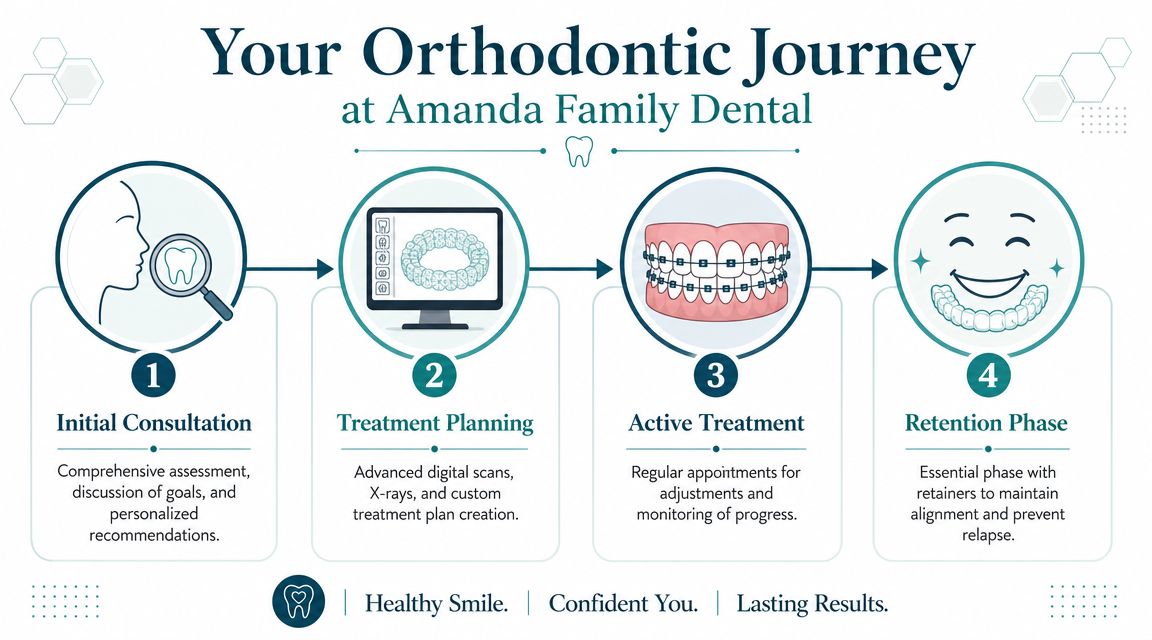
The first step is a consultation and exam. That visit typically looks at tooth alignment, bite position, gum health, and any existing dental work that could affect treatment planning. Digital imaging and dental X-rays help show what's happening below the surface, not just what's visible in the mirror.
This early stage is also where adults can raise the questions that matter to them most. They may want the least noticeable option. They may need to coordinate orthodontics with cosmetic dentistry, restorative dentistry, or general dental care. Some are also balancing treatment with work travel, parenting schedules, or other family appointments.
For patients exploring clear aligners specifically, how Invisalign works gives a useful look at the day-to-day basics of tray wear and follow-up care.
What happens during active treatment
Once records are gathered, the treatment plan becomes more specific. The plan may recommend aligners, braces, or another approach based on the bite and the goals discussed during the exam. This is also where realistic expectations get set around wear time, hygiene, and the likely sequence of appointments.
During active treatment, regular visits matter because tooth movement needs monitoring. Appliances may need adjustment, progress needs review, and small refinements may be needed along the way. These appointments are usually straightforward, but they're an important part of keeping treatment efficient and predictable.
Amanda Family Dental provides services that include digital X-rays, new patient exams, Invisalign clear aligners, cosmetic dentistry, restorative dentistry, and routine dental care, which can help adults coordinate orthodontic decisions with broader oral health needs.
A good orthodontic plan answers two questions at the same time. What will move the teeth well, and what will the patient realistically be able to follow through on?
The final active-treatment phase leads into retention. That step doesn't get as much attention at the start, but it matters just as much as the aligners or braces themselves.
Maintaining Your New Smile After Treatment
You finish treatment, look in the mirror, and finally see the smile you were hoping for. Then a practical question sets in. How do you keep it that way while balancing work, family, meals out, and everyday life?
Why retainers matter so much
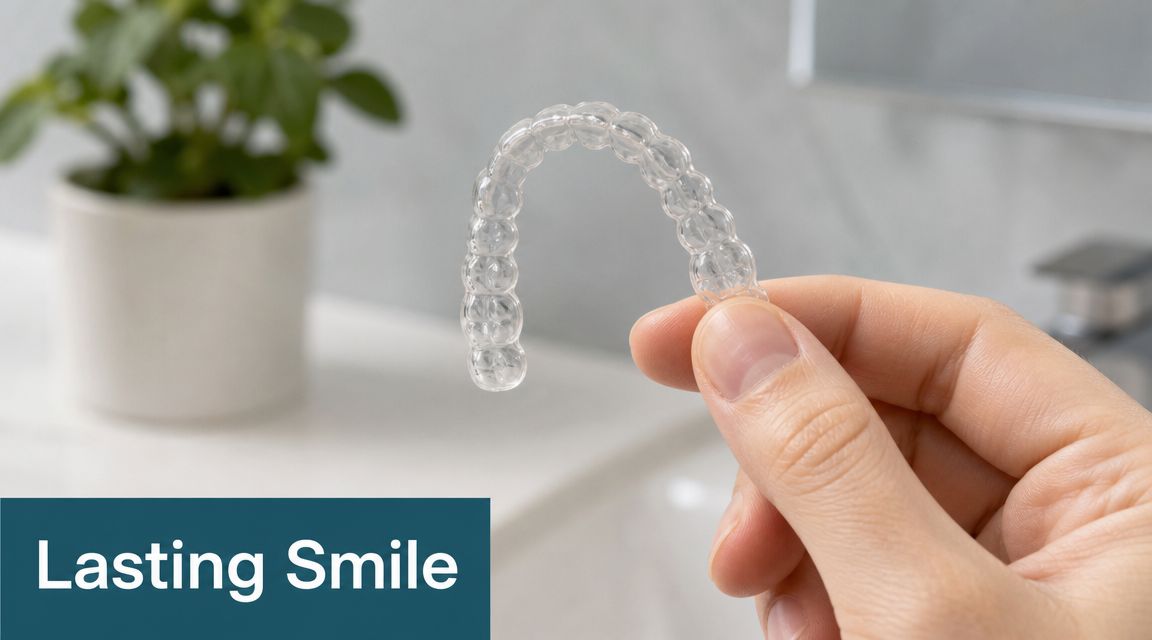
Teeth do not become permanently fixed in their new positions the day braces or aligners come off. The bone and gum tissue around them still need time to settle. A retainer works like a support brace after a knee injury. It holds the result steady while the surrounding structures adapt.
This matters even more for adults. Many adults start orthodontic treatment because they noticed gradual shifting over the years, often after previous braces in their teens or after dental work changed the bite. That same tendency to move does not disappear at the finish line.
Retention protects the time, effort, and money you already put into treatment. It also protects the professional appearance you worked toward. For many adults, that means keeping a smile that feels polished in meetings, photos, and daily conversation.
Useful habits after treatment often include:
- Wear retainers as directed so teeth stay in position while your mouth adjusts.
- Keep up with cleanings and exams because healthy gums help support stable tooth position.
- Report changes early if your retainer feels tighter than usual or teeth start to look different.
- Stay consistent with home care using brushing, flossing, and daily gum care habits.
Good retention and healthy gums go together. If you want practical home-care ideas, gum care tips for preventing gum disease can help support your smile after orthodontic treatment.
Combining orthodontics with other smile goals
Straight teeth are often the first step, not always the last one.
Some adults are fully happy once alignment is complete. Others want to whiten their teeth, refine shape with veneers, or replace worn or damaged dental work after the bite has been corrected. That order often makes sense. Straightening first creates a more accurate foundation, so cosmetic or restorative treatment can be planned around where the teeth belong, not where they used to sit.
This is one of the biggest advantages of adult treatment planned with the whole mouth in mind. Instead of using cosmetic dentistry to cover a spacing or bite problem, you can correct the position first and make later decisions with more confidence. At Amanda Family Dental, that can make the process feel more coordinated because orthodontic care, routine dental care, and follow-up smile improvements can be discussed together.
If you are the kind of adult who wants a result that looks good and lasts, retention is part of the treatment, not an optional extra. Keeping that final result steady is what turns months of progress into a long-term change.
Frequently Asked Questions About Adult Orthodontics
Does adult orthodontic treatment hurt
Most adults describe treatment as pressure or soreness rather than sharp pain. New aligners, adjustments, or early tooth movement can create temporary tenderness. That usually settles as the mouth adapts.
Will treatment affect work or professional life
It can, but usually less than expected. Adults who want low visibility often lean toward clear aligners, ceramic braces, or lingual braces. Some speech adjustment can happen at first with certain appliances, especially aligners or braces behind the teeth, but patients adapt with regular wear.
Can adults with crowns or fillings still get orthodontics
Often, yes. Existing dental work doesn't automatically rule out treatment. The key is careful planning. The exam should look at the condition of the teeth, the gums, and the bite before deciding how to move teeth safely.
How much does adult orthodontic treatment cost
Cost depends on the complexity of the case, the type of appliance, the length of treatment, and whether other dental care needs to happen first. A simple alignment case won't be priced the same as a more involved bite correction. The most useful next step is a consultation where the treatment options, timeline, and payment choices can be reviewed clearly.
Adults usually feel more comfortable once they know the plan, the expected routine, and what problem the treatment is meant to solve.
Adults in Amanda, OH, Lancaster, OH, Circleville, OH, and Carroll, OH don't have to keep guessing whether orthodontic treatment is still an option. Amanda Family Dental offers exams, digital X-rays, Invisalign clear aligners, cosmetic dentistry, restorative care, and patient-focused treatment planning that can help determine whether adult orthodontics fits a person's goals, bite, and schedule. Scheduling a consultation is the clearest way to find out what's possible and what next steps make sense.