

Tooth pain has a way of turning an ordinary day into a decision you didn't plan for. One visit, one X-ray, one sentence about a root canal, and suddenly the question isn't just, “How do we fix this?” It's, “Do we have to take that route at all?”
For patients searching for a dentist near me in Amanda, OH, Lancaster, OH, Circleville, OH, or Carroll, OH, the answer depends on what's happening inside the tooth. Some teeth can still be saved with conservative care. Some need root canal alternative treatments that still preserve part of the tooth. Others are too damaged and need tooth extraction with a replacement plan.
| Alternative | Typical Cost Range | Recovery | Best Fit |
|---|---|---|---|
| Pulp capping | Varies by case | Usually minimal | Small exposure, pulp still vital |
| Pulpotomy | Varies by case | Usually short | Coronal pulp is diseased, root pulp still healthy |
| Retreatment | Varies by case | Moderate | Prior root canal has failed, tooth is still salvageable |
| Apicoectomy | Varies by case | Moderate | Persistent infection after prior treatment |
| Extraction | Varies by case | Healing required | Tooth can't be saved predictably |
| Extraction plus implant | Varies by case | Longer overall pathway | Tooth is unrestorable and replacement is planned |
Table of Contents
- When a Root Canal Comes Up, You Have Options
- Why Dentists Recommend Root Canal Therapy First
- Conservative Alternatives That Save the Pulp
- Surgical Salvage Options After a Failed Root Canal
- Extraction as a Last-Resort Alternative
- Comparing Every Alternative Side by Side
- How Amanda Family Dental Decides Which Option Fits You
- Next Steps and Common Questions
When a Root Canal Comes Up, You Have Options
A patient hears “root canal” and often assumes the conversation is over. It isn't. The right path depends on how much of the pulp is still healthy, whether the tooth has already been treated, and whether the tooth can be predictably restored after care.
A cracked molar in Lancaster is not the same as a front tooth with a recent exposure in Circleville. A tooth that's already failed once is not the same as one with a small, fresh cavity near the nerve. That's why root canal alternative treatments are best thought of as a decision tree, not a shopping list.
Practical rule: if the tooth can still be saved predictably, preservation comes first. If it can't, extraction becomes the honest answer.
The four broad paths
The options usually fall into four groups. Some try to save the pulp, some try to salvage a treated tooth, and some remove the tooth and plan for replacement.
- Pulp-saving care includes direct pulp capping, indirect pulp capping, and pulpotomy.
- Surgical salvage includes nonsurgical retreatment and endodontic surgery, with apicoectomy as a common example.
- Extraction removes the tooth completely.
- Replacement follows extraction with a bridge, partial denture, or implant.
That last part matters. Extraction is not the end of treatment, it's the start of a different plan. Patients often ask whether they can avoid a root canal and “just pull it,” but that question only makes sense if they also want to talk about chewing, appearance, and replacement timing.
The short version is simple. If a tooth still has a realistic chance of lasting, save it. If the tooth can't be saved, remove it and replace it on purpose, not by accident.
Why Dentists Recommend Root Canal Therapy First
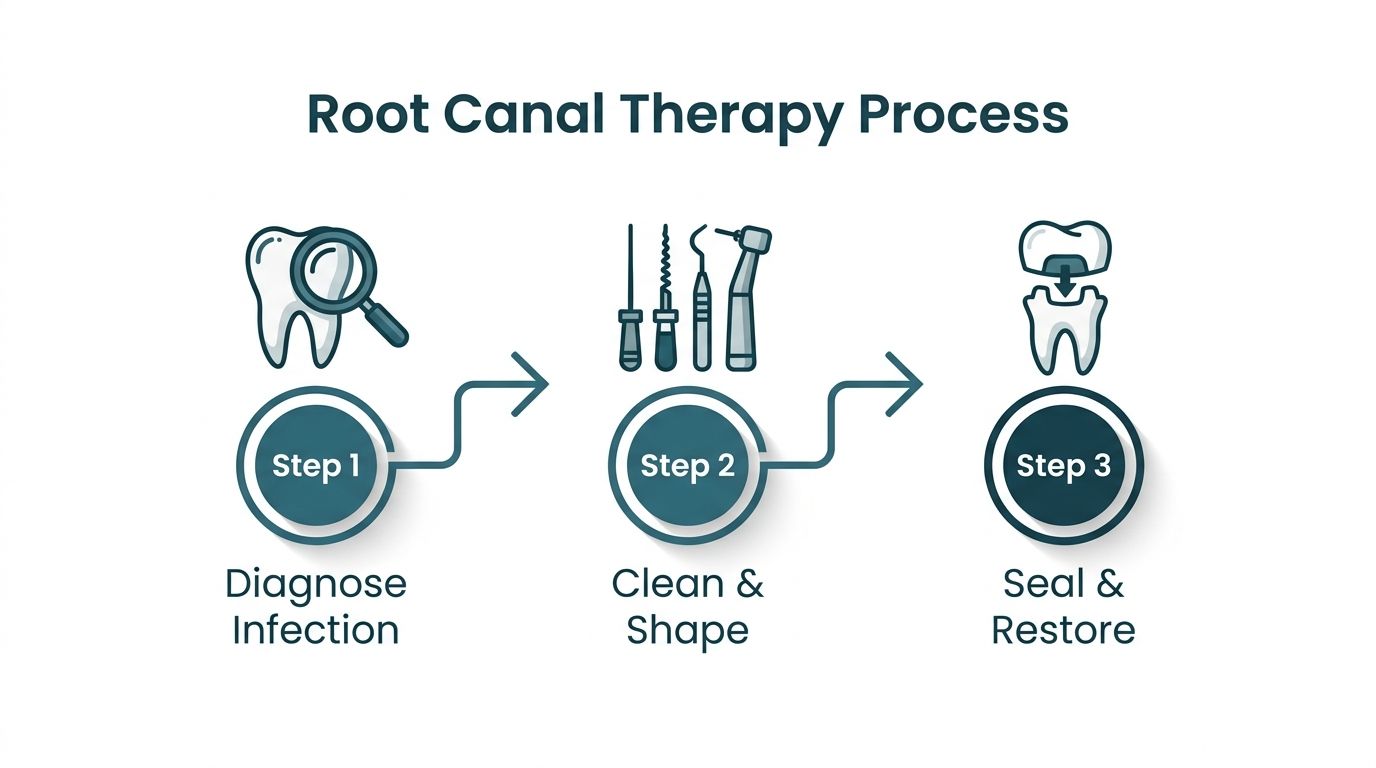
A tooth with deep decay, trauma, or a crack that reaches the pulp can still be worth saving, and root canal therapy is usually the first call for that reason. It removes the damaged tissue, cleans the inside of the tooth, and seals the space so the tooth can stay in place and keep doing its job.
That choice is practical, not sentimental. Keeping the tooth helps preserve chewing function, and it avoids the chain reaction that starts when a tooth is lost. Neighboring teeth can drift, the bite can shift, and replacement often becomes a separate project instead of a simple fix.
What root canal therapy is trying to preserve
A root canal is not only about taking away pain. It is about saving a tooth that still has enough structure to justify the work. If the crown and roots are sound enough, cleaning out the infection and sealing the canal system can keep that tooth working for years.
That is why tooth preservation stays the standard goal in endodontics whenever the canal system can still be saved. Extraction becomes the fallback when the tooth no longer offers a predictable result. After a failed initial root canal, the usual next move is nonsurgical retreatment first before extraction and replacement are considered, a point discussed in that review on retreatment and salvage procedures. The logic is straightforward, save the tooth when it still has a fair chance.
That same conservative mindset fits with tooth-colored repairs that can support preservation before a tooth reaches the point of no return. A well-placed restoration, such as the kind used in a composite filling procedure, can sometimes help stabilize a tooth earlier in the process, before more invasive treatment is needed.
When the comparison starts to change
Some teeth are poor candidates for another full canal treatment. The damage may be too extensive, the anatomy may make cleaning unreliable, or the tooth may be fractured in a way that makes a lasting seal unrealistic.
If the inside of the tooth is the only problem, preservation stays on the table. If the tooth structure itself is failing, the decision changes quickly.
That is also where patients start asking whether there is a way to avoid future decay and keep the rest of the mouth from landing in the same situation. Good habits matter, and fluoride-free cavity prevention tips can be part of that conversation for patients who want to reduce risk in a different way.
That is the reason alternatives matter. Root canal therapy is not the right answer for every tooth, but a generic shortcut is not the right answer either. The best plan is the one that fits the tooth in front of the dentist.
Conservative Alternatives That Save the Pulp
The most conservative root canal alternative treatments are the ones that leave as much living tissue in place as possible. That means pulp capping and pulpotomy, but only in the right case. These are not backup plans for a badly infected tooth. They work when the pulp is still vital enough to heal.
A small exposure from decay near the pulp is a different problem from a tooth that already has deep infection. In the first case, a dentist may be able to protect the pulp and let the tooth recover. In the second case, trying to save the pulp usually just delays a more definitive fix.
When pulp capping makes sense
Direct and indirect pulp capping are the most conservative options. Pulp capping is used when the pulp is exposed or nearly exposed, but not already infected. A biocompatible or medicated material is placed over the area to encourage healing and new dentin formation. Cedar Dental Group's overview of pulp capping describes that conservative role clearly.
That makes pulp capping a good fit for a small, recent exposure, especially when the tooth still feels restorable. It is not a good fit for a tooth with lingering swelling or obvious internal infection.
When pulpotomy is the better middle ground
A pulpotomy removes only the diseased coronal pulp and leaves the radicular pulp intact. It sits between pulp capping and a full root canal, which is why it gets used when the upper part of the pulp is the problem but the root pulp still has a chance. Milestone Family Dentistry's summary of pulpotomy notes that it's commonly used in baby teeth and sometimes in immature permanent teeth.
For younger teeth, that matters. The goal isn't just pain control. It's keeping the tooth alive long enough for normal development to continue.
Plain answer: if the pulp is still healthy enough to recover, conservative treatment can work. If it's already badly infected, those options are the wrong tool.
Patients trying to prevent future decay also need day-to-day habits that support the repair. For practical maintenance ideas, fluoride-free cavity prevention tips can be useful for families who are weighing conservative care and long-term prevention.
A small restoration may also be part of the plan after conservative treatment, and a dentist may pair that with a composite repair. A helpful reference for that kind of repair work is Amanda Family Dental's composite filling procedure.
Surgical Salvage Options After a Failed Root Canal
A tooth that still hurts after treatment needs a clear decision, not a quick pull. If the root canal has failed, the usual order is nonsurgical retreatment first, then endodontic surgery if the tooth still has a real chance, and extraction only when the tooth cannot be saved predictably. That sequence is the one to follow because a treated tooth can still be salvageable after the first attempt has not worked.
What apicoectomy actually is
An apicoectomy removes the tip of the root and the infected tissue around it. It is a microsurgical salvage procedure, not a substitute for root canal therapy at the start. That matters because the tooth has already been through treatment and still needs a targeted cleanup at the root tip. Swiss Smiles and Implants describes apicoectomy in that backup role, and Dentalpedia's overview places it among the surgical options used when infection keeps coming back.
This is the kind of procedure an endodontist usually handles. That is the right setting for it. These cases call for precision, and the goal is simple, keep the tooth when ordinary cleaning has already been tried and still did not solve the problem.
Where retreatment fits before surgery
If the canal system can be reopened and cleaned more thoroughly, nonsurgical retreatment comes before surgery. That is the better choice when the first filling missed a canal, left contamination behind, or did not seal the tooth well enough. Surgery makes more sense only after that path stops being predictable.
The recovery is usually more involved than conservative pulp-saving care, but it is still less disruptive than losing the tooth. The tradeoff is straightforward. Surgical salvage is specialized, and it belongs on the table when the tooth itself still deserves another attempt.
A patient who wants to understand what tooth removal would mean should also review Amanda Family Dental's tooth extraction options, because the decision changes once a tooth is no longer a good candidate for saving.
When a treated tooth fails, the real question is whether it can still be predictably saved.
That is the line that separates careful dentistry from rushed dentistry.
Extraction as a Last-Resort Alternative
Extraction is the most definitive of the root canal alternative treatments because it removes the whole tooth instead of trying to preserve the pulp. It becomes the right call when the tooth is too damaged, too fractured, or too infected to save predictably. Sources that describe this pathway also note that replacement commonly follows with a bridge, partial denture, or implant, which is why extraction is usually framed as a last-resort option rather than a routine substitute. Ariadentalcare's overview of extraction alternatives says that plainly.
The key point is that extraction is not a dead end. It starts a replacement conversation, and that conversation affects function and appearance.
What patients usually need to think about after extraction
A tooth gap can change the bite over time, and neighboring teeth can drift when the space stays open. That's one reason implant-based replacement gets discussed so often. The American Association of Endodontists notes that if a tooth cannot be saved, an implant can help maintain biting and chewing, prevent adjacent teeth from shifting, and preserve appearance. AAE's patient guidance on endodontic treatment options frames replacement as part of the treatment pathway.
That matters because a pulled tooth without a plan can create a second problem. The original pain is gone, but chewing and alignment may suffer later. The smart move is to decide on replacement before the extraction, not after the space becomes inconvenient.
When extraction is the honest answer
Extraction makes sense when the tooth can't hold a restoration well, the damage extends below the gumline, or infection keeps coming back despite treatment. In those cases, preserving the tooth just creates repeat procedures and more frustration. Patients often feel relieved once the treatment plan becomes direct.
A local team can also walk through the actual extraction procedure and what healing looks like. Amanda Family Dental's tooth extraction service is one place to start if the tooth is no longer salvageable.
Practical takeaway: if a tooth can't be saved with confidence, removing it is kinder than forcing a weak repair.
That said, extraction should be paired with a real replacement plan. Dentures, bridges, and implants each have tradeoffs, but doing nothing is usually the worst one.
Comparing Every Alternative Side by Side
The core question is simple: which tooth still has a workable path forward. A tiny pulp exposure belongs in one bucket. A molar with repeated infection belongs in another. A badly broken tooth that cannot hold a lasting repair belongs in yet another.
A good comparison starts with the tooth's condition, not with the procedure name.
If the pulp is still healthy and the decay has not turned into a full infection, pulp capping is the cleanest conservative option. If the decay has reached the crown pulp but the root pulp still looks healthy, pulpotomy makes more sense. If the tooth already had root canal treatment and is failing again, retreatment is the first place to look. If infection persists at the tip of the root after prior treatment, apicoectomy can remove the source without removing the whole tooth. If the tooth cannot be restored with confidence, extraction becomes the honest choice.
| Alternative | What it fits best | Recovery | What it means for the tooth |
|---|---|---|---|
| Pulp capping | Small exposure, pulp still vital | Usually minimal | Keeps the pulp in place and tries to preserve the tooth |
| Pulpotomy | Coronal pulp is diseased, root pulp still healthy | Usually short | Removes the diseased portion and keeps the deeper pulp |
| Retreatment | Prior root canal has failed, tooth is still salvageable | Moderate | Reopens the tooth and tries to clear the problem again |
| Apicoectomy | Persistent infection after prior treatment | Moderate | Removes the infected tip of the root |
| Extraction | Tooth can't be saved predictably | Healing required | Removes the tooth instead of forcing a weak repair |
| Extraction plus implant | Tooth is unrestorable and replacement is planned | Longer overall pathway | Replaces the missing tooth after removal |
That table is useful, but the decision still comes down to one question: can the tooth be repaired in a way that will last? If the answer is yes, saving the tooth usually stays on the table. If the answer is no, extraction followed by a planned replacement is the cleaner path. The most common mistake is spending time and money on a repair that only delays the same result.
The line between saving and removing a tooth is not subtle. A cracked tooth below the bone, a tooth with too little structure left, or a tooth that keeps failing after treatment usually points away from another repair attempt. A tooth with strong roots, workable structure, and a problem that can be cleared still deserves a preservation plan. Amanda Family Dental's root canal vs extraction page is a useful place to compare those two paths side by side.
Decision filter: save the tooth if a real repair exists, remove it if a real repair does not.
That keeps the plan honest. It also keeps patients from paying for procedures that do not change the final outcome.
How Amanda Family Dental Decides Which Option Fits You
At Amanda Family Dental, the decision starts with a new patient exam and digital X-rays, then moves into a plain conversation about what the tooth can reasonably do next. Dr. Alyssa Jenkins and the team review the tooth's condition, the patient's health history, and the long-term goal, whether that means saving the tooth, removing it, or planning a replacement. Patients in Amanda, Lancaster, Circleville, and Carroll, Ohio deserve that kind of direct answer.
That discussion works best when the dentist can see the tooth clearly and the patient can ask real questions. A consult is where the choice gets personalized, instead of guessed at from symptoms alone.
What the visit usually covers
A good plan should feel specific, not generic. In a comfortable office setting, the team may discuss:
- Root preservation if the tooth still has enough healthy structure.
- Tooth extraction if the tooth can't be saved predictably.
- Restorative options such as crowns, dentures, or dental implants after removal.
- Cosmetic dentistry choices if the tooth affects the smile line.
- Emergency dental services when pain or swelling needs fast attention.
For anxious patients, a calm process matters just as much as the procedure itself. Amanda Family Dental also offers mercury-free and fluoride-free options, and same-day care when available.
The office also uses a Power Plan Membership and flexible payment options to help keep cost from becoming the reason a tooth gets the wrong treatment. A local plan should fit both the tooth and the budget.
Later in the visit, the team can also explain longer-term replacement choices, including dental implants near me searches that often bring patients in after a tooth has been lost. For a more visual look at care and the team's style, a short office video gives a useful feel for the practice.
Next Steps and Common Questions
The safest move is simple. If a dentist has mentioned a root canal, get a real evaluation before deciding on extraction or trying to wait it out. The best treatment choice depends on the tooth, not on a guess from symptoms alone, and a consultation can separate a salvageable tooth from one that needs to come out.
Quick FAQs
Are root canal alternatives covered by insurance?
Coverage depends on the plan and the treatment. The office should verify benefits before treatment starts.
What if a patient just waits?
Waiting rarely solves infection or structural damage. It usually pushes the case toward a more limited set of choices.
Do options like ozone therapy replace standard care?
They should be viewed carefully and discussed against the tooth's actual condition. A patient should ask whether the option fits the diagnosis, not just whether it sounds gentler.
Is there a way to manage pain while deciding?
A dentist can recommend the right short-term approach after an exam. For patients looking for general comfort information, a resource on lidocaine with aloe vera gel can help explain topical comfort products, but it doesn't replace diagnosis or treatment.
If the tooth hurts now, don't guess at the answer. Schedule a consultation, bring any recent dental records, and ask whether the tooth can be saved or whether extraction is the smarter call.
Amanda Family Dental helps patients in Amanda, Lancaster, Circleville, and Carroll sort out root canal alternative treatments with clear exams, digital X-rays, and a practical treatment plan. If the tooth can still be saved, the team will say so. If it needs to come out, they'll explain the next step and help you move forward, so visit Amanda Family Dental to request an appointment and get a straight answer from a local dental team.