

A dark spot on a back tooth. A child who suddenly says cold water hurts. A parent wondering whether juice, crackers, or bedtime milk is part of the problem. Those are the moments when people usually start searching what causes tooth decay, and they often want a straight answer, not a chemistry lecture.
Tooth decay is common, but it isn't random, and it usually isn't a sign that someone has “bad teeth.” It's a process. Once that process is easier to recognize, it becomes much easier to prevent and treat.
For families in Amanda, Lancaster, Circleville, and Carroll, Ohio, that matters because small problems tend to stay small when they're caught early. Regular preventive care, including professional cleanings and exams, often gives patients the clearest picture of what's happening before a cavity turns into pain.
Table of Contents
- A Healthy Smile Starts with Understanding
- The Simple Science Behind a Cavity
- Key Risk Factors for Tooth Decay
- How We Diagnose and Treat Cavities in Amanda OH
- Modern Prevention for a Lifetime of Healthy Smiles
- Partner with Your Local Amanda Dentist for a Healthy Smile
A Healthy Smile Starts with Understanding
A lot of people assume a cavity appears because someone skipped brushing for a few days or ate too much candy. That explanation sounds simple, but it misses what patients deal with in real life. A child may brush well and still get a cavity in a deep groove. An adult may take medications that leave the mouth dry and suddenly start getting decay around the gumline.
That's why concern about a sore tooth or a child's first cavity deserves a calm, practical response. Tooth decay is manageable when the cause is understood. It becomes much harder when people blame themselves and wait too long.
For families around Amanda, OH, the more useful question isn't “Who messed up?” It's “What is feeding the problem?” Sometimes it's frequent snacking. Sometimes it's sipping sweet drinks all day. Sometimes it's dry mouth, crowded teeth, or a spot that's just hard to clean well.
Practical rule: Early sensitivity, a chalky white area, food catching between teeth, or a dark pit on a molar can all be signs that it's time for a closer look.
Parents in Lancaster and Carroll often ask whether baby teeth matter if they'll fall out anyway. They do. Decay in baby teeth can still cause pain, affect eating, and shape a child's future dental habits. Adults in Circleville often ask whether sensitivity means they need a filling right away. Sometimes yes, sometimes no. Early changes can sometimes be managed before they become larger problems.
Understanding the cause is where better decisions start. Once that piece is clear, prevention stops feeling like guesswork.
The Simple Science Behind a Cavity
What starts the damage
A cavity starts long before there is a visible hole.
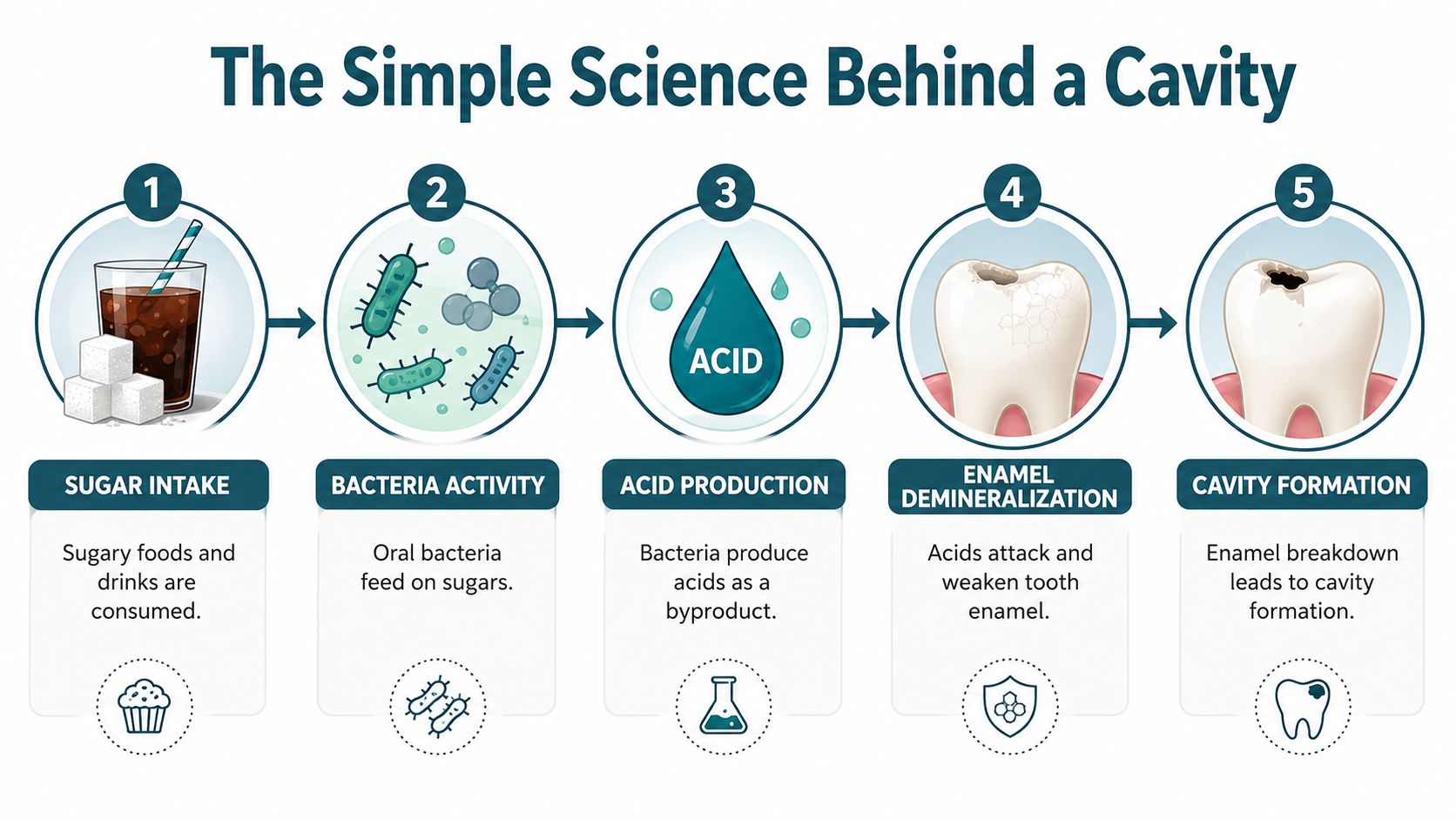
The process begins in plaque, a sticky bacterial film that clings to the teeth, especially along the gumline and in the deep grooves of molars. After you eat or drink carbohydrates, plaque bacteria break them down and produce acids. Those acids pull minerals out of enamel. If that cycle happens often enough, the tooth surface weakens.
In the office, I often explain it to Amanda parents this way. The problem is not one cookie or one missed brushing. The problem is repeated acid attacks without enough recovery time in between.
According to this clinical explanation of how cavities form, plaque bacteria metabolize fermentable carbohydrates, create organic acids, and can push plaque pH below the critical level of about 5.5, where enamel begins to dissolve. That is the point where demineralization starts to outpace repair.
A visual overview can help make that sequence easier to follow.
Why the cycle matters
Teeth are always going through a tug-of-war between mineral loss and mineral repair. Saliva helps repair early damage by bringing calcium and phosphate back to the enamel. Fluoride helps the surface become more resistant to future acid attacks. If acid exposure happens too often, the repair side cannot keep up.
That is why two patients with similar diets can have very different results. One person eats meals, drinks water, and gives the mouth time to recover. Another sips sweet coffee during a long commute from Circleville, snacks through the afternoon, or breathes through the mouth and stays dry. The biology is the same. The daily pattern changes the outcome.
Early decay may look white and chalky rather than dark. In children from Amanda and Lancaster, I often see these first changes near the gumline or in the pits of back teeth. In adults, the weak area may show up around older fillings or on root surfaces where the gums have receded. Those details matter because early damage can sometimes be managed before it turns into a larger cavity.
| Step | What happens |
|---|---|
| Food or drink exposure | Sugars and other fermentable carbs reach plaque on the teeth |
| Bacterial activity | Plaque bacteria digest those carbs |
| Acid attack | Acids lower the pH around enamel |
| Mineral loss | Enamel starts losing minerals |
| Visible cavity | Repeated damage creates a permanent defect |
A cavity is usually a process, not a single event.
Key Risk Factors for Tooth Decay
Diet patterns matter more than people think
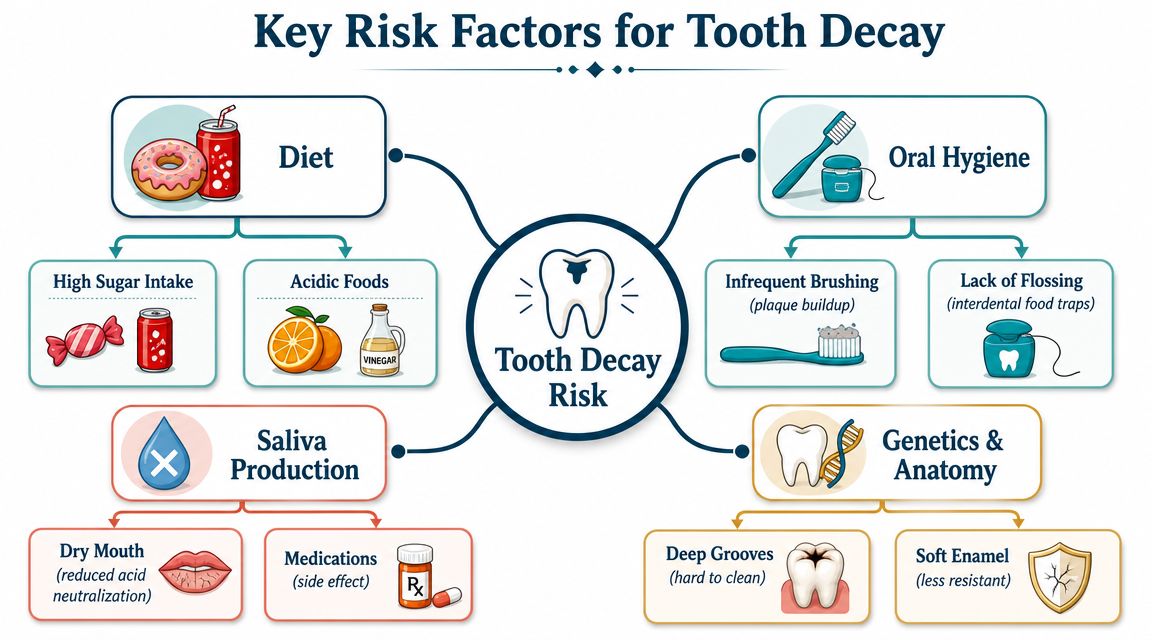
When patients ask what causes tooth decay, diet is part of the answer, but the pattern matters more than many people realize. It's not only candy. Plaque bacteria can use carbohydrates more broadly, which is why frequent exposure to foods like bread, crackers, cereal, juice, and other carb-containing snacks can contribute to decay when they show up all day long, as described in the NIDCR overview of tooth decay.
That's why some families feel confused. They cut back on obvious sweets, but a child still snacks often on sticky or starchy foods. An adult avoids dessert but sips a flavored drink all afternoon. Those habits can keep the mouth acidic for too long.
A practical way to look at diet risk:
- Frequent sipping: Sweet drinks, juice, and sweetened coffee can bathe teeth repeatedly.
- Sticky snacks: Foods that cling in grooves and between teeth give bacteria more time to feed.
- Bedtime exposure: Going to sleep with sugars on the teeth leaves less natural cleanup overnight.
- Constant grazing: Small snacks all day may be harder on teeth than one larger meal.
Saliva, anatomy, and everyday habits
Saliva's role is often underestimated. It helps clear sugars, buffers acids, and supplies minerals that support remineralization. The Mayo Clinic explanation of cavities and dry mouth notes that decay risk rises when saliva's protective function is reduced, which is why dry mouth can shift someone into a much higher-risk category.
That matters for adults taking medications that reduce saliva. It also matters for people who breathe through the mouth, have certain health conditions, or wake up with a dry mouth and think it's just an annoyance.
Some risks are easier to control than others. This side-by-side view helps.
| Risk factor | Why it matters in daily life |
|---|---|
| Low saliva | Acid stays on the teeth longer and sugars clear more slowly |
| Deep grooves | Molars can trap food and plaque even with decent brushing |
| Inconsistent plaque removal | Bacteria stay in place and keep producing acid |
| Gum recession | Root surfaces are more exposed and can decay more easily |
| Medication burden | Some medicines dry the mouth and raise cavity risk |
Teeth don't all face the same conditions. Two people can brush the same way and still have very different cavity risk.
That's also why brushing alone doesn't tell the whole story. Good brushing matters. So does flossing. But if someone has dry mouth, recessed gums, deep pits, or frequent snacking habits, those factors can outweigh a routine that seems “pretty good.”
How We Diagnose and Treat Cavities in Amanda OH

How decay is found
Cavities aren't always obvious in the mirror. Some start between teeth. Some form along old dental work. Some sit in grooves where they're easy to miss until they get deeper.
That's one reason professional diagnosis matters. In the United States, the National Institute of Dental and Craniofacial Research reports that nearly 90% of adults ages 20 to 64 had decay in their teeth in the 2011 to 2016 NHANES cycle, and 21% of adults ages 20 to 64 have at least one untreated cavity, according to NIDCR adult caries data.
In a typical exam, the dentist looks for soft spots, discoloration, white-spot lesions, changes around fillings, and areas where food traps repeatedly. Digital X-rays help reveal what can't be seen directly, especially decay between teeth or under existing restorations.
For patients searching for a dentist in Amanda, OH, or a dentist near me because of sudden discomfort, the main goal is clarity. Is the area watchable? Does it need a filling? Has the nerve been affected? The answer changes the treatment plan.
What treatment looks like
Treatment depends on how far the decay has progressed and how much healthy tooth structure remains.
Smaller cavities are often repaired with tooth-colored fillings. These restore the damaged area and seal the tooth so bacteria can't keep moving inward. For patients comparing options, composite fillings and bondings are commonly used to repair decay while blending naturally with the tooth.
When a cavity is larger and the tooth has lost more strength, a crown may be the better choice. A crown covers and protects the tooth more completely. If decay reaches the inner pulp and causes infection or severe pain, root canal treatment may be used to save the tooth. If the tooth can't be restored safely, tooth extraction may be the most predictable option.
Patients in Lancaster, Circleville, and Carroll who are looking for an emergency dentist usually aren't asking for perfect dentistry in that moment. They want the pain explained and the next step made clear. That's the right priority. Good care starts with an accurate diagnosis, then moves to the least invasive treatment that will solve the problem.
Modern Prevention for a Lifetime of Healthy Smiles
What works at home
Prevention works best when it's realistic enough to keep doing. That usually means a few consistent habits, not a complicated routine people abandon after a week.
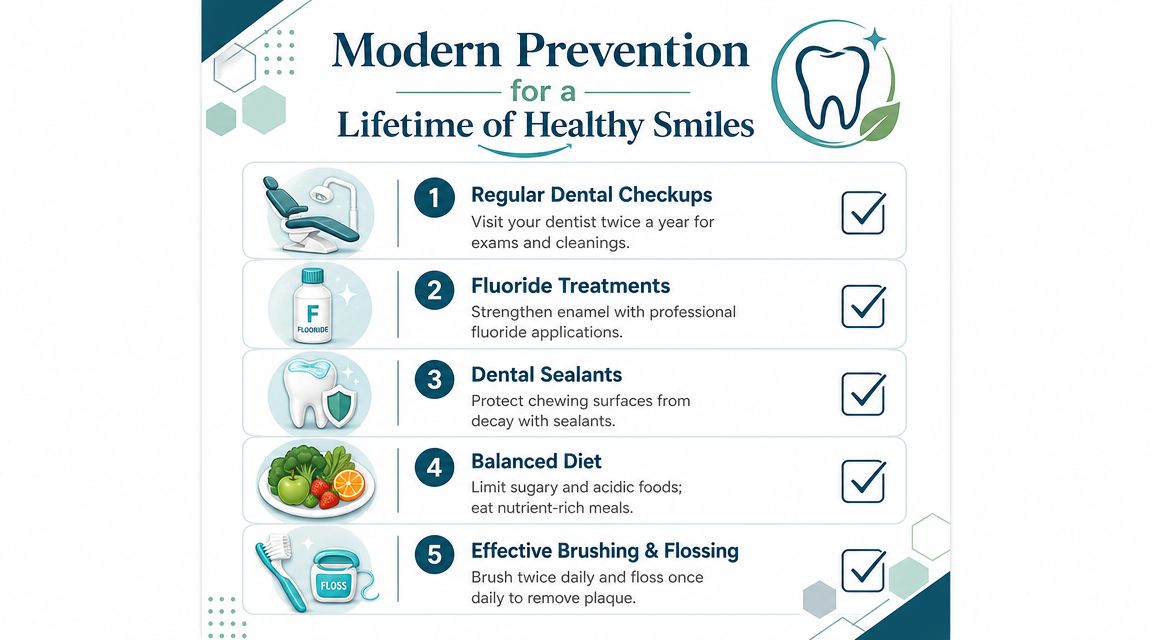
The first priority is reducing how often teeth are exposed to sugars and other fermentable carbs. The WHO advises keeping free sugars below 10% of total energy intake and ideally below 5% to reduce caries risk across life, as noted in the earlier WHO reference. That doesn't mean every family has to chase perfection. It means fewer exposures usually beat the same amount spread across the day.
A practical home strategy often includes:
- Better timing: Keep snacks and sweet drinks less frequent instead of stretching them across the day.
- Stronger daily cleaning: Brush carefully along the gumline and floss where the toothbrush can't reach.
- Hydration support: A dry mouth needs attention because saliva is part of the defense system.
- Diet awareness: “Healthy” foods can still be cavity-promoting if they're sticky, frequent, or sipped slowly.
Some families also like to learn more about nutrition and mineral support from broader wellness resources. For readers interested in that angle, this science-backed K2 health guide offers useful background on vitamin K2 in the context of overall health.
What helps in the dental office
Prevention in the dental chair is about more than being told to brush better. It includes early detection, risk assessment, and targeted protection for the teeth most likely to decay.
Clinical sources point out that some people get cavities despite brushing because factors like dry mouth, gum recession, and medications can shift the risk. The Cleveland Clinic cavity overview also notes that fluoride varnish cuts primary-tooth cavities by about one-third and sealants prevent about 80% of cavities on back teeth.
That makes two tools especially important for children and many adults:
- Fluoride support: Fluoride helps enamel resist acid and can support early remineralization. Patients who want to understand options can review this guide on fluoride mouthwash for cavities.
- Sealants: Molars have deep grooves that are hard to clean. Sealants add a protective barrier in those high-risk areas.
For some patients, prevention also means looking beyond the tooth surface alone. Mouth breathing, tongue posture, and sleep-related issues can affect dryness, oral habits, and long-term oral health. Services such as myofunctional therapy and comfort-focused care can be part of that broader conversation. Amanda Family Dental offers those types of services alongside routine preventive dentistry, restorative care, and digital X-rays for patients who want a more individualized plan.
Prevention works best when it matches the person. A child with deep molars needs a different strategy than an adult with dry mouth and exposed roots.
Partner with Your Local Amanda Dentist for a Healthy Smile
What a first visit feels like
A common Amanda scenario goes like this. A parent notices a dark groove on a child's back tooth after dinner, or an adult starts avoiding cold drinks on one side because that tooth has become sensitive. By the time you call the office, you usually want a straight answer, not a lecture.
That first visit should bring clarity. I want patients to leave knowing whether they are dealing with early enamel changes, a cavity that needs a filling, or a problem that calls for closer follow-up. The appointment often includes a conversation about symptoms, diet, dry mouth, home care, and past dental history, followed by an exam and digital X-rays if the tooth cannot be fully checked by sight alone.
Sometimes the right plan is treatment now. Sometimes the better choice is to monitor a suspicious area and tighten up prevention so we do not drill a tooth that can still be protected.
That distinction matters for families in Amanda, Lancaster, Circleville, and Carroll who are balancing time, cost, anxiety, and long-term oral health.
When to stop waiting
Some signs should not sit on the calendar for another month. Pain when biting, sensitivity that lingers after hot or cold foods, swelling, a visible hole, food packing between teeth, or a child chewing on one side all deserve an exam.
Tooth decay has clear causes, and many cases can be prevented. Sugar intake remains one of the biggest drivers, especially when teeth are exposed often throughout the day, as noted earlier in this article. Brushing and flossing at home still matter, but they do not answer every question. A professional exam helps sort out what is causing the problem, what can still be reversed, and what should be treated before it spreads deeper into the tooth.
I also look at the full picture. If a patient has dry mouth, mouth breathing, sleep-related concerns, or oral habits that keep the mouth dry, prevention has to go beyond a standard brushing talk. That is one reason some families ask us about broader care, including myofunctional therapy, when the pattern of decay keeps repeating.
Local dental care should feel specific to the person in the chair. A child with deep grooves, a teen sipping sports drinks during practice, and an adult taking medications that reduce saliva will not need the same plan.
If tooth sensitivity, visible spots, or recurring cavities have raised questions about what causes tooth decay, the next step is a professional exam and a clear plan. Amanda Family Dental provides new patient exams, digital X-rays, restorative treatment, preventive care, and family-focused guidance for patients in Amanda, OH, Lancaster, OH, Circleville, OH, and Carroll, OH. Scheduling a visit can turn worry into answers and help protect a healthy smile before a small issue becomes a bigger one.