

You've probably sat in the dental chair, heard “there's a cavity,” and then immediately wondered what happens next. That moment can feel simple at first, then suddenly complicated, because cavity filling options aren't just about “silver or white” anymore. For patients looking for a dentist near me or a dentist in Amanda, OH, the question is often which treatment fits the tooth, the bite, and the long-term plan, especially for families in Amanda, Lancaster, Circleville, and Carroll, Ohio.
Modern restorative care gives dentists more than one path forward. Some teeth need a filling right away, some early spots can be watched or treated conservatively, and some back teeth do better with materials chosen for strength instead of looks. That's why a calm, clear conversation matters so much at Amanda Family Dental, where the decision isn't treated like a one-size-fits-all choice.
Table of Contents
- Finding the Right Cavity Filling Options Near You
- Does Every Cavity Actually Need a Filling
- Comparing the Most Common Cavity Filling Materials
- What to Expect During Your Filling Appointment
- How to Choose the Best Filling for Your Situation
- Why Amanda Family Dental Is Your Trusted Local Choice
- Common Questions About Cavity Fillings Answered
Finding the Right Cavity Filling Options Near You
A patient hears “you need a filling,” then starts trying to decode the rest of the visit. The next question is usually, “What kind?” That's where clear guidance matters, because today's cavity filling options include materials and approaches that handle different jobs, from small visible spots to larger chewing surfaces.
At a local practice, the discussion should feel practical, not rushed. If someone is searching for a dentist in Amanda, OH or dentist in Lancaster, OH, they're usually looking for more than a procedure. They want a team that can explain what the tooth needs, what the bite demands, and whether a filling is even the right step today. Amanda Family Dental's local dental care page is one place patients can use to start that conversation.
Practical rule: the right filling is the one that fits the tooth in front of the dentist, not the one that sounds best in a general conversation.
A back tooth that takes heavy chewing forces may need a different plan than a front tooth that shows when someone smiles. A small cavity in a visible area often leads to a different recommendation than a larger repair on a molar. That's why community-minded care in Amanda, Circleville, and Carroll, Ohio should focus on the tooth's location, the size of the decay, and how much healthy structure is still left.
Patients also often bring lifestyle concerns into the visit. Some want a tooth-colored result. Some want the most durable answer for a back tooth. Some want to avoid repeated repairs if possible. A good dental team can talk through those priorities without pressure, then match the treatment to the clinical need. That kind of guidance is especially important for people comparing restorative dentistry, cosmetic dentistry, and even broader needs like tooth extraction, dental implants near me, or emergency dentist services when the damage is more advanced.
Does Every Cavity Actually Need a Filling
Not every cavity starts as a hole that needs drilling right away. Early decay can sometimes be managed before a conventional filling is placed, which is why the first question should be, “How advanced is it?” not “Which material is best?” The ADA notes that filling choice is only one part of care, and early lesions may be managed before drilling, while other clinical resources describe resin infiltration and silver diamine fluoride (SDF) as ways to slow or arrest very small lesions without conventional restoration.
That conservative mindset matters because it keeps the focus on preserving tooth structure. A tiny spot that has not yet become a true structural problem may be monitored, treated preventively, or addressed with non-drilling care depending on the exam. For readers who want the fuller picture of decay causes, Amanda Family Dental's guide to what causes tooth decay connects the dots between habits, risk, and treatment timing.
What changes the decision
Digital x-rays and a careful exam help the dentist see whether the tooth is stable, active, or already past the point where watchful waiting makes sense. That's one reason new patient exams matter. The goal isn't to rush every tiny spot into a filling. The goal is to stop disease at the right moment, with the least invasive step that still protects the tooth.
A small lesion that can be watched today may need a filling later if it changes. The decision is about timing as much as material.
This is also where patients get confused by online advice. Some articles talk as if every cavity is an emergency. Others make non-drilling care sound like a cure-all. Real dentistry sits in the middle. If decay is still very early, preventive care may be enough. If the enamel and dentin are already affected in a way that threatens the tooth, then a filling becomes the sensible next step. That judgment comes from the exam, the x-rays, and the clinician's ability to balance preservation with protection.
Comparing the Most Common Cavity Filling Materials
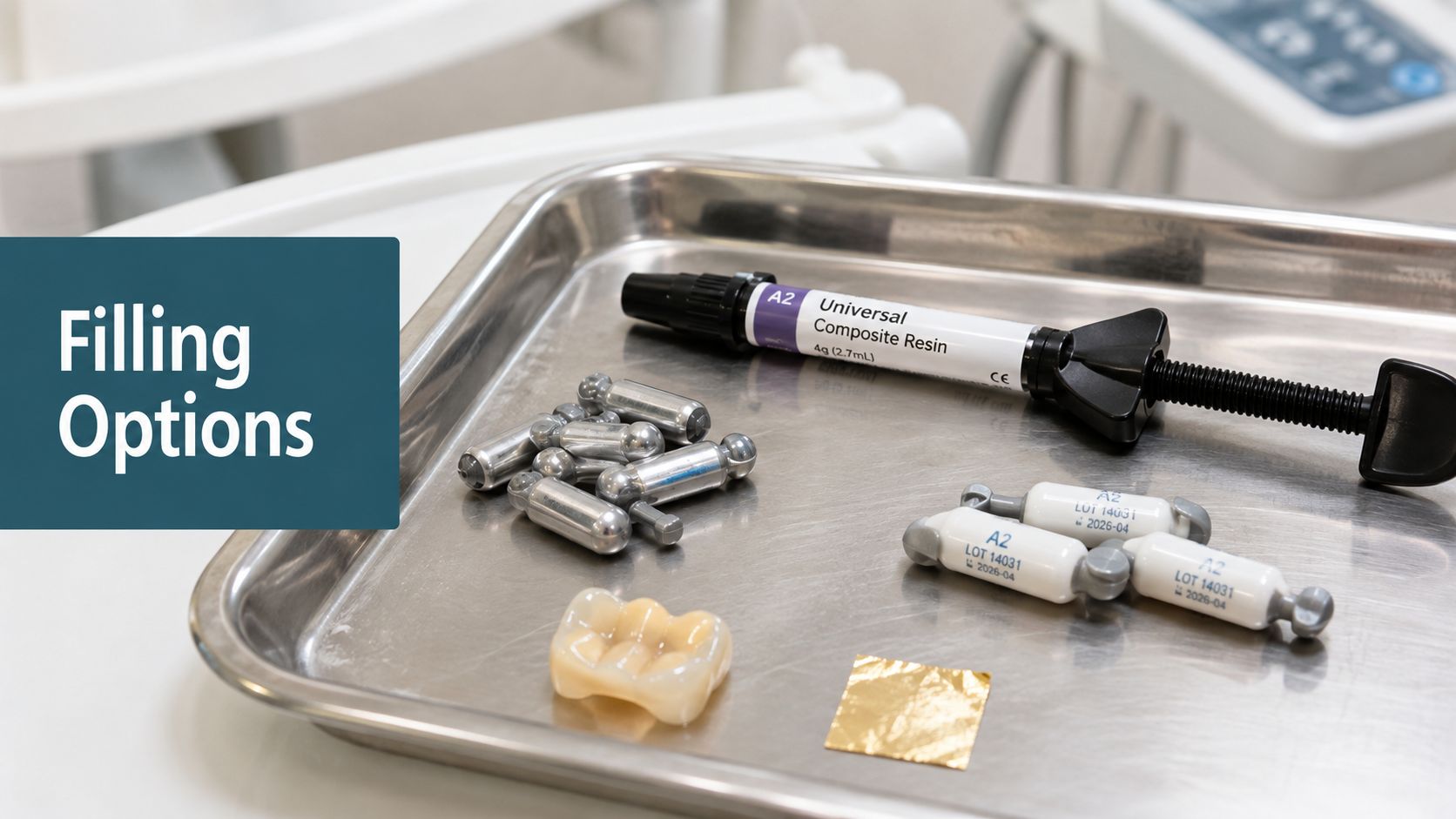
The main direct restorative materials are amalgam, resin-based composites, glass ionomer, and resin-modified glass ionomer, according to the ADA. Those four categories cover most direct fillings placed in modern dentistry, and each one behaves differently in the mouth. Some are chosen for appearance, some for strength, and some for special situations where fluoride release or easy placement matters more than aesthetics.
A quick comparison helps readers see why no single material wins every time.
Cavity Filling Materials at a Glance
| Material | Durability | Aesthetics | Relative Cost | Best For |
|---|---|---|---|---|
| Composite resin | Good for many small to mid-size restorations | Tooth-colored | Moderate | Visible teeth, moderate chewing loads |
| Amalgam | Very durable | Less esthetic | Lower | Back teeth, high-load areas |
| Glass ionomer | Lower strength in chewing areas | Tooth-colored | Varies | Liners, cements, non-load-bearing spots |
| Resin-modified glass ionomer | Helpful in selected cases | Tooth-colored | Varies | Liners and some non-load-bearing restorations |
| Ceramic or gold indirect restorations | Very durable | Tooth-colored or metal | Higher | Larger restorations, long-term strength |
Composite resin is often the first material people think of because it blends with tooth color. ADA and NIDCR guidance describe it as a good option for small- to mid-size fillings that face moderate chewing forces. It bonds to the tooth, which helps the final result look natural, but that bonding also makes it more technique-sensitive than a material like amalgam. For patients comparing restoration longevity, Amanda Family Dental's discussion of how long fillings last is a helpful companion resource.
Amalgam still has a role in posterior, high-load restorations. It's durable and usually less expensive, which is why many patients still hear it mentioned for back teeth. In contrast, glass ionomer and resin-modified glass ionomer are more limited in load-bearing situations. The Cochrane review notes that glass ionomer cement is not as strong in some settings and isn't suitable for chewing surfaces of teeth. Indirect options like ceramic or gold can be very durable, and the FDA notes that these “caps” can be the most durable and costly choices, especially when a tooth needs a more substantial repair.
Amanda Family Dental also offers mercury-free composite fillings for patients who want a tooth-colored option without amalgam. That preference often comes up in conversations about appearance, comfort, and personal values, especially for families who want a simple, modern restoration plan.
What to Expect During Your Filling Appointment
A filling visit usually starts before any material is placed. The dentist examines the tooth, reviews the x-rays, and confirms whether the cavity is small enough for a direct restoration or large enough to need an indirect option. Direct restorations are placed straight into the tooth and are usually completed in one appointment, while indirect restorations like inlays or onlays are custom-made and typically take two or more visits.
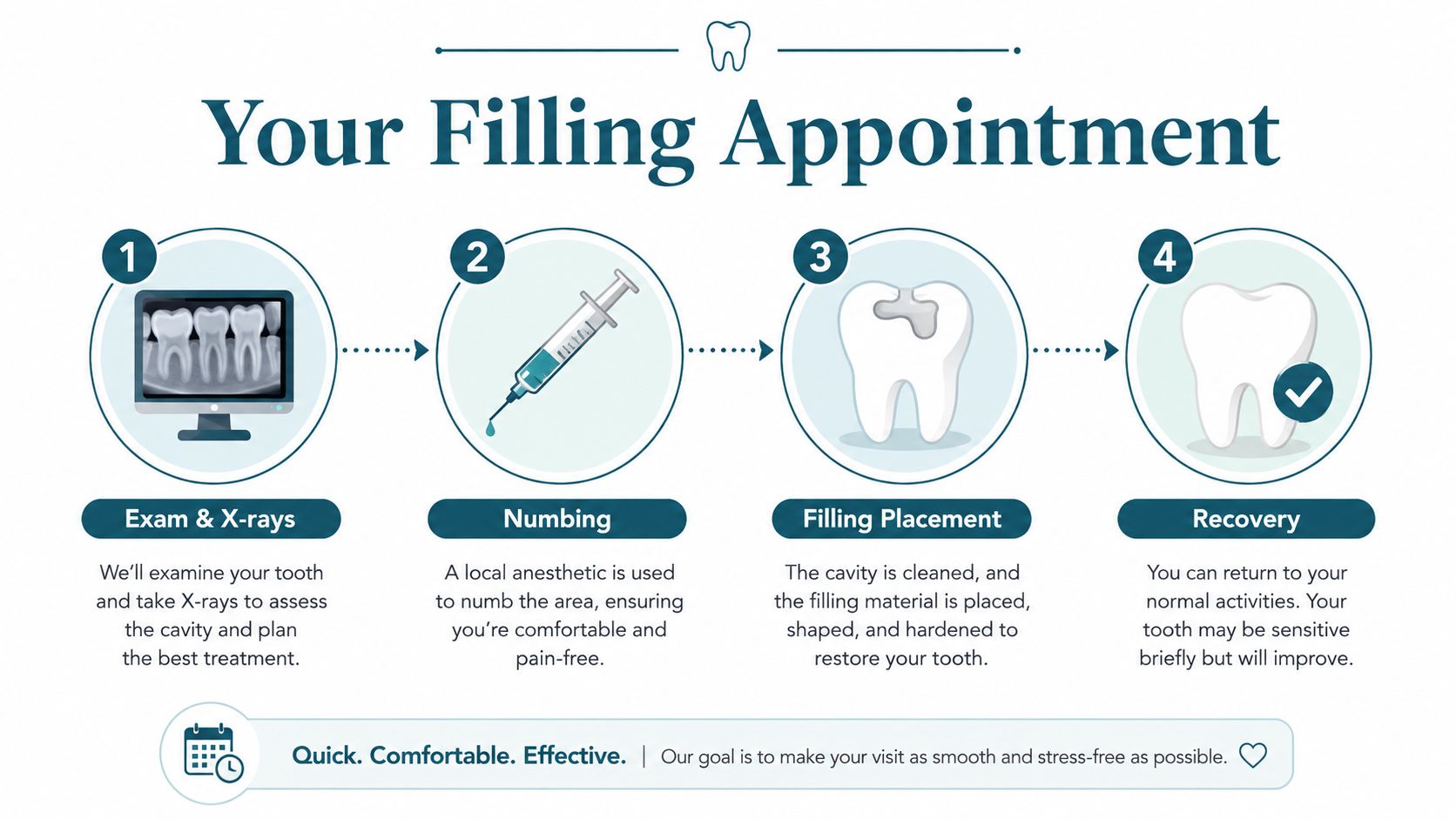
Step by step in the chair
- Exam and x-rays. The dentist checks the tooth, neighboring teeth, and the depth of decay.
- Numbing. Local anesthetic helps the area stay comfortable during treatment.
- Filling placement. The decay is removed, the tooth is prepared, and the chosen material is placed and shaped.
- Recovery. The bite is checked, and the tooth may feel mildly sensitive for a short time.
Comfort matters too. Some patients do well with local anesthesia alone, while others need a calmer setting because they're anxious about dental treatment. In those cases, sleep dentistry can help the appointment feel less stressful. The actual recovery is usually straightforward, but the dentist will still give instructions about chewing carefully until numbness fades and avoiding habits that put pressure on the new restoration right away.
Digital x-rays are useful here because they give the team a clear view of the tooth while fitting into a modern, patient-focused exam. They help the dentist confirm that the treatment plan matches the actual cavity size, not just what's visible from the surface. For people who like knowing what's happening before the work begins, that transparency can make the whole visit feel much easier.
How to Choose the Best Filling for Your Situation
The best filling is usually the one that matches the size of the cavity, the tooth's location, the bite force on that tooth, and the amount of healthy structure left. A tiny front-tooth cavity and a large molar repair are not the same problem, even if both are called cavities. The material choice should reflect that difference.
Match the material to the job
A small front tooth often benefits from composite because the goal is a natural look with solid everyday performance. A back tooth that does most of the chewing may need something tougher, especially if the cavity is large or the tooth has already been repaired before. For larger restorations, indirect options such as ceramic or gold may make more sense because they can better support long-term durability when the remaining tooth is limited.
Glass ionomer has a narrower role. It's often used in children's dentistry or in situations where fluoride release is helpful and the tooth isn't taking heavy bite pressure. That makes it useful, but not universal. The Cochrane review also notes that bulk-fill composite and resin-based composite show probably little or no difference in failure, which helps explain why dentists often think in terms of the tooth's needs first, then the exact product second.
Best-fit question: does the tooth need to look better, hold up better, or both?
Patient priorities matter too. Some people want the most discreet result. Others want the most durable choice they can reasonably get. Others want to manage cost while still protecting the tooth. Those are valid goals, and the answer isn't always the same. A good exam turns those goals into a workable plan instead of a guess.
For families in Amanda, Lancaster, Circleville, and Carroll, Ohio, that conversation should be direct and comfortable. It should also leave room for the next step, whether that's a simple filling, a more protective restoration, or a different service entirely if the tooth is too damaged. The right choice is the one that fits the tooth today and still makes sense months or years from now.
Why Amanda Family Dental Is Your Trusted Local Choice
Patients usually want three things from a dental office, clear answers, comfortable care, and a plan that doesn't feel rushed. Amanda Family Dental is set up around those needs, with services that include composite fillings, mercury-free options, digital x-rays, sleep dentistry, and restorative care for families across Amanda, Lancaster, Circleville, and Carroll, Ohio. That combination matters when a cavity decision involves more than one reasonable option.

The office also fits patients who want a broader view of oral health. That can include total health screening, comfort-focused treatment planning, and clear explanations of how a filling fits into bigger goals like cleaning and exams, cosmetic dentistry, dental implants, or emergency dental services. For some readers, a useful outside perspective on patient communication is reduce missed calls with AI, especially when they're trying to reach a busy office and need a smooth first contact.
After the visit starts, the process should still feel personal. The dentist can review findings, explain whether the tooth needs treatment now or later, and give a plan that matches the patient's comfort level. That's especially helpful for anxious patients, parents bringing in children, or adults who are comparing fillings with bigger restorative needs like tooth extraction or replacement options such as dental implants near me.
The value of a local office is simple. Patients can ask questions in plain language, return when they need follow-up, and build a relationship with a team that already knows their history. That kind of continuity makes cavity decisions easier, especially when the choice is between monitoring, filling, or choosing a more durable restoration for a tooth that's seen better days.
Common Questions About Cavity Fillings Answered
How long do fillings last?
It depends on the material, the size of the restoration, and where the tooth sits in the mouth. Longevity should be discussed with the dentist during the exam, especially for back teeth that take more force.
Can a filling be replaced if it wears out?
Yes. Fillings can be repaired or replaced when they fail, chip, or no longer seal the tooth well.
Are tooth-colored fillings as strong as silver ones?
They can be the right choice for many teeth, especially small to mid-size restorations. For higher-stress back teeth, the dentist may recommend a different material depending on the cavity and bite.
What if a filling falls out or the tooth becomes sensitive?
That should be treated as a prompt dental concern. Sensitivity can happen for several reasons, and a lost filling leaves the tooth exposed.
Is emergency care available if something breaks suddenly?
Yes, and that matters when a tooth starts hurting or a restoration fails without warning.
If a cavity has shown up on an x-ray, or a tooth has started hurting, Amanda Family Dental can help sort out whether a filling is needed and which material makes the most sense. Patients in Amanda, OH, Lancaster, OH, Circleville, OH, and Carroll, OH can visit Amanda Family Dental to schedule an appointment and get a clear, comfortable plan for restorative care.