

A lot of people search how long do fillings last when they notice something small that doesn't feel quite right. Maybe an old silver filling has started catching on floss. Maybe a back tooth feels sensitive when coffee hits it. Maybe there's no pain at all, but it's been years since that tooth was treated and the question won't go away.
That concern is reasonable. Fillings aren't meant to be ignored forever, and they don't all age the same way. The material matters. The tooth matters. Everyday habits matter too. For families looking for a dentist near me, or a dentist in Amanda, OH, Lancaster, OH, Circleville, OH, or Carroll, OH, it helps to understand what's normal, what isn't, and when a filling should be checked.
This guide follows the patient journey. It starts with lifespan expectations, then looks at why fillings fail, what warning signs deserve attention, and what replacement care usually feels like in a modern office. Patients who want more background on tooth-colored repairs can also review fillings and bondings as part of their restorative dental care research.
Table of Contents
- Your Guide to Dental Fillings from a Dentist Near Amanda OH
- How Long Different Types of Dental Fillings Last
- Factors That Shorten or Extend Your Fillings Lifespan
- Signs Your Filling Needs to Be Replaced
- What to Expect When Replacing a Filling in Our Amanda Office
- Your Questions About Dental Fillings Answered
Your Guide to Dental Fillings from a Dentist Near Amanda OH
An older filling often becomes a question before it becomes a crisis. Someone from Amanda might notice a rough edge while brushing. A parent from Lancaster may be scheduling a child's cleaning and suddenly remember a filling placed years ago. A patient from Circleville or Carroll may have no symptoms at all, but still wonder whether that restoration is living on borrowed time.
That's usually the right moment to ask. A filling can look stable for years, then start breaking down at the edges where bacteria and pressure do the most damage. Small changes matter because they affect comfort, chewing, and the chance of needing more than a simple repair later.
A filling doesn't have to hurt to deserve attention.
Patients often assume the only question is age. In reality, dentists look at a fuller picture. Is the tooth still sealed well? Is there staining or a gap around the margin? Is the bite placing too much stress on that surface? Has the material held up the way it should for that location?
Why people ask this question
The concern usually comes from one of a few situations:
- A new sensation that wasn't there before, such as cold sensitivity or pressure when biting
- A visible change like a crack line, dark edge, or a piece that looks worn down
- A long time since treatment, especially when the patient can't remember when the filling was placed
- A cosmetic concern when an older metal filling shows more than the patient likes
For those seeking a dentist in Amanda, OH or a nearby office for restorative dentistry, the most helpful answer is rarely a one-line number. It's a practical explanation of what different materials tend to do, what shortens their life, and what replacement options are available if a tooth needs help.
Why local evaluation matters
A filling that looks acceptable in a mirror can still hide decay under the surface. A filling that feels “mostly fine” can also be the reason a tooth keeps flaring up during meals. That's why regular exams, digital x-rays, and a close bite check still matter, even when symptoms seem minor.
This is especially true for busy families across Amanda, Lancaster, Circleville, and Carroll who want care close to home, whether they need routine cleaning and exams, dental x-rays, a filling replacement, a tooth extraction, or help from an emergency dentist if pain suddenly worsens.
How Long Different Types of Dental Fillings Last
The short answer is that fillings can last a long time, but not all materials perform the same way. According to this overview of filling longevity, amalgam fillings last 10–15 years on average, composite resin fillings average 7 years but can reach 10 years with good hygiene, gold fillings last 20+ years, and ceramic fillings exceed 15 years.
That range explains why two patients can have very different experiences. One person may still be chewing comfortably on an older filling for years. Another may need replacement sooner because the material, bite forces, and cavity size created a tougher situation from the start.
A quick comparison by material
| Dental Filling Material Comparison | Average Lifespan | Appearance | Best For |
|---|---|---|---|
| Amalgam | 10–15 years | Silver | Back teeth with heavy chewing pressure |
| Composite resin | 7 years on average, up to 10 years with good hygiene | Tooth-colored | Visible areas and patients who want a natural look |
| Gold | 20+ years | Gold | Long-term durability where appearance is less of a concern |
| Ceramic | Exceeds 15 years | Tooth-colored | Patients who want strength and esthetics |
Patients comparing options can also review composite vs. amalgam fillings when deciding between traditional and tooth-colored materials.
What the trade-offs look like in real life
Amalgam fillings have a long track record. They're known for durability, especially in back teeth that take heavy chewing force. The trade-off is appearance. Many patients don't like the silver color, and some prefer mercury-free restorative choices when replacement becomes necessary.
Composite fillings blend in much better with natural enamel. They're a common choice for people searching for a cosmetic dentist near me because they support a more natural smile. The trade-off is that they can be more technique-sensitive and may wear differently depending on the size of the filling and the location of the tooth.
Gold fillings can last a very long time. They're durable and stable, but they aren't the choice most patients make today because of appearance and cost considerations.
Ceramic restorations offer a strong, esthetic option and often appeal to patients who want a metal-free look. They can work very well in the right case, especially when the tooth needs more than a small direct filling.
Practical rule: The strongest material on paper isn't always the best choice for a specific tooth. The best choice is the one that fits the tooth, the bite, and the patient's goals.
Material choice also connects to the reason the tooth is being treated. A small cavity on a front tooth, a worn edge on a premolar, and a heavily loaded molar don't ask the filling to do the same job. That's why the same patient may have different restorative recommendations in different parts of the mouth.
For patients in Amanda, Lancaster, Circleville, and Carroll, this often comes down to two priorities. They want something that feels comfortable and looks natural. They also want it to hold up well enough that they aren't back in the chair again too soon.
Factors That Shorten or Extend Your Fillings Lifespan
A filling's material matters, but it's only part of the story. The way a person brushes, clenches, snacks, and chews often determines whether a restoration ages gracefully or breaks down earlier than expected.

According to clinical survival data summarized here, the probability of survival for amalgam fillings is approximately 85% after five years and 80% after ten years, while composites show a survival probability of roughly 80% after five years and 75% after ten years in private practice settings. That same source highlights oral hygiene and the absence of bruxism as critical variables.
Daily habits matter more than most people think
A filling doesn't fail in isolation. It sits in a mouth that deals with plaque, acid, temperature swings, and repeated force every day.
Some habits help fillings last longer:
- Consistent brushing and flossing keep the edges of the restoration cleaner and reduce the chance of new decay forming around it.
- Limiting frequent sugary or acidic snacking reduces the constant attack on enamel and filling margins.
- Regular cleanings and exams give the dentist a chance to catch tiny defects before they turn into cracks or recurrent decay.
Other habits do the opposite:
- Night grinding or daytime clenching can overload a filling, especially on molars.
- Chewing ice or hard objects can chip the filling or the surrounding tooth.
- Ignoring sensitivity gives a small issue more time to become a larger one.
Teeth grinding quietly shortens the life of dental work because the pressure repeats night after night.
The tooth itself changes the outcome
Not every filling starts from the same baseline. A tiny repair on a front tooth usually faces less pressure than a large restoration on a back molar. The bigger the filling, the less natural tooth structure remains to support it.
Dentists also look at where the restoration sits in the bite. A tooth that absorbs heavy contact every time the jaw closes will wear differently than a tooth that only sees light function. Saliva, dry mouth, enamel quality, and existing cracks can change the picture too.
Here are common reasons one filling lasts longer than another, even in the same mouth:
- Size of the cavity. Larger restorations usually face more stress.
- Tooth location. Back teeth work harder than front teeth.
- Bite pattern. Uneven pressure can create repeated strain in one area.
- Oral environment. Dry mouth and high cavity activity can speed up breakdown.
For patients looking for a dentist near me in Amanda or surrounding Ohio communities, personalized care is essential. A durable result doesn't come only from placing a filling. It comes from choosing the right material, shaping the bite correctly, and helping the patient protect the work afterward.
Signs Your Filling Needs to Be Replaced
A failing filling usually gives warning signs before the situation becomes more serious. Some are obvious. Others are subtle enough that patients dismiss them for months.
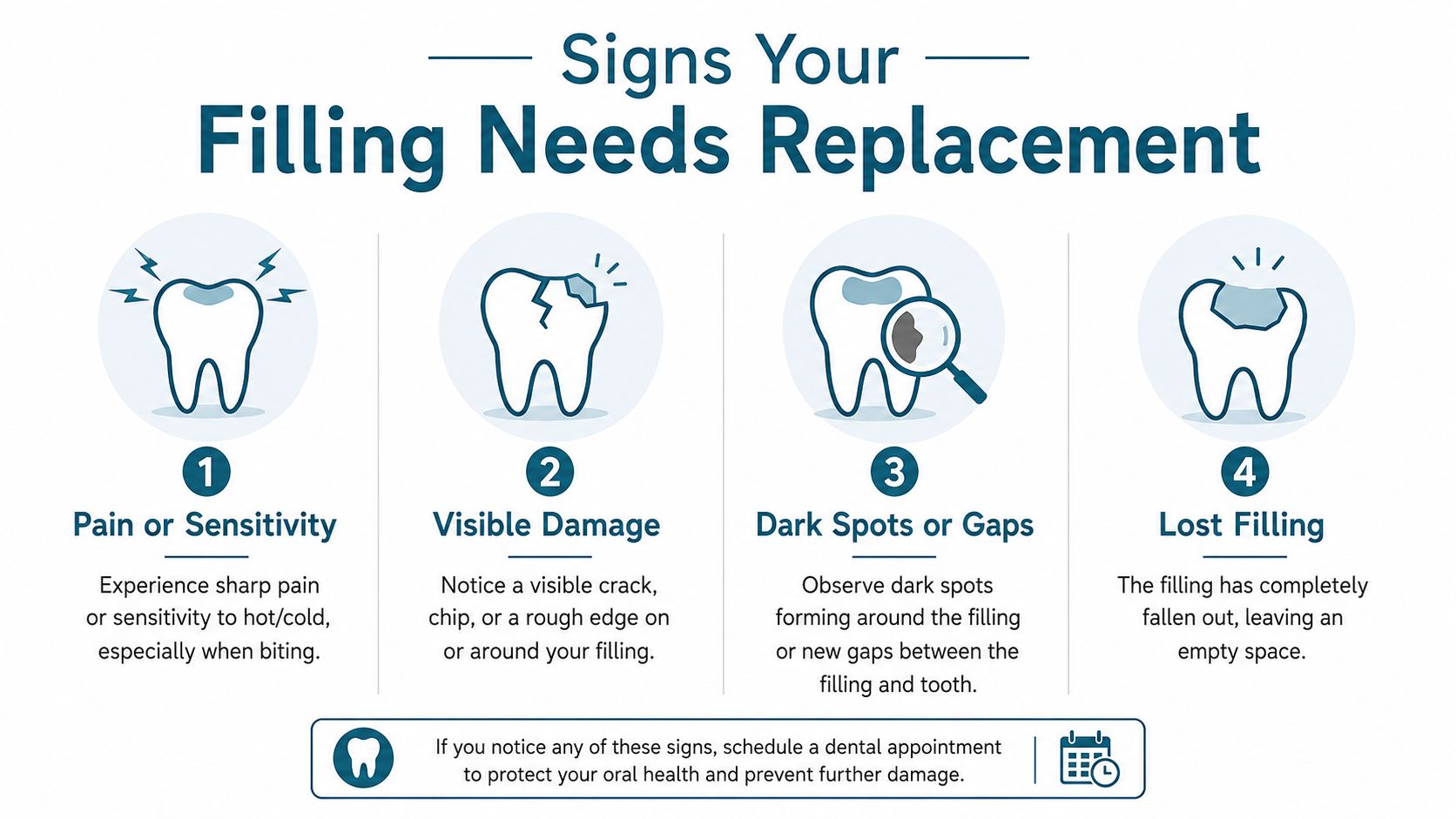
According to this summary of replacement timing, research from 2016 indicates that the average age of an amalgam filling at the time it requires replacement is approximately 15 years, with a variance of about 6 years, while a 2010 study found that composite fillings last an average of 7 years. Those averages are helpful, but symptoms matter more than the calendar when a tooth starts changing.
Symptoms worth taking seriously
A filling may need evaluation if any of the following show up:
- Pain or sensitivity that feels new, especially with cold drinks, sweets, or biting pressure
- Visible damage such as a chip, crack, worn edge, or a filling that looks flattened down
- Dark spots or gaps around the restoration, which can suggest leakage or new decay
- A rough feeling when the tongue rubs over the tooth
- Food trapping or floss shredding around one area over and over
- A lost filling that leaves a hole or sharp edge behind
Some patients also notice that a tooth feels “off” before they feel real pain. The bite may hit first on that tooth, or chewing on one side may suddenly become less comfortable.
A short visual overview can help patients know what to watch for:
When to call sooner rather than later
If a filling falls out, the tooth cracks, or biting sends a sharp jolt through the tooth, it's smart to call promptly. Waiting can allow bacteria to reach deeper into the tooth, which may turn a simple repair into a more involved restorative problem.
A filling rarely improves by being left alone once it starts breaking down.
Patients often search for an emergency dentist. That makes sense when pain is sudden, chewing becomes difficult, or the tooth has a visible fracture. Patients in Circleville, Lancaster, Carroll, and Amanda don't need to guess whether it counts as urgent. If the tooth is hurting, broken, or changing quickly, it deserves a professional look.
Even when the symptom seems minor, early treatment can protect the remaining tooth structure. That usually means a simpler solution, less discomfort, and a better chance of keeping the tooth strong long term.
What to Expect When Replacing a Filling in Our Amanda Office
Replacing a filling is usually far more straightforward than people expect. Most patients aren't worried about the tooth itself as much as they're worried about the unknown. They want to know if it will hurt, whether the old material has to be drilled out aggressively, and whether the new filling will look obvious.

The visit usually starts with a closer look
The first step is a careful exam. That often includes digital x-rays, a visual check of the filling margins, and a bite evaluation. If the filling is leaking, cracked, loose, or hiding decay beneath it, the tooth will usually need a replacement rather than a polish or small adjustment.
Patients coming in for new patient exams often appreciate that this stage is conversational. The dentist explains what's happening, what can wait, and what shouldn't. If the filling only has a minor issue, that's discussed plainly. If the tooth needs more than a filling, the treatment plan reflects that.
Replacement options are discussed before treatment begins
Modern replacement care often centers on mercury-free and natural-looking materials. For many patients, that means a composite restoration that matches the tooth more closely than an older silver filling ever could. Those who want to understand the treatment steps in more detail can review the composite filling procedure.
A typical replacement appointment may include:
- Numbing the area so treatment stays comfortable
- Removing the failing filling and any decay while preserving as much healthy tooth as possible
- Cleaning and shaping the tooth so the new restoration bonds well
- Placing and adjusting the new filling so it feels smooth and bites correctly
Patients who are anxious often do better when they know comfort is part of the plan, not an afterthought. Clear explanations, gentle pacing, and checking the bite before the visit ends can make a big difference.
The goal isn't only to replace the old filling. It's to leave the tooth comfortable, sealed, and easy to use.
If the tooth turns out to be too damaged for a standard filling, the recommendation may shift to another form of restorative dentistry, such as a crown. If infection, severe pain, or a non-restorable fracture is present, treatment may involve emergency dental services, a tooth extraction, or a discussion of future replacement with options such as dental implants near me.
For many people in Amanda and nearby communities, the biggest relief is knowing what's going on. Once the tooth is evaluated and the choices are explained clearly, the next step usually feels much easier.
Your Questions About Dental Fillings Answered
Patients usually ask practical questions, not technical ones. They want to know if the procedure will be comfortable, whether an old filling has to come out, and what they can do to avoid repeating the problem.
Do filling replacements hurt
Most patients do well with local numbing and careful technique. During the procedure, the tooth should feel pressure and vibration more than pain. Afterward, some mild sensitivity can happen for a short time, especially with cold foods or chewing, but that usually settles as the tooth adjusts.
Patients with dental anxiety should say so early. Comfort-focused care works best when the team knows what the patient is worried about before treatment starts.
Should old silver fillings always be replaced
Not always. An older amalgam filling isn't automatically a problem just because it's old or silver. If it's sealed, stable, and the surrounding tooth structure looks healthy, a dentist may recommend monitoring it rather than replacing it.
Replacement becomes more likely when there's decay around the margins, a crack, leakage, a poor bite, or a cosmetic reason the patient wants to discuss. Many patients also prefer modern mercury-free alternatives when replacement is needed.
How can patients help fillings last longer
The simplest steps are still the most effective:
- Brush thoroughly and pay extra attention to the gumline and around filled teeth.
- Floss daily so plaque doesn't sit at the edges of the restoration.
- Keep recall visits for cleanings, exams, and x-rays when recommended.
- Address grinding if clenching or bruxism is wearing teeth down.
- Avoid using teeth as tools for opening packages or biting hard objects.
These habits support not only fillings, but the health of the entire mouth. They also reduce the odds that a small repair turns into a larger restorative need later.
What if a filling problem turns into an emergency
If a filling falls out, the tooth breaks, swelling develops, or pain becomes hard to ignore, it's time to call. Those situations can change fast. A cracked tooth may still be restorable early on, but waiting can reduce the available options.
For patients searching for an emergency dentist, dentist in Lancaster, OH, dentist in Circleville, OH, dentist in Carroll, OH, or dentist in Amanda, OH, the best next move is direct evaluation. The sooner the tooth is checked, the sooner the cause of the pain can be identified and treated.
A healthy, comfortable smile depends on catching changes early. That applies whether someone needs a routine filling check, teeth whitening, cosmetic dentistry, a restorative repair, or a full exam because something just doesn't feel right.
If an old filling feels rough, sensitive, loose, or overdue for a professional look, Amanda Family Dental is here to help patients in Amanda, OH, Lancaster, OH, Circleville, OH, and Carroll, OH with thoughtful exams, digital x-rays, personalized treatment plans, and comfortable, modern care. To schedule an appointment, request a consultation, or get help with a painful tooth, contact the office and take the next step toward a healthier, more confident smile.