


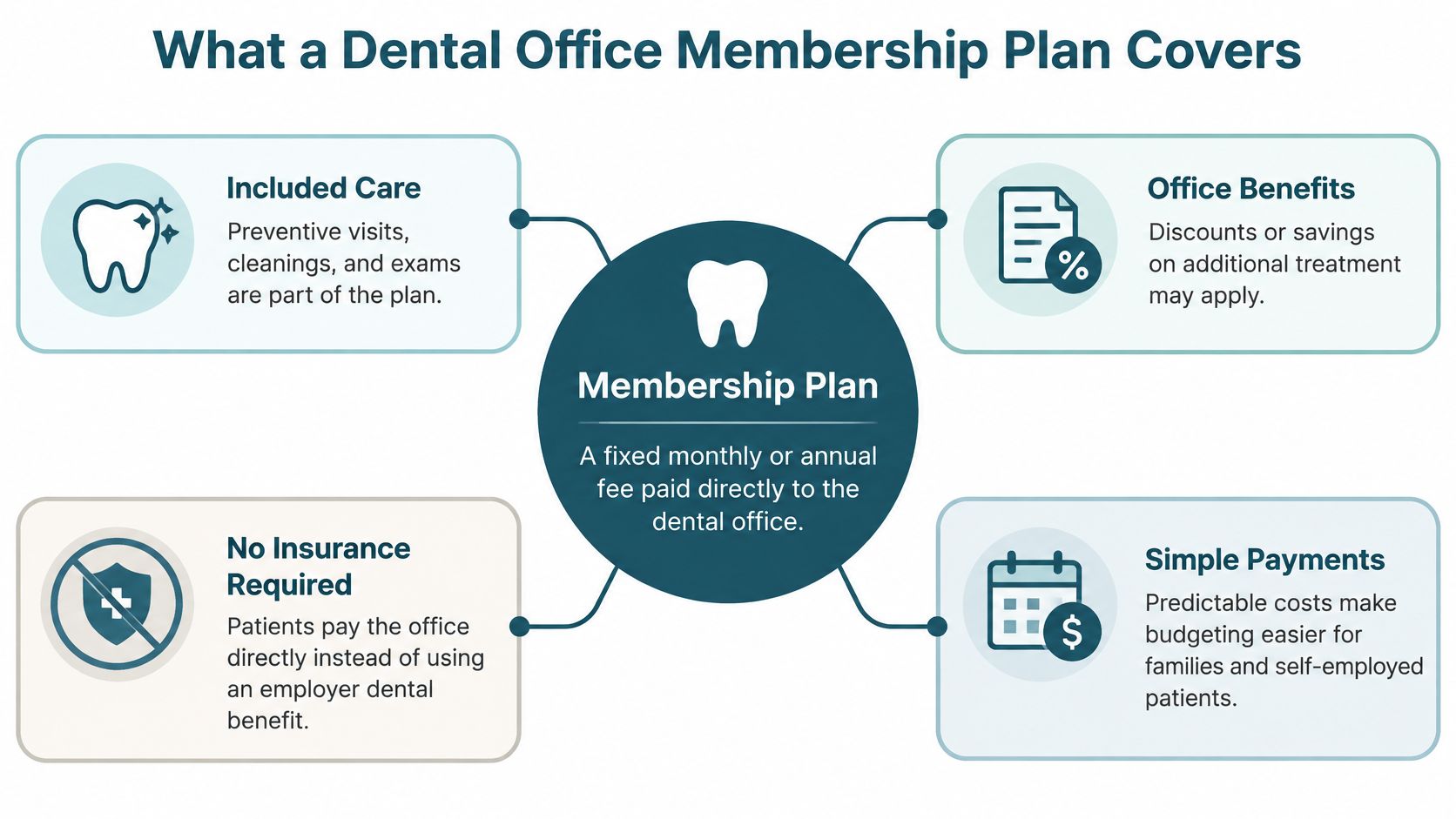
A dental office membership plan is a fixed monthly or annual fee paid directly to the dental office for defined preventive services and a discount on other treatment; it isn't insurance. Its value depends on the written benefits, the care a patient expects to use, and the total cost compared with other payment options.
For a parent arranging a child's cleaning while putting off care for a painful tooth, predictable costs can make scheduling feel more manageable. Families searching for a dentist near Amanda, OH, Lancaster, Circleville, or Carroll can ask about the Power Plan Membership alongside treatment recommendations, insurance, and payment arrangements.
Table of Contents
- Why Families Are Looking Beyond Dental Insurance
- What a Dental Office Membership Plan Covers
- Benefits and Exclusions to Review Before You Enroll
- Membership Plans Compared With Dental Insurance
- How the Power Plan Works at Amanda Family Dental
- Answers to Common Patient Questions About Membership Plans
- Choosing the Right Plan for Your Family and Next Steps
Why Families Are Looking Beyond Dental Insurance
Consider a hypothetical Lancaster family: a child needs a cleaning, a parent is self-employed, and there's no employer dental benefit. Before anyone schedules an appointment, the family wants to know what the visit includes and what might become a separate bill.
That concern isn't unusual. In 2021, at least 65 million Americans lacked dental insurance, and one in four adults delayed or skipped dental care in 2019 because of cost, according to reporting on dental membership plans and affordability.
A conversation about paperwork can help families separate routine expenses from treatment costs.
The problem is uncertainty, not just the bill
Workers without employer benefits, self-employed adults, and households paying entirely out of pocket often want a clearer way to budget. A Circleville parent might be comfortable paying for planned preventive care but uncertain about the cost of a filling discovered during an exam.
A membership can help organize that conversation. It separates services included in the membership fee from treatment that remains the patient's responsibility.
Practical rule: A useful plan should make the next bill easier to understand, not simply make the advertised discount sound appealing.
A local starting point
Amanda Family Dental's approach to affordable family dental care includes flexible payment options. The appropriate choice depends on each household's needs, not whether the household currently has insurance.
For families in Amanda and nearby communities, the first question is straightforward: which appointments are likely to happen, and what would those appointments cost under each available option? Answering that question is more useful than enrolling solely because a plan sounds convenient.
What a Dental Office Membership Plan Covers
A helpful comparison is a prepaid maintenance subscription at a neighborhood service shop. Routine upkeep may be included, while repairs are billed separately at an agreed reduced price.
The American Dental Association's explanation of in-office dental plans describes fixed monthly or annual payments, specified preventive services, and discounts on eligible additional procedures. It also states that the annual membership fee must be paid in full before treatment.
The distinction between included care and discounted treatment is central to understanding the paperwork.
The working parts of the agreement
Preventive services should be named individually. “Preventive care included” is less useful than a written description identifying examinations, professional cleanings, eligible dental X-rays, and the permitted frequency of each.
Treatment discounts need a clearly defined scope. A discount on eligible fillings doesn't establish whether the same terms apply to crowns, a tooth extraction, teeth whitening, or dental implants.
The fee schedule connects those promises to actual costs. It should explain the membership charge, payment timing, and how the office calculates the reduced price for eligible treatment.
- Included services: Confirm which procedures require no additional payment.
- Discounted services: Identify which treatments remain separately payable.
- Payment terms: Check when the fee is due and when eligibility begins.
Reading examples without assuming identical benefits
An outside plan page can provide another format for reviewing the paperwork. Readers comparing descriptions may find a dental membership scheme useful as an example, but another office's terms don't establish local benefits or eligibility.
The written agreement matters more than the phrase “membership plan.” Patients should be able to point to the language explaining each promised benefit before making a payment. If monthly billing is offered, the office should also explain whether that arrangement changes the annual payment obligation or divides it into installments.
Benefits and Exclusions to Review Before You Enroll
Enrollment only helps when the benefits match care the patient can use. A predictable preventive-care budget may make scheduling easier, but paying a membership fee doesn't replace attending appointments.
The access difference is substantial. In 2024, 53% of privately insured adults ages 19–64 had a dental visit, compared with 17% of uninsured adults; among children ages 0–18, the corresponding figures were 64% and 26%, according to ADA coverage and access data. These figures describe differences in attendance, not proof that membership enrollment produces the same result as insurance.
Why the preventive schedule matters
Regular examinations give the dentist opportunities to identify tooth decay, gum problems, and worn or failing restorations. Patients can then discuss treatment before a problem becomes more uncomfortable or requires a more involved procedure.
The schedule still needs to reflect the individual patient. A routine cleaning benefit may not address every periodontal-care need, and imaging should follow clinical need rather than a desire to use every listed benefit.
What the discount doesn't pay
A published membership agreement explaining treatment discounts and exclusions states that the plan doesn't pay for procedures, limits benefits to treatment at the participating office, and excludes previously completed treatment and outside hospital or specialist services. Those are examples of written limits to check, not confirmed Power Plan terms.
For instance, a patient referred elsewhere for a complicated procedure shouldn't assume that the receiving provider will honor an in-office discount. Similarly, joining after paying for treatment doesn't automatically create a credit for that earlier bill.
A reduced treatment price and a paid treatment bill are different things.
Before enrollment, the benefits review should answer these practical questions:
- Visit eligibility: What scheduling windows and visit limits apply?
- Cleaning type: Does the benefit match the cleaning the dentist recommends?
- Imaging rules: Which dental X-rays qualify, and when?
- Treatment boundaries: Which procedures, providers, and locations are excluded?
A clear answer may be reassuring even when a service isn't included. Knowing the boundary allows the patient to budget rather than discover it during checkout.
Membership Plans Compared With Dental Insurance
The less expensive option depends on the household's expected care. A membership may fit someone primarily seeking preventive visits, while insurance may offer a more favorable outcome for another patient's treatment needs.
A dental coverage analysis published by the Colorado Division of Insurance reports that 22.8% of adults ages 19–64 were uninsured for dental care in 2021. It also discusses an industry-sponsored survey in which 84% of respondents believed dental insurance saves money long term, with reported median annual savings of $400 for individuals and $1,000 for families. Those survey findings aren't a promise of savings for any particular household.
Membership Plan Versus Dental Insurance Cost Factors
| Cost factor | Membership plan | Dental insurance |
|---|---|---|
| Recurring cost | Written membership fee | Premiums paid by the household |
| Preventive visits | Defined services under the agreement | Benefits specified by the policy |
| Additional treatment | Patient pays the eligible discounted fee | Patient share depends on policy benefits |
| Deductible and coinsurance | Review the membership's own charges | Check deductible and coinsurance obligations |
| Annual maximum | Check benefit limits and exclusions | Check the insurer's annual payment limit |
| Waiting periods | Confirm the effective date and restrictions | Confirm procedure-specific waiting periods |
| Provider restrictions | Confirm participating office and services | Check network and out-of-network rules |
A break-even worksheet without guesswork
The worksheet should use written estimates, not assumed treatment needs. A patient anticipating crowns, root canals, implants, orthodontics, or extensive cosmetic dentistry needs more than the preventive-care price.
- Expected care: List recommended visits and treatment, separating immediate needs from optional work.
- Membership total: Add the fee, separately payable preventive services, and quoted member treatment prices.
- Insurance total: Add household premiums and estimated patient responsibility after applicable benefits.
- Cash total: Request the office's direct-pay estimate for the same care.
- Other coverage: For an eligible patient, compare Medicaid benefits and participating-provider access before replacing that option with private payments.
The break-even point occurs when the membership fee plus member-priced care equals the alternative's total household cost. If a family expects to miss preventive visits, the worksheet should reflect that possibility rather than counting every included service as guaranteed savings.
The practice's discussion of family dental insurance costs can help frame questions for the office. Insurance estimates should still be checked against the actual policy.
A membership is a budgeting and access tool. It isn't a guarantee of lower spending, and a treatment discount doesn't resolve how a household will finance a large remaining balance.
How the Power Plan Works at Amanda Family Dental
The Power Plan Membership is part of Amanda Family Dental's flexible payment options. It provides a way to discuss preventive care and discounts on eligible additional treatment without treating membership as an insurance policy.
A plan review should feel like a conversation, with time to examine the paperwork before enrollment.
Starting with the current written terms
Patients in Amanda, Lancaster, Circleville, and Carroll, Ohio, can begin by calling the office or submitting an online consultation request. The purpose of that first contact is to obtain the current agreement and arrange an appropriate visit, not to commit before receiving answers.
Pricing tiers and eligibility should be confirmed directly with the office. The current agreement should identify included cleanings and exams, imaging benefits, and any discount applying to eligible restorative or cosmetic treatment.
A patient considering a filling may need different information from someone considering veneers or tooth replacement. The office should identify the relevant provision rather than rely on a general statement that additional treatment receives a discount.
- Review before paying: Read the benefit schedule, exclusions, and financial obligations.
- Confirm individual needs: Match the dentist's recommendations to the applicable membership terms.
- Establish the start date: Confirm when services become eligible and how payment affects activation.
- Keep the agreement: Retain a copy alongside treatment estimates and payment records.
Renewal deserves the same attention as enrollment
Patients should ask whether renewal requires approval or occurs automatically, when the next payment becomes due, and whether pricing or benefits can change. A reminder process is helpful, but the written agreement should establish the actual obligation.
Cancellation language deserves equal attention. The office should explain the notice process, any unpaid balance, and whether a refund depends on services already received.
Before signing: The patient should understand both how membership begins and how it ends.
The practice video offers another way to become familiar with the office before an appointment.
For a new patient exam, the membership discussion and clinical assessment serve different purposes. Digital X-rays, when appropriate, help inform the personalized treatment plan; the financial review explains how recommended services will be paid for.
Patients should leave with clear next steps, including which appointments to schedule, which treatment estimates remain outstanding, and which membership questions still need written answers.
Answers to Common Patient Questions About Membership Plans
Can membership move to another dentist?
An office membership generally stays with the participating practice. It isn't a transferable insurance policy, a distinction reflected in the ADA's dental-benefits overview.
For the Power Plan, patients should confirm who may use the membership and where benefits apply. A spouse or child shouldn't assume that another family member's unused benefits are available to share.
What happens after a missed appointment?
A missed visit doesn't necessarily cancel a payment obligation or extend the membership period. Patients should ask about rescheduling deadlines, missed-appointment charges, and whether an appointment must occur before the benefit expires.
Unused visits shouldn't be assumed to roll over. The Power Plan agreement needs to establish whether unused services expire, carry forward, or receive any other treatment.
Are cancellation refunds available?
The written policy determines the answer. Patients should obtain the refund terms before paying, including how the office handles benefits already used and any remaining installment obligation.
Cancellation and stopping a payment method aren't necessarily the same action. The office should identify the required notice method and confirm the effective cancellation date.
What if a patient moves or loses employment?
A move may make attending appointments impractical, so cancellation and remaining-benefit questions should be addressed before departure. A patient losing employment should ask how a payment difficulty affects membership status rather than assume that eligibility automatically ends.
Continuity also matters for unfinished treatment. Patients should request clarity about records, ongoing care, and whether an existing estimate remains valid after membership ends.
Do emergency visits qualify?
Patients searching for an emergency dentist should ask separately about the emergency examination, imaging, and any recommended procedure. A benefit applying to the examination doesn't establish the price of a root canal or tooth extraction.
The Power Plan's emergency provisions should be confirmed directly. Same-day appointments depend on availability, and membership shouldn't be mistaken for guaranteed immediate scheduling.
Why do these details matter?
A membership can improve predictability while leaving substantial treatment costs with the patient. CareQuest's oral-health equity report discusses the relationship between coverage, affordability, and access, reinforcing the importance of reviewing likely care alongside the payment arrangement.
Choosing the Right Plan for Your Family and Next Steps
The appropriate choice starts with the patient's treatment needs, availability for appointments, and household budget. A large advertised discount matters less if it excludes the service being considered or applies during a period when the patient can't attend.
For families, a preventive-focused arrangement may make sense when children and adults can use their own scheduled benefits. Pediatric appointments also provide an opportunity to discuss a child's developing needs rather than assume the adult benefit schedule is suitable.
Match the payment decision to the care
Adults considering teeth whitening, veneers, Invisalign clear aligners, or cosmeceuticals should request an itemized consultation estimate. Each service may have different eligibility, so the treatment timeline and applicable discount should be settled before enrollment.
Someone searching for dental implants near Amanda or a cosmetic dentist near Lancaster needs a clinical assessment first. The dentist can then explain suitable options, expected stages, and which portions qualify under the written plan.
- Preventive-care households: Compare likely attendance with the fee and included benefits.
- Restorative-care patients: Request a complete estimate for fillings, crowns, root canals, dentures, or implants.
- Cosmetic-care patients: Confirm each elective service individually rather than assume a shared discount.
- Anxious patients: Discuss comfort needs and scheduling preferences alongside financial questions.
Comfort and affordability can be discussed together
Predictable pricing may ease financial worry, but dental anxiety can require a separate conversation. Comfort-focused care and sleep dentistry options can be discussed during a consultation, with suitability and costs reviewed individually.
For larger treatment plans, the practice's information about financing dental procedures provides another starting point. Financing and membership answer different questions: one concerns paying a balance over time, while the other establishes eligible services and prices.
Families seeking a dentist in Carroll, OH, or Circleville can begin with a phone call or consultation request. Bringing insurance details, recent treatment estimates, and questions about unused visits or cancellation helps the office prepare a useful discussion.
A new patient exam with clinically appropriate digital X-rays allows treatment recommendations to come before the final financial decision. Patients can ask questions about the Power Plan without treating that conversation as a commitment to enroll.
Amanda Family Dental offers family, restorative, and cosmetic dental care, with a Power Plan Membership and flexible payment options to discuss alongside personalized treatment recommendations. Patients in Amanda, Lancaster, Circleville, and Carroll, Ohio, can visit Amanda Family Dental to request a consultation or arrange a new patient exam and review the current membership terms before deciding.