

Family dental insurance typically costs $50 to $150 per month, or about $600 to $1,800 per year, with plan type, location, and family size driving the range. A family in Amanda, Lancaster, Circleville, or Carroll may pay more or less depending on the network, deductible, annual maximum, and benefits included.
A parent comparing plans after a child's overdue cleaning may focus on the monthly premium and miss the larger question: what happens when someone needs a filling, crown, root canal, tooth extraction, or dental implants? The right plan depends on how much care a household expects, which providers it can use, and how much financial risk it can comfortably carry.
Families near Amanda, Ohio, often search for a dentist near me only after pain or a broken tooth makes the decision urgent. Amanda Family Dental helps local patients understand preventive care, restorative dentistry, cosmetic dentistry, and emergency dental services before treatment becomes more stressful. The same practical approach helps families in Lancaster, Circleville, and Carroll compare insurance with cash pricing or an in-office membership option.
Table of Contents
- Understanding Family Dental Insurance Cost at a Glance
- How Family Dental Insurance Works and What You Actually Pay For
- What Drives Your Family Dental Insurance Premium
- Comparing Plan Types Deductibles and Annual Maximums
- Example Costs for Different Family Sizes and Needs
- Smart Ways to Lower Your Family Dental Costs in Ohio
- What to Expect at Amanda Family Dental and Next Steps
Understanding Family Dental Insurance Cost at a Glance
A family in Amanda may include two adults and children who mainly need cleanings and exams. A household in Lancaster may be comparing coverage because one parent expects a crown while a teenager may need orthodontic care. Both are shopping for family dental insurance, yet the better financial choice may differ.
The broad U.S. range is $50 to $150 per month, or $600 to $1,800 per year for coverage alone, according to Humana's dental insurance cost guide. That premium keeps the policy active, much like a reservation for help with eligible care. It is only one part of the yearly cost. Deductibles, coinsurance, excluded services, waiting periods, and the annual maximum can all affect what the family pays at the dental office.
A national database covering 1,196 plans reported an average premium of $49.60 per month, with state averages ranging from $36.98 in West Virginia to $65.58 in Massachusetts. Those figures show why a national average is a reference point, not a quote for an Ohio household.
Why the monthly bill doesn't answer everything
A lower premium may come with a narrower provider network, a lower annual maximum, or fewer benefits. A higher premium may reduce the family's share of restorative treatment, though the policy can still include waiting periods or limits for specific services.
The American Dental Association recorded an earlier benchmark of $31.69 per month for a family stand-alone plan sold through the federally facilitated marketplace in 2015. Its ADA marketplace analysis illustrates how plan design can affect the price of family coverage.
Practical rule: Compare the premium, expected dental work, provider access, and benefit limits together. A policy with a low monthly bill may cost more overall if several family members need restorative care.
Amanda Family Dental gives families a local point of reference when they compare insurance with direct payment or the Amanda Family Dental Power Plan Membership. A new patient exam, dental x-rays, and a personalized discussion can clarify which care is urgent, what can be scheduled, and which payment approach fits the household in Amanda, Lancaster, Circleville, or Carroll.
How Family Dental Insurance Works and What You Actually Pay For
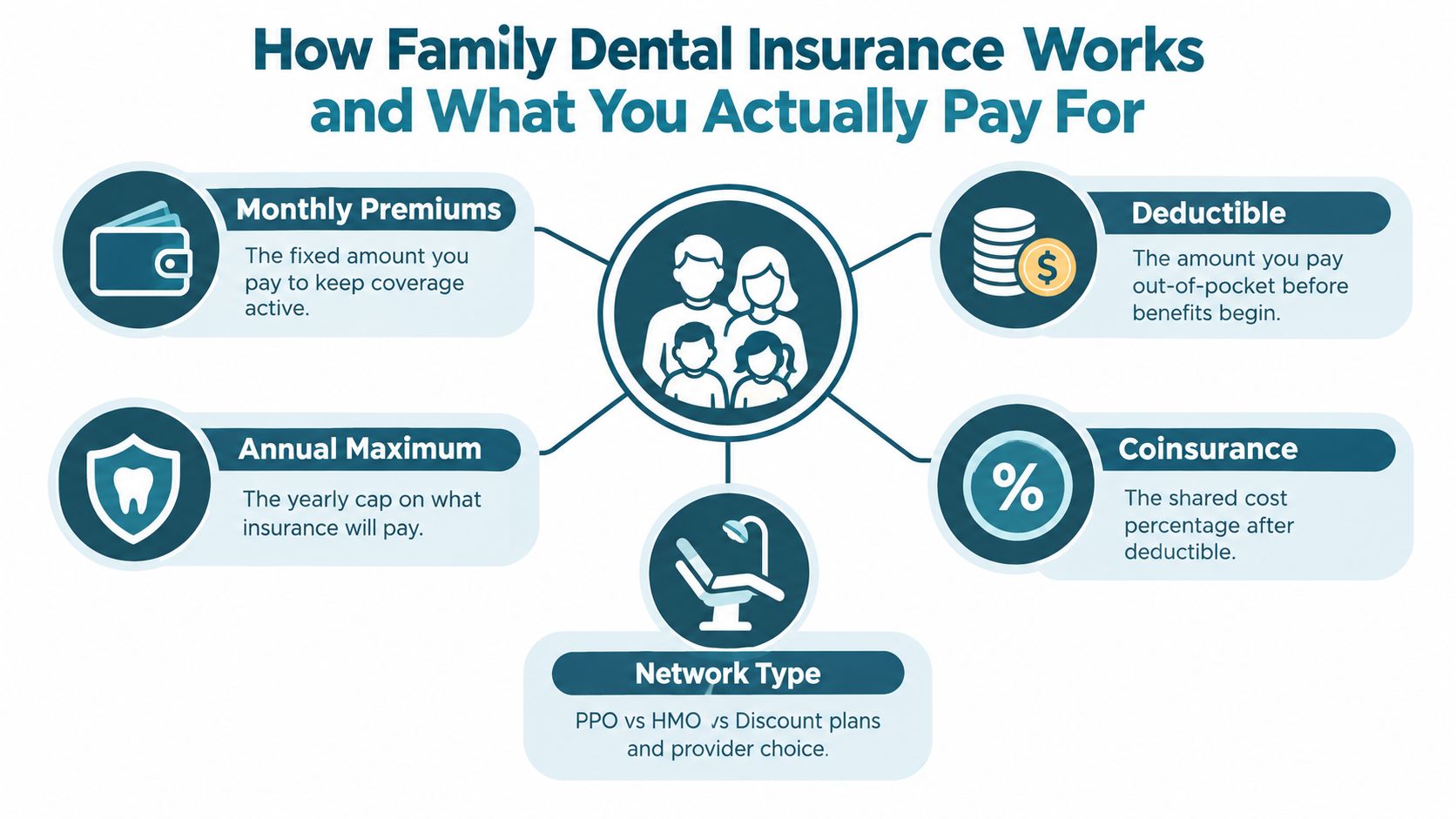
Dental insurance works a little like a household repair budget. The premium is the recurring amount paid to keep the policy active. The deductible is the initial share a family pays before certain benefits begin. Coinsurance divides later costs between the plan and the patient, while the annual maximum limits what the insurer pays during the benefit year.
The five parts that shape the bill
Premiums are predictable. They arrive every month whether anyone visits the dentist or not. A family should include this fixed expense in its yearly dental budget before estimating treatment costs.
Deductibles usually apply to covered restorative services rather than routine preventive visits, but each policy sets its own rules. Common dental deductibles range from $50 to $100 per covered person, and some family plans use $50 per person up to $150 per family, as described by Money's dental insurance guide.
Coinsurance is the portion left after the deductible. For example, a plan may pay part of a filling or crown while the patient pays the balance. The exact share depends on the procedure, plan, and network status.
Annual maximums limit the insurer's yearly contribution. Many plans cap benefits at approximately $1,000 to $2,000, while some higher-end plans offer $2,500 or more, according to Forbes Advisor's dental coverage explanation.
Network type affects both provider choice and negotiated fees. A DHMO usually requires more structured participation, while a PPO generally gives families broader access. Indemnity coverage may offer flexibility but can involve different reimbursement rules.
Preventive care and restorative care follow different paths
Preventive services often receive the strongest coverage. Many plans pay 100% for cleanings, exams, and x-rays, and these services often don't count toward the annual maximum, according to MetLife's explanation of dental insurance coverage.
Restorative care is less predictable. Fillings, crowns, root canals, tooth extraction, dentures, and dental implants may involve deductibles, coinsurance, waiting periods, exclusions, or annual caps. A family should request a benefits summary and ask the dental office to review the expected patient portion before approving major treatment.
What Drives Your Family Dental Insurance Premium
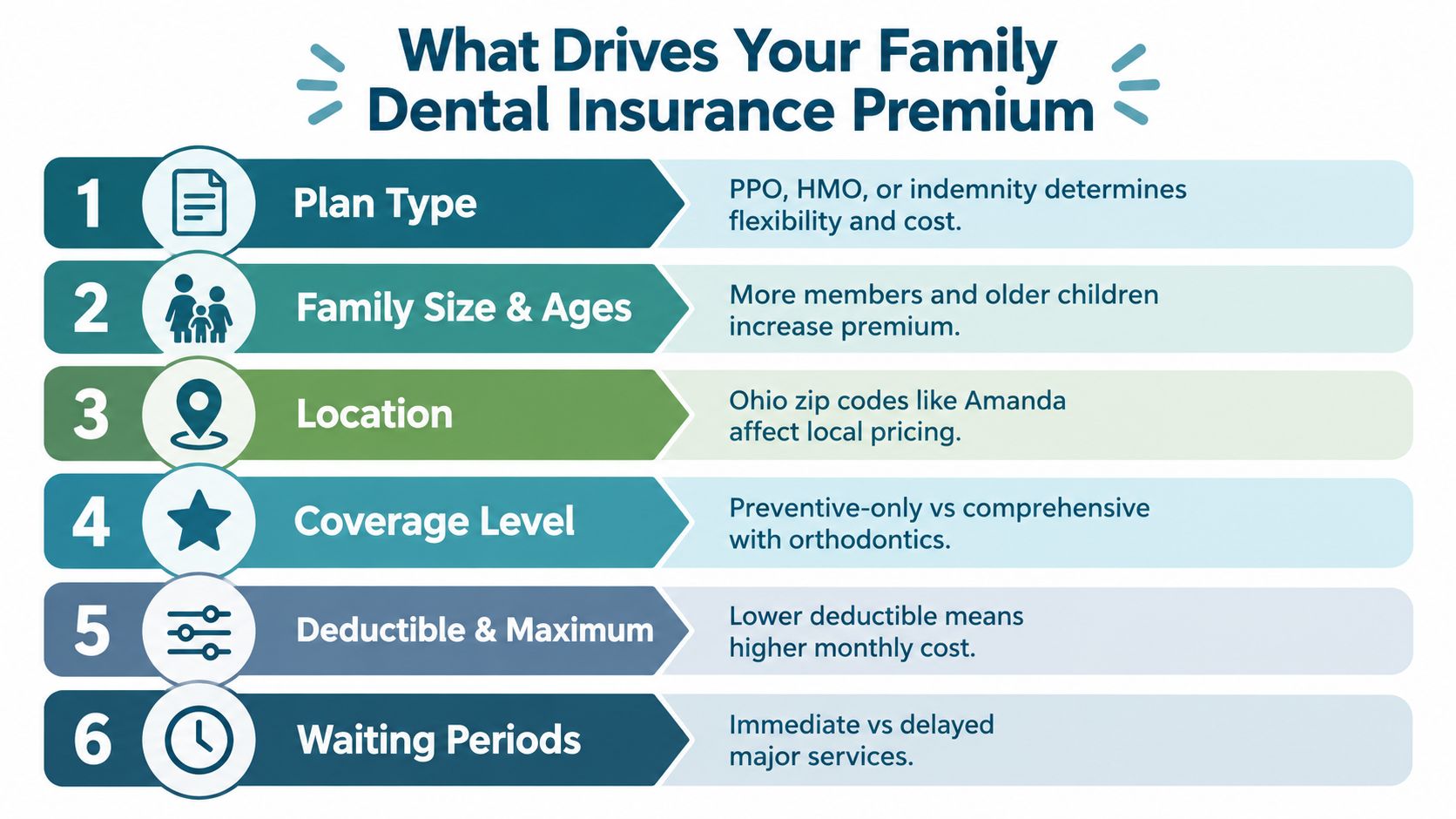
A family of four in Amanda may receive a different quote from a similar family in another Ohio market. Insurers look beyond the number of people applying. Plan type, family size, ages, location, coverage level, deductible, annual maximum, and waiting periods all shape the monthly premium and the amount a household may pay when care is needed.
Plan design changes the trade-off
A DHMO may cost less each month because it uses a structured network and benefit design. A PPO may have a higher premium in exchange for broader provider choice. An indemnity plan can offer flexibility, but the family must check reimbursement limits and whether its preferred dentist accepts the plan.
Family size usually raises the premium as dependents are added. Ages also affect the quote and the care a household may expect. Parents of young children may focus on regular pediatric cleanings and exams. A household with older adults may give more weight to crowns, root canals, dentures, or implants.
Location matters too. Prices vary by state and local market, so a national range may not match a quote for a family in Amanda, Lancaster, Circleville, or Carroll. That local difference is one reason to compare an insurance premium with Amanda Family Dental's Power Plan Membership when estimating yearly cost.
Coverage level and limits affect later spending
Preventive-only coverage may fit a family that expects routine visits and little restorative treatment. Broader coverage may be useful when major care is more likely, although richer benefits often increase the premium.
Some higher-benefit family plans list per-person annual maximums of $2,000 to $3,000, with benefits sometimes increasing after the first year. The Delta Dental PPO plan information also shows why families should check whether implants or orthodontia have separate limits or rules.
A lower deductible can make a procedure easier to budget, while increasing the monthly premium. Waiting periods create a timing concern as well. A policy that delays major services may offer limited help when a family already knows a crown or root canal is needed.
Before choosing, compare:
- Total yearly premium: What will the policy cost across the benefit year?
- Family deductible: Is it charged per person, capped for the household, or waived for preventive care?
- Annual maximum: Is the limit sufficient for likely restorative treatment?
- Network rules: Can each family member see a convenient dentist in Amanda or nearby?
- Service exclusions: Are orthodontics, implants, crowns, or emergencies handled differently?
- Waiting periods: When can the family use major benefits?
Comparing Plan Types Deductibles and Annual Maximums
A family choosing dental coverage is balancing three things: monthly premium, freedom to choose a dentist, and help with treatment costs. The main plan types are DHMO, PPO, and indemnity coverage.
| Plan Feature | DHMO | PPO | Indemnity |
|---|---|---|---|
| Premium tendency | Often lower | Moderate to higher | Varies by benefit design |
| Provider access | More structured network | Broader network flexibility | Usually flexible, subject to reimbursement rules |
| Cost control | Predictable contracted fees | Negotiated in-network fees | Patient may pay the difference above allowed amounts |
| Annual maximum | Depends on policy | Commonly included | Depends on policy |
| Best fit | Families focused on predictable network pricing | Families wanting broader dentist choice | Families prioritizing flexibility |
A DHMO can work well when a participating dentist is convenient for the household and expected care is mostly routine. A PPO may suit an Ohio family that wants to keep a particular dentist in Amanda or nearby, or wants more options for restorative care. Indemnity coverage offers flexibility, but the family may need to pay the difference between the dentist's charge and the plan's allowed amount.
The label alone does not show the final cost. Read the deductible and annual maximum beside the premium.
Deductibles and caps deserve equal attention
A family deductible may apply separately to each covered person or stop increasing after the household reaches a stated limit. That difference becomes important when several family members need fillings or other covered services in one benefit year.
The annual maximum sets the plan's ceiling for covered benefits. A plan with a $2,000 to $3,000 per-person annual maximum may provide more room for restorative treatment than a lower-cap policy, though its premium may be higher. A $2,000 cap might cover preventive care and some basic treatment, yet leave limited support after one person has a crown and root canal, coinsurance, and other services. Review the plan rules in Delta Dental's PPO coverage details, including limits for specific procedures.
Judge a plan by the care it can support, not only by its monthly premium.
For a household comparing insurance with cash payment or the Amanda Family Dental Power Plan Membership, compare the expected yearly premium, deductible, and treatment balances with the membership fee and included services. This cost benefit of dental plans comparison can show which option fits the family's likely care in Ohio.
Example Costs for Different Family Sizes and Needs
Examples make the family dental insurance cost easier to understand, but they shouldn't be mistaken for quotes. The ranges below come from the requested local comparison framework, while actual pricing depends on the selected plan, eligibility, network, benefits, and household details.
Four household situations
A family of two might compare a premium of $60 to $90 per month for coverage focused on preventive care. That equals $720 to $1,080 per year in premiums before any deductible or treatment balance. If both adults mainly need cleaning and exams, a lower-cost plan may be reasonable, provided the network includes a convenient dentist.
A family of three might look at $90 to $150 per month, or $1,080 to $1,800 per year, while accounting for pediatric cleanings and fluoride. Preventive services may be strongly covered, but the household should still confirm how fillings, dental x-rays, and emergency visits are handled.
For a family of four, a planning example of $130 to $200 per month equals $1,560 to $2,400 per year in premiums. A balanced plan may suit parents expecting preventive care and occasional basic restorative treatment, but the family should compare the deductible and annual maximum before assuming the richer policy is cheaper overall.
A family of five may consider $170 to $250 per month, or $2,040 to $3,000 per year, especially when orthodontic needs are possible. Orthodontia may have separate limits, so a high annual maximum for ordinary dental work doesn't automatically mean orthodontic treatment is fully protected.
Insurance versus cash or membership pricing
The break-even point depends on the family's expected use. A preventive-focused household may pay premiums that exceed the value of claims, while a family expecting crowns, root canals, or tooth extraction may reach the plan's limits quickly and still face coinsurance.
A membership plan can be easier to compare because the family pays a set fee and receives specified discounts or preventive benefits rather than submitting insurance claims. Families evaluating direct payment can review dental cleaning costs without insurance before deciding whether traditional coverage or membership pricing better fits their needs.
The clearest comparison includes annual premium, expected deductible, estimated coinsurance, excluded services, and the office's cash or membership price. That calculation should be completed before a family commits to a policy.
Smart Ways to Lower Your Family Dental Costs in Ohio
Families in Amanda, Lancaster, Circleville, and Carroll can reduce surprises by making decisions before pain appears. The most effective approach usually combines preventive visits, careful plan review, and an honest estimate of likely treatment.
Choose an in-network dentist. Before enrolling, families should confirm that the selected dentist participates in the plan. Network status can affect the negotiated fee and the amount the patient owes.
Use preventive appointments. Regular cleaning and exams help the dental team identify small problems before they become larger restorative cases. Parents should schedule children's visits as part of the household calendar rather than waiting for tooth pain.
Compare annual maximums. A family expecting crowns, root canals, or dental implants should compare the annual maximum with the likely treatment plan. A larger cap may justify a higher premium when major care is probable.
Review waiting periods early. A policy purchased after a problem is identified may not provide immediate benefits for that service. Families should read the waiting-period language before selecting coverage.
Reassess each year. Children age, family needs change, and a plan that worked for routine care may no longer fit when orthodontics or restorative dentistry becomes more likely. An annual review can also reveal whether an in-office membership option deserves comparison.
The same planning principle applies to a dental practice's online guidance. Families researching dental marketing with Outrank can see how clear service information helps patients find relevant care, but patients still need a direct benefits review for their own household.
Families without traditional insurance can also compare affordable family dental care and ask whether a Power Plan Membership may reduce routine out-of-pocket costs. The right choice depends on the services included, the family's expected treatment, and the payment terms.
What to Expect at Amanda Family Dental and Next Steps
A cost conversation should begin with diagnosis, not guesswork. At Amanda Family Dental, a new patient exam can include digital x-rays and an evaluation of the teeth, gums, bite, and symptoms. The team can then outline a personalized treatment plan and explain which services may involve insurance, membership pricing, or direct payment.
That process matters for families dealing with tooth pain, a missing tooth, cosmetic concerns, or an emergency. Timely care can support oral health, relieve discomfort, improve chewing and speaking, and restore confidence. Services may include cleaning and exams, pediatric dentistry, fillings, crowns, root canals, tooth extraction, dental implants, teeth whitening, Invisalign, and other cosmetic or restorative treatments.
Families should bring insurance information and ask for a pre-treatment estimate when major care is being considered. Patients without insurance can ask about the Power Plan Membership, while families who need payment flexibility can review financing for dental procedures.
For a household in Amanda, Lancaster, Circleville, or Carroll, the next step is a conversation with a local dental team that can connect the policy details to actual care needs. A new patient exam can replace uncertainty with a clear plan.
Amanda Family Dental offers preventive, emergency, cosmetic, and restorative dental care for families comparing insurance and affordable payment options. Families in Amanda, Lancaster, Circleville, and Carroll can visit Amanda Family Dental to schedule an appointment, request a consultation, and discuss the right next step.