


If the dental estimate lands in the middle of an already tight month, the hard part usually isn't the tooth. It's the math. A parent in Amanda, OH, can feel fine about scheduling a cleaning, then hesitate when a cracked filling, a child's exam, or a bigger treatment plan turns that one visit into a much larger bill than expected.
That's why affordable family dental care has to mean more than a low first-visit price. It has to mean clear planning, predictable costs, and a local team that helps families in Amanda, Lancaster, Circleville, and Carroll, Ohio decide what to do now, what can wait, and what protects the budget over time. For families comparing benefits and household coverage, a practical overview like the Florida family health insurance guide can also help frame how dental fits alongside broader family coverage.
Table of Contents
- What Most Families Get Wrong About Affordable Dental Care
- What Affordable Family Dental Care Really Includes
- Typical Costs of Family Dental Services in 2026
- What Actually Drives the Price of Family Dentistry
- Five Practical Ways to Lower Family Dental Costs
- What to Expect at Amanda Family Dental
- Local Questions and Next Steps for Amanda-Area Families
What Most Families Get Wrong About Affordable Dental Care
A lot of families shop for dentistry the same way they shop for school shoes, they look for the lowest upfront price and hope the rest sorts itself out. That approach can work for a quick purchase, but it breaks down when a child needs a cleaning, a teenager has a chipped tooth, and a parent is still dealing with a sore filling from last year.

The better question is not, “What's the cheapest visit today?” It's, “What will this family spend across the next 12 months if care is delayed, split up, or handled in emergencies?” That is the difference between chasing a low sticker price and comparing the full out-of-pocket cost of the treatment path. The ADA's national trends report shows that access still varies widely, with many people not getting regular dental care, so families often have to make cost decisions before they feel fully ready ADA national trends report.
Practical rule: a family-friendly dental office should help compare the full treatment path, not just the first chair time.
That is also why local families often do better with clear pricing and membership options instead of chasing one-time discounts. When a practice can map out preventive care, likely follow-up needs, and payment timing together, the year becomes easier to budget. For a local example of how a practice presents that kind of structure, see Amanda Family Dental's family-friendly services page. Families who are comparing medical and dental benefits together can also look at the Florida family health insurance guide to see how broader coverage choices affect what they pay.
A simple way to think about it
A low-cost cleaning can still be the first step in a more expensive year if hidden problems show up later. Affordable care is really a budgeting strategy, not just a price tag. Families in Amanda, Lancaster, Circleville, and Carroll usually feel the difference when they can see the likely next step before they sit down.
That is the common mistake many households make. They judge one appointment in isolation, then get surprised when the next visit, the follow-up, or the repair changes the total bill.
What Affordable Family Dental Care Really Includes
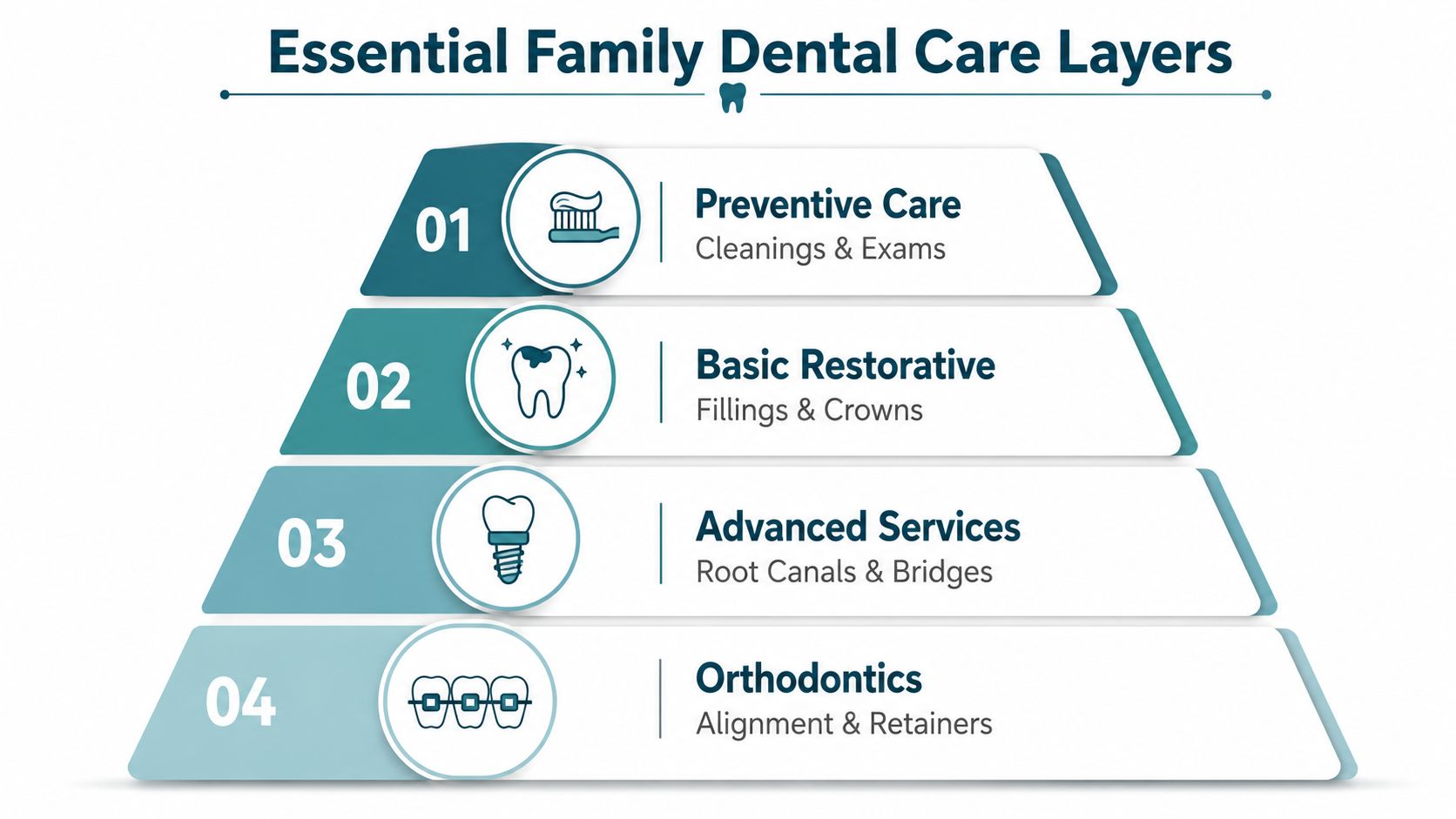
A family's dental budget usually breaks into layers, and the cheapest-looking visit is only one layer of the bill. The useful question is whether the office helps you see the whole treatment path before you commit, because that is what determines the out-of-pocket cost. A house needs a solid foundation before anyone worries about paint or decor, and family dental care works the same way.
The four layers families usually need
The first layer is preventive care, which includes cleanings, exams, and x-rays when they are needed. This is the part that keeps small problems from turning into larger ones, and it is usually where families get the most value over time. The CDC notes that dental sealants and community water fluoridation are strongly recommended because they prevent cavities and save money, which makes prevention the clearest cost-saving move in dentistry CDC oral disease prevention.
The second layer is basic restorative care, things like fillings and crowns. These treatments repair teeth that are already damaged, and they usually cost more than prevention because they require more chair time, more materials, and more planning.
The third layer is advanced repair or replacement, such as root canals, bridges, dentures, and dental implants. These are the services families often hope to avoid, but they become necessary when damage has gone too far or a tooth cannot be saved.
The fourth layer is cosmetic dentistry, including whitening, veneers, and alignment options like Invisalign. These services are not only about appearance. For many adults, confidence matters, and a healthy smile can make everyday conversations feel easier.
Affordable family dental care works best when the same office can handle the first layer, the second layer, and the occasional bigger repair without sending the family somewhere new every time.
Matching care to family values
Some families care about digital x-rays, mercury-free fillings, or fluoride-free choices. Others want the simplest plan that keeps teeth healthy and costs predictable. A strong local practice should explain those options plainly, then let the family choose what fits.
That is why a clear service list matters. Families can compare routine preventive care, restorative visits, and higher-level treatments by looking at the service overview page, then deciding which parts of care they are likely to need this year and which parts they can plan for later.
Typical Costs of Family Dental Services in 2026
A family may sit down expecting a simple estimate, then the bill changes as soon as the dentist maps out the full treatment path. That is normal in dentistry. A cleaning is one visit, but the cost picture changes once a filling, crown, extraction, or replacement enters the plan.
How payment models change the picture
| Service | No Coverage | Traditional Insurance | Power Plan Membership |
|---|---|---|---|
| New patient exam | Varies by treatment needs | Often reduced if covered | Usually bundled into preventive access |
| Routine cleaning | Varies by office and visit type | Often covered or heavily reduced | Usually included |
| Composite filling | Varies by tooth and complexity | Shared cost after coverage rules | Discounted under membership pricing |
| Crown | Varies by material and prep needs | Shared cost after coverage rules | Discounted under membership pricing |
| Dental implant | Varies by surgical and restorative phase | Coverage is often limited | Discount structure depends on plan terms |
Without coverage, the total can feel uncertain because each step is billed on its own. Traditional insurance can reduce some of that pressure, but the plan rules still shape what the family owes. A membership model usually makes preventive care easier to predict and can reduce the cost of later services too, which helps when routine visits and restorative work land in the same year.
The ADA's research summary also shows that access remains uneven by coverage type. In 2022, only 45% of the U.S. population had a dental visit in the past 12 months, with 40% of working-age adults ages 19–64 getting care, compared with 52% of children and seniors ADA dental care market summary. For many families, the barrier is not getting into the chair. It is the total bill that follows the visit.
Why the entry price can mislead
A low first number can hide a larger treatment path. A parent who only compares the cleaning may not be comparing the filling, the crown, or the follow-up visit that comes after the diagnosis. A treatment estimate should show the whole picture, because that is how families decide whether care fits the month's budget or needs to be staged over time.
The same logic applies to a child, a parent, or an older relative in the same household. One person may need only preventive care, while another needs repair work that adds several lines to the estimate. Looking at the full out-of-pocket cost helps families compare plans with real clarity, instead of reacting to the first fee they hear.
What Actually Drives the Price of Family Dentistry
Dental fees usually rise for reasons that make sense once they're visible. The problem is that most families only see the final number, not the four levers behind it. Once those levers are clear, it gets easier to choose where to save and where not to compromise.
Insurance design changes the bill
A family's cost depends heavily on the rules inside the plan. Annual maximums, waiting periods, deductibles, and the insurer's allowed fee all affect what reaches the patient. That's why two families can get the same treatment and still walk out with very different bills.
Timing decides whether a tooth stays simple
A small cavity found during a cleaning is usually much easier to address than a tooth that's been hurting for weeks. The first version often stays in the restorative lane, while the second can move into root canal or extraction territory. The cost difference comes from delay, not just diagnosis.
Materials and technology change the total
Composite fillings, crowns, x-rays, and implant work all rely on different materials and workflows. Digital tools can improve planning and fit, while restoration choices affect how long a repair lasts. Families don't need to memorize every product, but they should know that material choice and longevity are part of the bill.
Emergencies almost always cost more than plans
A broken tooth that waits for a weekday appointment is often easier to manage than the same tooth treated during urgent care hours. Planned treatment gives the office room to sequence care, explain options, and avoid crisis pricing. Emergency dentistry has its place, but it's rarely the cheapest path.
The cheapest dental move is often the one that keeps a problem from becoming urgent.
The U.S. study on affordability and oral health makes the downside of delay even clearer. People who could not afford dental treatment had a mean ratio of 3.27 for untreated caries and 1.39 for missing teeth from caries compared with people who could afford treatment 2025 U.S. affordability and caries study. That's the clearest reminder that postponing care rarely saves money for long.
Five Practical Ways to Lower Family Dental Costs
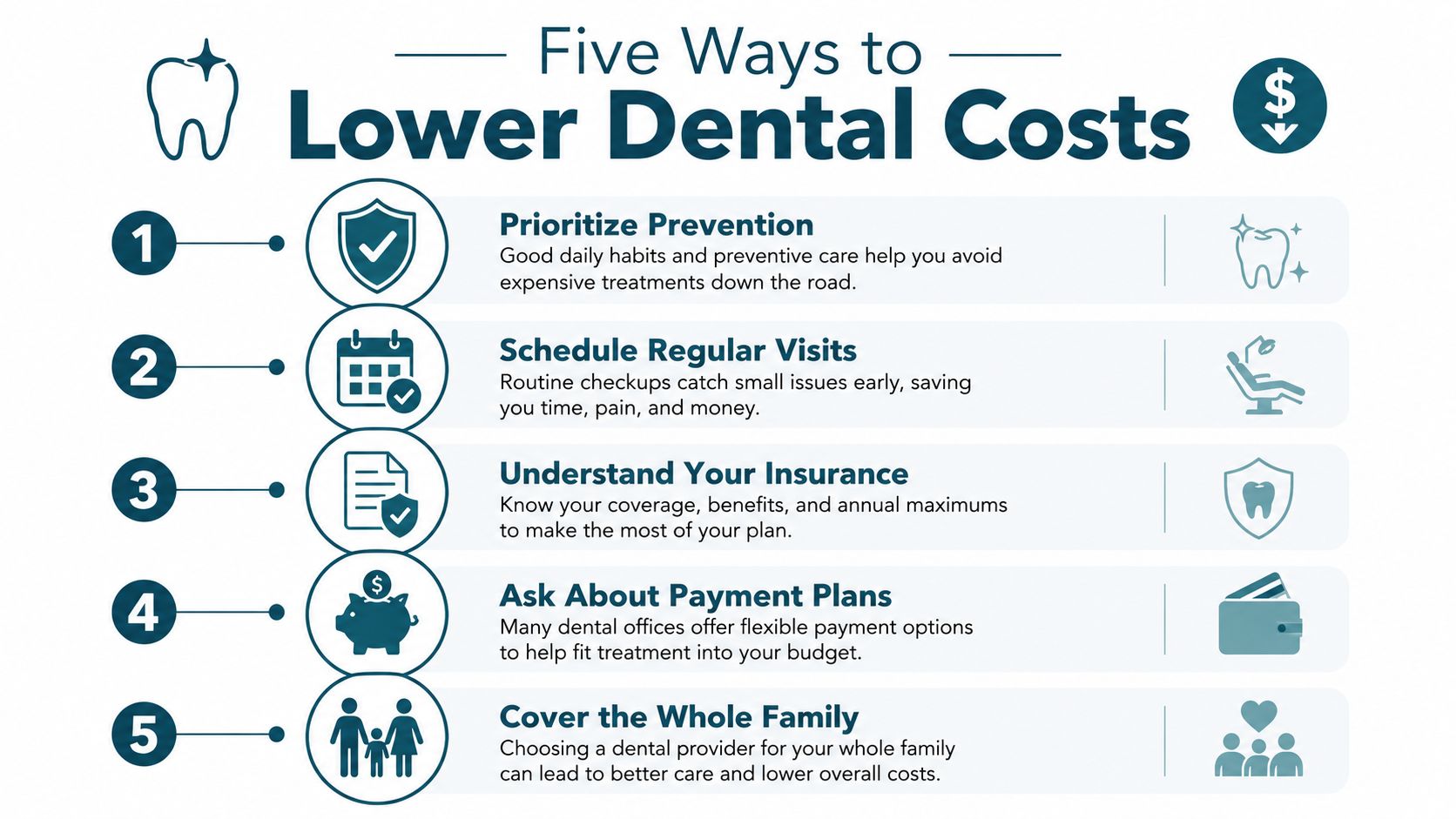
A family can keep dental spending under control without chasing the cheapest appointment on the calendar. The better approach is to compare the full out-of-pocket path for care, then build habits that reduce the chance of larger bills later. That usually means combining prevention, payment planning, and a treatment plan that fits the household instead of just the day's problem.
1. Keep prevention boring and regular
Routine cleanings, exams, and home care do a lot of the money-saving work. Sealants and fluoride can help lower the chance that a small cavity turns into a larger repair, which is the kind of shift that changes the bill from manageable to stressful CDC oral disease prevention. Families usually do best when prevention is treated like routine maintenance, the same way you keep up with oil changes before the car starts making noise.
2. Use a membership model when coverage is thin
A membership plan can make sense when a family wants predictable preventive care and discounted restorative care without depending only on insurance rules. The point is not fancy coverage, it is clearer pricing for the care you are most likely to use. A U.S. membership plan review found that family plans for four people averaged $80.84 per month, preventive services were typically included at no extra cost, and the same review reported average discounts of 17.8% on endodontics, 18.6% on dentures, and 27.1% on sealants. For families who want to spread costs across routine visits and restorative work, that structure can smooth out the year instead of letting one problem dominate the budget.
3. Ask for treatment in phases
A dentist can often separate care into steps so the family handles the most urgent need first, then schedules the next part later. That makes the bill easier to absorb and gives the household time to plan around work, school, and other expenses. It also keeps a parent or child from facing one large treatment total all at once.
This approach works especially well for families comparing payment options. If the plan is bigger than the current budget, ask about a financing option for dental care and whether the office can match the payment plan to the treatment sequence.
4. Compare the whole plan, not the first visit
A new patient exam is only the starting point. The cost comes from what the dentist finds, what the office recommends, and how many appointments are needed to finish the job. Families usually make steadier choices when they ask for the full estimate up front, including follow-up care, rather than focusing only on the check-in cost.
That question becomes easier to answer when the office explains the work in plain terms. A filling, crown, or extraction may sound like a single line item, but each one can lead to different next steps, and those next steps affect the total bill. Clear treatment planning helps families see where the money is going before they agree to anything.
5. Choose one team that can treat the whole household
A single office that handles cleanings, exams, pediatric dentistry, restorative care, and emergency visits can reduce repeat travel and save time for parents. It also helps the dental team spot patterns across the family, such as repeated cavities or signs of grinding, which can shape a better long-term plan. Amanda Family Dental offers that kind of full-service setup, and families who want a more predictable monthly approach can ask about the Power Plan Membership.
A household plan works best when everyone stays in the same system. The office already knows the family history, the children do not have to start over with a new provider every time, and the adults can compare options in one place instead of piecing together care from several clinics.
What to Expect at Amanda Family Dental
The first call usually starts with a simple conversation about what hurts, what is overdue, and what kind of budget feels realistic. That gives the office a place to begin, whether the family needs a new patient exam, records gathered, or a visit organized so nobody has to repeat the same details over and over.

The exam usually includes digital x-rays when needed, a close look at the teeth and gums, and a conversation about pain, priorities, and long-term goals. That matters because a family with a loose crown needs a different plan than a family that just wants the kids checked before school starts. Dr. Alyssa Jenkins and the team can also talk through pediatric visits, comfort options for anxious adults, and cosmetic planning for whitening, veneers, Invisalign, Botox, or Juvéderm when those services fit the case.
The cost conversation is part of the visit, not an afterthought. Families can ask what needs attention now, what can wait, and what can be handled in stages so the total out-of-pocket cost stays clearer from the start. If a household wants more predictable budgeting, the office can also explain the Power Plan Membership and how that fits with preventive care and treatment planning.
Sometimes a visit also includes myofunctional therapy or total health screening when those concerns affect dental care. That keeps the discussion connected to the whole mouth and the rest of the body without turning the appointment into a pile of separate topics. Families usually appreciate plain language, clear choices, and a plan that explains why each step belongs in the treatment sequence.
Local Questions and Next Steps for Amanda-Area Families
Families in Amanda, Lancaster, Circleville, and Carroll, Ohio usually ask the same few questions once they're serious about booking. The first is whether new patients are welcome, and the answer is yes, Amanda Family Dental works with families looking for a regular local dentist near me.
Another common question is what happens if a tooth cracks or pain starts suddenly. In many cases, the office can help with emergency dental services and guide the family toward the right next step, whether that's a tooth extraction, a restorative visit, or a more complete treatment plan. Parents also ask what a child's first visit looks like, and it usually starts with a calm exam, simple explanations, and a focus on keeping the experience easy.
Many families also compare membership plans with traditional insurance. The useful difference is predictability, especially when a household has a mix of preventive visits and restorative needs. For the right family, the Power Plan can make the year easier to budget even when care is needed for more than one person.
If the next step is a cleaning, a consultation, or a second look at a treatment estimate, the office is ready to help. A clear conversation now can prevent a much bigger bill later, and it's easier to plan when the numbers are on the table.
A CTA for Amanda Family Dental.