


You're sitting in the dental chair, ready for a cleaning, when the team asks whether today's dental X-rays are due. If the teeth feel fine, it's natural to wonder whether another image is necessary or whether a fixed six-month routine is doing the deciding.
The answer to how often should you get dental X-rays depends on the person, not just the calendar. Age, cavity risk, gum health, previous dental work, symptoms, growth, medications, and treatment goals all influence the safest and most useful schedule. Amanda Family Dental serves families searching for a dentist in Amanda, OH, as well as patients from Lancaster, Circleville, and Carroll, Ohio, with exams, digital imaging, preventive dental care, restorative treatments, cosmetic dentistry, dental implants, tooth extraction, and emergency dental services.
Table of Contents
- Why Your X-Ray Schedule Is Personal
- Recommended X-Ray Frequency by Age and Risk
- Types of Dental X-Rays and What Each One Shows
- Safety, Digital Imaging, and Pregnancy Considerations
- Factors That Shorten or Extend Your Interval
- How Amanda Family Dental Builds Your Imaging Plan
- Common Questions Patients Ask About Dental X-Rays
- Schedule Your Next Visit in Amanda, OH
Why Your X-Ray Schedule Is Personal
A patient in Amanda may arrive for a routine cleaning with no pain and still need an image that shows what a mirror cannot. A bitewing can reveal decay between teeth, while a periapical image can show changes around a root. The decision isn't based on a preset package. It starts with what the dentist needs to diagnose safely.
The American Dental Association and FDA describe dental X-ray timing as individualized ranges, not rigid dates. The recommendations consider age, oral health, caries risk, and clinical findings, and the FDA-hosted ADA guidance on dental X-rays explains that the schedule should support patient-specific care rather than apply one interval to everyone.
Consider three patients. A teenager in braces near Amanda may need images to monitor eruption and tooth movement. A grandparent in Lancaster who has dry mouth from medication may develop decay more readily. A child in Circleville with erupting molars may need closer observation than an adult whose teeth and gums have remained stable.
What images reveal
A visual exam is essential, but it has limits. Dental X-rays can help identify:
- Decay between teeth, where toothbrush bristles and direct vision may not reach.
- Bone changes, including loss around teeth affected by gum disease.
- Root and internal infections, especially when a tooth is painful, swollen, or unusually sensitive.
- Developing and unerupted teeth, which matters during childhood, adolescence, orthodontic evaluation, and wisdom-tooth planning.
Practical rule: No pain doesn't always mean no problem. Many dental conditions remain quiet until they become more advanced.
Skipping images until discomfort appears can leave less room for conservative care. Well-timed imaging may help the dentist identify a small concern before it requires more extensive restorative dentistry, a root canal, extraction, or emergency treatment. A comprehensive dental exam brings the images together with the clinical examination, medical history, and treatment conversation.
Recommended X-Ray Frequency by Age and Risk
The clearest numeric guidance applies to bitewing X-rays, the images commonly used to inspect areas between back teeth. The ADA and FDA ranges vary according to age and caries risk, so patients can use them as a starting point rather than a personal prescription.
For low-risk children, bitewings may be recommended every 12 to 24 months. Low-risk adolescents may fall into an 18- to 36-month range, while low-risk adults may fall into a 24- to 36-month range. Children and adolescents with increased risk may need images every 6 to 12 months, and adults with increased caries risk may need them every 6 to 18 months, according to the FDA dental radiographic examination guidance.
A practical comparison
| Patient Group | Low Risk | High Risk |
|---|---|---|
| Children | 12 to 24 months | 6 to 12 months |
| Adolescents | 18 to 36 months | 6 to 12 months |
| Adults | 24 to 36 months | 6 to 18 months |
A child with new cavities, a teen wearing orthodontic appliances, or an adult with recent decay may need the shorter end of a range. A patient with stable teeth, healthy gums, consistent home care, and no active disease may be able to use the longer end.
A new patient exam can involve broader baseline imaging when the dentist needs a complete starting picture. The exact combination, such as bitewings, periapical images, a panoramic image, or a full-mouth series, depends on age and clinical need. After reviewing diet, hygiene, fluoride exposure, medications, dry-mouth symptoms, previous restorations, and medical history, Amanda Family Dental can set a recall plan suited to the individual. Parents can also review guidance on the recommended age for a child's first dentist appointment.
Types of Dental X-Rays and What Each One Shows
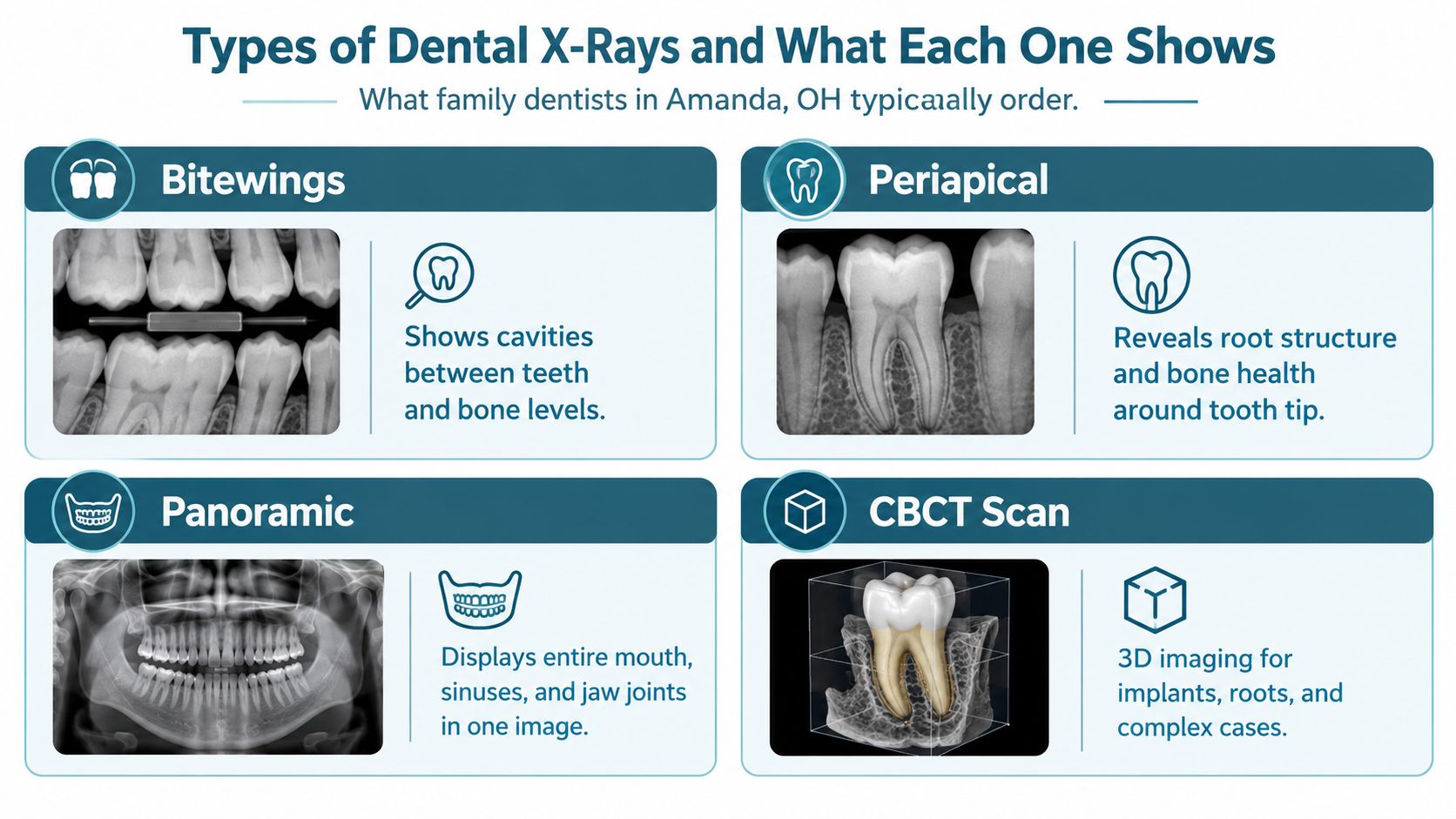
Dental X-rays answer different clinical questions. A family dentist in Amanda, OH, chooses the image that provides the needed information while avoiding an unnecessarily broad examination.
Bitewing images
Bitewings show the crowns of upper and lower teeth together. They're especially useful for finding decay between teeth, checking the edges of existing fillings, and reviewing the bone level near the teeth. These are often the images considered during a routine cleaning and exam when the patient's risk profile supports them.
Periapical images
A periapical image captures one tooth from crown to root tip. It can help investigate pain, swelling, an abscess, changes around the root, or a suspected fracture. If a patient reports a persistent toothache, the dentist may order a limited periapical image rather than repeat a broader series.
Panoramic images
A panoramic X-ray creates a wide view of the mouth, jaws, and surrounding structures in one image. It can support evaluation of wisdom teeth, jaw development, sinus-related findings, cysts, and the position of unerupted teeth. This view may be useful for teens being evaluated for orthodontic treatment or adults considering wisdom tooth removal.
CBCT scans
CBCT, or cone beam computed tomography, creates a three-dimensional view. It may be selected for dental implant planning, complex root canal evaluation, or a complicated jaw concern when two-dimensional images don't provide enough detail.
The lowest-dose image that answers the clinical question should be chosen first. A person considering dental implants near me, cosmetic dentistry, or a tooth extraction may need a different image than someone attending a preventive cleaning.
Safety, Digital Imaging, and Pregnancy Considerations
Radiation exposure from dental imaging is measured in microSieverts, but the most important safety principle is simpler: an image should be taken when it provides necessary diagnostic information. The ADA says X-rays should be ordered when the dentist believes they'll contribute to diagnosis, and the ADA guidance on using dental X-rays in moderation emphasizes clinical necessity and minimizing exposure.
Modern digital sensors are fast and sensitive. They also allow images to appear quickly on a monitor, which helps the dentist review findings with the patient and reduces the need for avoidable retakes. Protective measures and careful positioning remain part of a responsible process.
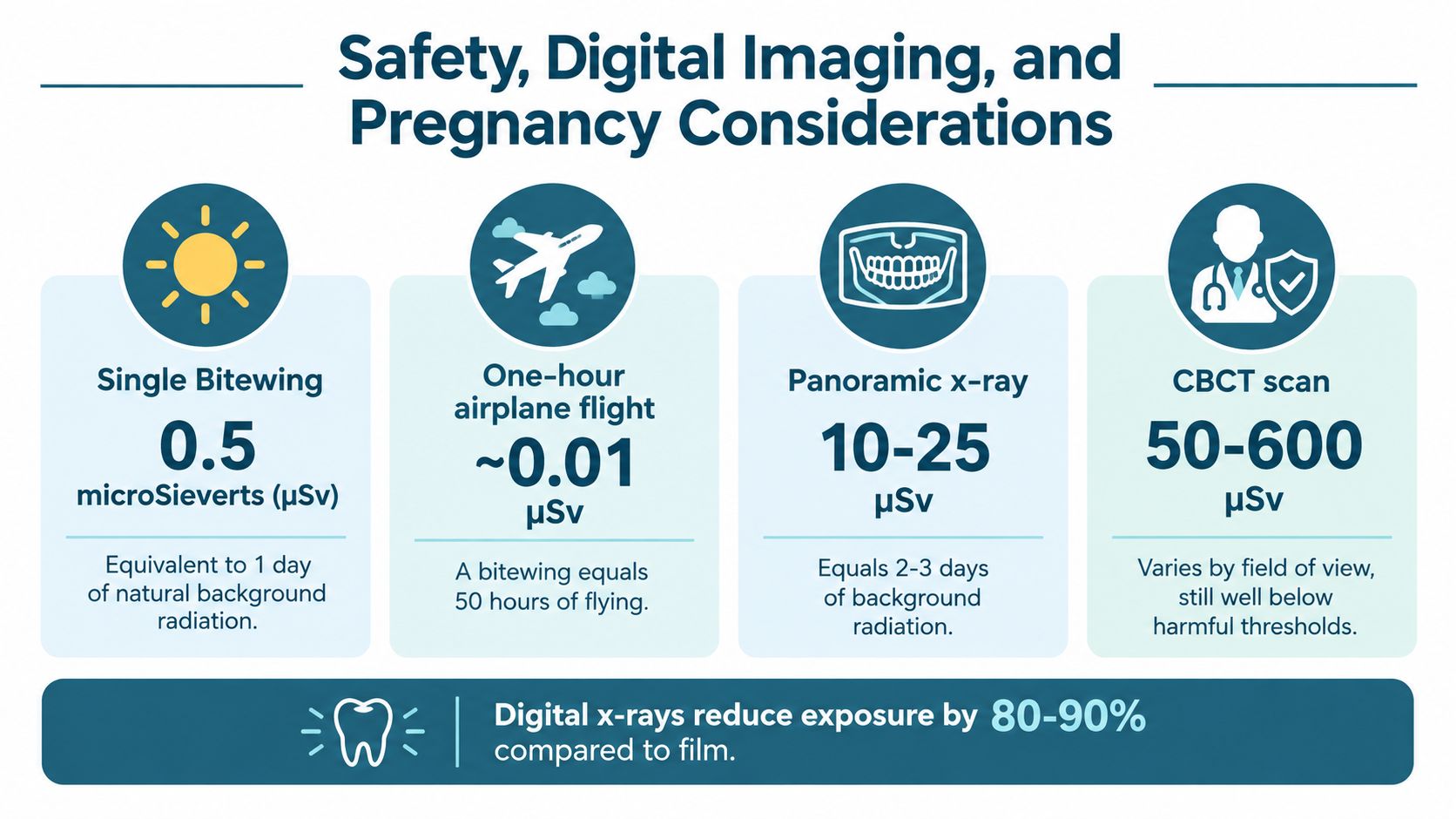
A thyroid collar, lead apron, and precise beam limitation can help keep exposure focused. Amanda Family Dental's digital X-ray advantages include faster image capture and immediate review, both of which support a more controlled appointment.
Pregnancy should always be disclosed before imaging. Nonurgent images may be deferred when clinically appropriate, while urgent concerns still require thoughtful diagnosis so infection or injury doesn't go untreated. The dental team can review the reason for the image, protective steps, and timing before proceeding.
Patients with dental anxiety can ask for an explanation before each image. Staff can describe where the sensor goes, how long the exposure takes, and what the patient should do to remain comfortable.
Factors That Shorten or Extend Your Interval
The interval becomes shorter when the mouth has a higher chance of changing between visits. Recent cavities, deep grooves, orthodontic treatment, gum disease, dry mouth, and developing teeth can all affect what the dentist needs to monitor.
A patient with active decay may need bitewings closer together than a patient whose teeth have remained cavity-free. Orthodontic treatment can create additional areas where plaque collects and may require monitoring of roots or erupting teeth. Children in mixed dentition also need consideration because adult teeth are developing and moving into position.
Factors that increase monitoring
- Recent or active cavities: New decay can change the recommended recall interval.
- Orthodontic treatment: Braces and eruption changes may require additional evaluation.
- Periodontal disease: Bone levels and treatment response can guide follow-up images.
- Dry mouth: Medications or conditions such as Sjögren's syndrome can raise decay risk.
- Head and neck radiation therapy: Medical history may affect oral-health monitoring.
- Mixed dentition: Children with both primary and permanent teeth may need closer observation.
A watch area between teeth can also change the plan. If that area becomes stable, the schedule may lengthen later. If it progresses, the dentist may recommend imaging in the 6- to 12-month range for higher-risk patients, consistent with the ADA/FDA ranges.
| Risk Factor | Effect on Interval | Typical New Cadence |
|---|---|---|
| Active or recent decay | Shortens monitoring | 6 to 12 months may be considered |
| Orthodontic treatment | Adds eruption or root monitoring | Based on clinical findings |
| Periodontal disease | Tracks bone and treatment response | Based on disease activity |
| Dry mouth | Raises concern for new decay | Often closer review |
| Stable, caries-free adult | May extend monitoring | Up to 24 to 36 months for bitewings |
| Limited imaging tolerance | May require prioritization | Focused images when clinically necessary |
Consistently healthy adults may use a longer interval. Extensive restorative work that has remained stable, an edentulous arch, or a fully implant-rehabilitated arch can also change which images are useful. The dentist still needs to consider symptoms, tissue health, implant status, and the purpose of the visit before extending or reducing imaging.
How Amanda Family Dental Builds Your Imaging Plan
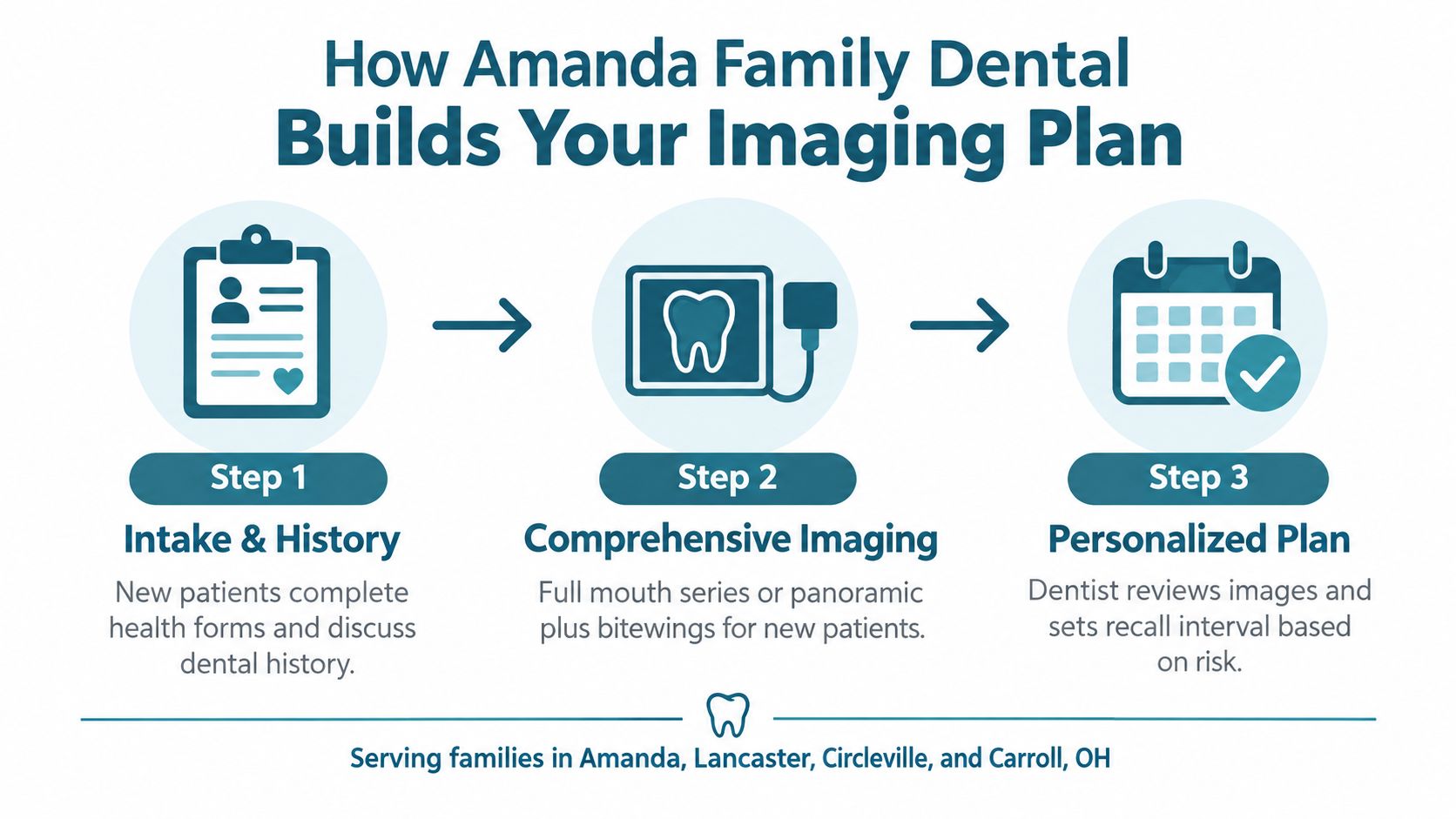
A first visit at Amanda Family Dental begins with health history, dental history, current concerns, and an examination. For patients from Amanda, Lancaster, Circleville, and Carroll, the baseline images may include a full-mouth series or panoramic image with bitewings, but the exact selection depends on age and clinical need.
The dentist reviews the images chairside and can point to findings on a monitor. That visual conversation helps patients understand why a filling, gum treatment, crown, root canal, dental implant, or other option may be appropriate.
Three parts of the process
- History and intake: The team records medications, previous dental treatment, symptoms, and relevant health conditions.
- Focused imaging: Digital images are selected to answer the diagnostic questions raised by the exam.
- Individual recall planning: The dentist documents when the next image may be useful and updates that plan when the patient's risk changes.
A cracked tooth, new bleeding during gum measurements, swelling, or persistent sensitivity can justify a limited image outside the routine recall schedule. Prior images may be compared side by side, helping the dentist evaluate changes rather than viewing every appointment as a blank slate.
Treatment goals also matter. Someone exploring cosmetic dentistry near me, teeth whitening, veneers, or Invisalign may need a different examination than someone seeking an emergency dentist for swelling or a broken tooth. A patient considering restorative dentistry or dental implants near me may need imaging that supports treatment planning rather than routine cavity screening.
Common Questions Patients Ask About Dental X-Rays
Does insurance determine the schedule? Many dental insurance plans cover bitewings once a year and a panoramic or full-mouth series every three to five years, but benefits vary by carrier. Patients should confirm coverage before scheduling so insurance rules don't get confused with clinical recommendations.
Can an adult decline routine X-rays? Adults can discuss or decline recommended imaging, but skipping it means the dentist may not be able to evaluate decay between teeth, bone loss, or infection below the gumline. The patient and dentist should talk through the diagnostic tradeoff before making that decision.
When should a child first see a dentist? A child's first visit is recommended by age one or within six months of the first tooth. Initial imaging is usually limited to simple periapical shots when a specific concern exists, rather than taken automatically for every child.
Are anxious patients protected? Lead aprons and thyroid collars remain standard protective measures, and the team can explain each step before taking an image. Patients can also share concerns about gagging, discomfort, pregnancy, or fear of dental treatment before the appointment begins.
Schedule Your Next Visit in Amanda, OH
A new patient exam at Amanda Family Dental includes a review of health history, an oral cancer screening, and digital X-rays selected for the individual rather than a preset package. The dentist can explain findings, discuss preventive or restorative needs, and create a schedule that reflects age, oral-health history, and treatment goals.
Families from Amanda, Lancaster, Circleville, and Carroll, Ohio, can contact the office about appointment availability that fits school, work, and family responsibilities. Bringing a medication list and prior imaging, when available, can help the dentist build a more complete plan.
Amanda Family Dental provides new patient exams, digital X-rays, preventive dental care, restorative treatment, cosmetic dentistry, dental implants, tooth extraction, and emergency dental services for families in Amanda and nearby communities. Visit Amanda Family Dental to request an appointment and discuss a dental X-ray schedule suited to the patient's needs.