

A dental exam can be completed in 5 minutes or less, yet it evaluates far more than visible cavities, including the teeth, gums, soft tissues, bite, and signs of certain systemic conditions. It's an extensive, whole-person assessment that helps a dentist understand current problems, future risks, and the care that may protect comfort, function, and confidence.
A patient searching for a dentist near me may be dealing with tooth pain, missing teeth, a cosmetic concern, or uncertainty about what happens during a new patient visit. Someone in Amanda, Lancaster, Circleville, or Carroll, Ohio, might expect a quick cleaning and leave surprised by how much a careful examination can reveal. Amanda Family Dental approaches the visit as a complete health screening, not just a routine tooth check.
Table of Contents
- More Than Just a Quick Tooth Check
- Routine Cleaning vs Full Evaluation
- The Step by Step Clinical Sequence
- A Modern Approach to Dental X-Rays
- How Early Detection Protects Your Smile
- Your Experience at Amanda Family Dental
More Than Just a Quick Tooth Check
A patient can feel perfectly fine and still have early tooth decay, gum changes, a damaged restoration, or an abnormal area that deserves attention. A full dental exam gives the dentist time to look beyond the complaint that brought the patient through the door. It combines a review of medical, social, and dental history with visual and hands-on checks inside and outside the mouth.
The National Institute of Dental and Craniofacial Research explains that a full oral exam can take 5 minutes or less, while still being designed to identify early signs of systemic disease, including diabetes, HIV, and Sjögren's syndrome, in the head and neck region (NIDCR oral exam guidance). The short appointment time doesn't make the exam superficial. A structured sequence helps the dentist use those minutes purposefully.
What the dentist looks at
A thorough evaluation can include:
- Teeth and restorations: The dentist checks for decay, cracks, worn fillings, loose crowns, and areas that may need restorative dentistry.
- Gums and supporting bone: The exam looks for inflammation, bleeding, pocketing, recession, and other signs of periodontal disease.
- Soft tissues: The lips, cheeks, tongue, floor of the mouth, palate, throat, and gingiva all receive attention. WHO guidance describes a systematic oral-health assessment of these areas (WHO STEPwise oral health guidance).
- Head, neck, and jaw: The dentist checks for swelling, tenderness, lumps, facial changes, bite concerns, and TMJ symptoms.
That broader view is useful for children, adults, anxious patients, and anyone returning after years away. It helps a dentist in Amanda, OH, understand not only what hurts today, but also what could become a larger problem later.
Routine Cleaning vs Full Evaluation
A patient who arrives expecting only polishing may leave with a clearer picture of what the mouth needs. A routine cleaning removes plaque and tartar, polishes teeth, and reinforces daily hygiene. A full evaluation adds diagnosis, risk assessment, and a treatment plan, much like checking a home's foundation rather than just washing its windows.
For a new patient or someone returning after a long absence, the dentist also needs time to establish a dependable baseline. That visit may identify decay between teeth, early bone changes, gum disease, unusual oral tissues, or a bite that puts extra stress on specific teeth. The clinical purpose is different, and the documentation is different as well. A diagnostic evaluation is commonly recorded with CDT code D0150, while an adult cleaning is associated with D1110.
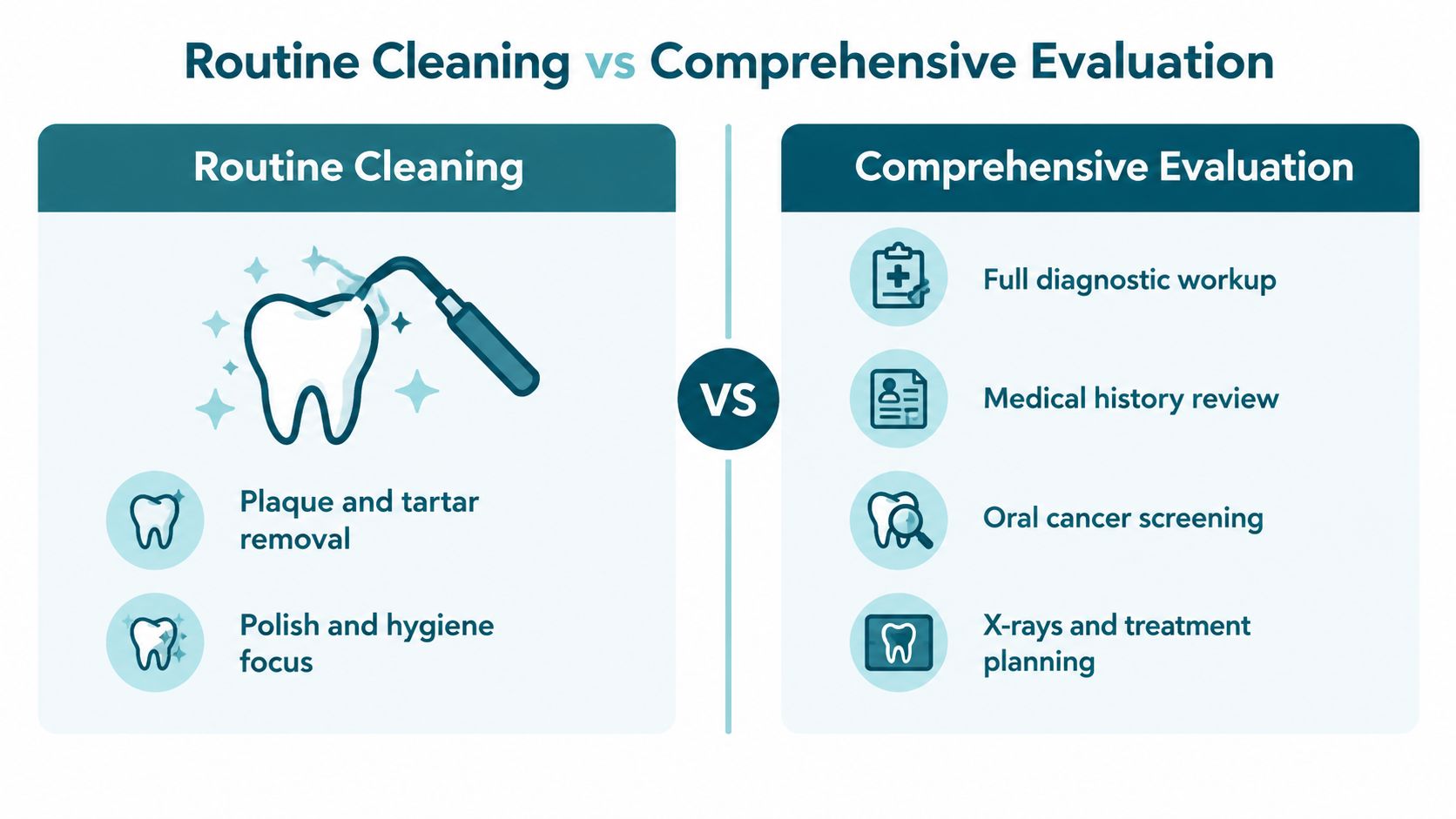
A simple comparison
| Routine cleaning | Full evaluation |
|---|---|
| Removes plaque and tartar | Reviews medical, social, and dental history |
| Polishes teeth | Examines hard and soft tissues |
| Supports daily hygiene | Screens for oral cancer risk and other abnormalities |
| May include a brief check | Establishes findings and treatment priorities |
Patients who want a closer explanation of the hygiene portion can read what a dental cleaning includes. The cleaning maintains oral health, while the evaluation determines whether prevention alone is enough.
Findings may support preventive care or point toward a filling, crown, root canal, extraction, periodontal therapy, dental implants, or cosmetic dentistry. Clear records also help with administrative coordination, including streamlining prior authorization workflows when an insurer must approve planned treatment.
The Step by Step Clinical Sequence
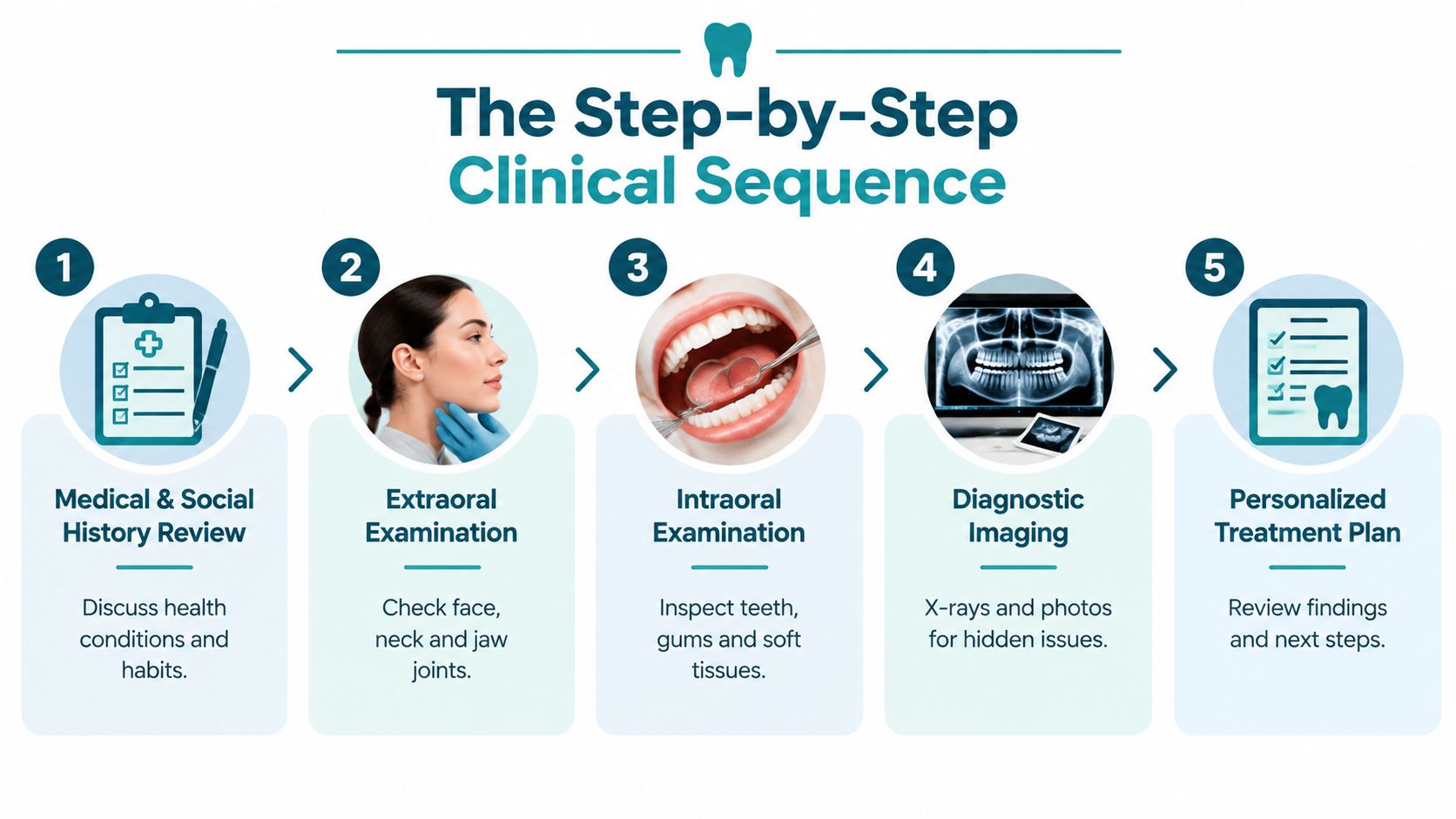
A patient may arrive worried about one sore tooth, while the examination reveals a gum concern, a jaw issue, or a tissue change elsewhere. The dentist follows an organized sequence so the visit covers the mouth as a connected system, rather than stopping at the symptom that brought you in.
The history helps set priorities
Information already collected about your health and dental background helps the dentist triage the visit. It can show whether pain, medication use, allergies, tobacco or alcohol exposure, jaw symptoms, sleep concerns, or treatment goals should change the order or pace of the examination. Someone focused on whitening or alignment may need a different discussion from a patient seeking relief from pain or replacement of missing teeth.
That context also helps the dentist judge whether a finding can be managed in the office or whether communication with a medical provider may be appropriate. In other words, the history acts like a map for deciding what deserves attention first.
The outside and inside of the mouth receive attention
The extraoral examination covers the face, neck, jaw area, and nearby tissues. The dentist looks for swelling, asymmetry, tenderness, or enlarged areas that may need further evaluation. The NIDCR oral cancer examination guidance describes examining the face, neck, lips, mouth, tongue, throat, and area beneath the jaw, including gentle checks for lumps or tenderness.
The intraoral examination then covers the teeth, gums, tongue, cheeks, palate, floor of the mouth, and other soft tissues. This is a routine screening step, not a reason to feel alarmed. Careful observation gives the dentist a better chance to recognize changes while they are still easier to assess.
The dentist evaluates function, not just appearance
Periodontal charting checks the gums and supporting tissues. The dentist also reviews the bite, tooth contacts, jaw movement, and TMJ function. Saliva concerns, esthetic goals, and habits such as clenching can shape the recommendations.
The clinical examination comes before imaging. ADA oral cancer and clinical examination guidance states that radiographs should not be taken before the clinical examination, because the imaging choice depends on symptoms, disease risk, previous images, and the patient's needs.
A brief explanation before each part makes the visit more predictable and comfortable.
A Modern Approach to Dental X-Rays
Many patients assume a full exam automatically means a full set of X-rays. Modern dentistry uses a more careful approach. The dentist first examines the mouth, then selects imaging only when it can answer a clinical question or reveal an area that cannot be assessed adequately by sight and touch.
FDA and ADA guidance describes bitewing imaging intervals that vary with caries risk. For recall patients at low risk, bitewings may be considered at 12 to 24 month intervals, while patients with higher risk or limited visual access may need shorter intervals (FDA and ADA dental radiographic examination guidance). Specific bitewing or periapical views may be chosen when the dentist suspects particular pathology.
Practical rule: A patient doesn't need the same images at every appointment simply because an image was taken previously.
Radiographs can show details that a visual examination can't, including proximal decay, apical disease, alveolar bone levels, periodontal ligament spaces, furcation involvement, root shape, and decay or restorations below the gumline. Those findings can affect whether a patient needs monitoring, a filling, periodontal therapy, endodontic treatment, or oral surgery.
The ADA also states that there isn't one universal frequency for panoramic radiographs or full-mouth surveys. Repeat imaging should reflect individual needs rather than insurance limits, while bitewing timing is the imaging schedule specifically connected to caries risk (ADA radiograph recommendations).
A full-mouth radiographic survey is commonly described as 14 to 22 periapical and posterior bitewing images, showing the crowns and roots, areas around the root tips, and alveolar bone (dental radiographic examination guidance). That doesn't mean every patient needs that series. It describes one possible baseline, not a fixed package.
Patients can ask why an image is recommended, whether previous images can be reviewed, and what information the image is expected to provide. The 2026 ADA/JADA update also emphasizes reviewing prior images and using cone-beam CT judiciously rather than routinely (Dental Tribune summary of updated ADA imaging guidance). Patients interested in the role of digital imaging can learn more about digital X-ray advantages.
How Early Detection Protects Your Smile
Early findings often give patients more choices. A small area of decay may be manageable with a conservative restoration, while a neglected problem can eventually involve deeper tooth structure and require more involved treatment. A thorough exam doesn't guarantee that every issue can be avoided, but it gives the dentist an opportunity to identify concerns before they become urgent.
The same principle applies to gum disease. Early inflammation may respond to improved home care and professional treatment, while advanced periodontal problems can affect the tissues and bone supporting the teeth. Periodontal evaluation also helps the dentist plan restorative work, because a crown, bridge, denture, or dental implant needs a stable environment.
Comfort and function are part of oral health
Patients often focus on visible problems, but function matters just as much. A bite that feels uneven, jaw muscles that stay tense, or a TMJ that clicks and hurts can interfere with chewing and everyday comfort. Finding those patterns during an exam may lead to recommendations for monitoring, bite management, myofunctional therapy, or other appropriate care.
Tooth loss can affect chewing, speaking, and confidence. Depending on the condition of the mouth and the patient's goals, treatment may include restorative dentistry, dentures, or dental implants. Someone searching for dental implants near me deserves an evaluation that considers gum health, bone support, remaining teeth, medical history, and long-term maintenance rather than focusing only on the replacement tooth.
An exam can also guide cosmetic decisions. Teeth whitening, composite bonding, veneers, and Invisalign may improve appearance, but the dentist first needs to check for active disease, damaged teeth, gum concerns, or bite issues.
A confident smile begins with a healthy foundation, not with a cosmetic treatment chosen in isolation.
Preventive care is most useful when patients understand what it protects and why. Amanda Family Dental's explanation of what preventive dental care means offers additional context for patients deciding how regular evaluations fit into long-term dental care.
When symptoms do appear, early access matters. Tooth pain, swelling, a broken tooth, or a knocked-out tooth can require an emergency dentist, and a full evaluation helps determine whether the right response is a filling, root canal, tooth extraction, crown, or another service.
Your Experience at Amanda Family Dental
Walking into a new dental office can feel uncertain, especially if you are unsure which records or questions matter. At Amanda Family Dental, the visit is organized around your health history, concerns, and goals. The team may review your history, examine your teeth and gums, assess periodontal health, and take digital X-rays when the findings and risk level support them. Dr. Alyssa Jenkins then discusses what was found and which next steps fit your situation.
For families in Amanda, Lancaster, Circleville, and Carroll, Ohio, one practice may serve changing needs over time. A child with developing teeth may benefit from preventive and pediatric care, while an adult with a cracked tooth may need a crown after the examination. Other visits may lead to fillings, root canal treatment, dentures, implants, cosmetic care, or urgent treatment. The recommendation depends on the condition found, not a preset list of services.
Comfort can be part of the plan. Patients with dental anxiety may ask about gentle care or sleep dentistry before arriving. The office also offers digital X-rays, mercury-free fillings, fluoride-free options, myofunctional therapy, and flexible payment arrangements, including the Power Plan Membership.

Bring your symptoms, questions, medication list, previous dental records, and concerns about cost, imaging, pain, appearance, or timing. You do not need to arrive with a diagnosis. The appointment gathers the information needed for a personal plan, from routine monitoring to more involved care.
Amanda Family Dental provides new patient exams, preventive care, clinically appropriate digital imaging, restorative and cosmetic dentistry, implants, extractions, and emergency care near Amanda, Lancaster, Circleville, and Carroll, Ohio. Request an appointment through Amanda Family Dental.