

A routine dental visit often starts the same way. A patient checks in, sits down for a cleaning or exam, and then hears that dental X-rays are needed. For many families in Amanda, OH, and nearby Lancaster, Circleville, and Carroll, that part of the appointment brings a few quiet questions. Will it take long? Is it safe? Will it be uncomfortable?
Modern digital imaging helps answer those concerns in a reassuring way. Instead of treating X-rays as just another step in the visit, many patients now see them as part of a smoother, more comfortable experience. The images show up quickly, the dental team can review them right away, and treatment decisions often feel clearer and less stressful.
That patient-centered difference matters in a community practice. People looking for a dentist near me, a dentist in Amanda, OH, or even an emergency dentist usually want more than technology for its own sake. They want care that respects their time, explains things clearly, and helps them feel confident about what comes next. That is where digital X-ray advantages stand out most clearly.
Table of Contents
- A Modern Approach to Your Dental Health
- What Are Digital X-rays and How Do They Work
- The Patient-Centered Advantages of Digital X-rays
- How We Use Advanced Imaging at Amanda Family Dental
- Frequently Asked Questions About Dental X-rays
- Experience Modern Dental Care in Amanda OH
A Modern Approach to Your Dental Health
For many patients, the most stressful part of a dental visit isn't the cleaning or the exam. It's the uncertainty. They don't always know what the team is looking for, why images are needed, or whether the process will slow everything down.
Digital X-rays help remove a lot of that uncertainty. The technology supports a visit that feels more organized, more comfortable, and easier to understand. When an image appears quickly and the dentist can point to it on a screen, patients usually feel more involved in their care.
Families in Amanda, OH often want one office that can handle preventive care, answers, and long-term planning without making appointments feel rushed. That same need is common for patients traveling from Lancaster, Circleville, and Carroll, Ohio. A modern dental practice should make it easier to spot problems early, explain findings clearly, and keep records organized over time.
Comfort matters as much as technology
A digital image on a screen may sound like a small upgrade, but patients usually notice the practical difference right away. There is less waiting. There is less confusion about whether an image turned out clearly. There is also less chance of having to come back because something couldn't be reviewed promptly.
Practical rule: The best dental technology should make the visit feel simpler for the patient, not more complicated.
That same patient-first approach shows up in related services such as total health screening, where the focus is on seeing the bigger picture instead of treating oral health as separate from overall wellness.
Why local families pay attention to digital X-ray advantages
Patients searching for a dentist in Amanda, OH or a dentist in Lancaster, OH often compare offices based on comfort, convenience, and trust. Digital X-ray advantages fit all three. They support clearer communication during new patient exams, help dentists move quickly when someone arrives with tooth pain, and give families a sense that their care is current and thoughtful.
For parents bringing in children, for adults considering cosmetic dentistry, and for anyone dealing with a sudden dental problem, that reassurance goes a long way. Modern imaging doesn't just change the equipment in the room. It changes how the whole visit feels.
What Are Digital X-rays and How Do They Work
The easiest way to understand digital dental X-rays is to think about cameras. Older cameras used film that had to be developed before anyone could see the picture. Digital cameras changed that by showing the image right away on a screen. Dental imaging followed a similar path.
With digital X-rays, a small electronic sensor captures the image. The dental team can then view it almost immediately on a computer instead of waiting for film processing. That makes the appointment more efficient and often less frustrating for patients.
From film to instant images
Traditional film X-rays depended on chemical development and physical storage. Digital radiography changed that process. According to an overview of advances in digital radiography, digital imaging produces an image immediately after exposure, with electronic capture and computer-based storage replacing film development. That shift allows clinicians to identify positioning errors right away and retake an image during the same visit rather than recalling the patient later.
That difference is easy to picture in a dental setting. If a bitewing image doesn't capture the area clearly, the team can see that at once and correct it on the spot. The patient doesn't leave wondering whether another appointment will be needed just to repeat the image.
Why the difference matters in a real appointment
Patients often hear "faster results" and assume that only matters to the dental office. In reality, it matters just as much to the person in the chair.
A quicker image process can mean:
- Shorter pauses during the visit because there isn't a wait for film development
- Clearer chairside explanations because the dentist can review the image on screen
- Fewer interruptions to the schedule when positioning issues are caught immediately
- Better record organization because images are stored electronically
For readers who want a simple outside overview of how scans fit into routine care, this explanation of preventive dental imaging offers a useful patient-friendly reference.
Dental imaging works best when patients understand why it's being taken and what the dental team sees in it.
That is one reason digital X-ray advantages matter beyond technology alone. The image appears quickly, but the primary benefit is what that speed allows. The dentist can explain a cavity between teeth, watch a developing wisdom tooth, or compare older records more easily. For patients, that often means less guesswork and more confidence.
The Patient-Centered Advantages of Digital X-rays
When patients ask about digital X-ray advantages, they usually aren't asking for a technical lecture. They want to know one thing. How does this make the appointment better for them or their child?
The answer is that digital imaging improves safety, convenience, and communication all at once. It also helps the dentist make decisions with less delay.
Lower radiation exposure
One of the most widely discussed benefits is radiation reduction. A review available through the Journal of Integrated Community Research and Clinical Reports notes that digital X-rays can reduce a patient's radiation exposure by a significant margin, often cited as being between 50% and 90% lower than traditional film-based systems.
That matters most for patients who need periodic imaging over time, such as children, people monitoring dental development, and adults receiving ongoing restorative care. It also gives families welcome peace of mind during routine cleaning and exams.
Faster visits and less waiting
Digital images are available quickly, so the appointment can keep moving. In practical terms, that often means less sitting and waiting while the team processes images, checks whether they turned out correctly, or prepares them for review.
For busy families in Amanda, Lancaster, Circleville, and Carroll, that convenience isn't minor. It can make routine visits feel much more manageable.
Better image review without starting over
Another key benefit is flexibility after the image is taken. A peer-reviewed review in the National Library of Medicine archive on digital radiography explains that digital systems allow post-acquisition image processing, including adjustments for density, contrast, and detail. In plain language, that means the dentist can often examine the same image more effectively without needing to repeat the scan.
That can help in situations like:
- Early decay between teeth where subtle contrast matters
- Changes near the root that need a closer look
- Minor cracks or fracture lines that may be easier to assess with image adjustment
- Long-term comparisons when previous digital images are easy to retrieve
Easier conversations and less dental anxiety
Many anxious patients feel better when they can see what the dentist sees. A digital screen makes that easier. Instead of hearing abstract terms, patients can view the area of concern and understand why a filling, crown, or follow-up is recommended.
For some families, pairing clear explanations with a calm office environment is a big step toward more comfortable visits. Helpful support can also come from learning how to overcome fear of the dentist before an appointment.
Seeing the image often turns a confusing diagnosis into a conversation that makes sense.
Simple storage and sharing
Digital records are also easier to organize and transfer when needed. For patients, that can mean smoother coordination if insurance documentation is needed or if outside consultation becomes part of treatment planning. Readers interested in a broader patient-facing overview can also explore how practices discuss modern digital dental imaging.
Digital X-rays vs. Traditional Film X-rays
| Feature | Digital X-rays | Traditional Film X-rays |
|---|---|---|
| Image availability | Immediate on a screen | Requires film development |
| Image review | Can be adjusted for contrast and detail after capture | Fixed once film is processed |
| Retakes | Positioning issues can be spotted right away | Problems may be noticed later |
| Storage | Electronic storage and retrieval | Physical film storage |
| Sharing | Easy electronic transfer when needed | Less convenient to share |
| Patient experience | Faster and more streamlined | Often slower and less flexible |
Patients don't need to memorize the technical side. The takeaway is simple. Digital imaging helps support a visit that feels safer, quicker, and easier to understand.
How We Use Advanced Imaging at Amanda Family Dental
Modern imaging becomes most meaningful when patients can see how it affects actual care. In everyday dentistry, digital X-rays help move from questions to answers with less delay and less confusion.
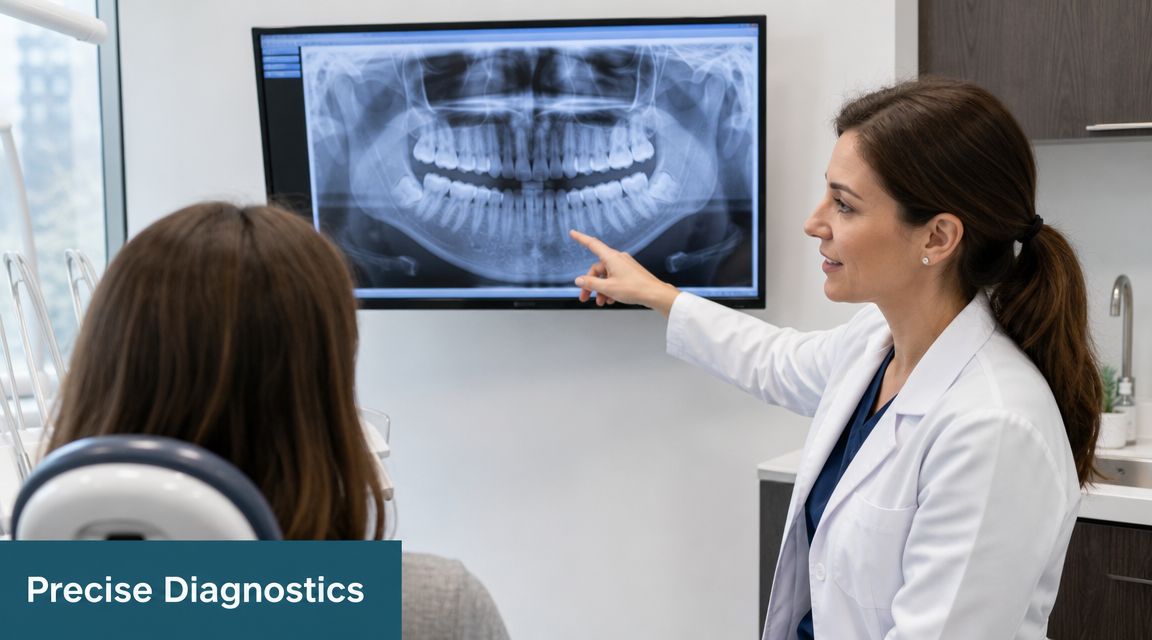
For a new patient exam, imaging can help identify decay between teeth, evaluate bone levels, and create a baseline for future comparison. During a problem-focused visit, it can help the dentist locate the source of pain, check a damaged tooth, or assess an area before recommending treatment.
During exams and everyday dental care
In a family practice, advanced imaging supports more than one kind of appointment. It can play a role in:
- Cleaning and exams when the dentist needs a clearer look below the surface
- Emergency dental services when a patient has swelling, pain, or a broken tooth
- Tooth extraction planning when root position or surrounding structures need review
- Restorative dentistry when crowns, fillings, or other treatment options are being considered
- Cosmetic dentistry when planning depends on oral health foundations as well as appearance
Amanda Family Dental offers digital X-rays as part of diagnostic care, alongside services such as preventive exams, restorative treatment, and cosmetic options for patients in Amanda and nearby communities.
For treatment planning and second opinions
Digital files are valuable because they don't stay trapped in one room or one format. A review in the National Center for Biotechnology Information archive on digital image transfer notes that digital images can be transferred electronically and interpreted remotely, which is useful when specialists are off-site or a practice needs a same-day second opinion. That capability supports continuity of care, team-based planning, and faster decisions.
For patients, that may help when treatment involves several steps. Implant planning is a good example, since image quality and record access matter when evaluating bone support and placement goals. Patients considering that option can learn more about the implant placement procedure.
This short video gives a helpful visual sense of how digital imaging fits into care:
Some patients also like seeing how other practices explain technology in a patient-facing way. This overview of how West Harbour Dental uses technology is one example of how digital tools are presented as part of comfort and care planning.
For someone looking for a dentist in Circleville, OH, a dentist in Carroll, OH, or a dentist near me after moving to the area, this is often what modern care looks like in practice. The technology supports quicker understanding, smoother coordination, and a visit that feels more settled from start to finish.
Frequently Asked Questions About Dental X-rays
Patients usually don't mind X-rays once they understand why they're needed and how the process works. Most questions come down to safety, timing, and cost.
Are dental X-rays safe for children and during pregnancy
Dental X-rays use a very low dose of radiation, and digital systems add an important safety benefit by helping avoid unnecessary repeat scans. As explained in this overview of digital X-ray safety advantages, the most significant benefit often comes from instant image review, which allows positioning errors to be corrected on the spot and helps minimize cumulative exposure over time.
That is especially reassuring for children, who may need periodic monitoring as their teeth develop. Pregnancy questions should always be discussed directly with the dental team, since recommendations depend on the situation, timing, and urgency of care.
Patient note: Safety decisions in dentistry are personalized. The dentist considers what information is needed and whether imaging is appropriate for that visit.
How often does someone need dental X-rays
There isn't one schedule that fits everyone. A patient with a history of decay, active symptoms, or ongoing treatment may need imaging on a different timeline than someone with stable oral health and no current concerns.
The dentist considers factors such as age, dental history, symptoms, previous findings, and treatment goals. For children, cavity risk and growth changes may matter. For adults, gum health, restorations, implants, or sudden pain may guide the decision.
Are digital dental X-rays covered by insurance
Coverage depends on the patient's dental plan and the type of exam or treatment involved. Many plans include X-rays as part of preventive or diagnostic benefits, but details can vary.
The most helpful approach is a simple one. Patients should ask what their plan covers, and the dental office can often help review benefits, explain expected costs, and discuss timing for any recommended images. Clear communication usually removes most of the stress around billing.
Experience Modern Dental Care in Amanda OH
Patients looking for a dentist in Amanda, OH want more than a convenient location. They want care that feels organized, respectful, and easy to trust. Digital imaging supports that kind of experience by helping appointments move smoothly and giving patients clearer answers during exams, emergency visits, and treatment planning.
That matters for families from Amanda, Lancaster, Circleville, and Carroll, Ohio who want one dental home for preventive care, restorative dentistry, cosmetic dentistry, and unexpected dental needs. A modern office should help patients feel informed, not rushed. It should also make it easier to understand what is happening and why a recommendation is being made.
Digital X-ray advantages aren't only about the machine. They are about a more comfortable visit, better communication, and a care process that fits real family life. For new patient exams, follow-up care, or urgent dental concerns, modern imaging can make the next step feel simpler.
Patients who want comfortable, modern dental care close to home can schedule a visit with Amanda Family Dental. The office serves Amanda, OH and nearby Lancaster, Circleville, and Carroll with family-focused care, digital X-rays, personalized treatment planning, and support for everything from routine exams to emergency dental needs.