

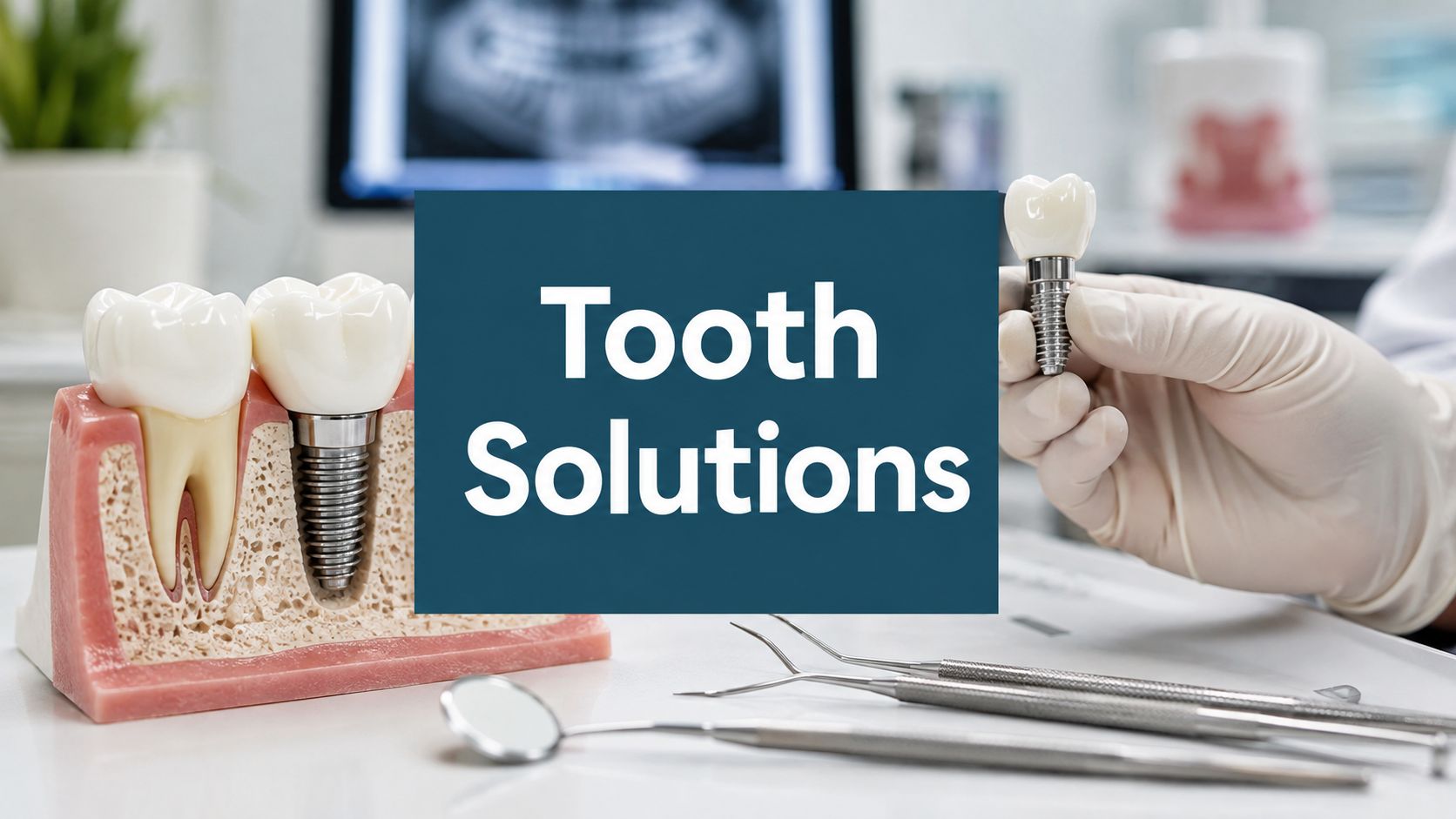
A missing tooth usually shows up in ordinary moments first. A bite feels different on one side, food catches in the gap, or a front tooth makes speaking feel awkward during a conversation in Amanda, Lancaster, Circleville, or Carroll. That's when people start searching for missing tooth solutions and, just as often, wondering whether they need to rush into treatment or can slow down and think it through.
Amanda Family Dental treats this as a real decision, not a sales pitch. Some teeth should be replaced right away, some gaps are better watched for a while, and some situations call for a bridge, denture, implant, or even no replacement at all for the moment. The right answer depends on the mouth in front of the dentist, not on a one-size-fits-all script.
Table of Contents
- When a Missing Tooth Changes Everyday Life
- How Missing Teeth Affect Health and Confidence
- Why Doing Nothing Can Be the Right First Step
- Comparing Dental Implants, Bridges, and Dentures
- Candidacy, Imaging, and Treatment Timeline
- Cost, Insurance, and Financing for Tooth Replacement
- Choosing the Right Option With a Local Dentist
When a Missing Tooth Changes Everyday Life
A patient from Lancaster may finally stop avoiding selfies after a front tooth is gone, while someone in Amanda might keep chewing on the same side because a back tooth makes biting uncomfortable. The problem often starts small, then becomes part of the day. That gap can affect meals, speech, and the simple confidence to smile without thinking about it.
The important thing is that missing teeth are not rare. The American College of Prosthodontists estimates that 178 million Americans are missing at least one tooth, and about 40 million are missing all of their teeth, according to its missing teeth talking points. The same source says the burden rises with age, which is why replacement choices keep showing up in everyday family dentistry.
Practical rule: a gap matters most when it starts changing chewing, speech, or the way the rest of the mouth fits together.
People often assume the issue is only cosmetic. It isn't. A missing tooth can change how the jaw comes together, how food is broken down, and how comfortable a person feels in social settings. That's why patients looking for a dentist near me in Amanda, OH, or a dentist in Lancaster, OH, usually want more than a quick patch. They want a clear plan.
Amanda Family Dental sees this as part of broader restorative dentistry and emergency dental services when the tooth loss came from fracture, decay, or extraction. The right first conversation is straightforward. What is missing, what is bothering the patient, and what kind of solution fits the mouth and the person?
How Missing Teeth Affect Health and Confidence
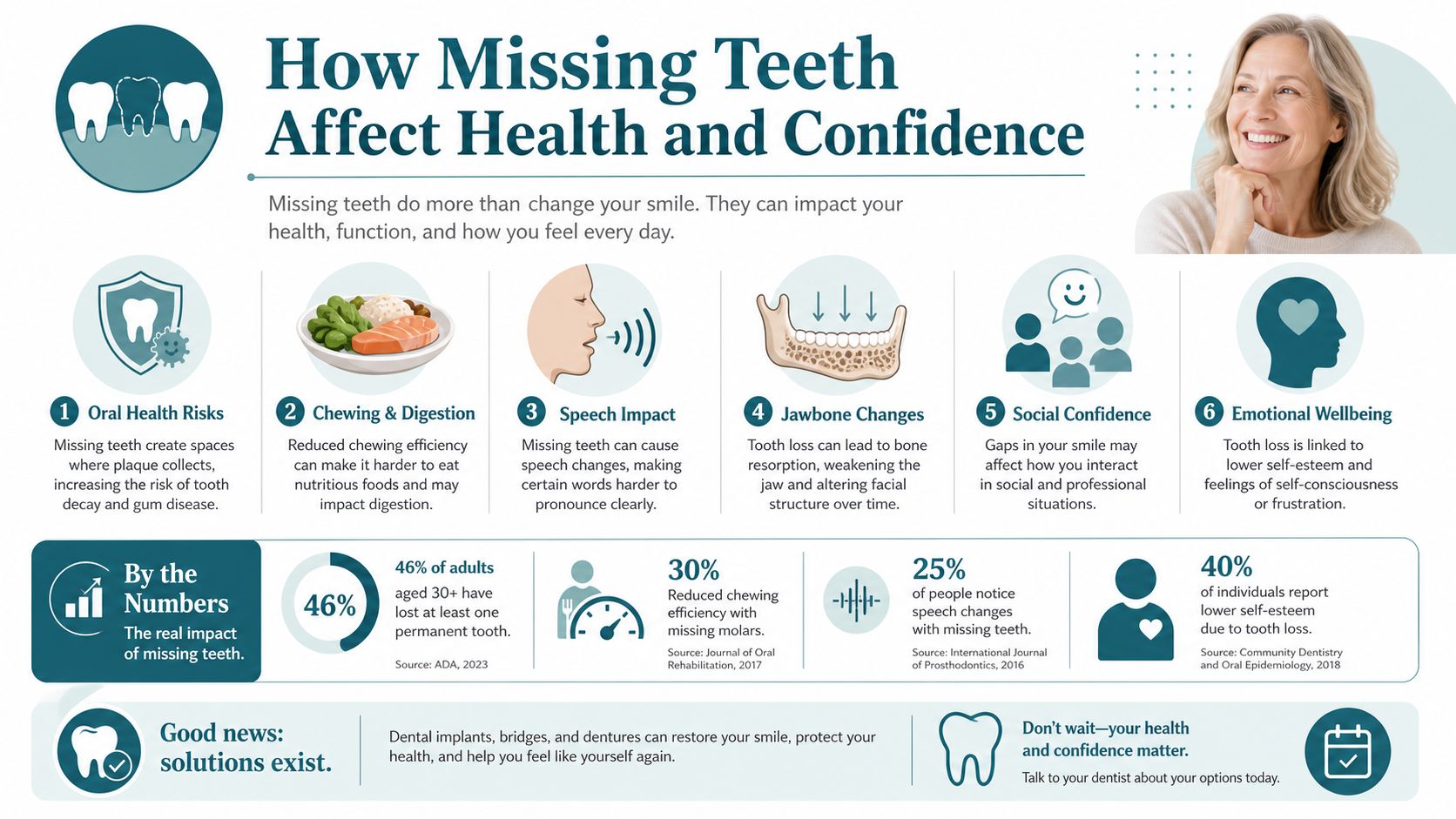
A missing tooth changes more than appearance because the teeth around it don't stay frozen in place. Neighboring teeth can drift, the bite can shift, and chewing often gets less efficient. Over time, the jaw can also lose support in the area where the root used to be, which is one reason the timing of replacement matters.
Partial loss and complete loss are different problems
A person missing one tooth faces a different decision than someone missing several or all teeth. Partial tooth loss is common well before retirement. The National Institute of Dental and Craniofacial Research reports that adults ages 20 to 64 have an average of 26 remaining teeth out of 32, and about 2% of adults in that age range have no remaining natural teeth, as summarized in the NIDCR tooth loss data. That means missing teeth aren't just a senior issue.
The age pattern becomes even clearer later in life. The CDC reports that in 2017 to March 2020, about 11% of adults ages 65 to 74 had lost all their teeth, and 20% of adults ages 75 and older were completely edentulous, according to its tooth loss overview. Those figures help explain why replacement choices need to be age-aware and realistic.
Confidence is part of oral health
Missing teeth can change how someone speaks, smiles, and shows up in public. That emotional pressure is real, but it shouldn't push the decision. The clinical problem and the social problem overlap, yet they don't always require the same treatment.
A good plan protects function first, then appearance.
That's why dental implants near me, bridges, dentures, and cosmetic options all belong in the same conversation. Patients in Circleville, Carroll, and Amanda often start with confidence concerns, then discover the actual issue is bite stability or oral health maintenance. Good treatment answers both.
Why Doing Nothing Can Be the Right First Step
Not every missing tooth needs to be replaced immediately. That sounds unusual because most public dental content jumps straight to a product, but a period of observation is often the more thoughtful clinical choice, especially when gum disease, decay, or hygiene problems still need control. The British Dental Journal specifically states that when there isn't a compelling reason, especially in older adults, not replacing missing teeth is the preferred option, and definitive replacement is often delayed until disease control and preventive care are in place, as discussed in this British Dental Journal article.
What the dentist checks first
A careful dentist looks at more than the empty space. The exam needs to answer whether the mouth is ready for replacement or whether the smarter move is to stabilize things first.
- Hygiene and gum health: active inflammation makes replacement less predictable.
- Bone level and spacing: the site has to physically fit the chosen solution.
- Bite stability: heavy bite forces can change which option makes sense.
- Overall health: some medical conditions and habits affect healing and maintenance.
If the surrounding teeth are still moving, the bite is unstable, or the patient is dealing with active disease, a rushed replacement can be the wrong move. In older adults especially, observation can be the safer path until the mouth is under control.
When waiting makes sense
Waiting doesn't mean ignoring the problem. It means gathering information and treating the mouth in the right order. A patient with a fresh extraction, inflamed gums, or uncertain bone support may need time before committing to a long-term restoration. That approach is especially useful when the patient is comparing a tooth extraction recovery, a bridge, and implant-based options all at once.
The honest answer is simple. If the gap is not causing immediate functional trouble, and the mouth still needs treatment elsewhere, there's no prize for moving too fast. A measured plan usually gives better choices later.
Comparing Dental Implants, Bridges, and Dentures
The best missing tooth solutions are not interchangeable. Each one solves a different problem, and each one brings a trade-off. A patient in Amanda might want the longest-lasting fix, while someone in Circleville might care more about avoiding surgery or protecting budget. That's why the decision has to start with the mouth and the goal, not the product name.
Fixed and removable options work differently
Dental implants are the most independent option. They stand on their own, which means neighboring teeth usually don't have to be reshaped. They also fit the general pattern of preserving bone better than options that don't replace the root. For single-tooth replacement, implant size and spacing matter a great deal. For a posterior single-tooth site, a mesiodistal space of at least 6.5 mm is cited as the minimum, and the treatment literature recommends roughly 3.5 to 6 mm in diameter and 9 to 15 mm in length for a single posterior implant, with titanium alloy used for strength and prosthetic stability, as described in single-tooth replacement treatment options. That spacing reality is why implants are not automatic.
Traditional fixed bridges use the neighboring teeth for support. They can be a solid choice when those teeth already need crowns or when the site isn't ideal for surgery. The downside is simple. Healthy adjacent teeth must usually be altered to hold the bridge.
Resin-bonded bridges are more conservative and can make sense when minimal tooth preparation is the priority. They are useful in selected cases, but they are not the answer for every bite pattern or every missing tooth location.
Removable options fill bigger gaps well
Removable partial dentures are often the practical answer for multiple missing teeth when the patient wants a non-surgical route. They can be adjusted over time, which is helpful when the mouth is still changing. Full dentures are the standard route for complete tooth loss and remain common, which fits the fact that 90% of people with edentulism wear dentures, according to the American College of Prosthodontists facts and figures.
Interim choices also matter. A flipper or another temporary restoration can keep a person functional while healing or planning continues. Those options are usually about getting through the next phase, not solving the problem forever.
The right question isn't “Which option is best?” It's “Which option fits this mouth without creating a bigger problem later?”
| Option | Best for | Impact on other teeth | Typical maintenance |
|---|---|---|---|
| Dental implant | Single or selected multiple missing teeth, when bone and spacing allow | Usually preserves neighboring teeth | Daily cleaning, routine checkups |
| Fixed bridge | Patients who want a fixed option without implant surgery | Requires support from nearby teeth | Brushing, flossing under the bridge, checkups |
| Resin-bonded bridge | Selected front-tooth cases or conservative replacement needs | Minimal alteration compared with traditional bridges | Careful hygiene, periodic evaluation |
| Removable partial denture | Several missing teeth, budget-conscious or non-surgical cases | Usually less impact on tooth structure | Removal for cleaning, adjustments |
| Full denture | Complete tooth loss | No reliance on natural teeth | Daily cleaning, relines, periodic fit checks |
| Temporary flipper or interim option | Short-term replacement during healing or planning | Limited, temporary impact | Gentle use, replacement when the final plan is ready |
Amanda Family Dental can talk through these paths, including the relationship between dental implants and dentures, through its dentures and implants overview. The point is not to sell one route. It's to match the solution to the gap.
Candidacy, Imaging, and Treatment Timeline
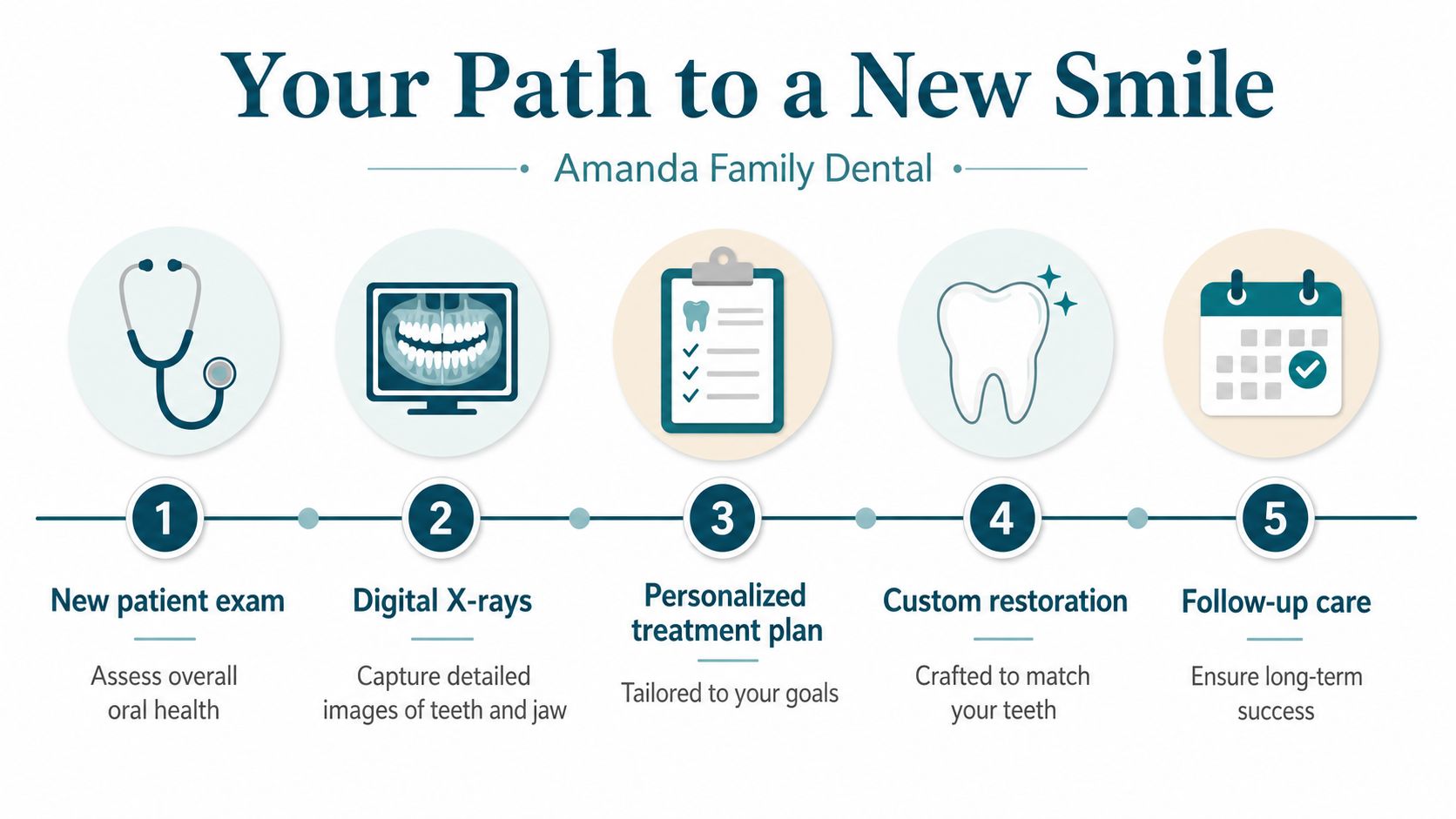
The first step is not choosing a tooth. It's getting a clear picture of the mouth. A new patient exam and digital X-rays let the dentist see bone levels, root health, spacing, and the condition of nearby teeth before anyone commits to treatment. At Amanda Family Dental, that information gets folded into a personalized treatment plan instead of a generic recommendation.
What the planning visit needs to answer
The diagnosis should be practical, not theoretical. The dentist needs to know whether the site can support an implant, whether a bridge would overload the neighboring teeth, or whether a removable option is more sensible.
- Bone and spacing: enough room is needed for the chosen restoration.
- Bite pattern: the force direction changes the plan.
- Medical history: healing and long-term maintenance depend on it.
- Patient goals: speed, appearance, stability, and budget all matter.
A patient with bone concerns may need an additional step before a permanent replacement. That is especially relevant for readers who also want to understand broader bone-health issues, including the osteoporosis patient information guide, because jaw support and systemic bone health can overlap in a real treatment discussion.
Timeline depends on the starting point
Implants usually take the longest because healing has to happen before the final tooth goes in. Bridges often move faster because they don't rely on implant integration, but they still require multiple visits for preparation, lab work, and placement. Bonded options and many dentures can move more quickly, especially when the site is straightforward.
The biggest mistake patients make is asking for a timeline before the exam. The right question is whether the mouth needs prep first. Some patients need bone grafting or space management before the final restoration can be built, and orthodontic adjustment can sometimes be part of the plan as well. For patients who want a closer look at implant surgery details, Amanda Family Dental also provides an implant placement procedure guide.
Good planning shortens regret more than it shortens the calendar.
Cost, Insurance, and Financing for Tooth Replacement
Cost matters, and patients should say so out loud. The right plan depends on the option you choose, how many teeth are involved, the materials used, whether bone grafting is part of the case, and the lab work required for custom restorations. An implant case can look straightforward until imaging shows extra work is needed, and a bridge or denture can also cost more if the supporting teeth or bone need treatment first.
Insurance usually helps in pieces, not all at once. Preventive care, diagnostic imaging, and parts of restorative treatment may be covered depending on the plan, but full replacement is often only partly covered. Patients comparing dental implants near me, bridges, or dentures should ask for a treatment estimate that separates the required clinical steps from optional upgrades. For a more detailed breakdown of missing tooth replacement costs, see a detailed breakdown of missing tooth replacement costs.
The cost of dental care on Medicare is also a useful reference when patients are comparing coverage gaps and out-of-pocket planning. The question is not whether anything is covered, but which parts still need to be paid for directly.
Amanda Family Dental also offers flexible payment planning and a Power Plan Membership, which can help patients spread out expenses and keep preventive care in the picture. Payment should make treatment possible, not force a patient to delay care until a small problem becomes a bigger one.
Ask for the full plan, not just the final number.
The best consultation question is simple: what changes the cost in this case? The answer tells a patient whether the price is driven by timing, materials, or a preliminary step such as bone support.
Choosing the Right Option With a Local Dentist
The easiest way to choose is to match the solution to the priority. If longevity and bone preservation matter most, implant-based care usually belongs at the top of the list. If protecting neighboring teeth is the main concern, a conservative bonded option may deserve a closer look. If speed and affordability matter most, a bridge or removable restoration may be the more realistic route. If the best fit is something removable that can be adjusted over time, partial or full dentures can make a lot of sense.
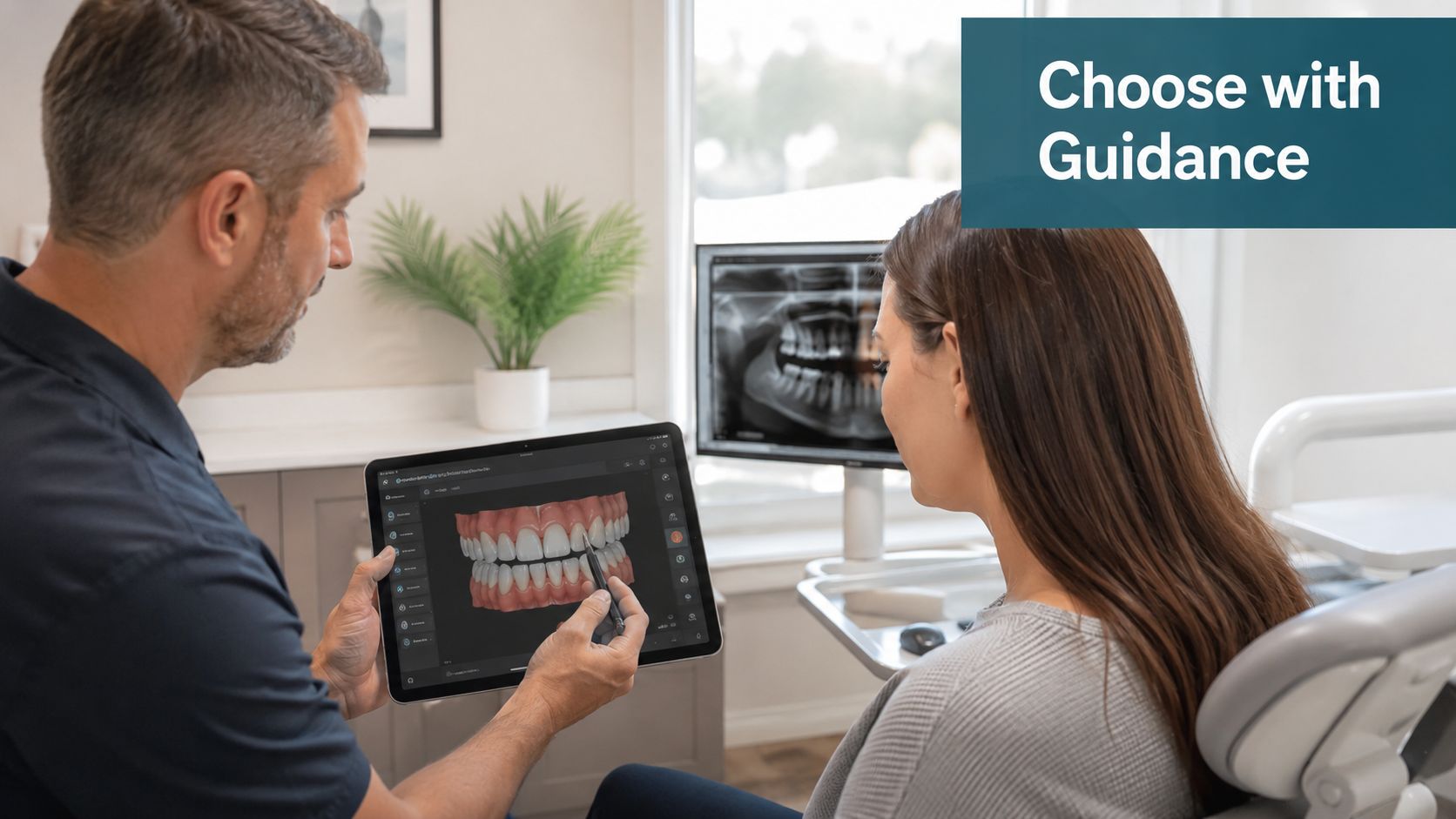
Amanda Family Dental serves patients in Amanda, OH, Lancaster, OH, Circleville, OH, and Carroll, OH who want a clear answer, not pressure. That matters for someone looking for a dentist in Amanda, OH or a cosmetic dentist near me after a gap changes how they look and feel. The right consultation turns a confusing choice into a simple path.
The office can help sort out cleaning and exams, dental X-rays, new patient exams, restorative dentistry, and replacement planning in one conversation. That makes it easier to move from concern to action without guessing.
A good plan starts with the facts in the mouth and ends with a solution that fits real life. Patients ready to stop guessing should schedule a consultation with Amanda Family Dental, get a personalized replacement plan, and take the next step toward comfortable chewing, clearer speech, and a confident smile.