

Missing teeth rarely affect just one part of life. Meals get harder. Speech can feel less natural. Many people start smiling with their lips closed, or they avoid photos altogether because they don't want attention on the gaps.
That's usually where the search begins. Someone in Amanda, Lancaster, Circleville, or Carroll starts looking for a dentist near me, or for dental implants near me, and tries to sort through dentures, implants, costs, healing time, and whether they're even a candidate. It can feel like a lot, especially when every option sounds good until the details show up.
Both dentures and implants can restore a smile. They just do it in different ways, and the right answer depends on anatomy, comfort goals, budget, and long-term expectations. Modern implant treatment has also moved well beyond a niche option. Nationally representative research found implant prevalence among adults missing at least one tooth rose from 0.7% in 1999 to 2000 to 5.7% in 2015 to 2016, with an average 14% annual increase, and projected use could reach 17% to 23% by 2026 under growth scenarios, according to research on implant prevalence in the United States.
For patients looking for a dentist in Amanda, the most helpful approach is a calm, practical one. Clear diagnosis first. Plain-English options second. Then a treatment plan that fits real life, not just an idealized version of it.
Table of Contents
- Your Guide to Restoring Your Smile in the Amanda Ohio Area
- Understanding Your Three Main Tooth Replacement Options
- Detailed Comparison of Dentures and Implants
- Your Treatment Journey Step by Step Timelines
- Are You a Candidate for Dentures or Implants
- Understanding Costs and Financing at Amanda Family Dental
- Schedule Your Tooth Replacement Consultation in Amanda OH
Your Guide to Restoring Your Smile in the Amanda Ohio Area
A missing tooth sometimes starts as a practical problem. Food catches in one spot. Chewing shifts to one side. A person notices that speaking on the phone or laughing in public feels different than it used to.
Then it becomes personal. Confidence slips. Social plans become less appealing. Some people want the quickest replacement possible. Others want the most stable long-term solution they can get. Most want both.
What patients are usually deciding between
For some patients, the decision is straightforward. They want a non-surgical replacement and need to restore appearance and function as soon as possible. For others, the priority is stability, especially if loose teeth, failing dental work, or repeated denture movement have already made daily life frustrating.
That's why the dentures and implants conversation shouldn't be reduced to “old option versus new option.” Both still have an important place in care.
A good treatment plan doesn't start with the product. It starts with the patient's mouth, health, priorities, and tolerance for time, maintenance, and surgery.
Why this choice still matters for many families
Traditional dentures continue to serve a very large population. The American College of Prosthodontists reports that more than 36 million Americans have no teeth, and about 90% of people with edentulism have dentures, based on prosthodontic facts and figures. That matters because it shows dentures are still a mainstream answer for complete tooth loss, not a fallback that's disappeared.
In practical terms, that means patients in Amanda, OH and nearby communities don't need to feel pressured into one path. A well-made denture may be the right fit. An implant-supported option may be the better fit. Sometimes the right next step is a diagnostic visit, digital X-rays, and a conversation about what will work.
Understanding Your Three Main Tooth Replacement Options
There are three main categories most patients compare when they're deciding between dentures and implants. The differences matter because each option solves a different problem.
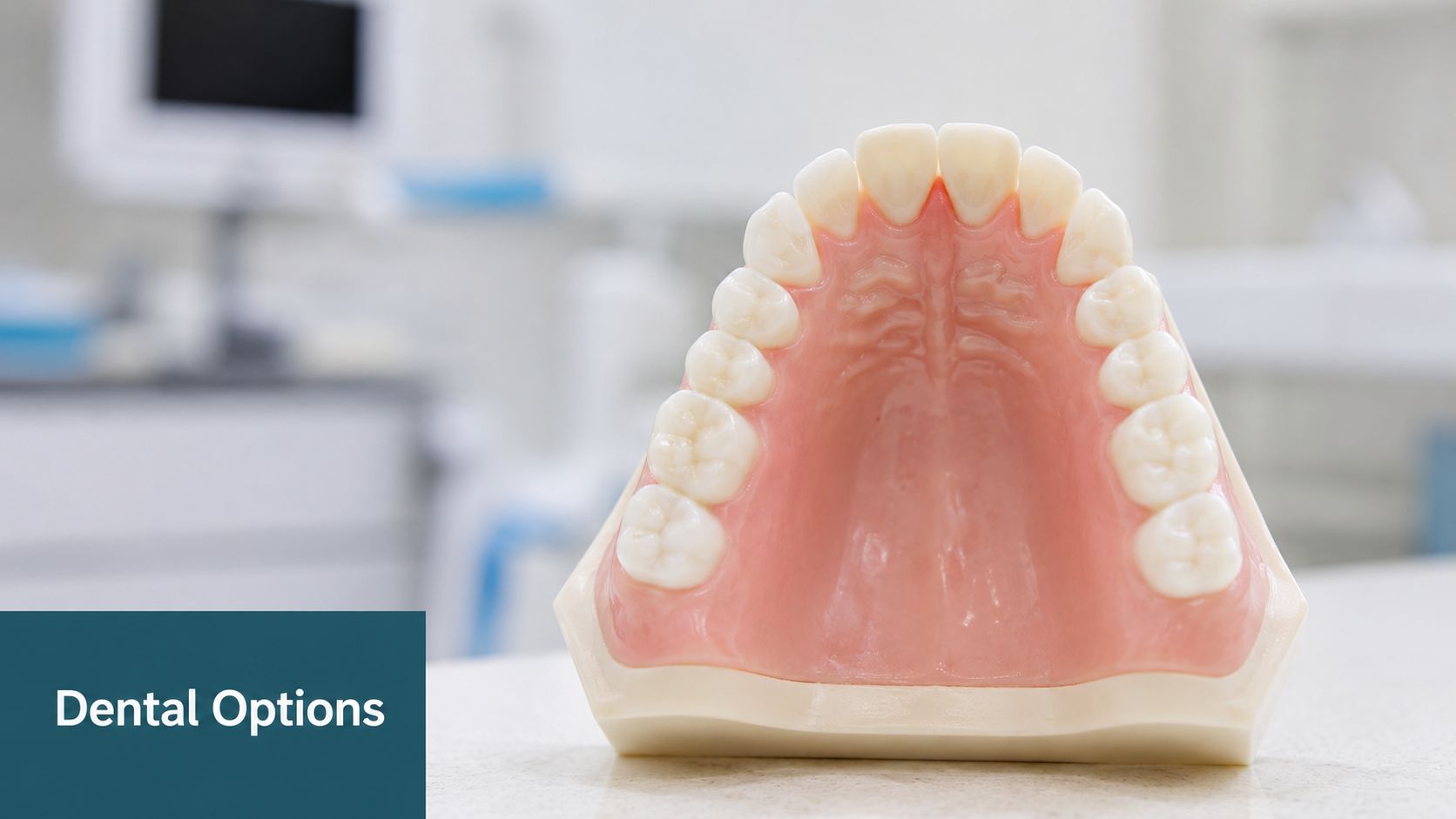
Traditional dentures
A traditional denture is a removable appliance that sits on the gums. It can replace all teeth in an arch, or in some cases several missing teeth. This option doesn't require implant surgery, which is one reason it remains common.
Think of it as a replacement that rests on the surface rather than being anchored into the jaw. That can work very well for appearance and basic function, but it also means the denture depends heavily on fit, gum shape, and day-to-day adaptation.
Traditional dentures often make sense when a patient wants:
- A non-surgical option that avoids implant placement
- A faster path to replacement after extractions or tooth loss
- A lower upfront commitment compared with implant treatment
Implant-retained dentures
An implant-retained denture blends both approaches. The denture is still removable in many cases, but it attaches to a small number of implants for added hold. Many patients think of these as “snap-in” dentures.
This is often the middle ground. It offers more security than a conventional denture while stopping short of replacing every missing tooth with separate implants and crowns.
Dental implants with crowns or bridges
A dental implant works more like a replacement root. The implant is placed in the jawbone, and then a crown or bridge attaches to it after healing. If traditional dentures are like a structure resting on the ground, implants are more like a foundation anchored below the surface.
For patients missing one tooth, several teeth, or even all teeth in an arch, implant treatment can be designed in different ways. Some plans use individual implants with crowns. Others use implants to support bridges or full-arch restorations.
Why all three still matter
Patients sometimes assume dentures are outdated because implants get so much attention online. That isn't accurate. Each option fills a real need.
What matters most is matching the design to the mouth. Number of missing teeth, bone support, medical history, bite forces, and cleaning habits all shape the recommendation. A person searching for a dentist in Lancaster, OH or an emergency dentist after a failing tooth may need a very different plan than someone who has worn dentures for years and wants more stability.
Detailed Comparison of Dentures and Implants
The fastest way to compare dentures and implants is to look at the features patients notice every day. Stability while eating. Cleaning. How the replacement feels throughout the day. Whether it protects the jawbone or only replaces visible teeth.
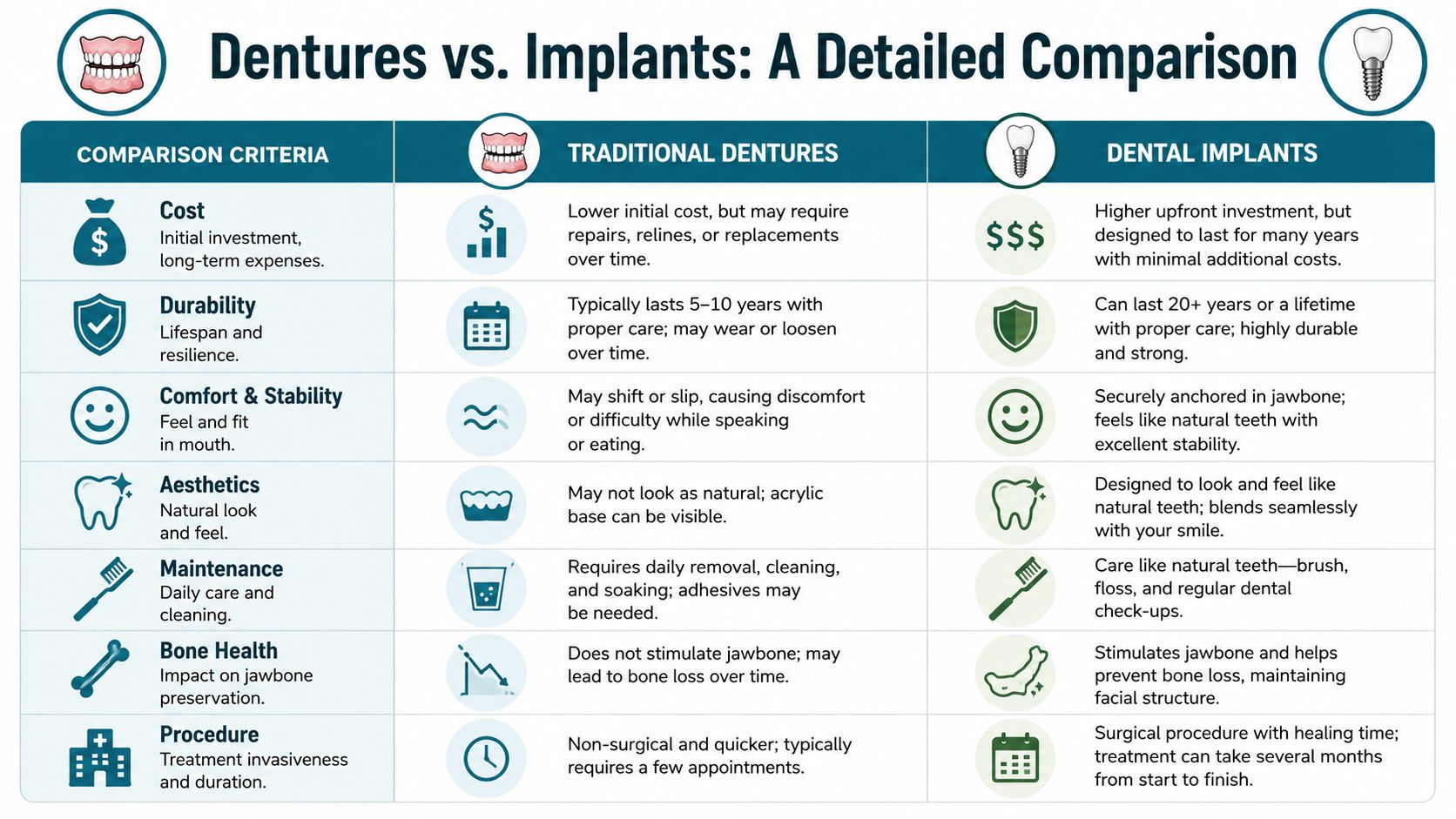
Tooth Replacement at a Glance
| Feature | Traditional Dentures | Implant-Retained Dentures | Dental Implants (Crowns/Bridges) |
|---|---|---|---|
| Stability | May move depending on fit and anatomy | More secure than conventional dentures | Most tooth-like stability |
| Chewing confidence | Often more limited | Improved support for chewing | Strongest everyday function |
| Bone support | Doesn't replace the tooth root | Some implant support under the denture | Replaces the root function directly |
| Daily care | Remove and clean | Clean denture and implant attachments carefully | Brush and floss around restorations |
| Surgery required | No | Yes | Yes |
| Best fit for | Patients wanting a non-surgical removable option | Patients wanting a removable option with more hold | Patients wanting the most fixed-feeling replacement |
A helpful way to understand the full-arch side of treatment is this guide to understanding full arch dental implants, especially for readers trying to sort out fixed versus removable implant options.
Where each option works well
A traditional denture can work very well for someone who needs broad tooth replacement without surgery. It can also be the right answer when immediate practicality matters more than maximum bite stability.
An implant-retained denture often works well for patients who dislike looseness but still want a removable prosthetic they can manage more easily. This category can offer a meaningful jump in day-to-day confidence.
Dental implants with crowns or bridges are usually the most natural-feeling option when anatomy and treatment goals line up. For patients trying to understand candidacy, healing, and restoration design in more depth, this complete guide to dental implants is a useful companion resource.
The trade-offs patients feel day to day
The quality-of-life difference between conventional removable designs and implant-supported removable designs isn't just theoretical. A 2022 systematic review and meta-analysis found better outcomes for implant-supported removable partial dentures than conventional distal-extension removable partial dentures, with pooled quality-of-life scores of 30.9 ± 18.1 versus 65.5 ± 16.3, and the difference was statistically significant, as reported in this systematic review on implant-supported removable partial dentures.
That's one reason patients often describe implant-supported options as feeling more dependable, not just more modern.
Practical rule: If the top priority is avoiding surgery, conventional dentures stay in the conversation. If the top priority is reducing movement during eating and speaking, implant support becomes much more appealing.
The video below gives a visual overview that many patients find easier to process than text alone.
Aesthetics matter too, but fit and function usually determine long-term satisfaction. A denture can look very good and still feel frustrating if it shifts. An implant plan can feel solid and still require patience because surgery, healing, and staged appointments take time.
Most disappointment happens when people compare only the final photo and not the daily experience of wearing, cleaning, eating, and maintaining the restoration.
Your Treatment Journey Step by Step Timelines
Many patients feel more comfortable once the process is broken into steps. The path for dentures isn't the same as the path for implants, and knowing the sequence helps people plan around work, family schedules, and healing.
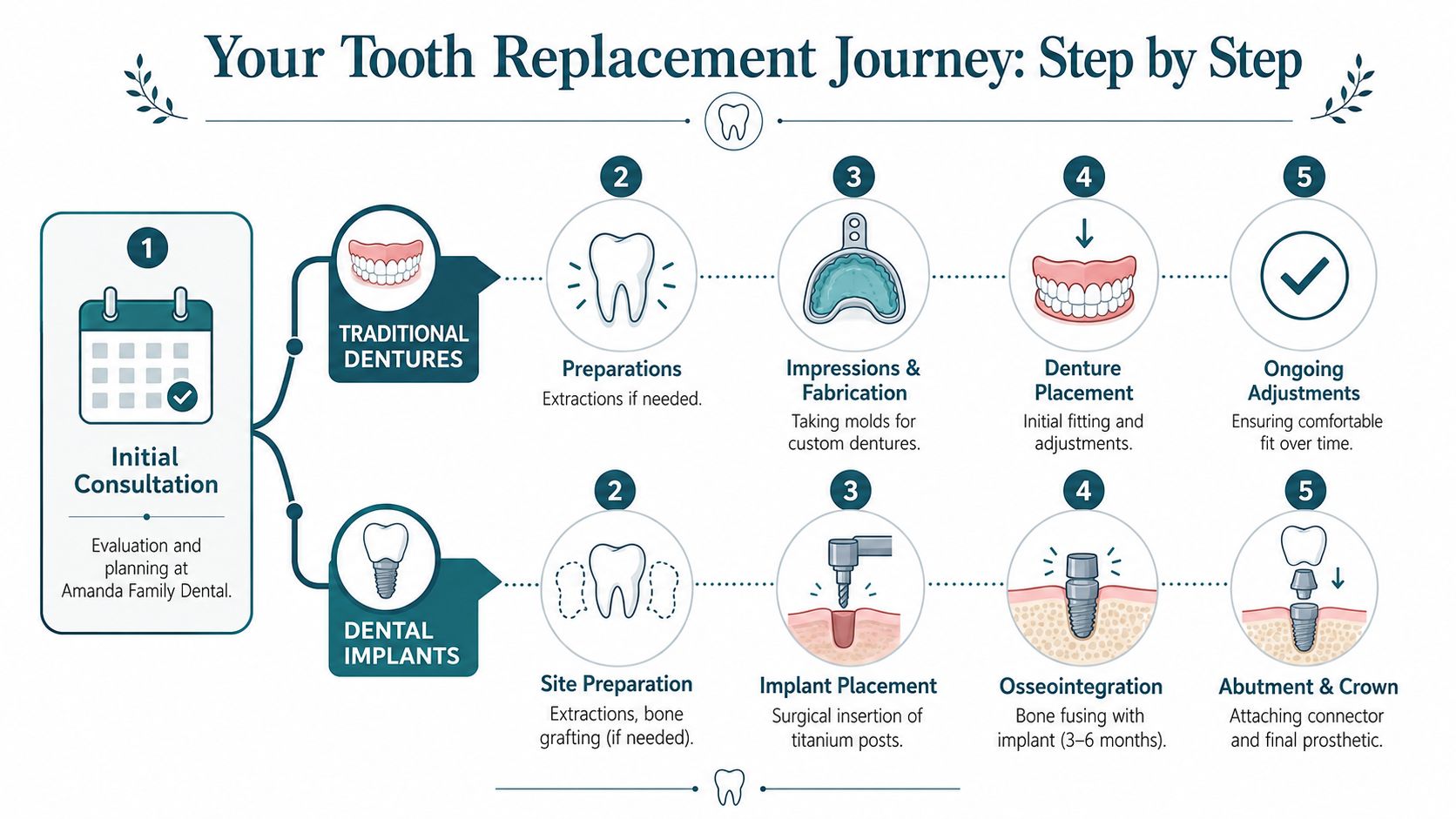
Traditional denture timeline
A conventional denture usually begins with a new patient exam, digital X-rays, and a discussion of which teeth can be saved and which can't. If extractions are needed, those are planned first.
After that, the process often includes:
- Impressions or scans so the denture can be designed to fit the mouth.
- Try-in appointments to check shape, bite, and appearance before the final version is delivered.
- Delivery and adjustment visits because new dentures often need refinement as tissues settle.
This route is usually more straightforward than implant care, but it still requires follow-up. Pressure spots, bite changes, and gum healing can affect comfort.
Implant timeline
Implants take more stages. The first visit focuses on whether the mouth and bone can support the plan safely and predictably. If a failing tooth needs removal, that may happen before or during implant treatment, depending on the case.
A typical sequence includes:
- Diagnostic planning with exam and digital imaging
- Site preparation if the area needs extraction or other preparatory care
- Implant placement
- Healing period while the implant integrates with bone
- Final restoration with a crown, bridge, or denture connection
Healing is the part patients often underestimate. The surgical appointment is only one step. The bone also needs time to integrate with the implant before the final tooth replacement is attached.
Implant-retained denture timeline
This option combines parts of both paths. The denture portion still requires records, design, and fittings. The implant portion still requires surgical planning and healing.
The middle option isn't always the shortest option. It's often the option that balances stronger hold with a removable prosthetic design.
Patients searching for a dentist in Circleville, OH or a dentist in Carroll, OH often want to know what the office experience feels like as much as the treatment sequence. A calm first visit matters. Clear explanations matter. For many people, comfort details matter too, including digital X-rays, sleep dentistry options for selected cases, and patient-centered choices such as fluoride-free options when those are appropriate to discuss within the treatment plan.
A good timeline also leaves room for adjustments. Tissue healing can change a denture fit. Implant restoration details can change after integration. The right office doesn't treat that as a surprise. It builds those steps into the process from the beginning.
Are You a Candidate for Dentures or Implants
The better question isn't “Which is better?” It's “Which fits this mouth, this health history, and this person's goals?”
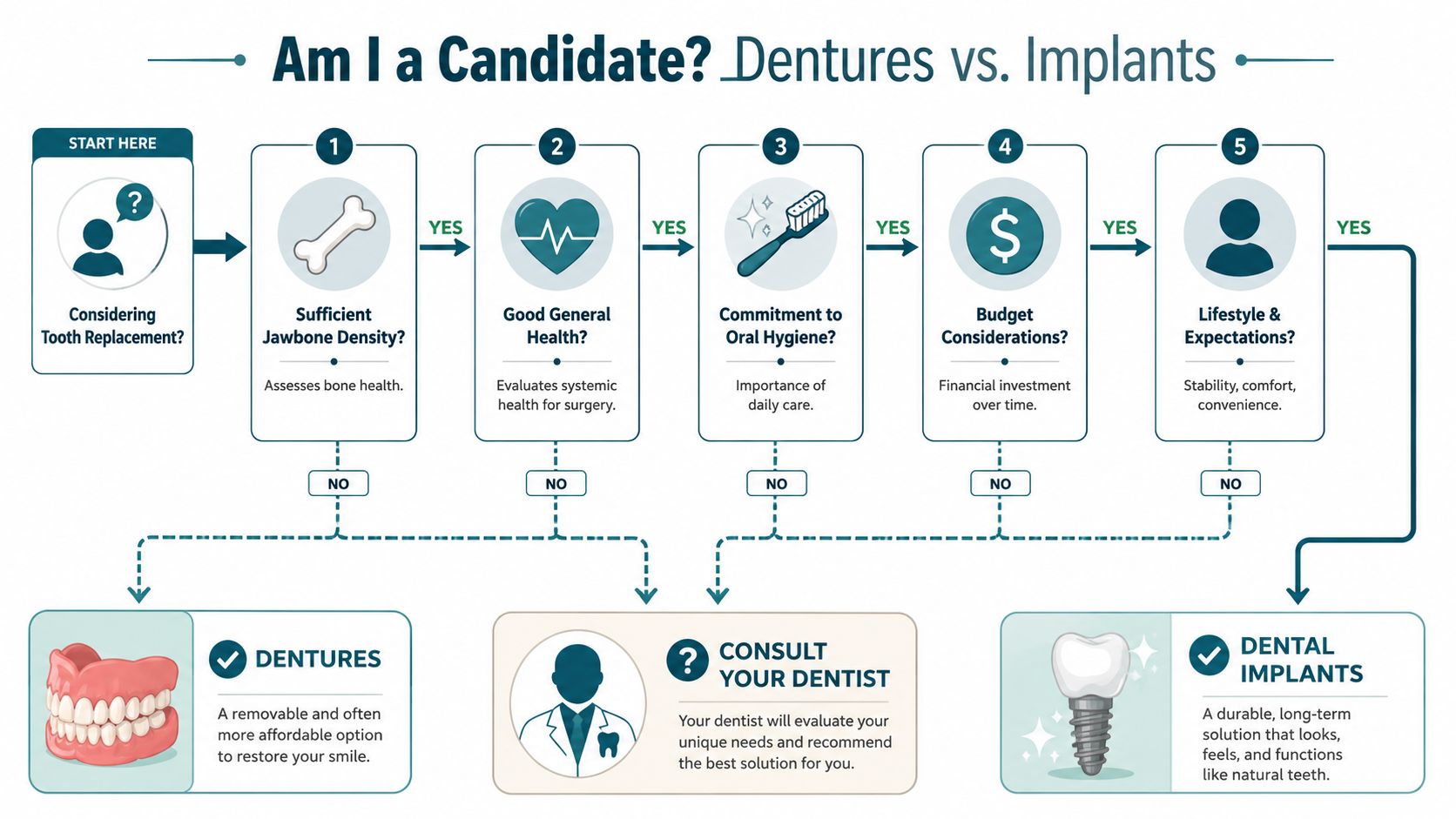
A simple decision flow
Patients can start with a few practical questions:
- Do you want a removable or fixed-feeling solution? Some people don't mind removing a prosthetic. Others know they want something that feels closer to natural teeth.
- How important is chewing stability? If movement during meals would be a major frustration, implant support deserves serious consideration.
- Are you open to surgery and healing time? Implant treatment asks more upfront of the patient.
- What kind of maintenance fits your routine? Every option requires care, but the daily habits differ.
A visual flowchart helps. The decision isn't really dentures versus implants in the abstract. It's comfort, anatomy, timeline, and expectations meeting one actual treatment plan.
Why bone and placement both matter
Patients often hear that implants depend on “having enough bone,” which is true but incomplete. Placement quality matters too. In challenging anatomy, clinicians may use specialized parts such as angled abutments. One technical source describes systems that can correct 15 degrees of angulation and restore implants up to 35 degrees, while some housings allow 20 degrees of total divergence and extended-range inserts allow up to 40 degrees, according to this discussion of angled abutments and implant divergence.
That matters because limited jawbone doesn't always end the conversation. It changes the planning conversation.
Some patients aren't choosing between a simple denture and a perfectly placed implant. They're choosing between a removable solution and an implant plan that requires advanced prosthetic design to work around anatomy.
Comfort preferences matter too
A candidate decision also includes how someone wants to experience treatment. Patients with anxiety may prefer to stage care. Others want to move efficiently once they know the plan. Some want the most conservative route possible. Others are willing to accept a longer process for a more stable result.
Amanda Family Dental offers digital X-rays, restorative planning, sleep dentistry support in appropriate situations, and wellness-oriented options such as mercury-free fillings and fluoride-free choices as part of its broader care model. Those details don't determine candidacy on their own, but they often make the decision journey feel more manageable for families comparing options in Amanda and nearby communities.
Understanding Costs and Financing at Amanda Family Dental
Cost affects treatment decisions just as much as clinical design. That's not a side issue. It's part of responsible planning.
What changes the fee
A conventional denture is usually the most accessible starting point because it doesn't include implant surgery or implant components. Implant-retained dentures add surgical and prosthetic complexity. Individual implants with crowns or bridges can vary based on how many teeth are missing, where they're missing, and whether any preparatory treatment is needed first.
Other factors can influence cost, including:
- Extractions before replacement
- Temporary appliances during healing
- Type of final restoration
- Follow-up adjustments and maintenance
Patients should expect a real treatment estimate only after the exam and imaging. Before that, broad online comparisons are often too generic to be useful.
How patients make treatment workable
Access is uneven, especially for more advanced restorative care. A report discussing underserved populations noted that expanding access to implant-supported dentures required an academic-community partnership, as described in this discussion of access to implant-supported dentures. In plain terms, availability and affordability shape the decision as much as preference does.
That's why financing matters. Insurance, phased treatment, and office payment options often determine whether a patient moves forward now, waits, or chooses a different solution. For patients trying to compare the practical side of replacement options, this overview of missing tooth replacement cost helps frame the conversation before an exam.
Amanda Family Dental also offers flexible payment approaches and a Power Plan Membership, which can be part of the budgeting discussion for patients seeking restorative care in Amanda, Lancaster, Circleville, and Carroll. The right financial conversation should feel as clear as the clinical one.
Schedule Your Tooth Replacement Consultation in Amanda OH
The choice between dentures and implants is rarely just about teeth. It's about eating comfortably, speaking naturally, and not thinking about your smile every time a camera comes out or a meal starts.
Some patients need a practical removable option that restores appearance and function without surgery. Others want a more secure solution and are willing to go through a longer treatment process to get it. Both are reasonable goals. The key is matching the plan to the person.
For patients searching for a dentist in Amanda, OH, a dentist in Lancaster, OH, a dentist in Circleville, OH, or a dentist in Carroll, OH, the most useful next step is a consultation built around diagnosis, not guesswork. A full exam, digital X-rays, and a conversation about comfort preferences can show whether the better answer is a traditional denture, implant-retained denture, or implant-supported crown or bridge.
The right office experience matters too. Many people value a setting that explains treatment clearly, respects anxiety, and offers comfort-focused care along with options that consider overall well-being when appropriate. That kind of environment makes big decisions easier.
If missing teeth are affecting meals, confidence, or oral health, there's no need to keep guessing from search results. A personalized evaluation can narrow the options quickly and show what's realistic now, what may need to be staged, and what's likely to serve the smile best over time.
If you're ready to compare your options with clear guidance and a personalized treatment plan, contact Amanda Family Dental to schedule a tooth replacement consultation for Amanda, Lancaster, Circleville, or Carroll, Ohio.