

A lot of people ask the same question after a nightly routine that seems simple enough. Brushing is done, the rinse goes in, and instead of feeling fresh, the mouth suddenly stings. That moment can be confusing, especially when the label makes the product sound clean, soothing, or minty.
For families searching for a dentist in Amanda, OH, or for patients in Lancaster, Circleville, and Carroll, Ohio, this is one of those small symptoms that can mean a few different things. Sometimes the mouthwash formula is the issue. Sometimes a canker sore, dry mouth, or irritated gums makes an otherwise normal rinse feel harsh. Sometimes the pattern points to something worth having checked during a dental visit.
Table of Contents
- That Burning Sensation A Common Question We Hear in Amanda
- The Main Reason Your Mouthwash Burns Alcohol and Menthol
- Other Ingredients That Can Cause Discomfort
- When the Burn Is a Clue About Your Oral Health
- Simple Steps to Soothe the Burn and Find Relief
- When to See Your Dentist in the Amanda Area
That Burning Sensation A Common Question We Hear in Amanda
A common version of this story goes like this. A patient picks up a mouthwash, swishes for a few seconds, and expects that crisp, clean feeling. Instead, the tongue tingles sharply, the cheeks feel raw, and the gums start to sting.
That reaction often leads to the same thought. Why does my mouthwash burn if it's supposed to help?
For many people in Amanda, OH, that question comes up after trying a stronger rinse for bad breath, gingivitis concerns, whitening, or a general attempt to improve daily dental care. Some notice the burning only once in a while. Others notice it every single time, even after switching brands. Both patterns matter.
Why the confusion is so common
Mouthwash marketing often connects a strong sensation with being effective. That can make people assume the burn means the rinse is doing extra work. In many cases, that isn't what's happening.
Burning can be a side effect of the formula, not proof that the rinse is cleaning better.
A patient may also wonder whether brushing order matters, because timing can change how products feel in the mouth. Amanda-area readers who want a practical overview can review this guide on mouthwash before or after brushing.
A better way to think about it
The easiest way to sort this out is to ask three simple questions:
- Does it burn with one brand only. That often points to a specific ingredient issue.
- Does it burn when there's a sore spot. That can mean the tissue is irritated before the rinse ever touches it.
- Does every rinse burn. That may be a clue that the mouth itself needs attention.
That's the difference between guessing and understanding the symptom.
The Main Reason Your Mouthwash Burns Alcohol and Menthol
The most common cause is the formula itself. Two ingredients show up again and again when patients describe that strong sting. Alcohol and menthol are often responsible for the burning sensation people notice first.
Alcohol can dry and irritate soft tissue
Many commercial mouth rinses contain roughly 18% to 26% alcohol, with some products exceeding 25%, and at those levels alcohol can dry out oral tissues and trigger a stinging or burning sensation. That burn is generally a side effect of the formula, not a sign that the rinse works better, according to Delta Dental's explanation of why mouthwash burns.
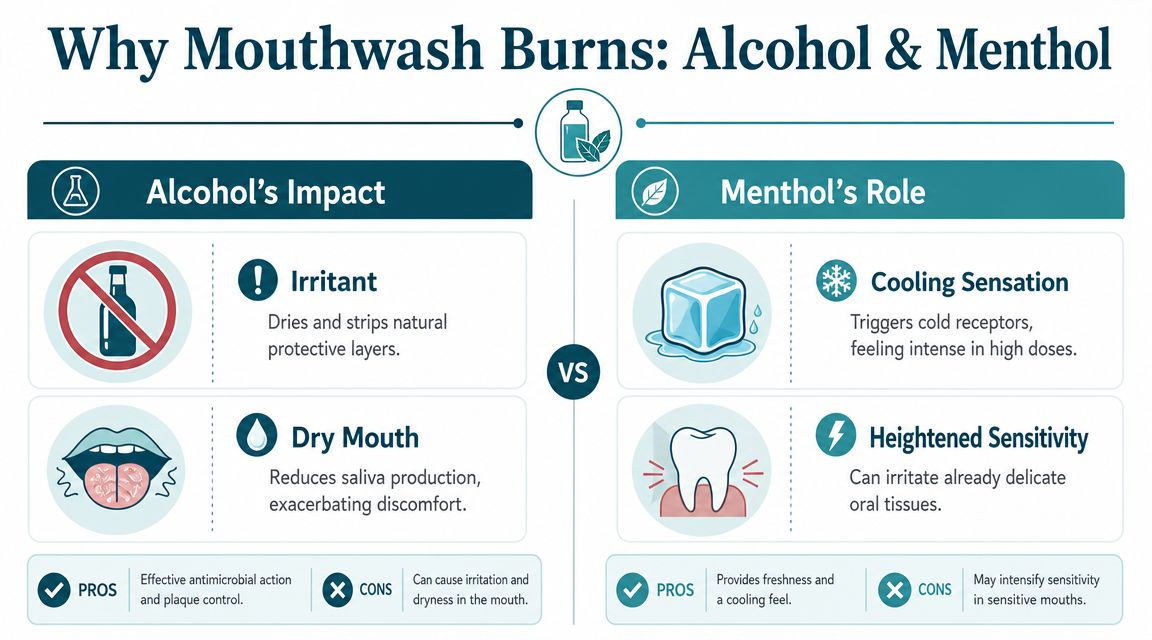
A simple way to picture it is this. Skin that's already dry reacts faster to harsh soap. Mouth tissue behaves in a similar way. When alcohol strips moisture away, the cheeks, gums, and tongue can feel sharp, hot, or raw for a short time after rinsing.
That's one reason many patients end up preferring gentler options. People who are already familiar with the broader benefits of alcohol-free body care often understand the same basic comfort principle. Less drying usually means less irritation.
Menthol can make the sensation feel stronger
Menthol is added for that cold, minty finish many people associate with freshness. But menthol can also stimulate sensory receptors in a way that feels intense, especially on sensitive tissue.
For someone with a healthy mouth, that may register as a mild cooling tingle. For someone with irritated gums, a tender tongue, or a recent sore, it may feel much more aggressive.
Practical rule: If a rinse feels “too strong” rather than simply refreshing, the formula may be too irritating for that mouth, even if the product is popular.
What to do with that information
The first useful test is simple. Compare labels. If one rinse contains alcohol and another is alcohol-free, the gentler option may feel very different. Patients who are choosing a cavity-focused rinse may also find this overview of fluoride mouthwash for cavities helpful when deciding what kind of product fits their needs.
A strong burn does not automatically mean something is wrong. It often means the ingredients are harsh for that particular mouth.
Other Ingredients That Can Cause Discomfort
Some people switch to an alcohol-free rinse and still ask why does my mouthwash burn. That's when it helps to look beyond alcohol and mint.
Modern rinses often contain active ingredients meant to reduce plaque, control gingivitis, freshen breath, or support whitening. Those ingredients can be useful, but some mouths tolerate them better than others.
Common ingredients that may sting
Dental guidance notes that modern rinses may include chlorhexidine, cetylpyridinium chloride, and hydrogen peroxide, and these ingredients can all cause tingling or burning. The same guidance also notes that the sensation is often worse when gum tissue is already inflamed by gingivitis because the rinse touches exposed, sensitive tissue directly, as explained in Thomas Dentistry's article on why mouthwash burns.
A quick breakdown helps:
| Ingredient | Often used for | How it may feel |
|---|---|---|
| Chlorhexidine | Plaque and gingivitis control | Can feel irritating in sensitive mouths |
| Cetylpyridinium chloride | Antiseptic support | May cause tingling or burning |
| Hydrogen peroxide | Whitening rinses | May sting sensitive tissue |
| Essential oils | Freshness and antiseptic effect | Can feel sharp on irritated areas |
Why one formula may bother someone while another doesn't
Readers often find this confusing. A mouthwash can be “good” in general and still be a poor fit for one person.
One patient may tolerate a whitening rinse without any problem. Another may feel instant discomfort because the cheeks are dry, the gums are inflamed, or the tissue is naturally more reactive. Someone else may do well with a simple fluoride rinse but struggle with stronger antiseptic ingredients.
A useful self-check
If discomfort happens only with one bottle, one flavor, or one type of rinse, that usually points toward formulation sensitivity. That does not necessarily mean a dangerous reaction. It means the ingredients in that product aren't a good match for that mouth.
A mild tingle is common. A strong burn that keeps happening with the same formula is a good reason to stop using that product and reassess.
That distinction matters because it keeps people from assuming all mouthwash is the same.
When the Burn Is a Clue About Your Oral Health
Sometimes the mouthwash isn't the main problem. The mouth is.
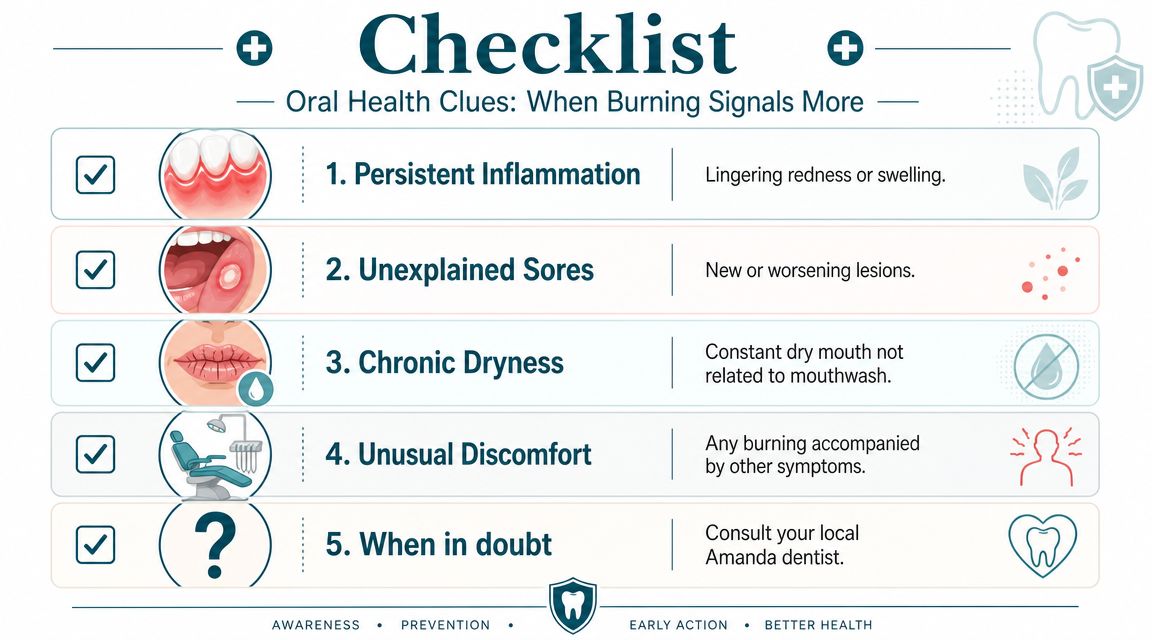
If burning happens with nearly every rinse, or if the sensation got worse around the same time as bleeding gums, dryness, or a sore spot, the symptom may be acting like a clue rather than a random annoyance.
Sensitive tissue reacts faster
Small mouth ulcers, irritated gums, minor cuts, and dry mouth can all lower the mouth's tolerance for ingredients that might otherwise feel manageable. Tissue that is inflamed or exposed doesn't need a very harsh product to react.
This is one reason a person may use the same mouthwash for months with no issue, then suddenly feel a painful sting one week. The product may not have changed. The condition of the mouth may have changed.
When repeated burning means more than product sensitivity
If mouthwash consistently burns regardless of the brand, it may signal an underlying issue like mouth ulcers, gingivitis, or dry mouth, which makes tissue more sensitive. In rare cases, swelling or a rash can suggest an allergy, including a chlorhexidine allergy, and a dentist should be consulted, as noted in Caspersmile's discussion of mouthwash burning and oral sensitivity.
That's a useful self-triage point:
- One product burns. Think ingredient sensitivity.
- Any rinse burns. Think irritated tissue, dryness, or inflammation.
- Burning plus swelling or rash. Stop using the rinse and seek professional advice.
Related sensitivity can overlap
Mouth discomfort rarely exists in isolation. People dealing with burning rinses may also notice tenderness with cold drinks, sweets, or brushing. For a broader look at overlapping symptoms, this article on what causes sensitive teeth can help connect the dots.
Readers who want to understand how local oral symptoms can reflect broader patterns may also appreciate this resource on the link between oral health and overall wellness.
If the mouth keeps reacting to everyday products, the most useful question isn't “Which rinse is strongest?” It's “Why is this tissue so sensitive right now?”
That shift in thinking helps people know when to stop experimenting and start looking for answers.
Simple Steps to Soothe the Burn and Find Relief
For many people, relief starts with changing the routine, not forcing the mouth to “get used to it.”

A stinging rinse should not feel like a test of toughness. If a product makes the mouth feel raw, there are a few practical ways to reduce irritation while figuring out what's causing it.
Easy adjustments at home
- Switch formulas first. An alcohol-free or sensitivity-focused rinse is often the simplest change to try.
- Read the ingredient list. If the burn started after using a whitening rinse or a stronger antiseptic rinse, the active ingredient may be the reason.
- Take a short break. If there's a canker sore, irritated gums, or recent dental tenderness, pausing mouthwash for a bit may help calm the tissue.
- Use water after stopping the rinse. A gentle rinse with plain water can reduce lingering discomfort.
- Watch for patterns. The timing matters. Burning after one specific product is different from burning with everything.
Some patients also choose to dilute a rinse temporarily if a dentist has already confirmed that the formula is otherwise appropriate for them. That's not a fix for every situation, but it can help identify whether concentration is part of the problem.
Gentle routines matter
There's also value in simplifying the whole routine for a few days. A soft toothbrush, non-irritating toothpaste, and a gentler rinse can give the mouth time to settle down.
For readers who want another plain-language overview of managing sensitivity, Inspire Dental Group's gentle guide offers a useful comparison of common triggers and comfort strategies.
This short video can also help patients think through comfort-focused oral care choices before a visit.
A simple adjustment is often enough. If it isn't, that's when a dental exam becomes more useful than trying bottle after bottle.
When to See Your Dentist in the Amanda Area
There's a point where changing products stops being productive. If mouthwash burn becomes a pattern, a dental visit can help identify whether the issue is irritation, inflammation, dryness, or a condition that needs treatment.
For patients searching online for a dentist near me, dentist in Lancaster, OH, dentist in Circleville, OH, or dentist in Carroll, OH, this kind of symptom is worth bringing up during a routine visit. It may seem minor, but it can reveal a lot about gum health and tissue sensitivity.
Signs that deserve an appointment
A professional evaluation is a smart next step when any of these are happening:
- Every mouthwash burns. That can suggest ulcers, gingivitis, or dry mouth rather than a one-product issue.
- The gums bleed or stay tender. Ongoing irritation may point to inflammation that needs treatment.
- Sores keep showing up. Repeated or slow-healing spots should be examined.
- Swelling or rash appears. That raises concern for a reaction that shouldn't be ignored.
- Dry mouth is becoming routine. Chronic dryness can make daily oral care products feel harsher and can affect comfort and oral health.

What a dental exam can clarify
A visit for dental cleaning and exams or new patient exams can help narrow the cause quickly. A dentist may look for gum inflammation, mouth ulcers, dry tissue, plaque buildup, or signs that a specific rinse ingredient is too irritating.
Depending on the situation, the visit may include:
| What the team checks | Why it matters |
|---|---|
| Gums and soft tissue | Helps identify inflammation, irritation, or sores |
| Digital x-rays | Useful if symptoms overlap with deeper dental concerns |
| Home-care routine | Shows whether the product choice fits the patient's needs |
| Personalized treatment planning | Helps match care to the actual cause |
That matters for patients looking for more than a quick guess. Some cases call for a change in mouthwash. Others may lead to preventive care, gum treatment, restorative dentistry, or follow-up for ongoing discomfort. If pain becomes severe or is paired with swelling, an emergency dentist visit may be appropriate.
Why local care helps
For people in Amanda and nearby communities, a local office can compare symptoms with the rest of the patient's oral health picture. That includes gum condition, dryness, current dental work, sensitivity history, and any recent treatment. One available resource is Amanda Family Dental, which provides exams, digital x-rays, personalized treatment planning, and routine dental care for patients in Amanda, Lancaster, Circleville, and Carroll, Ohio.
Mouthwash should support oral health. If it keeps causing pain, the routine needs a closer look.
A persistent burn is not something patients need to tolerate. It's often a useful signal, and signals are easier to understand with the right exam.
If mouthwash has started to sting, burn, or feel harsher than it used to, scheduling a visit can help uncover the reason. Amanda Family Dental provides patient-focused care for families in Amanda, OH, Lancaster, OH, Circleville, OH, and Carroll, OH, including new patient exams, digital x-rays, cleaning and exams, and personalized treatment plans. Contact the office to schedule an appointment and get clear answers about what the burning may be trying to tell the mouth.