

A parent notices the same problem every few months. A child comes home from school with a new snack habit, brushing gets rushed before bed, and the next dental visit brings another conversation about cavities. Adults run into the same pattern too. Coffee in the morning, something sweet in the afternoon, dry mouth at night, and suddenly a routine cleaning turns into a filling appointment.
That’s why so many families ask about fluoride mouthwash for cavities. They want something simple, safe, and practical that fits real life. They’re not looking for a miracle product. They’re looking for one more way to protect teeth between visits.
For families in Amanda, Lancaster, Circleville, and Carroll, Ohio, fluoride mouthwash can be a useful part of daily dental care when it’s chosen well and used correctly. It works best as part of a full prevention routine that includes brushing, flossing, cleanings, and personalized guidance from a local dental team.
Table of Contents
- Your Local Guide to Preventing Cavities in Amanda OH
- How Fluoride Mouthwash Fights Cavities and Repairs Enamel
- Who Should Use Fluoride Mouthwash for Extra Protection
- Using Fluoride Mouthwash Correctly for Maximum Benefit
- Mouthwash vs Toothpaste vs Professional Fluoride Treatments
- Partner with Your Amanda Dentist for Complete Cavity Prevention
Your Local Guide to Preventing Cavities in Amanda OH
In many households around Amanda, OH, the cavity conversation starts the same way. A child says a tooth feels “weird.” A parent wonders whether braces are making brushing harder. An adult who hasn’t had pain in years gets told a small spot is starting between the teeth.
That kind of news can feel frustrating because most families are already trying. They’re buying toothbrushes, reminding kids to brush, and cutting back on obvious sweets. What often gets missed is that cavity prevention usually comes down to consistency and the right support, not perfection.
People in Amanda, Lancaster, Circleville, and Carroll want dental advice that feels realistic. They want to know what matters at home, what’s optional, and what can make the biggest difference for a child with braces, a teen with frequent snacking, or an adult with a history of fillings. For many families, fluoride mouthwash becomes part of that conversation because it adds another layer of protection without making the routine complicated.
A good preventive plan doesn’t treat mouthwash like a cure-all. It treats it as one tool. Brushing removes plaque from tooth surfaces. Flossing reaches the tight spaces between teeth. Fluoride mouthwash helps support enamel after brushing, especially for people who need extra help in the spots a toothbrush doesn’t reach well.
A cavity-prevention routine works best when each step has a job. Brushing cleans. Flossing reaches between teeth. Fluoride supports enamel.
Families who want a more complete home routine often look for guidance that includes children, teens, and adults under one roof. That’s why many local patients start by learning about family-friendly dental services in Amanda, then build a daily routine that matches each person’s age, habits, and risk level.
For some patients, fluoride mouthwash for cavities is a smart add-on. For others, it’s one of the most useful preventive steps they can take at home.
How Fluoride Mouthwash Fights Cavities and Repairs Enamel
Cavities usually begin long before anyone sees a dark spot or feels pain. A child with braces can brush at night, go to bed feeling fine, and still have tiny areas on the teeth where acid has started to weaken the surface. Fluoride mouthwash helps protect those early weak spots before they turn into damage that needs a filling.
Why enamel weakens in the first place
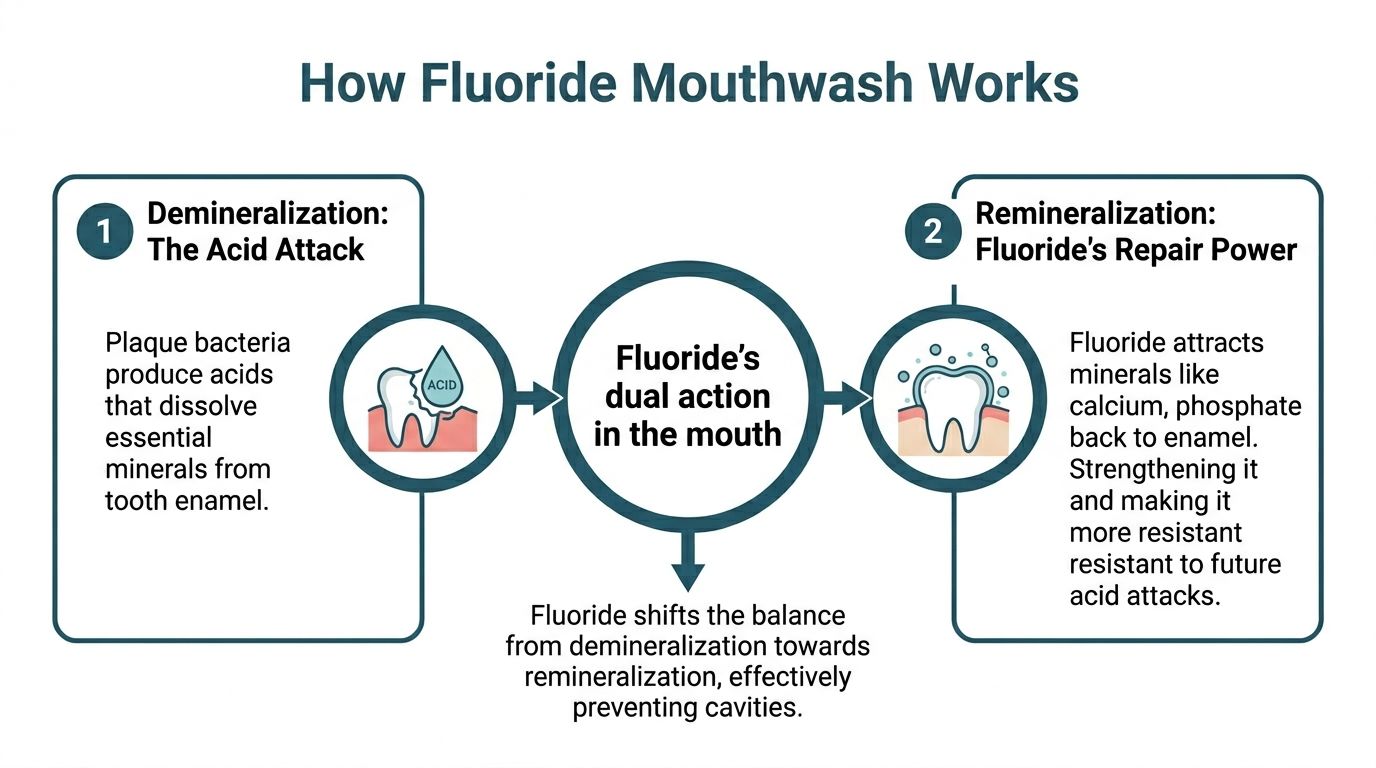
Your enamel is the outer layer that protects each tooth. Acid can pull minerals out of that layer a little at a time. Dentists call that demineralization.
This happens in normal daily life. Bacteria in plaque use sugars from snacks and drinks, then make acids. If those acid attacks happen often, especially with frequent sipping, grazing, or food trapped around braces, enamel does not get enough time to recover between them.
That is why some family members need more support than others. A teen with aligner attachments, a child with brackets and wires, or an adult who snacks often may have more places where plaque sits and acid lingers. The result is not immediate tooth decay. It starts as small areas of mineral loss that may still be repairable.
How fluoride helps teeth recover
Fluoride mouthwash supports the repair side of this cycle, called remineralization. After acids weaken enamel, fluoride helps minerals return to the tooth surface. The repaired surface becomes more resistant to future acid exposure.
It's like patching worn spots in a driveway before potholes form. The surface is still there, but it needs reinforcement while the damage is early and shallow.
Fluoride also keeps working in a practical way families can understand. It reaches around brackets, along the gumline, and into areas that are harder to clean well with a toothbrush alone. That added contact can be helpful for Ohio kids in orthodontic treatment, where plaque tends to collect in the same trouble spots day after day.
Research supports that benefit. A Cochrane review of 35 trials on fluoride mouthrinses found that regular, supervised use reduced decayed, missing, and filled tooth surfaces in permanent teeth.
Practical rule: Fluoride mouthwash helps repair early mineral loss. It cannot heal a cavity that has already progressed to the point of needing a filling.
Parents often ask whether mouthwash still helps if the family already uses fluoride toothpaste or drinks fluoridated water. The Cochrane review above noted benefits even in those settings, which means a rinse can add another layer of protection instead of repeating the same job.
That extra layer is often where personalized advice matters. At Amanda Family Dental, we help families sort out who may benefit most from a fluoride rinse, especially children with braces, teens with a history of cavities, and adults who need more protection than brushing alone provides.
Who Should Use Fluoride Mouthwash for Extra Protection
Not everyone needs the same home care routine. A child with braces has different risks than an adult with dry mouth, and a teen with several past cavities needs a different plan than someone who rarely gets decay.
Children and teens with braces or high cavity risk
This group often benefits the most from fluoride mouthwash for cavities. Brackets, wires, and aligner attachments can trap plaque and make brushing less effective around the gumline and between teeth. Even careful brushers can miss areas.
Evidence supports that extra protection. A study summary on sodium fluoride mouthwash in children and orthodontic care notes that fluoride mouthwash is highly recommended for children in orthodontics or those with high caries risk, and that programs using 0.2% sodium fluoride mouthwash reduced the DMFT index by as much as 51.5%.
Children also need age-appropriate guidance. Rinses are for kids who can reliably spit them out. Supervision matters, especially in younger school-age children, because mouthwash should be swished and spit, not swallowed.
A few examples of children who may need added support include:
- Kids with braces: Food and plaque collect around brackets and wires.
- Teens with frequent snacking: Repeated acid exposure gives enamel less time to recover.
- Children with a history of cavities: Past decay often signals the need for stronger prevention.
- Patients with dental anxiety: Extra home protection can help while a family works on building better consistency with office visits.
This short video gives a helpful visual overview of cavity prevention habits families can discuss with their dentist.
Adults who need more support than brushing alone
Adults often assume fluoride rinses are mostly for kids. That’s not the full picture. Many adults are good candidates too, especially when teeth face extra stress from daily habits or health conditions.
Common examples include people who have dry mouth, existing crowns, many past fillings, exposed root surfaces, or areas where plaque tends to collect. A rinse can also be helpful for adults wearing Invisalign or other orthodontic appliances, since any appliance can make hygiene more technique-sensitive.
Some patients brush faithfully and still keep getting cavities. In those cases, the issue often isn’t effort. It’s risk level.
For adults who prefer a more personalized plan, a dentist may recommend either an over-the-counter rinse or a stronger prescription option, depending on cavity history and current findings. The right choice depends on the person, not the label on the bottle.
Using Fluoride Mouthwash Correctly for Maximum Benefit
A common family scene in our Amanda office goes like this: a parent says everyone is brushing, everyone is using mouthwash, and someone still ends up with a new cavity. The missing piece is often not effort. It is timing and technique.
Fluoride rinse works a bit like putting a protective coat on wood. If it goes on clean teeth and stays in place for a while, it has time to do its job. If someone swishes for a few seconds and chases it with water, much of that benefit is washed away.
A simple routine that works
For many over-the-counter fluoride rinses, the directions are similar. Adults and children age 12 and older are often told to measure the recommended amount, swish for a full minute, spit it out, and wait before eating or drinking. The bottle matters here. Always follow the label and any instructions your dentist gives, especially if your child has braces, a high cavity rate, or a prescription-strength product.
A practical home routine usually looks like this:
- Brush first. Fluoride reaches teeth better after plaque and food are brushed away.
- Measure the rinse. Use the cap or dosing line instead of guessing.
- Swish long enough. A full minute feels longer than people expect, but that contact time matters.
- Spit it out. Do not swallow the rinse.
- Skip the water rinse. Let the fluoride stay on the teeth.
- Wait before snacks or drinks. Giving it time on the enamel helps the rinse do more work.
Families who want help with the timing can read our guide on when to use mouthwash after brushing.
Common mistakes that reduce the benefit
The biggest mistake is using fluoride mouthwash like it is only for fresh breath. A cosmetic rinse can be quick and casual. A fluoride rinse needs a little patience.
Children need special attention here. A child who cannot spit reliably is usually not ready for fluoride mouthwash at home. For kids with braces, the issue is different. They may be old enough to rinse, but they often miss the gumline and the areas around brackets where plaque collects. In those cases, parents may need to supervise, use a timer, and keep the routine tied to the same part of the day so it becomes automatic.
At Amanda Family Dental, we often tailor this advice to the family’s real routine in Amanda and nearby Ohio communities. A teen in orthodontic treatment, a parent with dry mouth, and a younger sibling with early enamel weak spots may all need different fluoride instructions, even in the same household.
Steady habits protect teeth better than occasional extra rinsing after candy, sports drinks, or a rough day of brushing.
Mouthwash vs Toothpaste vs Professional Fluoride Treatments
A lot of parents ask this in a very practical way: if everyone in the house is already brushing with fluoride toothpaste, does anyone really need fluoride mouthwash or an in-office treatment too?
Usually, these options are not substitutes for each other. They work at different times and in different ways. Toothpaste is the everyday base. Mouthwash adds another short fluoride contact after brushing. Professional treatment gives a stronger layer of protection for patients who need more help than home care can provide.
Comparing fluoride therapies for cavity prevention
The chart below shows how these options differ. The fluoride rinse concentration ranges are based on this product reference comparing over-the-counter and prescription neutral sodium fluoride rinses.
| Therapy Type | Fluoride Level | Frequency | Primary Role |
|---|---|---|---|
| Fluoride toothpaste | Lower-strength daily home fluoride | Daily | Cleans teeth and provides routine fluoride exposure during brushing |
| Over-the-counter fluoride mouthwash | About 100 to 200 ppm during rinsing | Often part of a regular home routine | Adds extra topical fluoride after brushing, especially for patients who need more protection |
| Prescription 0.2% neutral sodium fluoride rinse | About 900 to 2000 ppm during rinsing | Often weekly, based on the dentist’s instructions | Higher-strength support for high-risk patients and stronger remineralization help |
| Professional fluoride varnish | In-office fluoride treatment | At dental visits, based on risk | Gives concentrated professional protection, especially for children and high-risk patients |
How to choose the right role for each one
It helps to picture these as layers in a family routine.
Toothpaste is the steady daily layer. It does the brushing work and leaves fluoride behind. For many adults and children with low cavity risk, that may be enough when brushing habits are solid and dental visits stay on track.
Fluoride mouthwash is often the extra layer for families who need a little more support at home. That includes teens with braces who trap plaque around brackets, adults with dry mouth, and patients who are starting to show early weak spots in enamel. A rinse can reach around wires, back molars, and other places that are easy to miss with hurried brushing, but it still depends on good technique and regular use.
Professional fluoride treatment has a different job. It is selected after a dentist looks at the whole picture: recent cavities, enamel changes, orthodontic appliances, diet, saliva flow, and age. A child in Amanda may need varnish during high-risk years. A teen in orthodontic treatment may need both varnish and a home rinse. A parent with dry mouth from medication may need prescription fluoride instead of relying on a store-bought rinse.
That is why one family can have three different recommendations under one roof.
At Amanda Family Dental, we tailor fluoride plans to real life in Ohio households, not a one-size-fits-all checklist. If you are comparing providers and want a practice that explains prevention clearly, our guide to choosing the right family dentist for your preventive care needs can help.
The right combination depends on cavity history, age, braces, and how easy or hard it is for each person to keep plaque under control every day.
Partner with Your Amanda Dentist for Complete Cavity Prevention
Fluoride mouthwash helps. Daily brushing matters. Cleanings and exams matter too. The strongest cavity prevention plan brings those pieces together and adjusts them to the person, not just the product.

What comprehensive prevention looks like
A home rinse can support enamel, but it can’t spot a cavity forming between teeth or evaluate whether braces are creating plaque traps in the back. That’s where regular dental visits become essential.
The value of a complete approach is clear. When at-home fluoride use is combined with professional dental care like cleanings and sealants, cavity development can be reduced by 40% to 60%, according to this ADA patient resource on fluoride and preventive care.
That combination matters for families across Amanda, Lancaster, Circleville, and Carroll, Ohio because needs change over time. A child may need sealants and brushing help. A teen may need added support during orthodontic treatment. An adult may need closer monitoring around older dental work or dry mouth.
What patients can expect from ongoing dental care
A strong preventive relationship usually includes:
- New patient exams: A full look at current dental health and cavity risk.
- Digital x-rays when needed: These help find areas that can’t be seen during a visual exam alone.
- Personalized treatment planning: Some patients do well with standard home care. Others need a prescription-strength rinse or more frequent preventive visits.
- Support beyond prevention: If a cavity, broken tooth, or urgent problem does come up, patients may also need restorative treatment, cosmetic care, or even an emergency dentist visit.
Good prevention is personal. The right fluoride plan for a child with braces may not be the right plan for a parent with dry mouth or several older crowns.
People searching for a dentist near me, a dentist in Amanda, OH, or a dentist in Lancaster, OH, Circleville, OH, or Carroll, OH often want more than a one-time cleaning. They want a dental home that can guide routine care, answer questions clearly, and help prevent small issues from turning into bigger ones. Many patients start that search by learning more about how to choose the right local dentist for long-term care.
Amanda Family Dental provides family-centered preventive care for patients in Amanda, Lancaster, Circleville, and Carroll, Ohio. From new patient exams and dental x-rays to cleanings, fluoride guidance, restorative dentistry, cosmetic dentistry, tooth extraction, emergency dental services, and dental implants near me searches that need a trusted local answer, the team offers practical care built around comfort and long-term oral health. To schedule an appointment or request a consultation, visit Amanda Family Dental.