

A restless night can leave an adult wondering whether the problem is stress, aging, or a busy schedule. Loud snoring, morning headaches, dry mouth, daytime fatigue, and difficulty concentrating may point to something more specific, especially when a partner notices pauses in breathing. For patients searching for a dentist near me, a dentist in Amanda, OH, or sleep-focused dental care close to Lancaster, Circleville, or Carroll, the first step is understanding how the airway and the mouth work together.
Sleep apnea dental treatment gives qualified patients another path to discuss with a medical team. It doesn't replace a physician's diagnosis, and it isn't the right choice for every person. It can, however, connect screening, custom oral appliance therapy, and myofunctional therapy through a practical local care plan.
Table of Contents
- When the Bedroom Finally Goes Quiet
- What Sleep Apnea Is and Why a Dentist Cares
- The Dental Treatment Options Available Today
- Who Is a Good Candidate and What Results to Expect
- What Treatment Looks Like at Amanda Family Dental
- Common Worries and Misconceptions Addressed
- Your Next Step Toward Better Sleep in Amanda, OH
When the Bedroom Finally Goes Quiet
At 2:00 in the morning, an exhausted adult may lie awake listening to the uneven rhythm of a partner's snoring. The room is dark, the alarm is approaching, and another day already feels difficult before it begins. Morning headaches and brain fog have become familiar, while fatigue gets blamed on work, family responsibilities, or getting older.
Some patients spend years adapting. They drink more coffee, take short naps, or assume that restless sleep is just part of life. A partner may describe choking sounds or quiet pauses that the sleeper doesn't remember. The turning point often comes when the symptoms begin affecting concentration, mood, driving, or the ability to enjoy ordinary activities.
A dental office can be part of the answer
A dentist doesn't diagnose obstructive sleep apnea independently, but a dental visit can uncover clues that deserve medical attention. The shape of the jaw, tongue position, palate, bite, and visible airway structures can help identify a pattern worth discussing with a primary care provider or sleep physician.
Modern care has moved beyond the idea that sleep apnea belongs only in a sleep clinic. A joint guideline from the American Academy of Sleep Medicine and American Academy of Dental Sleep Medicine formalized custom, adjustable oral appliances as an option for adults with obstructive sleep apnea who can't tolerate CPAP or prefer another treatment. CPAP remains first-line because it generally improves oxygen saturation and reduces breathing events more effectively, but an oral appliance is recommended over no treatment for appropriate patients.
The quiet bedroom that patients want isn't achieved through guesswork. It begins with noticing the pattern, obtaining the right diagnosis, and choosing care that fits the person's health, anatomy, and ability to use the treatment consistently.
What Sleep Apnea Is and Why a Dentist Cares
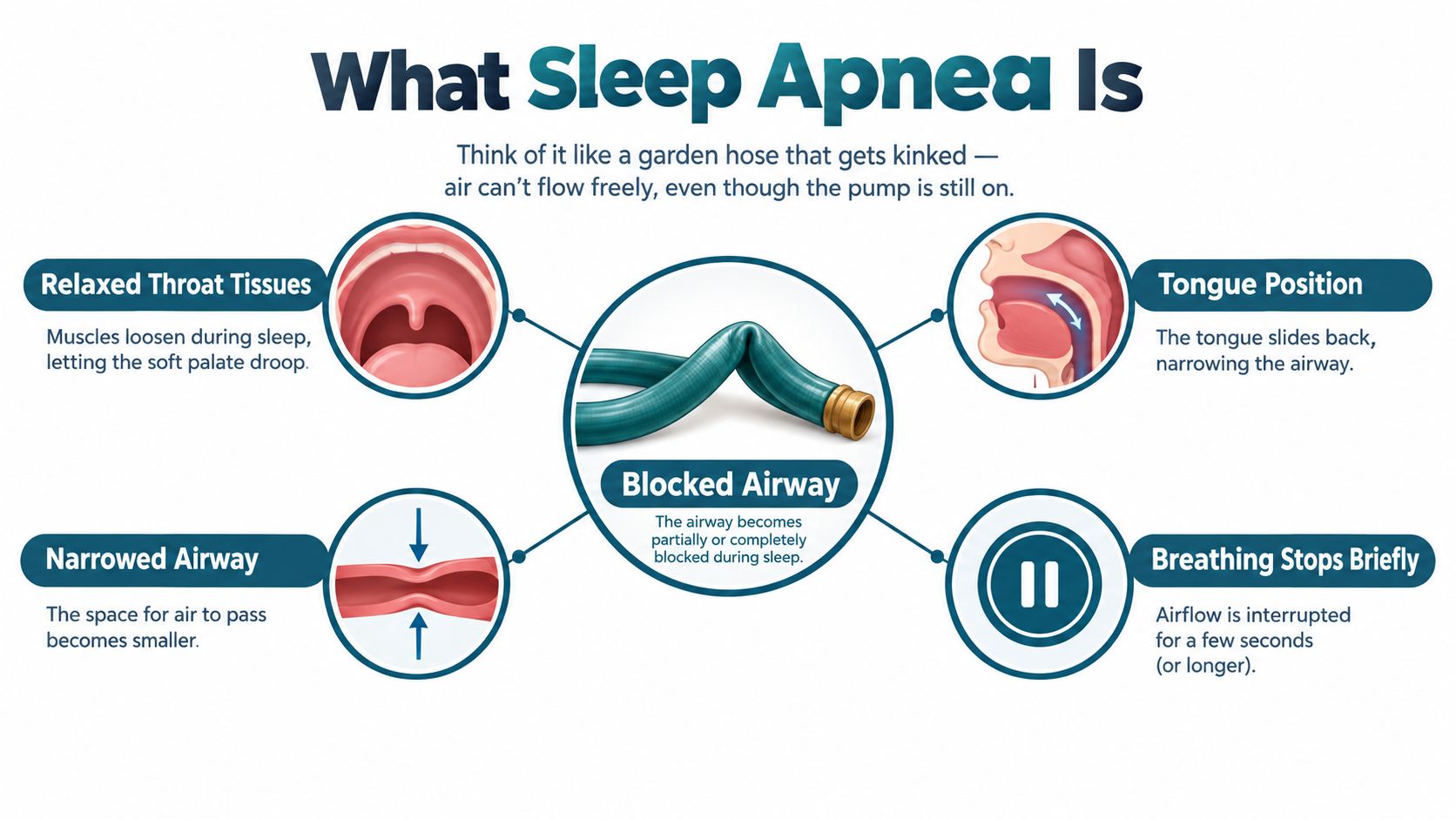
Obstructive sleep apnea occurs when the upper airway narrows or closes during sleep. A simple comparison is a garden hose with a kink in it. Water can't flow normally through the bent section, just as air struggles to pass when relaxed throat tissue, the tongue, and jaw position narrow the airway.
The person may continue trying to breathe, but airflow becomes restricted or briefly stops. The body can respond with a small awakening that restores muscle tone and breathing. Those interruptions may happen without the sleeper remembering them, yet they can fragment sleep and contribute to fatigue, headaches, and poor concentration.
Why oral anatomy matters
The tongue, soft palate, teeth, bite, and lower jaw all sit close to the airway. A dentist can examine how those structures relate to one another and can evaluate whether advancing the lower jaw might create more room behind the tongue. That structural perspective is one reason dental sleep medicine has become part of coordinated airway care.
The historical roots reach back well before current sleep clinics. Pierre Robin used a mandibular repositioning approach in 1923, and reviews describe the first modern oral appliances for obstructive sleep apnea emerging in 1982 and 1983. The field later developed into custom devices made from dental impressions or digital scans and adjusted for overnight use, as described in the history of dental sleep medicine.
Screening is not the same as diagnosis
A dental team may ask about snoring, witnessed breathing pauses, morning symptoms, sleep position, and daytime alertness. The findings can support a referral, but a sleep physician must determine whether obstructive sleep apnea is present and how severe it is. A home sleep test or laboratory study may provide the objective information needed for treatment planning.
Sleep habits also matter. Patients who are beginning to examine nighttime breathing may find practical background in this guide to improve sleep quality naturally, while understanding that lifestyle steps aren't a substitute for an evaluation when sleep apnea is suspected.
The Dental Treatment Options Available Today
Dental care offers a toolkit rather than one universal mouthpiece. The most established option is a custom-made, titratable mandibular advancement device, or MAD. It fits over the teeth and gradually holds the lower jaw forward, helping enlarge the space behind the tongue and reduce airway collapse.
A tongue-stabilizing device takes a different route. Instead of moving the jaw, it uses gentle suction or positioning to hold the tongue farther forward. It may be considered when jaw advancement isn't suitable, although comfort, dental anatomy, and retention must be assessed carefully.
Myofunctional therapy focuses on training. Exercises can help patients develop better tongue posture and strengthen or coordinate muscles involved in breathing and swallowing. It may complement an oral appliance, particularly when the tongue rests low or airway muscle control needs attention. The approach isn't a replacement for medical diagnosis or objective testing.
| Treatment | How It Works | Best For | Key Consideration |
|---|---|---|---|
| Custom mandibular advancement device | Holds the lower jaw forward during sleep | Adults with appropriate dental support, especially those with mild-to-moderate OSA or CPAP intolerance | Requires professional fitting, gradual adjustment, and efficacy testing |
| Tongue-stabilizing device | Holds the tongue forward to help keep the airway open | Selected patients who may not tolerate jaw advancement | Fit and comfort vary, and dental evaluation remains important |
| Myofunctional therapy | Trains tongue posture and airway muscle function | Patients with oral-motor or tongue-posture concerns, often as part of combined care | Progress depends on participation and should be coordinated with the medical plan |
| CPAP | Uses positive airway pressure to keep the airway open | Patients who need the most reliable reduction in breathing events or have significant disease | It remains first-line, though some patients struggle with comfort or regular use |
A custom oral appliance for sleep apnea should be distinguished from a generic sports guard or an over-the-counter snoring device. Custom, adjustable appliances are preferred because the dentist can control the jaw position and monitor dental effects.
Patients can also review sleep apnea options besides CPAP before discussing the choices with a physician and dental provider. The central question isn't which treatment sounds simplest. It's which option addresses the breathing problem and can be used consistently.
Who Is a Good Candidate and What Results to Expect
The strongest candidate for dental treatment is usually an adult with mild-to-moderate obstructive sleep apnea, suitable teeth and jaw structure, and a reason to avoid or supplement CPAP. A custom MAD can also be considered for severe disease when positive airway pressure isn't tolerated, but that decision requires close medical coordination.
An oral appliance may deserve discussion when a sleep physician identifies positional obstruction, a lower jaw that sits farther back, a large tongue, or a high-arched palate. Persistent snoring after broader health changes may also prompt screening, but snoring alone doesn't establish a diagnosis.
Results vary by anatomy and follow-through
A weighted meta-analysis reported an average AHI reduction of 13.60 events per hour with an oral appliance compared with no appliance in the reviewed evidence, while another trial-level analysis reported an AHI reduction of about 9.3 events per hour with MAD treatment compared with 25.4 events per hour with CPAP. These findings, summarized in an evidence review of oral appliance therapy, explain both the value and the limitation of dental treatment. Oral appliances can help substantially, but CPAP generally lowers AHI more.
Patients shouldn't judge success by quieter snoring alone. A follow-up sleep study checks whether breathing events and oxygen problems have improved, rather than relying only on how rested someone feels.
| Patient Profile | Apnea Severity | Typical Response | Notes |
|---|---|---|---|
| Appropriate dental anatomy with consistent appliance use | Mild to moderate | Often a meaningful reduction in events and symptoms | Custom titration and objective follow-up remain important |
| CPAP intolerance with a medically appropriate alternative plan | Any severity, with extra caution in severe disease | May gain a usable treatment pathway | The sleep physician should remain involved |
| Partial responder | Mild, moderate, or selected severe cases | Some improvement but residual obstruction | Combination care, further adjustment, or another treatment may be needed |
| Poor dental support or inadequate response | Any severity | Limited benefit from an appliance | CPAP or another medical or surgical approach may be more appropriate |
The evidence also shows why adherence can't be assumed. One prospective study reported 49% adherence at three months and 44% at twelve months, with discontinuation common among non-adherent users, as reported in this recent dental sleep medicine study. Regular monitoring gives patients a chance to address comfort, bite changes, and maintenance before small problems become reasons to stop.
What Treatment Looks Like at Amanda Family Dental
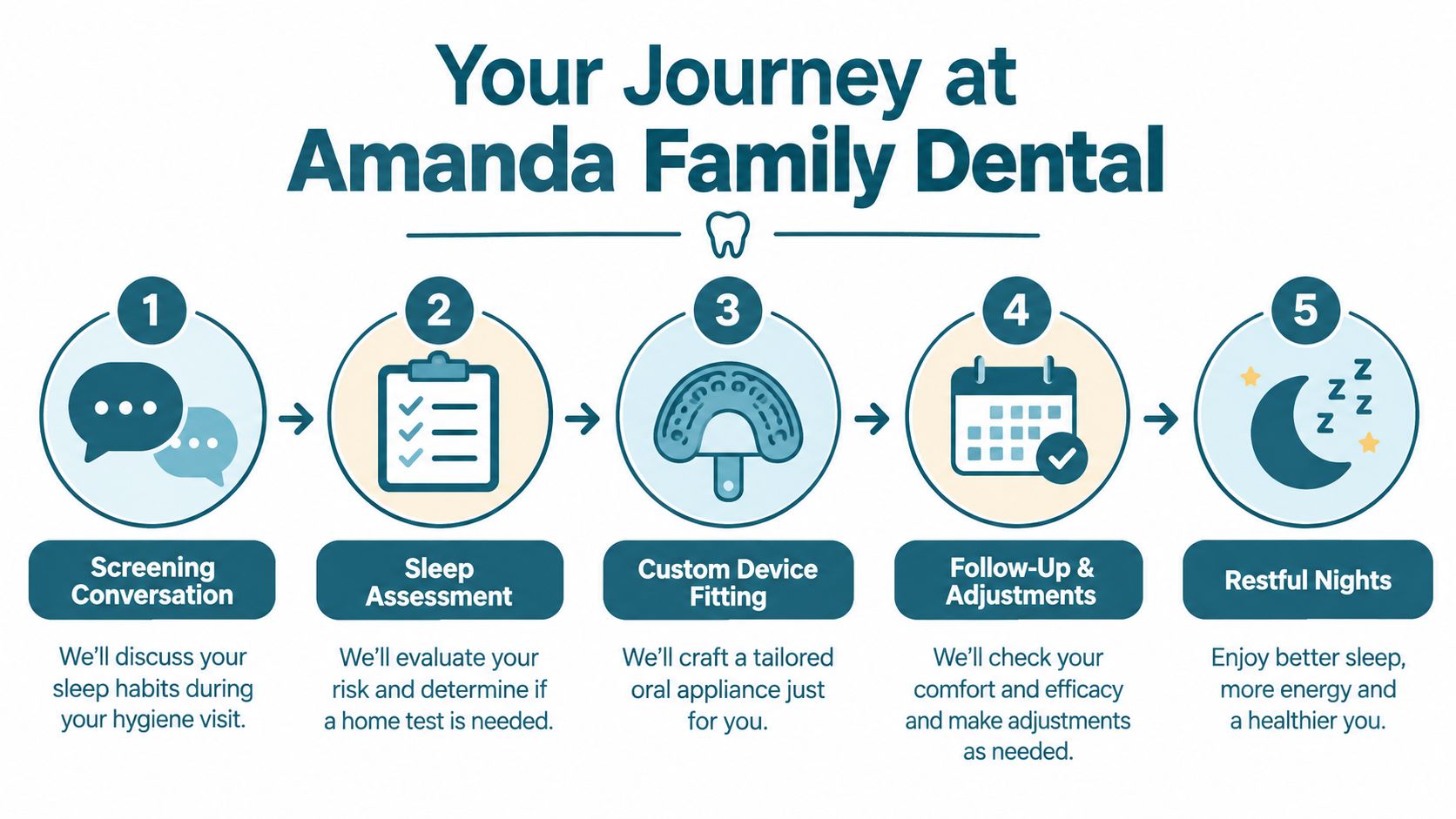
At Amanda Family Dental, the process can begin during a routine hygiene visit when a patient mentions snoring, morning headaches, or persistent tiredness. The dental team can discuss sleep habits, examine oral structures, and identify whether a sleep evaluation deserves attention. The office serves patients seeking dental care in Amanda, Lancaster, Circleville, and Carroll, Ohio, including families searching for a dentist in Amanda, OH or nearby sleep-focused care.
A coordinated path from screening to fitting
A typical care path may include these stages:
Screening conversation: A hygienist or dentist asks about symptoms, partner observations, sleep position, and daytime fatigue. This conversation doesn't diagnose apnea, but it can identify a reason for referral.
Medical sleep assessment: A sleep physician or primary care provider determines whether a home sleep test or other evaluation is appropriate. The diagnosis and severity guide the dental decision.
Digital records: If an oral appliance is selected, the office can collect dental impressions or digital bite scans. The laboratory uses those records to fabricate a device designed for the patient's mouth.
Fitting and calibration: The appliance is checked for retention and comfort. Jaw advancement is adjusted gradually rather than forced into a position that causes unnecessary strain.
Follow-up: A practical plan may include check-ins around two weeks, thirty days, and ninety days, with adjustments based on comfort and symptoms. A post-treatment home sleep test can help verify the actual change in breathing events.
Therapy can address more than the appliance
Some patients need attention to tongue posture, swallowing patterns, or airway muscle coordination. In those cases, myofunctional therapy for sleep apnea may be included alongside appliance care rather than treated as a separate issue.
The office can also coordinate records with the patient's physician, communicate with the local laboratory partner, and review insurance pre-authorization before fabrication when applicable. Digital X-rays, new patient exams, and a personalized plan help connect sleep concerns with overall dental health. Patients who also need restorative dentistry, tooth extraction, dental implants, or emergency dental services can discuss those needs during the same broader care process.
A short fitting visit should still feel unhurried. Patients in Amanda, Lancaster, Circleville, and Carroll deserve clear answers about what the appliance does, how it should be cleaned, what changes to report, and when follow-up testing matters.
Common Worries and Misconceptions Addressed
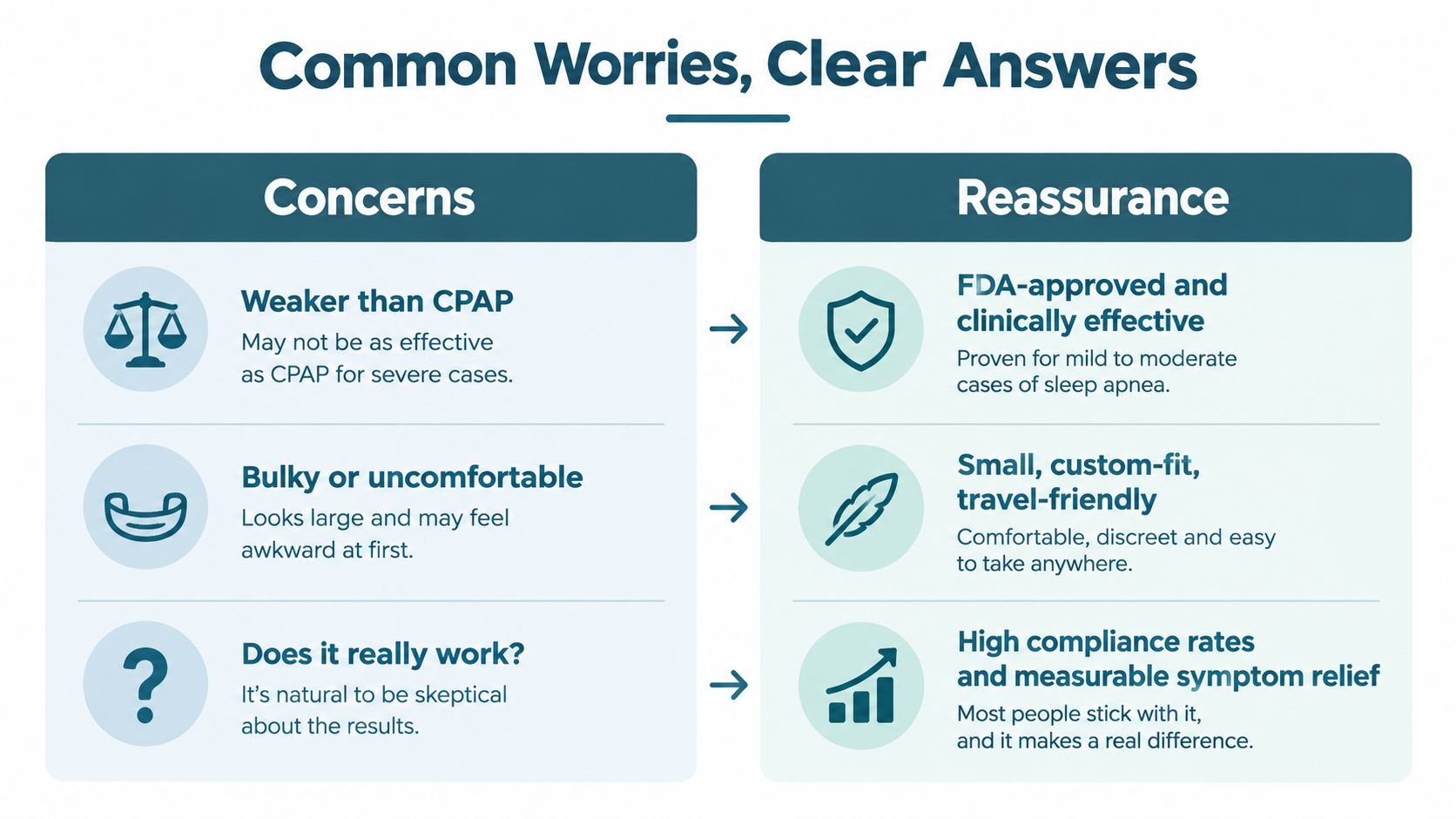
The first concern is often that an oral appliance is a weaker version of CPAP. The more accurate answer is that the treatments work differently. CPAP generally produces a greater reduction in AHI and remains first-line, while a custom appliance can be an appropriate alternative for selected adults who can't tolerate CPAP or prefer another medically reviewed option. Evidence reviews also report that oral appliances can produce similar improvements in daytime sleepiness and quality of life for selected patients, even when CPAP controls breathing events more strongly, as explained in this systematic review and guideline evidence summary.
Another worry is that a dentist will diagnose sleep apnea without a physician. That isn't the collaborative model. A dental team screens and evaluates oral structures, the medical team establishes the diagnosis, and both sides can use follow-up testing to judge whether treatment is working.
Comfort and long-term use
Jaw soreness, tooth pressure, bite changes, or temporomandibular joint symptoms deserve attention rather than dismissal. Gradual titration, morning jaw exercises, a morning repositioner when appropriate, and regular dental monitoring can help identify problems early. Patients should report discomfort promptly instead of silently reducing wear time.
Cost questions also deserve a direct conversation. Insurance coverage, pre-authorization, durable medical equipment rules, appliance fees, follow-up visits, and replacement policies vary. The office can explain the expected process before treatment begins rather than leaving patients to interpret a complicated bill after fabrication.
Practical rule: A quieter night is encouraging, but objective follow-up is what confirms whether the airway has improved.
Snoring shouldn't automatically be treated as harmless, especially when it occurs with witnessed pauses, gasping, headaches, or daytime sleepiness. The FDA-cleared ApnoDent appliance is intended for adults 18 years of age or older with nighttime snoring and/or mild-to-moderate obstructive sleep apnea, according to its FDA clearance documentation. That clearance illustrates why age and disease severity matter when selecting a device.
Your Next Step Toward Better Sleep in Amanda, OH
The adult who finally seeks help after years of restless nights doesn't need to solve the entire problem in one appointment. A reasonable path starts with a conversation, continues with medical assessment, and then uses dental findings to determine whether an oral appliance, myofunctional therapy, CPAP, or combined care makes sense.
Three practical actions
Schedule a sleep and airway consultation. Patients can bring a partner's observations, a list of morning symptoms, and any record of previous sleep testing. A dentist can review the mouth, jaw, tongue posture, and existing dental needs while explaining whether a physician referral is appropriate.
Complete the requested evaluation. A home sleep test or sleep physician referral provides information that a dental examination can't provide alone. The result helps distinguish simple snoring from obstructive sleep apnea and clarifies whether an oral appliance is medically suitable.
Commit to the follow-up plan. Appliance therapy isn't a one-time purchase followed by guesswork. Patients may need adjustments, comfort checks, dental monitoring, and a post-treatment sleep test during the first thirty to ninety days. The process also gives the care team a chance to change direction if the response isn't adequate.
Patients searching for a sleep apnea dentist near me can ask about appointment availability, insurance pre-authorization, billing, and whether digital records are used. Bringing a medication list, previous sleep reports, physician contact information, and a description of nightly symptoms can make the first visit more productive.
The same office may also help patients address routine cleaning and exams, dental X-rays, tooth pain, missing teeth, cosmetic concerns, or urgent dental problems. Someone looking for dental implants near me, a cosmetic dentist near me, a tooth extraction, or an emergency dentist can raise those concerns while building a complete oral health plan. Sleep health and dental health often overlap through the bite, jaw, airway, and daily comfort.
Better sleep is a realistic goal, but the right treatment depends on diagnosis, anatomy, medical history, and consistent follow-through. A screening conversation in Amanda can lead to coordinated care with sleep physicians and primary care providers serving patients from Lancaster, Circleville, and Carroll, without requiring patients to manage every step alone.
Amanda Family Dental offers sleep and airway screening, custom oral appliance therapy, myofunctional therapy, and coordinated follow-up for patients with sleep concerns in Amanda and nearby Ohio communities. Patients can visit Amanda Family Dental to request an appointment, ask about a consultation, or begin a conversation about more restful nights.