

A knocked-out permanent tooth is a dental emergency: pick it up by the crown, keep it moist, and call a dentist immediately, ideally within 30 minutes. A child who has just fallen, bumped a front tooth, or started bleeding from the mouth also needs a careful check, even when nothing looks badly broken.
For families seeking an emergency dentist in Amanda, OH, the first decision is whether the child needs immediate medical help, urgent dental treatment, or a prompt assessment of a seemingly minor injury. Amanda Family Dental serves families in Amanda, Lancaster, Circleville, and Carroll, Ohio, with emergency evaluation and ongoing dental care. The guide below helps parents act calmly while leaving the final treatment decision to a dentist.
Table of Contents
- Sort the Injury and Know How Fast to Act
- How to Save a Knocked-Out Permanent Tooth
- How Dentists Diagnose and Treat Dental Trauma
- Prevention and Follow-Up Visits Over the Years
- Book a Trauma Exam at Amanda Family Dental
Sort the Injury and Know How Fast to Act
Dental injuries are common enough that every caregiver benefits from knowing the first steps. The IADT introduction to dental trauma guidelines states that traumatic dental injuries account for approximately 5% of all injuries, affect about 25% of schoolchildren, and occur mostly before age 19.
The injury pattern matters. Baby teeth are more often loosened or displaced, while permanent teeth more often sustain crown fractures. Trauma to a baby tooth can also affect the permanent tooth developing beneath it, so a tooth that will eventually fall out still deserves attention.
A One-Minute Injury Triage Chart for Parents
Start by checking whether the child is alert, breathing normally, and able to swallow. Trouble breathing, loss of consciousness, suspected head or jaw injury, or uncontrolled bleeding takes priority over dental treatment and requires emergency medical help.
| Injury | First action at home | How fast to call |
|---|---|---|
| Knocked-out permanent tooth | Pick up by the crown, rinse gently if dirty, and reinsert when safe or keep moist in milk | Immediately, ideally within 30 minutes |
| Knocked-out baby tooth | Never reinsert it; apply a cold compress outside the lip | Same day |
| Loose, pushed-in, or pushed-out tooth | Don't wiggle or reposition it; offer soft foods and cool liquids if the child can swallow comfortably | Same day |
| Chipped or cracked tooth, no pain | Save any fragment in milk and gently rinse the mouth | Within 24 hours |
| Bleeding lip or gums | Press clean gauze firmly for 10 minutes without repeatedly lifting it | Same day if bleeding continues after 15 to 20 minutes; uncontrolled bleeding needs immediate medical care |
| Tooth missing and not found | Look around the injury site and visually check the lips and cheeks; don't probe the throat or ask the child to swallow | Immediately, including medical evaluation if it cannot be located |
These are call priorities, not permission to wait when symptoms worsen. A child with facial swelling, fever, severe pain, a changed bite, or difficulty closing the mouth needs urgent advice even if the original injury seemed small.
A missing tooth deserves particular caution. It may be pushed into the gum, trapped in soft tissue, swallowed, or inhaled. Parents shouldn't assume that an empty-looking space means the tooth fell onto the ground.
Why Small Injuries Are Easy to Miss
In a 2026 study of 575 preschool children, 44.5% of caregivers failed to recognize that dental trauma had occurred. Visible fractures, exposed inner tooth tissue, discoloration, and effects on daily life made recognition more likely.
That finding has a practical consequence: recognition matters as much as first aid. Gum bleeding around an otherwise intact tooth, new looseness, or a child suddenly avoiding a front tooth can signal an injury that needs evaluation.
A painless chip isn't necessarily harmless. The dentist must check whether the impact also damaged the root, supporting tissues, or nearby teeth. A guide to a temporary fix for a broken tooth can help with short-term protection, but household glue, filing, and home repairs aren't substitutes for an examination.
Practical rule: A tooth that looks intact can still be injured. Changes in position, bite, comfort, or gum appearance deserve a call.
Keep the Child Comfortable Without Hiding the Problem
Clean visible dirt gently with water or saline. Avoid vigorous rinsing while the area is actively bleeding, and don't keep pulling the lip back to inspect a wound. A wrapped cold compress against the outside of the face can help with discomfort.
If the child is alert and swallowing normally, soft foods are reasonable unless the dental team advises otherwise. Avoid biting directly on the injured area, and ask about an age-appropriate pain reliever based on the child's weight, medical history, and current medicines. Aspirin shouldn't be placed against the tooth or gum.
Before calling, note when and how the injury happened, whether the bite changed, and whether any tooth or fragment is missing. A clear photograph can help the team triage the problem, but taking pictures shouldn't delay urgent care. When the injury is unclear, calling the office is reasonable.
How to Save a Knocked-Out Permanent Tooth
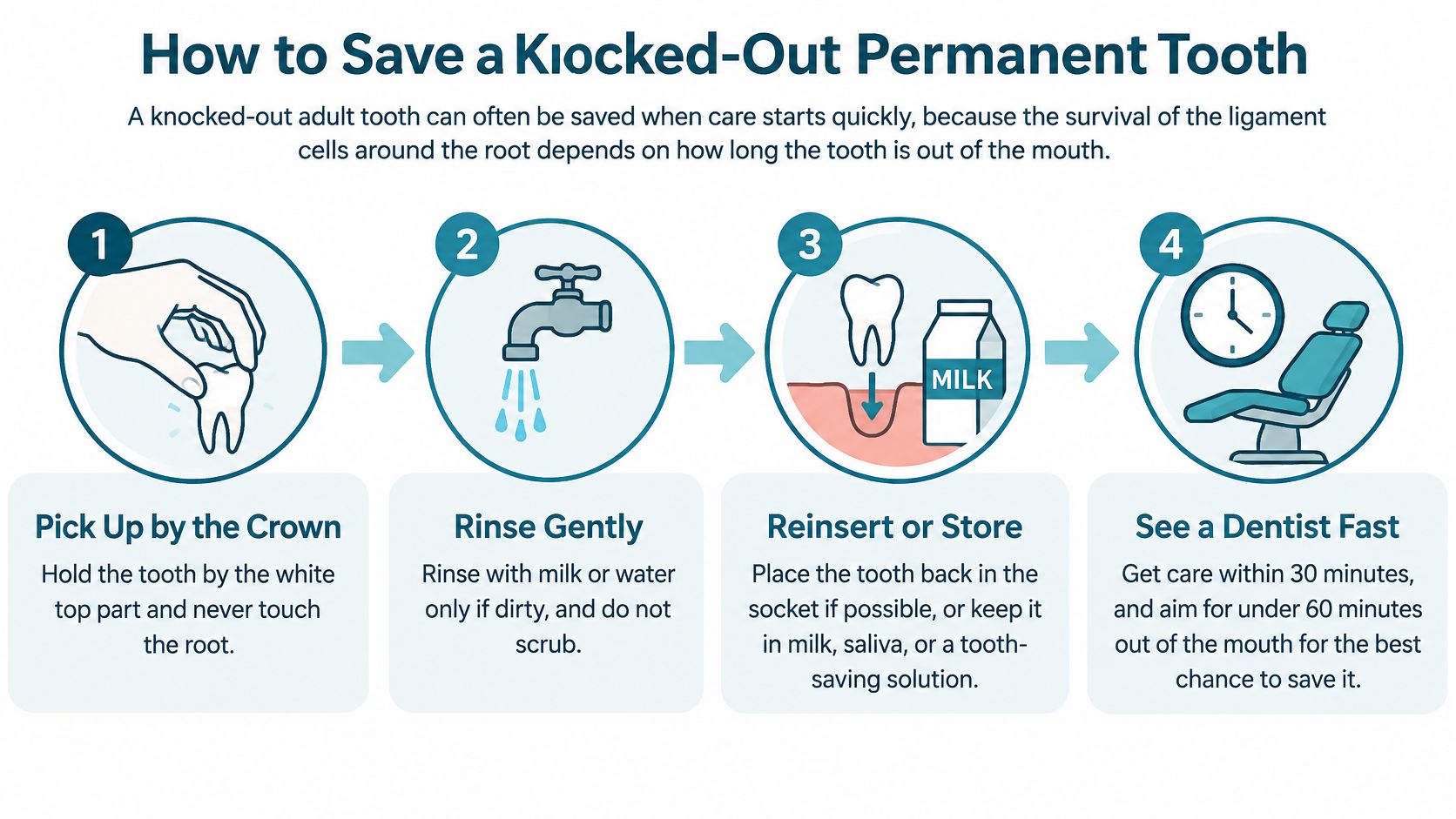
A knocked-out adult tooth can sometimes be saved when care starts quickly. The living ligament cells on its root are vulnerable to drying and handling, which is why the AAPD guidance on traumatic dental injuries emphasizes prompt replantation when feasible and suitable moist storage otherwise.
The rescue sequence focuses on protecting those cells while arranging professional treatment.
Protect the Root and Arrange Care
Confirm that it's a permanent tooth. Don't rely on color or size alone, especially when a child has a mixture of baby and adult teeth. If there's uncertainty, keep the tooth moist and get immediate telephone guidance before attempting replantation.
Hold only the crown. That's the part normally visible above the gum. Touching or rubbing the root can damage tissue needed for healing.
Rinse gently if it's dirty. Use milk or saline to remove visible contamination without scrubbing. Don't scrape away attached tissue or use soap, alcohol, or disinfectant.
Reinsert only when it's safe and feasible. For an alert, cooperative child with a confirmed permanent tooth, gently slide it into the socket in the correct orientation without forcing it. Have the child bite gently on clean gauze to hold it, and stop if placement isn't straightforward.
Use moist storage if replantation isn't possible. Place the tooth in milk, saline, or a tooth-preservation solution containing Hanks' Balanced Salt Solution. A container is safer than carrying a loose tooth in a young child's mouth, where it could be swallowed or inhaled.
Call immediately and leave for urgent dental care. Mild pain doesn't make the injury less urgent. Tell the team whether the tooth was dry, stored in liquid, or replanted, because those details influence treatment.
Don't wrap the tooth in a dry tissue or wait until the next morning to see whether the child feels better.
What Happens After Replantation
The dentist checks the socket, associated injuries, and tooth position before deciding on stabilization. A replanted permanent tooth commonly needs a flexible splint, often for about two weeks, although associated bone injuries can change the plan.
Medication decisions are injury-specific. Antibiotics aren't routinely indicated for uncomplicated displacement injuries or certain fractures, but a replanted tooth needs its own assessment. Parents shouldn't start leftover antibiotics or assume that every dental injury receives the same prescription.
The accompanying video offers another way to review emergency handling.
How Dentists Diagnose and Treat Dental Trauma
A trauma examination starts with the accident history and a check for injuries beyond the tooth. The dentist then assesses mobility, color, tenderness, displacement, bite changes, and the lips and gums. The IADT guidance for injuries in primary teeth recommends this broader assessment rather than judging the injury by visible breakage alone.
Digital dental x-rays may help identify root fractures, tooth displacement, and the stage of permanent-root development. Imaging is selected when it can inform care, with radiation exposure kept as low as reasonably achievable. A simple nerve-response test isn't reliable enough in baby teeth to determine treatment on its own.
Common Trauma Treatments and When They Are Used
| Treatment | Typical injury | What it involves |
|---|---|---|
| Monitoring with recheck visits | Mild displacement or selected baby-tooth injuries | Examination and clinically indicated x-rays at scheduled intervals |
| Tooth-colored bonding or composite filling | Small chip or enamel fracture | A restoration shaped and hardened, often in one visit |
| Splinting | Loose or replanted permanent tooth | A flexible support; duration follows the injury and healing needs |
| Crown | Large fracture of a permanent tooth | A protective cap, sometimes completed at a later visit |
| Root canal therapy | Pulp damage or infection after trauma | Damaged or infected inner tissue removed, with canals cleaned and sealed |
| Extraction | Severely damaged or infected baby tooth | Removal with consideration of the developing permanent tooth and future spacing |
More treatment isn't always better. Some immature permanent teeth pushed into the gum can reposition naturally under close supervision. The AAPD guidance on fractures and luxation injuries supports considering spontaneous repositioning in immature teeth rather than automatically forcing them back into place.
Conversely, observation isn't appropriate for every injury. Infection, unstable displacement, damage affecting the bite, or a non-restorable tooth can require active treatment. For a young permanent tooth, protecting living pulp and continued root development may also affect the choice of procedure.
A Personalized Plan Rather Than a Standard Repair
Amanda Family Dental provides pediatric dental exams, digital x-rays, composite fillings, crowns, and root canal care, with same-day appointments when available. The team can explain which care addresses immediate pain and which restorative dentistry can wait until the tooth's outlook is clearer.
Parents should receive an explanation of the options, expected timing, costs, and available payment arrangements before treatment begins. Small chips may suit bonding, while larger fractures need stronger protection; tooth extraction is reserved for situations where preservation isn't appropriate.
Treatment aims to restore comfortable chewing, speech, and appearance while protecting oral health. A finished repair doesn't automatically mean treatment is complete, since complications can emerge after early symptoms settle.
Prevention and Follow-Up Visits Over the Years
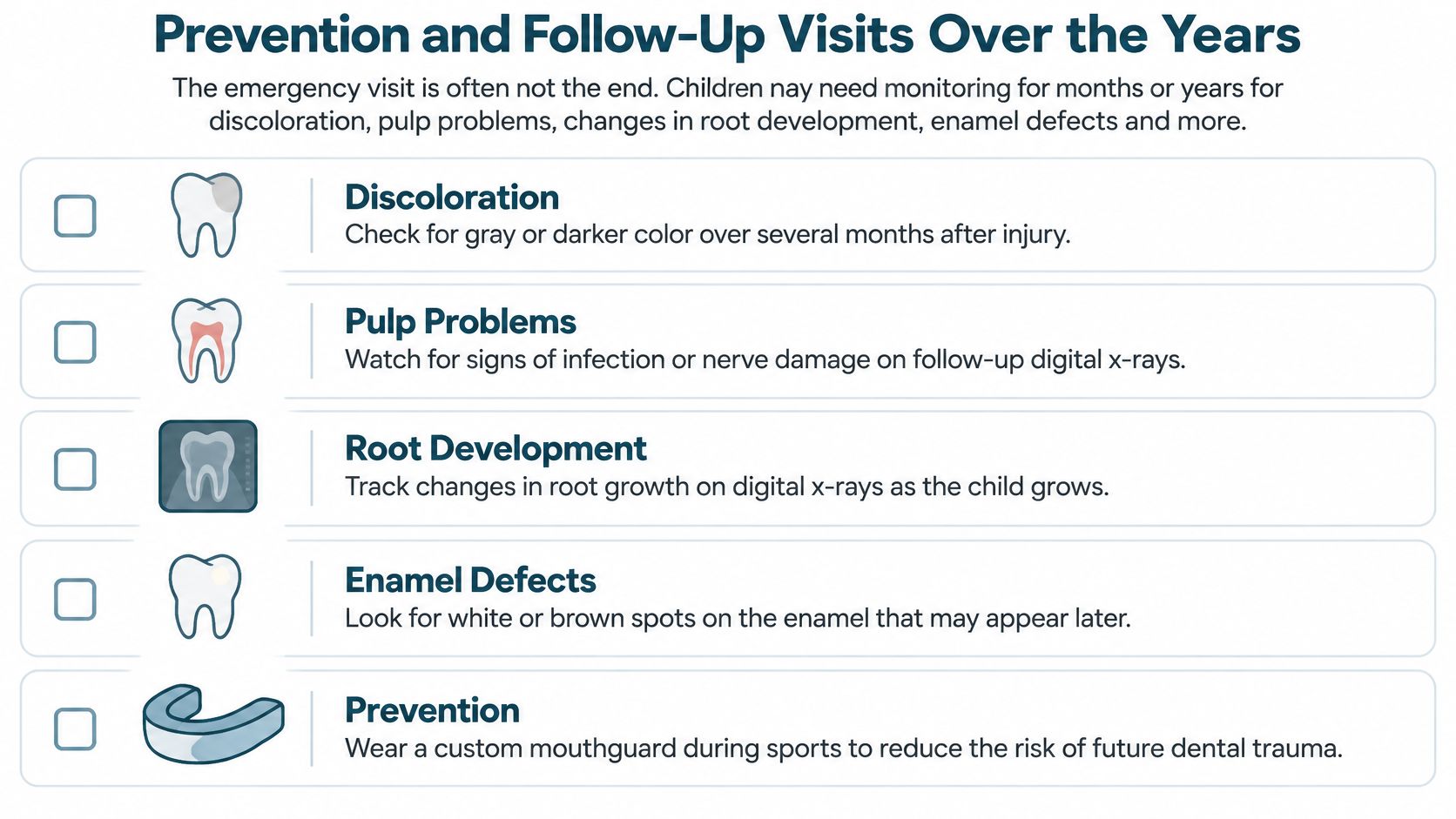
The emergency appointment is often the beginning of care, not the end. Depending on the injury, a child may need monitoring over months or years for discoloration, pulp problems, altered root development, enamel defects, or changes in appearance. After trauma to a baby tooth, the dentist also considers the development of its permanent successor.
Emotional recovery deserves attention without assuming every child will become fearful. A review of pediatric dental trauma and quality-of-life literature describes uneven evidence and notes that injured children don't consistently show greater dental anxiety than their uninjured peers. Repeated procedures, severe pain, visible front-tooth damage, and earlier difficult dental experiences are reasons to discuss extra behavioral support.
Match Prevention to the Child's Activities
- Toddlers at home: Use stair gates, cushion sharp furniture edges, and supervise climbing around hard surfaces.
- Children at playgrounds: Check landing surfaces and keep play appropriate to the child's coordination and abilities.
- Bike and scooter riders: Require a properly fitted helmet, while recognizing that helmets don't replace dental protection.
- Children in contact sports: Use a well-fitting mouthguard and have its fit reassessed as teeth erupt and the child grows.
Routine children's dental health care provides opportunities to review protective equipment, hygiene around injured teeth, and changes in the bite. Scheduled trauma reviews serve a different purpose from ordinary cleanings and exams and shouldn't be skipped because a tooth feels normal.
This checklist highlights issues the dental team may track.
Changes That Need an Earlier Call
- New gray or dark color: Report it promptly; color alone doesn't establish that a tooth needs treatment.
- Swelling or a gum bump: Request urgent assessment for possible infection.
- Pain when biting: Avoid loading the tooth and contact the office.
- Bad taste, drainage, or fever: Seek prompt advice rather than waiting for the scheduled review.
Follow-up reminder: New symptoms change the plan. Parents shouldn't wait for a routine appointment when swelling, drainage, or increasing pain develops.
Book a Trauma Exam at Amanda Family Dental
Families searching for a dentist near me after a child's accident need clear directions and a realistic appointment plan. Amanda Family Dental is a locally owned family practice serving Amanda, Lancaster, Circleville, and Carroll, Ohio, from first childhood visits through emergency and restorative care.
Pediatric dentistry, new patient exams, digital x-rays, composite fillings, crowns, and root canals are available under one roof. Same-day care is offered when available, so calling first helps the team assess urgency and provide directions rather than leaving parents to guess whether an injury can wait.
Have These Details Ready When Calling
- The injury timeline: When it happened, what caused it, and whether the child received medical care.
- The current symptoms: Bleeding, swelling, pain, looseness, or a changed bite.
- Photos and fragments: A photograph if readily available and any recovered fragment stored in milk.
- Medical information: Health conditions, allergies, and current medicines.
A comfortable, patient-focused visit includes explanations the child can understand and a personalized plan for the parent. The immediate priority is stabilizing the injury and relieving discomfort, not rushing into cosmetic treatment. Questions about future appearance or replacement options can be addressed once the dentist understands the tooth's condition.
If the office is closed and the child has uncontrolled bleeding, a suspected head or jaw injury, or a tooth that cannot be located, go to the nearest emergency department first. Call the office the next business day to coordinate dental follow-up. A knocked-out permanent tooth still requires immediate emergency dental help rather than waiting for regular hours.
Parents don't need to identify the exact injury before asking for help. Call the office today, describe what happened, and ask about the appropriate trauma appointment.
Amanda Family Dental offers pediatric trauma evaluations, digital x-rays when indicated, and treatment planning for injured teeth. Visit Amanda Family Dental for practice information, then call the office today to schedule an appointment or request a consultation and share questions about the child's injury before the visit.