

A child wakes with tooth pain, avoids breakfast, or starts covering a smile in photos. Other parents are searching for a dentist near me, a dentist in Amanda, OH, or a family practice serving Lancaster, Circleville, and Carroll because they want answers before a small concern becomes an emergency. A pediatric dental exam gives families that starting point. At Amanda Family Dental, children can receive age-appropriate evaluation, prevention guidance, and a plan that supports comfortable eating, speaking, smiling, and growing.
Table of Contents
- Understanding the Pediatric Dental Exam
- What Happens During Your Child's Visit
- Essential Preventive Treatments for Growing Smiles
- Preparing Your Child for a Stress-Free Experience
- Navigating Dental X-Rays and Digital Screening
- The Long-Term Benefits of Early Dental Care
- Schedule Your Child's Appointment Today
Understanding the Pediatric Dental Exam
A pediatric dental exam is more than cleaning and checking for cavities. The dentist evaluates tooth eruption, developing dentition, the bite, gums, oral hygiene, feeding practices, fluoride exposure, and early signs of decay. The appointment also gives caregivers practical guidance about brushing, diet, bottle or breastfeeding habits, and injury prevention.
The American Academy of Pediatric Dentistry recommends that a child's first examination occur when the first tooth erupts and no later than 12 months of age. This age-one visit establishes a preventive baseline and helps the dental team identify risks before disease becomes extensive. Families can review the professional guidance in the AAPD periodicity recommendations.
Why baby teeth deserve attention
Waiting until permanent teeth appear misses important opportunities. CDC data indicate that approximately 23% of children ages 2 to 5 have experienced decay in primary teeth, and approximately 37% of children ages 2 to 8 have experienced decay in primary teeth, according to national CDC data on dental caries in children. Among children ages 6 to 8, reported prevalence rises to approximately 56%.
Baby teeth help children chew and speak, maintain space, and become familiar with daily oral care. A cavity in a primary tooth can cause discomfort or infection before the tooth is ready to fall out. Early assessment lets the dentist distinguish between healthy development, a concern that needs monitoring, and a problem that deserves treatment.
Practical rule: The first dental visit shouldn't wait for pain, visible decay, or the arrival of permanent teeth.
What the appointment is designed to accomplish
The exam creates a dental home where changes can be compared over time. Some children need routine observation and coaching. Others may benefit from fluoride varnish, sealants, minimally invasive caries management, a filling, or referral for additional care.
Families who want a broader record of a child's symptoms, medications, and health history may find PatientNotes for dental practices useful when preparing information for a dental team. Parents can also explore children's dental health guidance before the appointment.
For families looking for a dentist in Amanda, OH, the most valuable result isn't automatically a procedure. It's a clear understanding of the child's current oral health and the next sensible step.
What Happens During Your Child's Visit
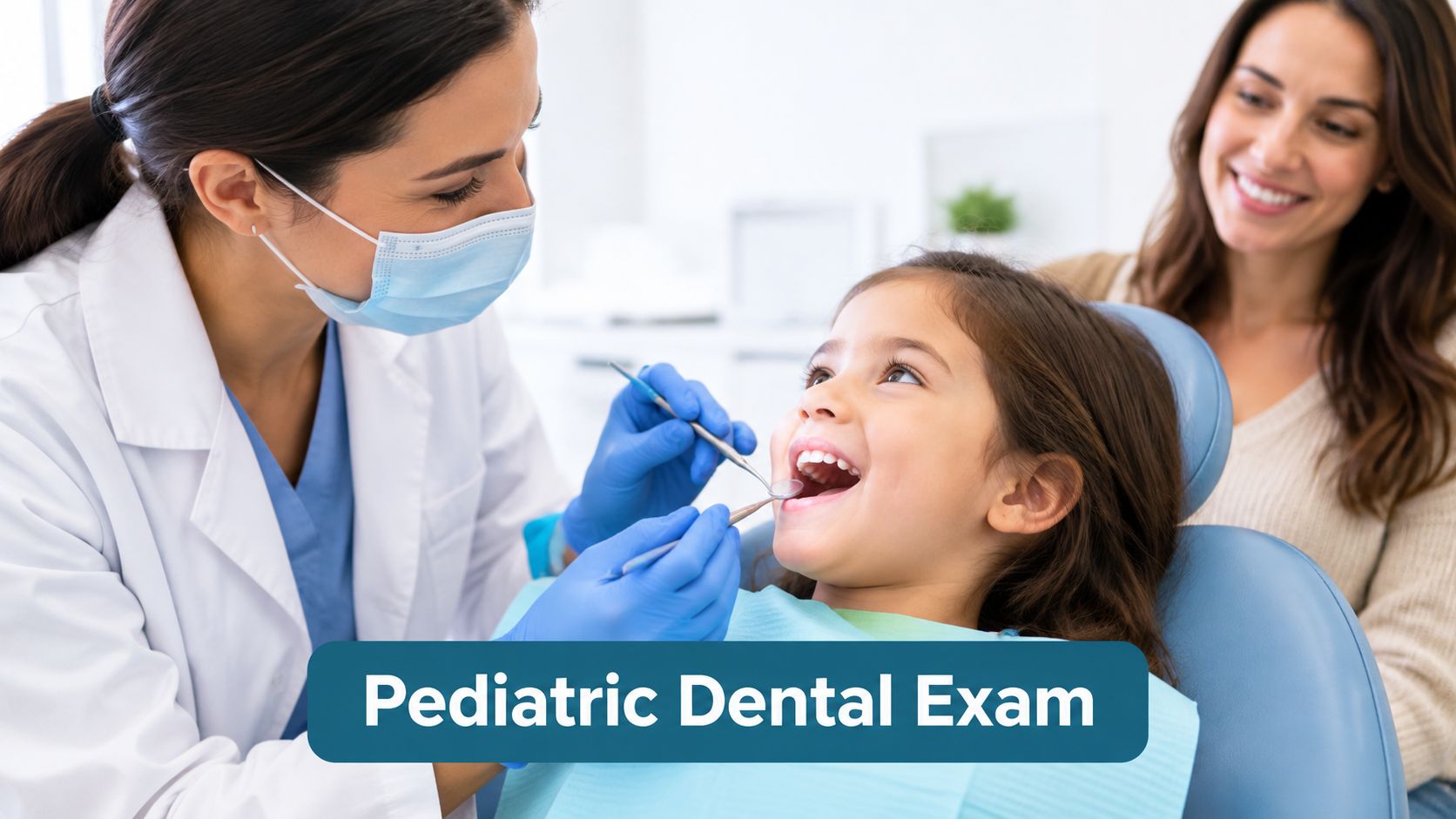
A typical appointment begins before the child sits in the chair. A team member welcomes the family, confirms health information, and explains what will happen in child-friendly language. A young child may sit with a parent at first, while an older child may choose to sit independently.

For toddlers, the dentist may use a gentle knee-to-knee examination. The child rests with the head near the dentist while the parent and clinician support the body, allowing a quick, secure look without forcing the child into an unfamiliar position. The dentist counts the teeth, checks the gums, looks at the bite, and observes eruption and jaw development.
A calm, predictable sequence
The clinician may show the child the mirror, light, and air syringe before using them. The explanation is simple and concrete: a mirror looks, a small brush cleans, and the light helps the dentist see. This tell-show-do approach gives the child time to understand the experience rather than encountering unfamiliar sounds and sensations without warning.
A cleaning may be included when appropriate. The team removes plaque or buildup that home brushing can't reach, then discusses brushing technique, flossing, snacks, and drinks. The dentist also looks for areas that are difficult for a child to clean, especially around crowded contacts and newly erupted teeth.
The examination may identify a healthy smile, early demineralization, visible decay, gum irritation, eruption changes, or bite concerns. If a problem appears, the dentist explains the choices in plain language instead of presenting treatment as an automatic outcome.
Parents dealing with a history of dental infection can also review practical information about recovering from a root canal abscess, although a child with swelling, fever, or significant pain needs prompt professional assessment.
A positive ending matters. The child may receive encouragement, choose a small reward, or leave after a high-five, depending on the practice's approach. The appointment is successful when the child feels safe enough to return and the parent leaves with a useful plan.
A short visual explanation can help families picture the process:
The exact sequence varies by age, cooperation, symptoms, and clinical findings. A child in pain may need the dentist to focus first on comfort and diagnosis, while a relaxed toddler may complete a more complete preventive visit.
Essential Preventive Treatments for Growing Smiles
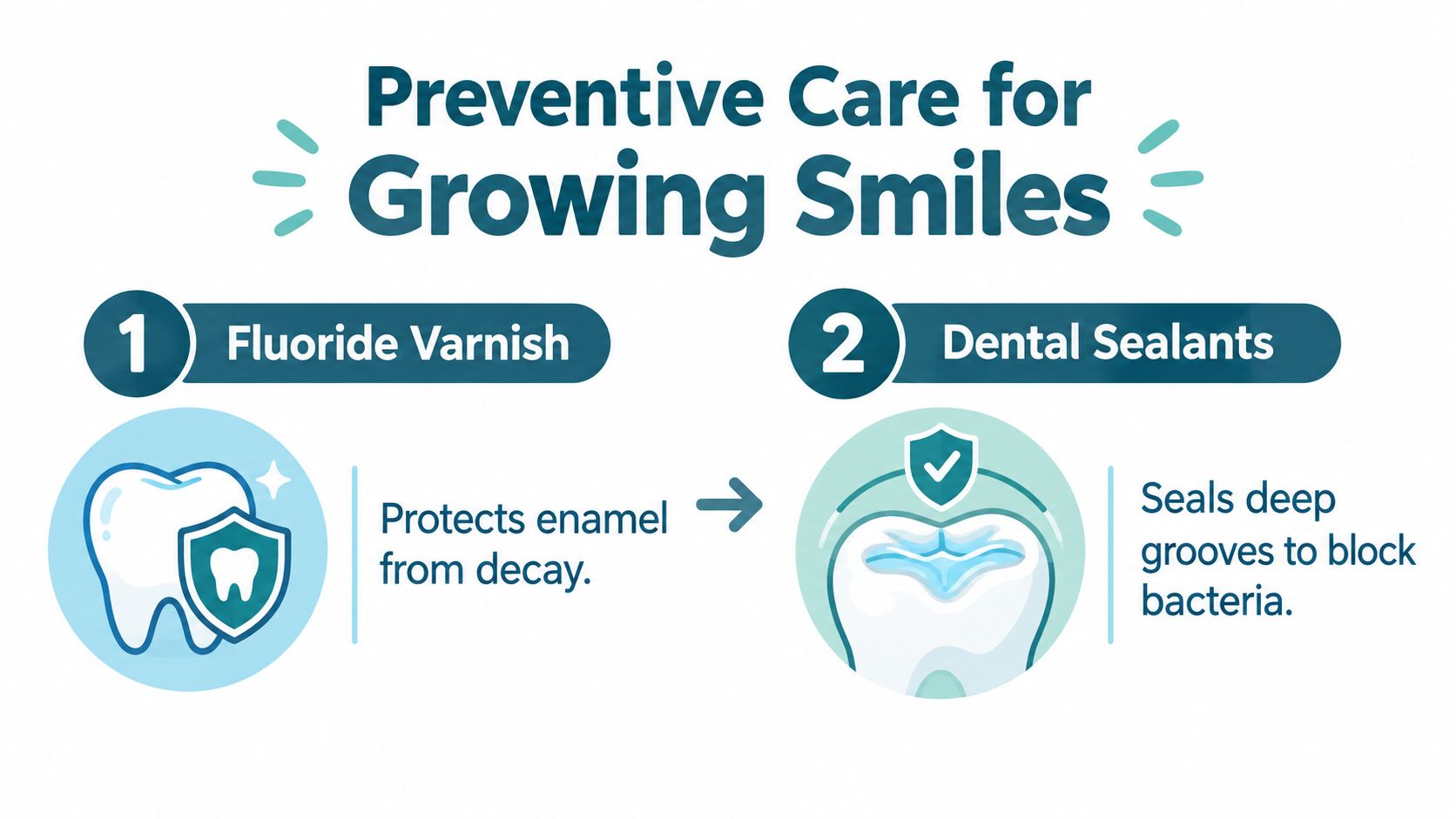
Preventive care works best when it matches the child's actual risk. A dentist may recommend fluoride varnish to strengthen enamel, improve resistance to acid, and support early lesion control. The recommendation depends on factors such as age, previous decay, diet, home care, fluoride exposure, and the appearance of the teeth.
Sealants address a different vulnerability. They are thin protective coatings placed in the grooves of back teeth, where food and plaque can remain difficult to remove. The CDC reports that 9 out of 10 cavities occur in the grooves of children's back teeth, and that sealants prevent about 80% of cavities in permanent molars during the first two years after placement and continue preventing about 50% for up to four years. These figures appear in the CDC information on dental sealants.
Timing matters for sealants
Sealants are most effective when placed soon after permanent molars erupt, typically around age 6 for first molars and age 12 for second molars, according to the CDC source above. The tooth must be erupted enough for the dentist to keep it clean and dry during placement.
The exam therefore determines more than whether a child already has decay. It also identifies whether newly erupted molars have deep grooves and whether a protective coating could reduce future treatment needs. CDC data show that children ages 6 to 11 without sealants have almost three times as many cavities in their first permanent molars as children who have them. The same CDC data report that approximately 60% of children in this age group don't receive sealants, while about 43% had at least one dental sealant during the reported survey period, as explained in the CDC sealant facts and statistics.
Prevention doesn't always mean drilling
Early caries management can include monitoring, fluoride varnish, sealants, silver diamine fluoride, selective caries removal, or a conventional filling. Silver diamine fluoride can arrest disease in selected situations, including cases involving severe anxiety, behavioral challenges, or limited access to conventional treatment. A 2025 questionnaire study found that 77.28% of respondents viewed SDF as a good noninvasive option for children with behavioral problems, while 70.87% considered it useful when conventional care or pharmacologic behavior management was unavailable, as reported in the 2025 SDF study.
SDF has an important trade-off. It can arrest disease but doesn't rebuild lost tooth structure, and treated decay can darken. Informed consent matters. A parent should understand when monitoring is reasonable, when SDF may fit, and when a filling is preferable.
Families seeking a dentist in Circleville, OH, or care near Amanda, Lancaster, or Carroll can review the practice's information about pediatric dental sealants before discussing prevention choices with the dentist.
Preparing Your Child for a Stress-Free Experience
Children often borrow their parents' emotional cues. A calm, matter-of-fact explanation helps more than repeated reassurance that “nothing will hurt,” which can accidentally introduce fear. Parents can describe the visit as a chance for the dentist to count teeth, look at the smile, and help keep teeth strong.
Use familiar language at home
Role-play with a toothbrush and mirror. Let the child examine a stuffed animal's teeth, open their mouth, and practice listening while an adult counts gently. Avoid threatening language, bribes that make the visit sound dangerous, and detailed descriptions of injections or drilling unless the dental team has advised otherwise.
Parents should also avoid sharing frightening personal dental stories before the appointment. A child doesn't need to carry an adult's past experience into a new environment.
The most helpful preparation is often simple: explain what will happen, keep the tone positive, and allow the dental team to guide the conversation.
Prepare the practical details
A rested, fed child usually has more capacity to cooperate. Unless the office provides different instructions, a normal meal and familiar routine can make the appointment easier. Parents should bring the child's medication and health information, insurance details, a comfort object if permitted, and any questions about brushing, snacks, thumb-sucking, sleep, or tooth grinding.
Families managing busy schedules can use Guiding Growth's dental appointment reminders as one organizational aid. The reminder itself isn't a substitute for a dental home, but it can help prevent routine care from disappearing among school, work, and family commitments.
If the child becomes upset, the parent should stay composed and let the clinician pause, explain, or adjust the pace. A first visit doesn't need to accomplish every possible task. Building trust may be the most important clinical result, especially for a toddler or a child with sensory sensitivities.
For families comparing a dentist near me in Amanda, Lancaster, Circleville, or Carroll, the right question isn't only whether the office performs cleanings. Parents should ask how the team introduces instruments, responds to anxiety, explains findings, and adapts care to the child.
Navigating Dental X-Rays and Digital Screening
Dental X-rays aren't automatic additions to every pediatric visit. The dentist first reviews the child's medical and dental history, listens to symptoms, examines the mouth, and considers age, tooth development, caries risk, eruption pattern, trauma history, and previous images.
The ADA and AAPD recommend selective prescribing. Imaging should be justified by a likely diagnostic benefit, optimized with the smallest appropriate examination, and performed with age- and size-appropriate exposure settings. The ADA guidance on dental X-rays explains why radiographs supplement, rather than replace, a clinical examination.
What an image can reveal
A bitewing image may help the dentist detect decay between teeth when the surfaces cannot be inspected directly. Other images may help evaluate developing permanent teeth, eruption concerns, trauma, or a symptom that isn't explained by visual inspection.
A low-risk child with accessible, clinically sound surfaces may not need immediate imaging. A child with active lesions, crowded contacts, high cariogenic exposure, or concerning symptoms may benefit from earlier images. The follow-up interval should reflect the child's individual risk rather than a fixed schedule.
Parents can ask three straightforward questions:
- Purpose: What specific diagnostic question will this image answer?
- Timing: Why is imaging appropriate at this visit rather than later?
- Impact: How will the result change diagnosis or treatment?
The FDA states that the FDA and ADA recommend dental X-ray examinations, including cone-beam CT scans, only when necessary to diagnose or treat disease. Families can read the FDA explanation of dental cone-beam CT.
Digital X-rays may support efficient image review, but “digital” doesn't mean an image should be taken without a clinical reason. The dentist still weighs exposure against benefit, avoids duplicating recent images, and interprets findings alongside visual and tactile assessment. Families considering a dentist in Lancaster, OH, can also review the practice's explanation of digital X-ray advantages before discussing imaging for a child.
The Long-Term Benefits of Early Dental Care
A dental home changes the meaning of a dental visit. Instead of waiting for pain, parents and dentists can monitor eruption, hygiene, bite development, and changing risk over time. Each appointment gives the child another opportunity to practice comfortable routines and gives caregivers a chance to adjust home care.
U.S. utilization data show that pediatric dental care is common but not universal. Among children ages 2 to 17, the share reported to have had a dental visit during the previous year rose from 78.4% in 2009 to 82.3% in 2012, reached 85.9% in 2018, and was 86.9% in 2019, according to CDC dental visit data. A separate analysis found that 83.8% of children ages 1 to 17 received a dental examination or cleaning in 2019, falling to 80.9% in 2020 during the COVID-19 disruption. Children ages 1 to 4 had the lowest reported use, 58.6% in 2019 and 51.3% in 2020.

The need for prevention also differs by household circumstances. From 2017 through March 2020, 15% of U.S. children ages 5 to 11 had untreated dental caries. The rate was 23% among children living in poverty, compared with 9% among children in families at or above 200% of the poverty level, based on the same CDC source.
Routine examinations can help identify disease before it interferes with sleep, meals, speech, school, or confidence. They can also connect families with prevention and treatment choices that preserve tooth structure when appropriate. When a child later needs restorative dentistry, a tooth extraction, dental implants for an adult family member, or an emergency dentist for sudden pain, a trusted local practice can provide continuity across changing needs.
Schedule Your Child's Appointment Today
Parents don't need to wait for a cavity, toothache, or dental emergency before seeking a pediatric dental exam. A child with no symptoms can still benefit from an evaluation of eruption, oral hygiene, bite, fluoride exposure, and risk for hidden or developing decay.
Families in Amanda, Lancaster, Circleville, and Carroll can prepare for the appointment by gathering health information, listing concerns, and noting changes such as sensitivity, bleeding gums, difficulty chewing, mouth breathing, grinding, or a tooth that appears slow to erupt. Pain, swelling, fever, facial injury, or a knocked-out tooth deserves prompt contact with a dental office rather than a routine wait.
Amanda Family Dental provides pediatric dentistry alongside preventive cleanings and exams, fluoride varnish when indicated, restorative care, emergency dental services, and broader family care. The same office also supports patients seeking a cosmetic dentist near me, teeth whitening, Invisalign, crowns, root canals, dentures, dental implants near me, or a tooth extraction, so parents can access care for the whole household in one location.
Make the next step simple
- Request an appointment: Contact the office and explain that the child needs a new patient exam, routine exam, or evaluation for a specific concern.
- Share relevant details: Mention age, symptoms, prior dental experiences, medical conditions, medications, and any anxiety or sensory needs.
- Ask about the visit: Confirm what the appointment may include, whether a parent can stay nearby, and how the team approaches preventive treatment or imaging.
- Choose a sustainable routine: Follow the individualized recall recommendation and keep the next visit visible on the family calendar.
A comfortable first experience can shape how a child views dental care for years. Scheduling early gives the dentist more choices and gives the child a calm place to learn healthy habits before a problem demands urgent attention.
Amanda Family Dental offers gentle pediatric dental exams, preventive cleanings, fluoride care, sealant evaluations, and personalized treatment planning for families in Amanda, Lancaster, Circleville, and Carroll. Visit Amanda Family Dental to request an appointment and give your child a comfortable starting point for lifelong oral health.