

A sudden toothache often starts with one small word: oh.
“Oh, that hurts.” “Oh no, that chip wasn't there yesterday.” “Oh, it's finally time to find a dentist near me.”
For families in Amanda, OH, and nearby communities like Lancaster, Circleville, and Carroll, that moment usually comes with urgency. Sometimes it's pain. Sometimes it's a missed cleaning that turned into a bigger problem. Sometimes it's a child due for a first visit, or an adult looking into whitening, Invisalign, or dental implants near me after putting it off too long.
Finding the right dental office close to home matters more than many people realize. It affects how quickly someone gets seen, how easy follow-up visits feel, and whether care stays consistent over time. A local guide can make that decision less stressful and more practical.
Table of Contents
- From 'Oh No' to Amanda OH A Guide to Finding Your Dentist
- Why a Local Dentist in the Amanda Area Matters
- Complete Family Dentistry for Your Loved Ones
- Smile Restoration and Cosmetic Enhancements
- What to Expect at Amanda Family Dental
- Schedule Your Visit with Your Local Dentist Today
- Frequently Asked Questions About Dental Care in Amanda OH
From 'Oh No' to Amanda OH A Guide to Finding Your Dentist
That little word, oh, fits dentistry better than is widely expected. It's the sound people make when a filling falls out at dinner, when a child says a tooth feels “funny,” or when someone notices blood while brushing. In Ohio, it's also part of the address search itself: dentist in Amanda, OH.
For many households, the hardest part isn't deciding whether dental care matters. It's figuring out where to go for care that's close, reliable, and broad enough to handle routine visits and unexpected problems. That's especially true in smaller communities where people want convenience without giving up treatment options.

Why local access changes the outcome
In Fairfield County, access isn't just a scheduling issue. Data from the Ohio Department of Health shows that 28% of Fairfield County residents lack a dental home, and rural areas have 35% higher emergency room visits for preventable dental issues according to Ohio outreach reporting on underserved communities. That's a practical reminder that delayed preventive care often becomes urgent care.
A dental home means more than having a name on a reminder postcard. It means there's an office to call when a crown loosens, when a child wakes up with swelling, or when a patient wants a plan instead of another temporary fix.
Practical rule: The best time to find a dentist is before there's an emergency.
People searching for help in Amanda, Lancaster, Circleville, or Carroll usually want three things at once. They want care that feels personal, appointments that fit real life, and treatment choices explained in plain language.
What a new patient should look for
A smart search goes beyond “closest office.” It helps to look for:
- Range of care: Cleanings and exams are important, but so are restorative and emergency options.
- Comfort options: Some patients avoid treatment because of anxiety, past experiences, or sensitivity.
- Clear communication: Good dental care includes clear next steps, not vague recommendations.
- Convenience for families: One office that can serve multiple ages often makes long-term care easier.
For readers comparing options, this guide to choosing your ideal dentist is a useful place to start. It reflects the kind of questions patients should ask before booking, especially if they've recently moved or haven't had regular dental care in a while.
Why a Local Dentist in the Amanda Area Matters
Choosing a local dentist isn't only about saving drive time. It changes how manageable care feels when treatment requires more than one visit, when a child needs follow-up, or when an emergency dentist appointment suddenly becomes necessary.
In Ohio, access pressure is real. General dental practices average 4,499 residents per practice, higher than the U.S. average, and dental care is the top unmet need for children in the state based on Ohio dental access data from Dentagraphics. In practical terms, that means families benefit when they establish care before a problem becomes urgent.
The difference between nearby and convenient
A dentist may look “close enough” on a map, but convenience is more than mileage. It includes whether the office can support recurring visits for crowns, root canals, implants, aligners, or children's preventive care without turning every appointment into a half-day event.
A local office also helps with the smaller details that matter over time:
- School-year scheduling: Parents can manage checkups with fewer disruptions.
- Faster emergency response: A cracked tooth or sudden pain is easier to address when the office is nearby.
- Continuity: The team gets to know health history, habits, concerns, and treatment preferences.
Why relationships matter in dentistry
Dental care works best when it's consistent. A patient who sees the same team over time usually gets more personalized recommendations because the office can compare changes, monitor older work, and catch issues earlier.
A hometown dental office often provides something large systems struggle to match: familiarity that leads to faster, more confident decisions.
That matters for adults looking for cosmetic dentist near me options and for parents trying to keep children comfortable with care. It also matters for people who've put off treatment and want a setting that feels less rushed and more conversational.
For Amanda, Lancaster, Circleville, and Carroll residents, local care supports a better pattern. Problems get handled sooner. Follow-up is easier. Dental visits become part of normal life instead of a last resort.
Complete Family Dentistry for Your Loved Ones
Family dentistry should make life simpler, not more complicated. Parents usually aren't looking for a long list of technical features. They want an office where children feel comfortable, adults can stay on track with cleanings and exams, and treatment recommendations make sense.
That starts with prevention. According to the Ohio Department of Health, 51% of Ohio school children have a history of tooth decay, untreated decay affects 19%, and sealant prevalence has dropped to 42% as detailed in the Ohio Dental Association summary of the state children's oral health survey. For families in Fairfield County, those numbers underline why regular cleanings, checkups, and sealants still matter.

What parents should expect from a family dentist
A strong family dental office should be able to support several stages of care without making each visit feel complicated.
Common needs include:
- New patient exams: A baseline visit helps identify current concerns and future risks.
- Dental x-rays: Digital imaging supports diagnosis with less guesswork.
- Cleaning and exams: Routine preventive care helps limit larger restorative needs.
- Pediatric support: Children often need a gentler pace, clearer explanations, and a team used to working with kids.
- Preventive treatments: Sealants and fluoride discussions should be straightforward and individualized.
A family-centered office should also adapt communication to the patient in the chair. A child may need simple reassurance. A parent may want timing, priorities, and payment options explained clearly. A teenager asking about Invisalign may need a different conversation than a grandparent needing a replacement crown.
What tends to work, and what usually doesn't
Consistent care works. Long gaps between visits usually don't. Waiting until pain appears often means treatment gets more invasive, more time-sensitive, or harder to schedule around work and school.
Parent guidance: If a child only sees the dentist when something hurts, the visit starts with stress instead of familiarity.
It also helps when parents choose an office that can grow with the family. That includes everything from first exams and preventive cleanings to fillings, cosmetic consultations, and restorative treatment later on. For local readers weighing those needs, this overview of family-friendly dental services offers a useful picture of what full-service care can look like close to home.
For practices trying to help patients understand these services more clearly, thoughtful education matters. This article on patient acquisition with content marketing shows why clear, patient-first explanations often help families choose care sooner and with more confidence.
Smile Restoration and Cosmetic Enhancements
Adults often search for dental care because something has changed. A tooth breaks. An old filling fails. A gap from a missing tooth starts affecting chewing or confidence. Sometimes the issue is less about pain and more about appearance, such as staining, uneven edges, or interest in a straighter smile.
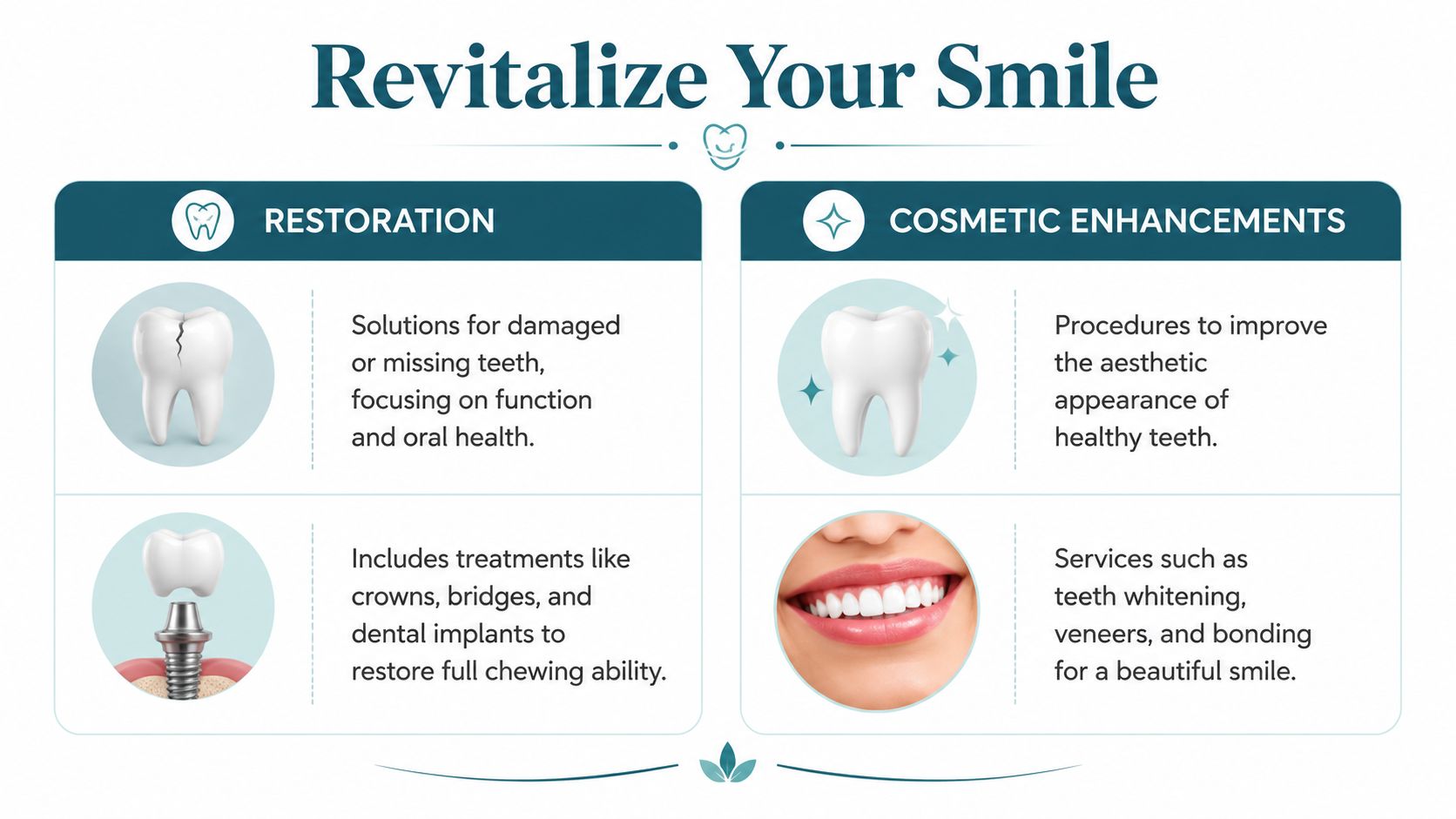
The right treatment depends on the problem being solved. Restorative dentistry focuses on function, comfort, and long-term stability. Cosmetic dentistry focuses on appearance, though many treatments improve both.
Restoration versus appearance
A simple comparison helps.
| Treatment goal | Common options | Best fit |
|---|---|---|
| Replace a missing tooth | Dental implant, denture, bridge | Patients who want to restore bite and appearance |
| Save a damaged tooth | Crown, filling, root canal | Teeth that can still be preserved |
| Remove a painful or unsalvageable tooth | Tooth extraction | Severe damage, infection, or crowding |
| Brighten or refine a smile | Teeth whitening, veneers, bonding | Patients focused on cosmetic improvement |
| Straighten alignment discreetly | Invisalign clear aligners | Adults and teens who want a less noticeable orthodontic option |
A crown protects and rebuilds a tooth that's still worth saving. An extraction removes a tooth that can't be predictably restored. A denture can replace several missing teeth. An implant replaces one missing tooth or helps support broader restorative plans.
Why implants stand apart
For many adults searching dental implants near me, implants are attractive because they replace both the visible tooth and its root structure. The implant post is usually made from titanium, which is chosen for biocompatibility and stability. The jawbone gradually fuses to that post through osseointegration.
Dental implants have a success rate over 95%, and the bone typically fuses to the titanium post over 2 to 6 months, according to this dental implant component guide. That process is supported by microtextured threads that help bone adhesion and long-term stability.
An implant can be an excellent option when the goal is to restore chewing, preserve space, and avoid relying on neighboring teeth for support.
That doesn't mean an implant is always the first choice. If a tooth can be saved predictably, many patients prefer to keep it. If bone support, budget, timing, or medical history complicates implant treatment, another restorative path may make more sense.
Cosmetic options for a more confident smile
Not every patient needs reconstruction. Some just want to improve a smile they already like. In those cases, cosmetic care may include:
- Professional whitening: Good for broad stain reduction and a brighter look.
- Veneers: Useful for shape, color, small gaps, or worn edges.
- Bonding: A conservative way to repair chips or refine contour.
- Invisalign: Clear aligners for patients who want alignment improvement without traditional braces.
- Botox and Juvéderm: For some adults, these complement smile aesthetics by softening surrounding facial lines.
The best cosmetic plans start with healthy teeth and gums. Whitening over untreated decay, or veneers placed before bite issues are addressed, rarely creates a stable result. The strongest outcomes come from matching the treatment to the actual concern instead of choosing the most dramatic option first.
What to Expect at Amanda Family Dental
For many patients, the unknown part of dentistry is what causes the most stress. A first visit feels easier when the process is clear before anyone walks through the door.
A typical patient journey starts with a phone call or online request. The front desk gathers the basics, answers practical questions, and helps match the appointment type to the patient's need. Someone coming in for routine cleaning and exams needs a different block of time than someone calling about pain, a broken tooth, or a cosmetic consultation.

The first visit
Once in the office, new patients can expect a structured but comfortable appointment. That often includes updated health information, a conversation about concerns, and digital x-rays when needed to help diagnose what can't be seen during a visual exam.
A cleaning may happen at the same visit when appropriate. In other cases, the exam comes first so the team can determine the safest and most useful next step. That's especially important if a patient has been away from dental care for a while, has active pain, or needs more than routine preventive treatment.
Patients who want more detail on the basics can review what a dental cleaning includes. Understanding the difference between a regular preventive visit and problem-focused care helps remove a lot of uncertainty.
How treatment plans are explained
A good treatment plan should feel specific, not overwhelming. That means explaining what needs attention now, what can wait, and which options are available if there's more than one reasonable way to proceed.
Some patients want the fastest route out of pain. Others want the most conservative path. Others are balancing function, appearance, scheduling, and budget all at once. Dentistry works better when those trade-offs are discussed openly.
To help patients get familiar with the office environment and approach, this short video offers a helpful look:
Comfort and anxiety support
Patients with dental anxiety often assume every visit will feel tense. It doesn't have to. Offices that offer comfort-focused care, calm communication, and sleep dentistry options can make a major difference for people who've delayed treatment because of fear.
Some patients don't need less treatment. They need a pace, explanation style, and comfort plan that helps them actually receive it.
That applies to children, adults with difficult past dental experiences, and people facing longer restorative visits. A respectful environment, clear sequencing, and steady communication often matter just as much as the procedure itself.
Schedule Your Visit with Your Local Dentist Today
Many individuals begin searching for a dentist when they are already experiencing discomfort. That could mean tooth pain, a missed cleaning, a chipped front tooth, or a question about dental implants, Invisalign, or cosmetic dentistry. The simplest next move is to schedule before the issue gets harder to manage.
For patients in Amanda, OH, as well as Lancaster, Circleville, and Carroll, local care can make routine visits easier and urgent visits less disruptive. It also helps when an office offers broad treatment under one roof, including preventive care, restorative dentistry, cosmetic services, and emergency dental support when available.
Practical ways to make care easier
A few details often remove the last bit of hesitation:
- Flexible scheduling: Helpful for work, school, and family routines.
- Same-day emergency care when available: Important when pain can't wait.
- Transparent planning: Patients should know what's recommended and why.
- Payment support: Membership plans can help patients without traditional insurance budget for care.
For practice owners interested in how local offices reach high-intent patients online, this guide to attaining dental patients through Meta ads gives a useful marketing perspective. For patients, the more important point is simpler: once the right office is found, it helps to book the visit and establish care before a small issue becomes a stressful one.
Frequently Asked Questions About Dental Care in Amanda OH
| Question | Answer |
|---|---|
| How often should a patient schedule cleaning and exams? | The right timing depends on oral health history, current condition, and risk factors. Many patients benefit from regular preventive visits, but the office can recommend a schedule based on individual needs. |
| Can a local office help with dental emergencies? | Yes, many family dental practices handle urgent issues such as tooth pain, broken teeth, swelling, or lost restorations. Calling early in the day usually gives the office the best chance to help quickly. |
| Are cosmetic services available close to Amanda, Lancaster, Circleville, and Carroll? | Yes. Patients commonly look for whitening, veneers, Invisalign, bonding, and other smile-focused treatments without traveling far from home. A consultation helps determine which option fits the concern. |
| What if a patient feels anxious about treatment? | Anxiety is common. Offices that offer gentle communication, clear explanations, and sleep dentistry options can make care much more manageable. Patients should mention those concerns when scheduling. |
| Does a patient need insurance to get started? | Not always. Many practices offer flexible payment arrangements or in-house membership options that help uninsured patients access preventive and restorative care more predictably. |
| What should a new patient bring to the first appointment? | It helps to bring health information, a current medication list, insurance details if applicable, and any questions about pain, appearance, or past dental work. |
If it's time to find a trusted local dentist for preventive care, emergency treatment, cosmetic improvements, or smile restoration, Amanda Family Dental serves patients in Amanda, Lancaster, Circleville, and Carroll with a welcoming, community-centered approach. Schedule an appointment or request a consultation to get clear answers and care close to home.