

Impacted tooth symptoms range from none at all to visible swelling, jaw stiffness, and bad breath, and the absence of pain doesn't rule out a problem. A 2024 review estimated that 36.9% of people had at least one impacted wisdom tooth.
For someone noticing soreness behind the last molar during dinner, the immediate question is usually practical: can it wait, or does it need a dental appointment? That prevalence estimate comes from a systematic review of impacted third molars, but an individual tooth needs an individual assessment.
For families searching for a dentist near me, Amanda Family Dental offers a local starting point in Amanda, OH, serving patients from Lancaster, Circleville, and Carroll. A calm examination can help distinguish a trapped tooth from other causes of discomfort and identify the appropriate next step.
Table of Contents
- Noticing Something Off in the Back of Your Mouth
- What an Impacted Tooth Actually Is
- The Most Common Impacted Tooth Symptoms Patients Notice
- Warning Signs That Should Not Be Ignored
- Complications an Impacted Tooth Can Cause Over Time
- How Dentists Diagnose and Treat Impacted Teeth
- What to Expect at Amanda Family Dental
- When and How to Reach Amanda Family Dental
Noticing Something Off in the Back of Your Mouth
A Lancaster resident might notice that chewing on one side feels uncomfortable, then press a tongue against the gum behind the last tooth. An Amanda parent might hear a teenager describe a stiff jaw without being able to identify a particular sore tooth. These are familiar situations, not diagnoses.
The uncertainty often causes more worry than the discomfort itself. A tooth may look mostly normal from above while the gum around it feels tender, or the ache may seem to come from somewhere deeper in the jaw.
Details That Help a Dentist Understand the Problem
Patients don't need to identify the cause before calling. They can describe when the discomfort started, whether it affects eating, and whether the same area has bothered them before. Clear observations are more useful than deciding that a tooth definitely needs removal.
A simple symptom note can include:
- Location: Whether the discomfort is behind the last molar, along the jaw, or around another tooth.
- Pattern: Whether it stays present, returns during meals, or disappears and comes back.
- Changes: Whether the gum looks different or opening the mouth has become harder.
Pain, gum tenderness, jaw discomfort, unpleasant taste, and limited mouth opening can occur with an impacted tooth, according to MedlinePlus guidance on impacted teeth. Those findings aren't specific enough to confirm the cause at home.
A Practical First Step Close to Home
For patients looking for a dentist in Lancaster, OH, or nearby Amanda, the useful first step is an examination rather than a decision about surgery. Calling with a clear description helps the office determine how promptly the patient should be seen.
An appointment can also address a quieter concern, such as a tooth that never appeared where expected. Patients don't have to wait until discomfort becomes severe to ask whether something needs attention.
What an Impacted Tooth Actually Is
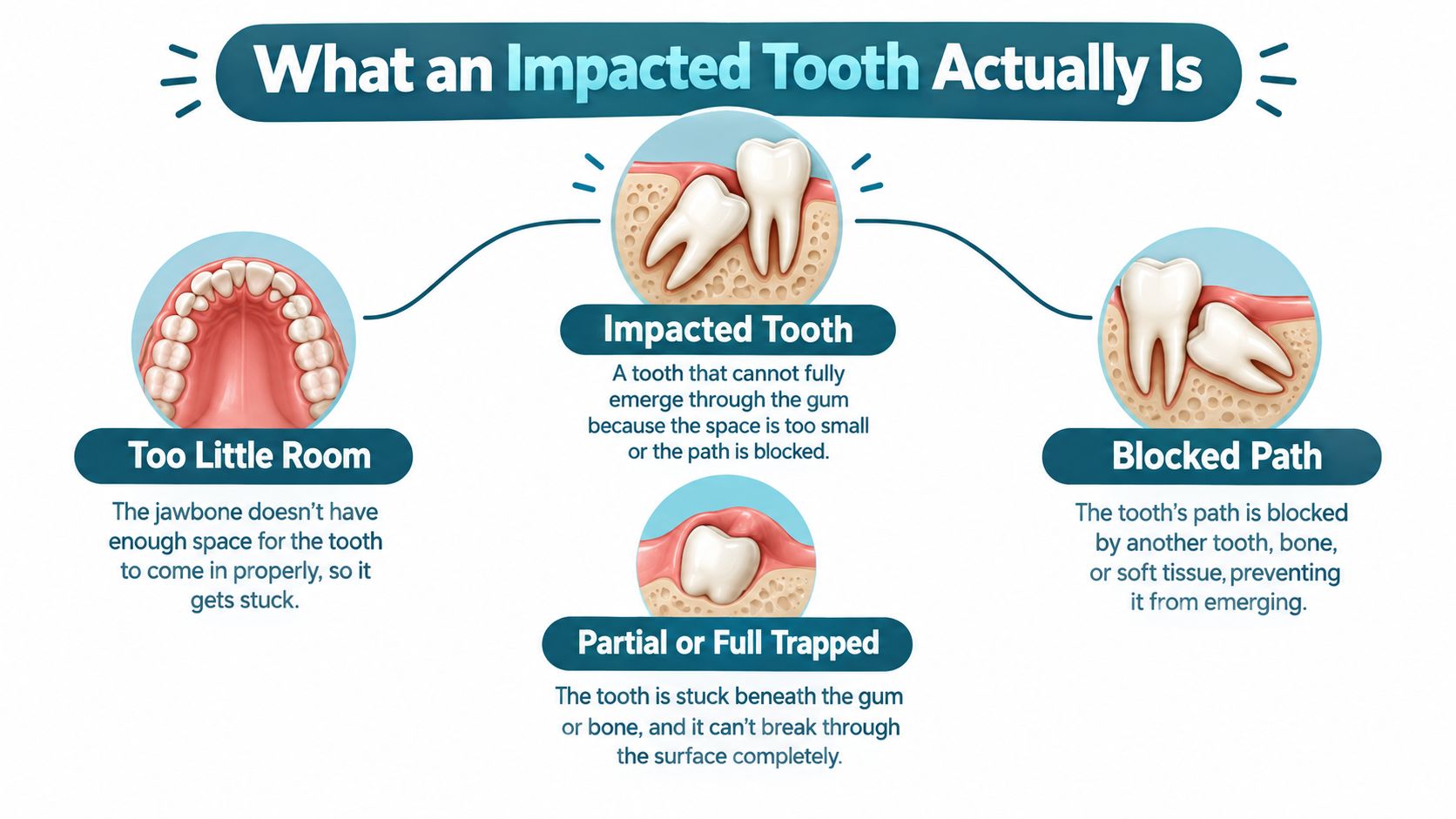
An impacted tooth is a tooth that cannot fully emerge into its expected position. Think of a tooth trying to move into a parking space that's too narrow or approaching it at the wrong angle. The obstacle may be insufficient room, an unfavorable position, or another structure blocking its path.
Wisdom teeth are especially associated with impaction. Other teeth can also fail to emerge normally, so an unexplained missing tooth deserves examination rather than an assumption that it never developed.
Different Positions Create Different Problems
A partially erupted tooth has some visible tooth surface above the gum. A fully trapped tooth remains beneath gum or bone, while an angled tooth may point toward the neighboring molar rather than toward an open space.
Those descriptions explain position, not severity. A visible portion doesn't prove that the rest of the tooth is positioned safely, and a fully covered tooth doesn't automatically require removal.
The illustration below shows how limited space and a blocked eruption path can affect a tooth.
Why Position Matters More Than Appearance
When a tooth emerges at an unfavorable angle, the contact with nearby teeth can create areas that are difficult to clean. Food and plaque can collect where an ordinary toothbrush has limited access. The oral surgery patient guide to impacted wisdom teeth describes how tooth position and inadequate eruption space can affect surrounding tissues.
Practical distinction: “Impacted” describes how a tooth is positioned. It doesn't, by itself, describe how much treatment the patient needs.
For families in Amanda, Lancaster, Circleville, and Carroll, routine dental care provides an opportunity to ask about eruption and tooth position. A teenager's developing dentition and an adult's longstanding unerupted tooth may require different conversations, but neither should be assessed from appearance alone.
The Most Common Impacted Tooth Symptoms Patients Notice
The most recognizable symptoms often come from irritated gum tissue around a tooth that has only partly emerged. Dentists call inflammation or infection in that tissue pericoronitis. The term sounds technical, but it describes a practical problem: a difficult-to-clean pocket around the tooth.
The wisdom tooth symptom guidance from oral and maxillofacial surgeons identifies persistent dull pain, gum redness, tenderness, bleeding, bad breath, unpleasant taste, and pain while chewing among the possible signs. It also explains that an examination is needed to distinguish this condition from other causes of jaw pain.
Pressure, Tenderness, and Changes Around the Gum
A dull ache or pressure behind the last molar may be the first noticeable change. Another patient may describe a more pronounced ache during chewing or tenderness when food touches the gum.
A small gum flap over part of the tooth can look red or swollen. Dentists sometimes call this flap an operculum, but patients only need to explain what they can see and feel.
| Finding | Useful Detail to Share at an Appointment |
|---|---|
| Back-of-jaw discomfort | Whether chewing makes the ache more noticeable |
| Tender or bleeding gum | Whether the irritation surrounds a partly visible tooth |
| Unpleasant taste or odor | Whether it seems to come from the same area repeatedly |
| Jaw stiffness | Whether ordinary mouth opening feels different |
Taste, Breath, and Mouth Opening
Bad breath or an unpleasant taste may accompany the gum symptoms. Persistent odor in a particular area shouldn't be treated as a cosmetic concern, especially when tenderness or swelling accompanies it.
Restricted mouth opening can occur when inflammation affects nearby chewing muscles. Dentists call this trismus, meaning the jaw cannot open as freely as usual.
Symptoms may settle and return, which can make postponing an appointment tempting. A temporary improvement doesn't establish that the underlying cause has resolved. For a patient searching for a dentist in Circleville, OH, documenting that repeated pattern can help make the first appointment more informative.
Warning Signs That Should Not Be Ignored
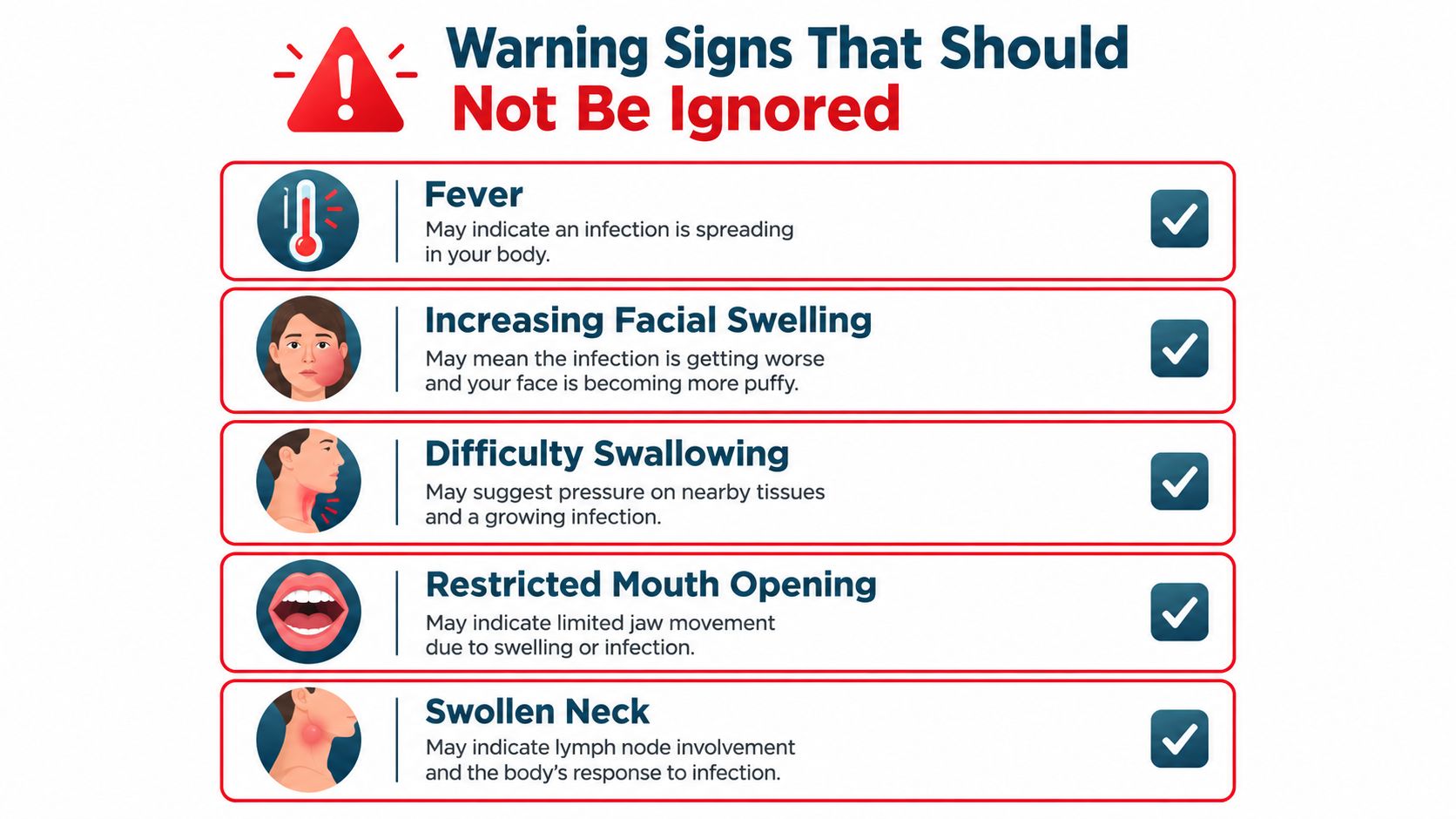
Increasing facial swelling, fever, difficulty swallowing, substantial restriction of mouth opening, and neck swelling need prompt attention. These findings can indicate that infection is extending beyond the gum immediately surrounding a tooth. Pus near the tooth also raises concern about infection rather than uncomplicated eruption discomfort.
The clinical review of wisdom-tooth symptoms and pericoronitis describes pain and local tenderness alongside more serious findings such as fever, swallowing difficulty, and enlarged neck lymph nodes. The important distinction is progression: a changing face, worsening illness, or declining ability to swallow shouldn't be managed by waiting for a routine cleaning.
The checklist below highlights findings that warrant urgent assessment.
When Same-Day Dental Assessment Makes Sense
Patients with worsening swelling, fever, pus, or markedly reduced mouth opening should contact the office promptly and describe those findings explicitly. Amanda Family Dental's emergency dental care information provides a local starting point for patients in Amanda, Lancaster, Circleville, and Carroll seeking an emergency dentist.
Same-day care depends on scheduling availability and the clinical situation. A routine appointment is more appropriate for a stable concern without urgent warning signs, such as a longstanding question about an unerupted tooth.
Breathing difficulty or an inability to swallow safely requires immediate emergency medical help, not waiting for an office appointment or a returned message.
Information to Give During an Urgent Call
The caller should report whether swelling is increasing, whether fever is present, and whether swallowing or breathing has changed. Describing functional changes is more useful than saying only that a wisdom tooth hurts.
The following video offers additional context for the discussion of wisdom teeth.
An urgent evaluation doesn't mean that every patient needs immediate extraction. It means that a clinician needs to assess the infection risk and choose a safe treatment plan without unnecessary delay.
Complications an Impacted Tooth Can Cause Over Time
A recurring irritated gum is only part of the picture. An impacted wisdom tooth can also affect the neighboring second molar, the gum attachment around it, and the surrounding bone. These nearby structures matter because preserving a comfortable, functional mouth involves more than treating the tooth that currently hurts.
The clinical guidance on third-molar complications includes decay, pericoronitis, periodontal disease, root resorption, infections, and cysts among possible disease processes. These are potential complications, not a prediction that every impacted tooth will develop them.
Gradual Changes Worth Reporting
Food repeatedly packing behind the last molar can be a useful clue. New sensitivity on the neighboring tooth may also deserve attention, even when that tooth previously felt healthy. Such observations don't establish a diagnosis, but they help direct the examination.
Root resorption means loss of neighboring root structure. A dentigerous cyst is a fluid-filled sac associated with an unerupted tooth; it may enlarge without obvious early discomfort and affect nearby tissues.
The patient's next step depends on the finding:
- Repeated gum infection: A dentist should assess why the episodes keep returning.
- Adjacent tooth damage: Treatment planning should consider protecting or restoring the neighboring molar.
- Suspected cystic change: Imaging and further evaluation are needed to determine the extent and management.
Silent Doesn't Always Mean Disease-Free
There's an important difference between an asymptomatic tooth and an asymptomatic, disease-free tooth. The first description means no symptoms are present. The second also means that the examination and imaging show no current disease.
Mayo Clinic's overview of impacted wisdom teeth supports this distinction between symptoms and possible complications. Patients cannot reliably make that distinction based on comfort alone.
When disease or neighboring damage makes removal appropriate, the practice's tooth extraction information can help patients understand that treatment option. The aim isn't automatic removal; it's preventing an identified problem from compromising surrounding teeth and tissues.
How Dentists Diagnose and Treat Impacted Teeth
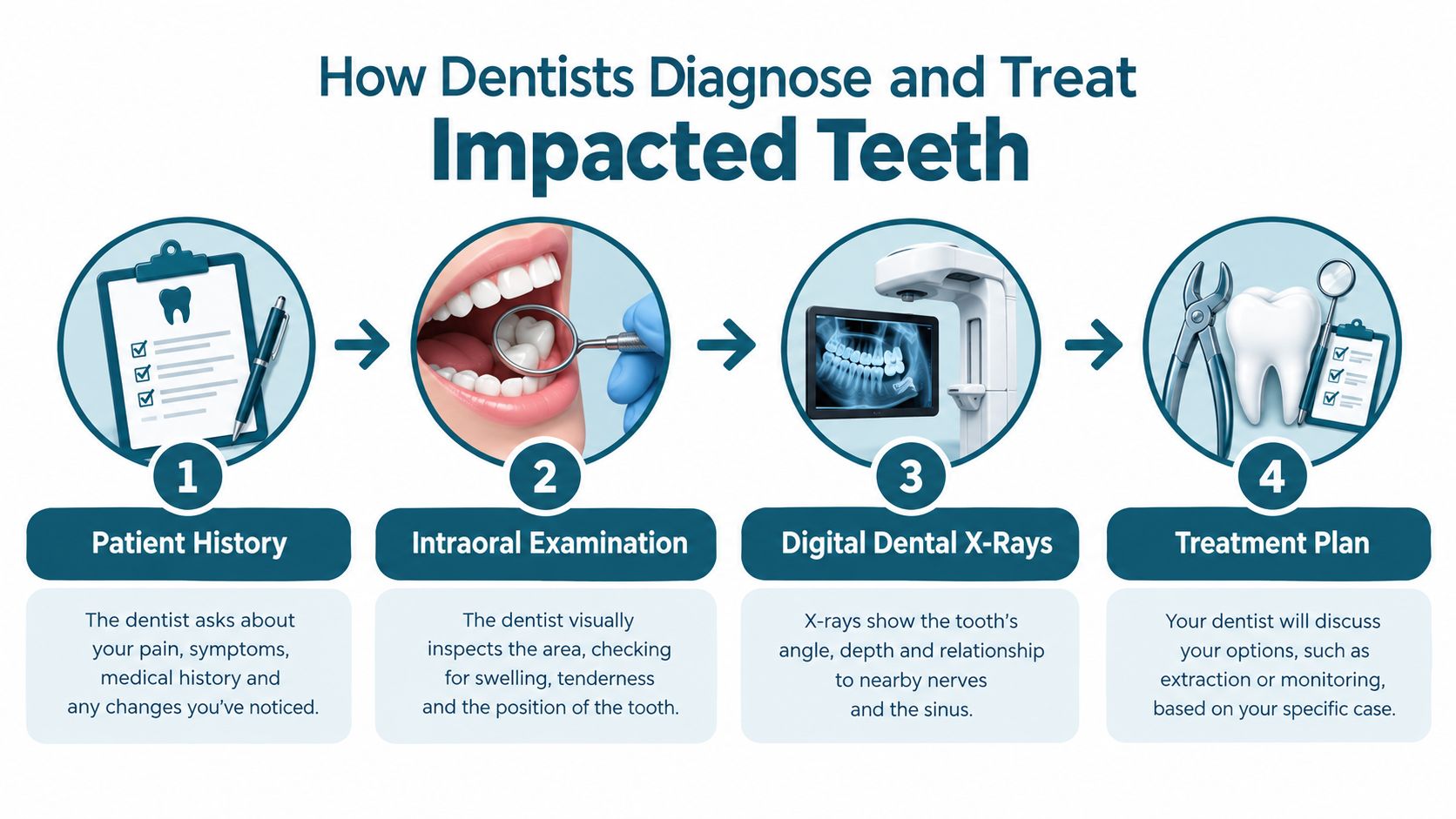
Diagnosis starts with a conversation, not an extraction appointment. A dentist reviews the patient's concerns, medical and dental history, and previous episodes before examining the tooth, gums, and nearby structures.
The professional guidance on impacted third-molar assessment recommends combining history, physical examination, and diagnostic imaging. Radiographs help show tooth and root anatomy and the relationship to the neighboring molar, the lower-jaw nerve, and the upper-jaw sinus.
From Examination to a Clearer Picture
During the examination, the dentist checks eruption status, gum health, decay, tooth position, and function. Dental X-rays provide information that looking into the mouth cannot supply, including the tooth's depth and angulation.
The process below illustrates how those findings inform a treatment plan.
Amanda Family Dental uses digital imaging, and its explanation of digital dental X-ray advantages gives patients context before an appointment. Imaging should answer a clinical question, not replace the examination or discussion.
Treatment Depends on What the Dentist Finds
| Clinical Situation | Possible Direction |
|---|---|
| No current disease or significant risk | Active clinical and radiographic surveillance |
| Infection or decay | Targeted treatment and assessment of the underlying cause |
| Disease or substantial risk associated with impaction | Surgical management, potentially including extraction |
Active surveillance isn't doing nothing. It means planned reassessment and imaging when appropriate, so the patient and dentist can respond to meaningful changes.
Complex surgical cases may require an oral and maxillofacial surgeon. The dentist should explain whether referral is appropriate and how the tooth's relationship to nearby structures affects planning.
Restorative dentistry belongs in the conversation when removal affects tooth replacement needs. Options may include dental implants, bridges, or dentures, but patients shouldn't assume that an extracted wisdom tooth needs replacement. Someone searching for dental implants near me should receive a separate assessment of the missing-tooth situation rather than treating an implant as an automatic follow-up to wisdom-tooth surgery.
Appropriate care aims to relieve discomfort, support chewing, preserve neighboring teeth, and help the patient understand the reason for treatment.
What to Expect at Amanda Family Dental
At Amanda Family Dental, the first call is an opportunity to describe symptoms, ask about appointment availability, and mention dental anxiety. Patients seeking a dentist in Amanda, OH, can also explain whether they're new to the practice or returning with a change since a previous examination.
The practice is led by Dr. Alyssa Jenkins and offers new patient exams, preventive cleaning and exams, digital X-rays, and personalized treatment planning. Its hometown approach emphasizes clear explanations and patient comfort rather than asking patients to make decisions without understanding their options.
A Visit Organized Around the Patient's Concern
An impacted-tooth assessment should leave the patient with a clear explanation of what was found, what remains uncertain, and what the next step involves. Patients can ask how a recommendation protects surrounding teeth, whether monitoring is reasonable, and whether specialist care is needed.
The practice website provides a view of the office and available dental services.

Practical questions can include:
- Comfort: Which comfort-focused options fit the proposed care and the patient's health history?
- Scheduling: Whether same-day care is available for the symptoms described.
- Payment: How flexible payment arrangements or the Power Plan Membership apply to the recommended services.
Keeping Immediate Care Separate From Other Goals
A patient looking for a dentist in Carroll, OH, may have several concerns, including a sore back tooth and interest in teeth whitening. Those goals can be discussed together without confusing their priorities.
Cosmetic dentistry, restorative treatments, and preventive care address different needs. Someone searching for a cosmetic dentist near me can ask about smile appearance, while the dentist first clarifies any active pain or infection. A personalized plan helps patients understand what needs prompt attention and what can be scheduled separately.
When and How to Reach Amanda Family Dental
Patients with recurring jaw discomfort, a tender back gum, or questions about an unerupted tooth can contact Amanda Family Dental to schedule an examination or request a consultation. Families in Amanda, Lancaster, Circleville, and Carroll, Ohio, can describe their concern before deciding which service to book.
Calling doesn't commit a patient to extraction. It creates an opportunity to identify whether the concern belongs in a routine examination, an urgent assessment, or a discussion of ongoing monitoring.
Making the First Contact Useful
Patients should have a short description of their symptoms, relevant medical information, and any known history of problems in the same area. Those overdue for an examination can also mention when they last received dental care.
For readers interested in how dental offices organize incoming enquiries, Rednea's resource on dental practice AI call handling offers background on reception workflows. It doesn't establish that this practice uses that technology, and online reading shouldn't delay an urgent clinical call.
Before booking: The most helpful question is what assessment the symptoms require, not whether the tooth must come out.
The office can discuss scheduling, new patient arrangements, and the available next steps. A clear diagnosis gives families a sound basis for care decisions and a plan for follow-up, rather than leaving them to judge a hidden tooth by discomfort alone.
Amanda Family Dental offers examinations, digital X-rays, and personalized treatment planning for patients concerned about impacted tooth symptoms. Families in Amanda, Lancaster, Circleville, and Carroll can visit Amanda Family Dental to request an appointment or contact the office for guidance on an urgent concern. The team can help clarify the cause and support the patient's oral health beyond the immediate problem.