

A cracked tooth usually doesn't happen at a convenient time. It happens during breakfast, at dinner, or when chewing something that didn't seem very hard until that sharp jolt stopped everything. Many patients from Amanda, Lancaster, Circleville, and Carroll, Ohio start searching for an emergency dentist, a dentist near me, or how to treat cracked tooth because they want one clear answer. Can this tooth be saved?
In many cases, yes. The key is getting the tooth evaluated quickly, protecting it from more damage, and choosing the right treatment based on how deep the crack goes. Some cracks need a simple repair. Others need a crown, root canal, or sometimes tooth extraction followed by a replacement option such as dental implants near me. The right next step depends on the tooth, the symptoms, and the exam.
Table of Contents
- That Sudden Crack What It Means for Your Smile
- Immediate Steps for a Cracked Tooth Before Your Dental Visit
- How We Diagnose a Cracked Tooth at Amanda Family Dental
- Cracked Tooth Treatment Options From Bonding to Crowns
- Pain Management and Recovery Expectations
- Tips to Prevent Future Cracked Teeth
- Your Local Partner for Dental Care in Amanda Ohio
That Sudden Crack What It Means for Your Smile
One common story sounds almost the same every time. A person bites into toast, a nut, or a crusty sandwich, feels a sudden crack, then notices pain when biting down. Sometimes there's a visible line in the tooth. Sometimes there isn't. What patients do notice is that something feels wrong immediately.
A cracked tooth can range from a minor enamel issue to a deeper fracture that affects the nerve. That's why symptoms can vary so much. One patient may only feel brief sensitivity to cold. Another may have pain every time the tooth flexes during chewing. Either way, it isn't something to ignore.
For families searching for a dentist in Amanda, OH, dentist in Lancaster, OH, dentist in Circleville, OH, or dentist in Carroll, OH, this is one of the most common urgent problems that brings people into the office.
A cracked tooth doesn't always look dramatic, but it can still create real pain and lead to bigger treatment if it's left alone.
What patients usually notice first
Some symptoms show up right away, while others come and go:
- Pain when biting: The tooth may hurt most when pressure is applied and then released.
- Temperature sensitivity: Cold drinks or hot foods may trigger a quick sharp response.
- A rough edge or visible line: Patients sometimes feel the crack with their tongue before they see it.
- Swelling or soreness nearby: The gum around the tooth may start to feel irritated.
Why quick attention matters
Cracks don't heal the way a cut on skin heals. Each time the tooth takes pressure, the damaged area can move a little more. That movement can worsen pain, allow bacteria deeper inside, and turn a simpler restorative dentistry visit into a more involved repair.
That's why the next steps matter. Calm the area, protect the tooth, and get it examined by a local dentist who can tell whether it needs bonding, a crown, root canal care, or another solution.
Immediate Steps for a Cracked Tooth Before Your Dental Visit
If a tooth cracks, the goal for the next few hours is simple. Keep the area clean, reduce swelling, lower pain, and stop the tooth from taking more force than it can handle.
What to do right away
Start with a gentle rinse using warm salt water. This helps clear away food debris and keeps the area cleaner while the tooth is vulnerable.
Use a cold compress or ice pack on the outside of the cheek if there's swelling or throbbing. Over the counter pain relievers can also help, as long as they're appropriate for the patient and taken as directed.
Most important, avoid chewing on that side.
According to guidance summarized by interim care recommendations for a cracked tooth, using ice packs, salt water rinses, and avoiding chewing on the affected side can reduce the risk of crack progression by 25-35% while you wait for professional care. The same guidance notes that delaying treatment beyond 10 days can increase the risk of nerve involvement by 40%.
What not to do
Some habits make a bad situation worse fast:
- Don't test the tooth repeatedly: Biting on it again to “see if it still hurts” can deepen the crack.
- Don't chew hard foods: Nuts, ice, crusty bread, popcorn kernels, and tough candy are all risky.
- Don't assume it'll heal on its own: The discomfort may come and go, but the crack itself won't repair itself.
- Don't wait too long if pain is increasing: Worsening pain often means the inside of the tooth is becoming more involved.
Practical rule: If the tooth hurts when chewing, treat it like a fragile glass. Keep pressure off it until a dentist can examine it.
If a piece broke off
If part of the tooth chipped away, keep the fragment if it's easy to retrieve. It may help during the exam, though many repairs don't require the original piece. If a sharp edge is rubbing the tongue or cheek, temporary protection may help until the visit. A more detailed guide to broken tooth temporary fix options can help patients protect the area while waiting to be seen.
Pain control matters, but protection matters just as much. The less stress placed on the cracked tooth before the appointment, the better the chance of a more conservative repair.
How We Diagnose a Cracked Tooth at Amanda Family Dental
A cracked tooth can be tricky because the symptoms and the visible damage don't always match. Some cracks are obvious. Others are tiny but painful. A careful diagnosis matters more than guesswork.
What happens during the exam
The visit usually starts with a conversation about what the patient felt and when it started. Pain when biting, lingering sensitivity, or a crack that happened during a meal all point in different directions.
The clinical exam then focuses on several things:
- Visual inspection: Looking for lines, chips, worn fillings, and stressed tooth structure.
- Gentle probing: A dental explorer can help identify rough margins or suspicious areas.
- Bite testing: Biting on a tool in a controlled way helps identify which cusp or section triggers pain.
- Pulp evaluation: The tooth's nerve status matters because normal pulp, reversible irritation, and irreversible damage lead to different treatment decisions.
Digital imaging is often part of the workup. Patients who want to understand that process can read about digital X-ray advantages and how those images support diagnosis while keeping the exam efficient.
What the exam is trying to answer
The core questions are straightforward. Is the crack shallow or deep? Is the tooth still restorable? Has the nerve been affected? Is the crack limited to the crown of the tooth, or does it extend farther down?
That distinction changes treatment.
Data from the National Dental Practice-Based Research Network found that direct restoration was recommended for 98% of cracked teeth, which is reassuring for anxious patients because it means most cracked teeth are managed with non-invasive restorations rather than more complex procedures.
Many patients arrive worried they'll lose the tooth. In practice, the exam often shows a repairable problem with a clear treatment path.
Why symptoms matter as much as the image
A crack line on an X-ray doesn't tell the whole story by itself. Bite pain, decay, and pulpal status often carry more weight than whether a fracture line is easy to see. That's why a thorough exam combines symptoms, testing, and imaging instead of relying on one sign alone.
For patients looking for a dentist near me after a sudden dental emergency, this part of the visit often brings the most relief. Once the source of the pain is identified, the treatment plan becomes much clearer.
Cracked Tooth Treatment Options From Bonding to Crowns
Treatment works best when it matches the depth of the crack and the condition of the nerve. Some teeth can be repaired in a straightforward way. Others need staged care to protect the tooth first and place the final restoration after symptoms settle.
Small cracks and single visit repairs
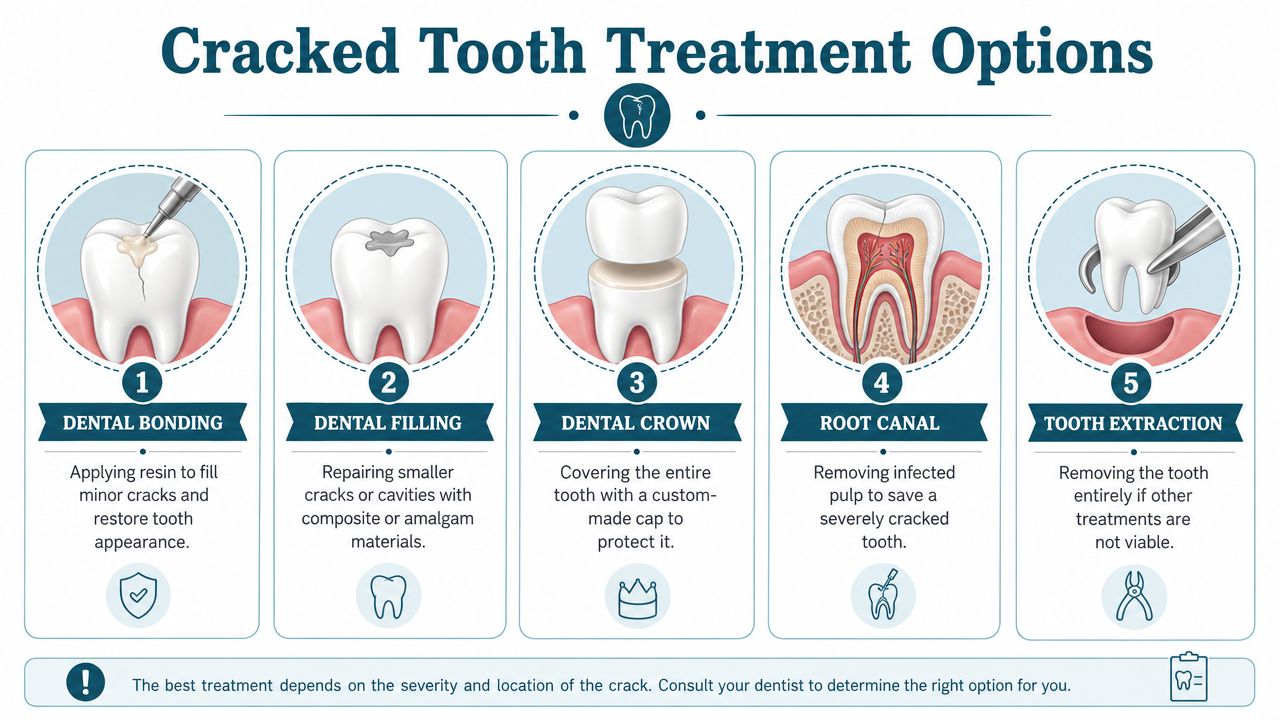
For minor cracks that don't extend below the gum line, dental bonding can be a practical single-stage repair. Composite resin seals and reshapes the damaged area, often in one visit, and it's especially useful when the crack is limited and the tooth still has enough healthy structure.
Fillings can also help when the damaged area is smaller and tied to a weak spot or cavity. The purpose is to close the defect, reduce movement, and restore normal function.
These are the most conservative options, and they work best when the crack hasn't reached the pulp.
Crowns staged treatment and deeper damage
When a crack compromises more of the tooth, a dental crown often becomes the better answer. A crown covers the entire visible tooth and helps hold the structure together during chewing.
A useful detail that patients rarely hear is that treatment isn't always a one-step decision. A narrative review on cracked teeth identified two common approaches, immediate definitive restoration and staged restoration after monitoring. It also noted that multiple-stage approaches can reduce over-treatment in 30-40% of cases where crack progression is uncertain in this review of single-stage and multiple-stage cracked tooth management.
That means some teeth benefit from an interim protective phase before the final crown goes on. The tooth gets stabilized, symptoms are watched, and the final restoration is chosen with more confidence. Patients who are preparing for this type of repair can review dental crown procedure steps to understand how a crown protects a damaged tooth.
A treatment discussion is often easier to follow with a side-by-side view.
| Treatment | Best For | Number of Visits | Goal |
|---|---|---|---|
| Dental Bonding | Minor visible cracks and small edge defects | 1 | Seal and reshape the tooth |
| Dental Filling | Smaller cracks or damage linked with decay | 1 | Restore structure and function |
| Dental Crown | Larger cracks with weakened tooth structure | Multiple or single-stage depending on symptoms | Protect the whole tooth from flexing |
| Root Canal and Crown | Cracks that have reached the pulp | Multiple | Remove infection and restore strength |
| Tooth Extraction | Non-restorable teeth | 1, then replacement planning | Remove the damaged tooth and protect overall oral health |
This short video gives a useful visual overview of how treatment can vary depending on severity.
When a root canal is the right choice
Root canal therapy is necessary when the crack extends into the pulp and bacteria can reach the nerve. If the diagnosis shows irreversible pulpitis, root canal treatment needs to happen before crown placement. For deep cracks, microscopic techniques using intra-orifice barriers have shown a 91% success rate and 97% survival rate at one year in this clinical discussion of newer cracked tooth management protocols.
That sounds technical, but the purpose is simple. Clean out infection, seal the tooth well, and give the remaining tooth structure its best chance to stay in service.
When extraction becomes necessary
Sometimes the crack goes too far below the gum line or into the root for the tooth to be restored predictably. In that case, tooth extraction protects the rest of the mouth from ongoing pain and infection.
Replacement should be part of that conversation right away. Depending on the area and the patient's needs, options may include a bridge, denture, or dental implants near me search results that point to restorative care close to home. Amanda Family Dental provides crowns, root canals, extractions, and restorative tooth replacement options as part of complete dental care for local families.
Pain Management and Recovery Expectations
Most patients want to know two things after treatment. How much will it hurt, and how long until the tooth feels normal again? Recovery depends on the procedure, but most cracked tooth treatment follows a predictable pattern.

What recovery usually feels like
After bonding or a filling, the tooth may feel mildly sensitive for a short time, especially with cold foods or pressure. Patients usually do well by avoiding very hard chewing on that side until the tooth settles.
After a crown preparation or crown placement, soreness around the tooth or gum can happen. Soft foods, careful brushing, and avoiding sticky or very crunchy foods early on usually make recovery smoother.
Root canal treatment often worries patients more than it should. The tooth and surrounding tissues can feel tender for several days because the area has already been inflamed. Long-term results are encouraging. A PubMed-indexed study reported that cracked teeth treated with root canal therapy had a 90.0% two-year survival rate in this survival analysis of cracked teeth treated with RCT.
Recovery discomfort usually comes from inflammation around the tooth, not from the idea that the treatment “didn't work.”
Helpful home care after treatment
A few habits make healing easier:
- Choose softer foods: Eggs, yogurt, pasta, soup, and other low-pressure foods are easier on the tooth at first.
- Keep the area clean: Gentle brushing and flossing matter because plaque around a treated tooth can irritate the gum.
- Watch the bite: If the tooth feels too tall or hits first when chewing, it should be adjusted.
- Use medicines as directed: Follow the dental team's instructions for discomfort control.
When to call and what parents should know
Call the office if pain keeps getting worse instead of better, if swelling increases, or if the bite feels off. A small adjustment can make a big difference after crown work or a restoration.
For children, a cracked tooth still deserves prompt evaluation even if they calm down quickly. Kids often return to eating and playing before the tooth is stable. Parents should keep chewing away from the injured side, offer softer foods, and watch for sensitivity, swelling, or complaints during meals.
That same steady, practical approach helps adults too. Protect the tooth, follow aftercare directions, and don't ignore new symptoms.
Tips to Prevent Future Cracked Teeth
A repaired tooth needs protection, but prevention matters just as much for the rest of the smile. Most cracked teeth don't come out of nowhere. They usually follow pressure, wear, impact, or a habit that puts too much force on enamel over time.
The habits that lower risk
Hard foods are a common trigger. Chewing ice, popcorn kernels, hard candy, or using teeth to open packages can turn a stressed tooth into a cracked one.
Grinding and clenching are another major factor. Patients often don't realize they're doing it until morning soreness, flattened teeth, or repeated fractures start showing up. A custom night guard can help protect teeth from those repeated heavy forces while sleeping.
Sports protection matters too. Cleveland Clinic guidance states that wearing a mouthguard for contact sports like football and basketball, and for higher fall-risk activities like biking or gymnastics, helps reduce dental fractures.
Prevention is usually less complicated than repair. A mouthguard, a night guard, and a few food habit changes can prevent a painful dental emergency.
Smart prevention for families
For households in Amanda, Lancaster, Circleville, and Carroll, Ohio, the most useful preventive steps are often the simplest:
- Skip the tooth-stressing habits: Don't chew ice, pens, or hard candy.
- Protect active kids and adults: Use a properly fitted sports mouthguard.
- Keep up with exams: Regular cleaning and exams help catch worn fillings, cracks, and bite issues before they turn urgent.
- Address grinding early: If morning jaw soreness or tooth wear is showing up, ask about a night guard.
Preventive care supports more than comfort. It protects chewing function, appearance, and the long-term strength of natural teeth.
Your Local Partner for Dental Care in Amanda Ohio
When a tooth cracks, patients don't want a long lecture. They want pain relief, a clear answer, and a plan that makes sense. That's exactly why local care matters. Patients from Amanda, Lancaster, Circleville, and Carroll, Ohio deserve a nearby office that can evaluate the tooth, explain the trade-offs plainly, and move quickly from diagnosis to treatment.

A good cracked tooth visit should feel organized and calm. New patient exams, digital X-rays, and a personalized treatment plan help patients understand whether they need a conservative repair, restorative dentistry, a crown, root canal therapy, cosmetic dentistry support for visible damage, or an extraction with replacement planning. For someone searching online for a dentist near me or an emergency dentist, that kind of clarity matters.
Patients often look at reviews before scheduling, and that's sensible. For anyone comparing patient experiences and communication styles, what 4squares Dentistry clients say offers a useful example of the kinds of details people notice most, including comfort, explanation, and follow-through after treatment.
The most important takeaway is simple. A cracked tooth won't improve by waiting and hoping. It needs an exam, a diagnosis, and treatment that fits the crack instead of a one-size-fits-all fix. Some teeth need quick bonding. Some need a staged approach before a final crown. Some need endodontic treatment to save the tooth. When a tooth can't be saved, replacement planning keeps the rest of the smile functioning well.
For families looking for a dentist in Amanda, OH, or nearby care in Lancaster, Circleville, and Carroll, having one local office for emergency dental services, cleaning and exams, dental X-rays, new patient exams, restorative care, and long-term smile maintenance makes follow-up easier too.
If a cracked tooth is causing pain, sensitivity, or worry, the next step is to schedule a visit with Amanda Family Dental. Prompt care can protect the tooth, relieve discomfort, and help patients get back to eating, speaking, and smiling with confidence.