

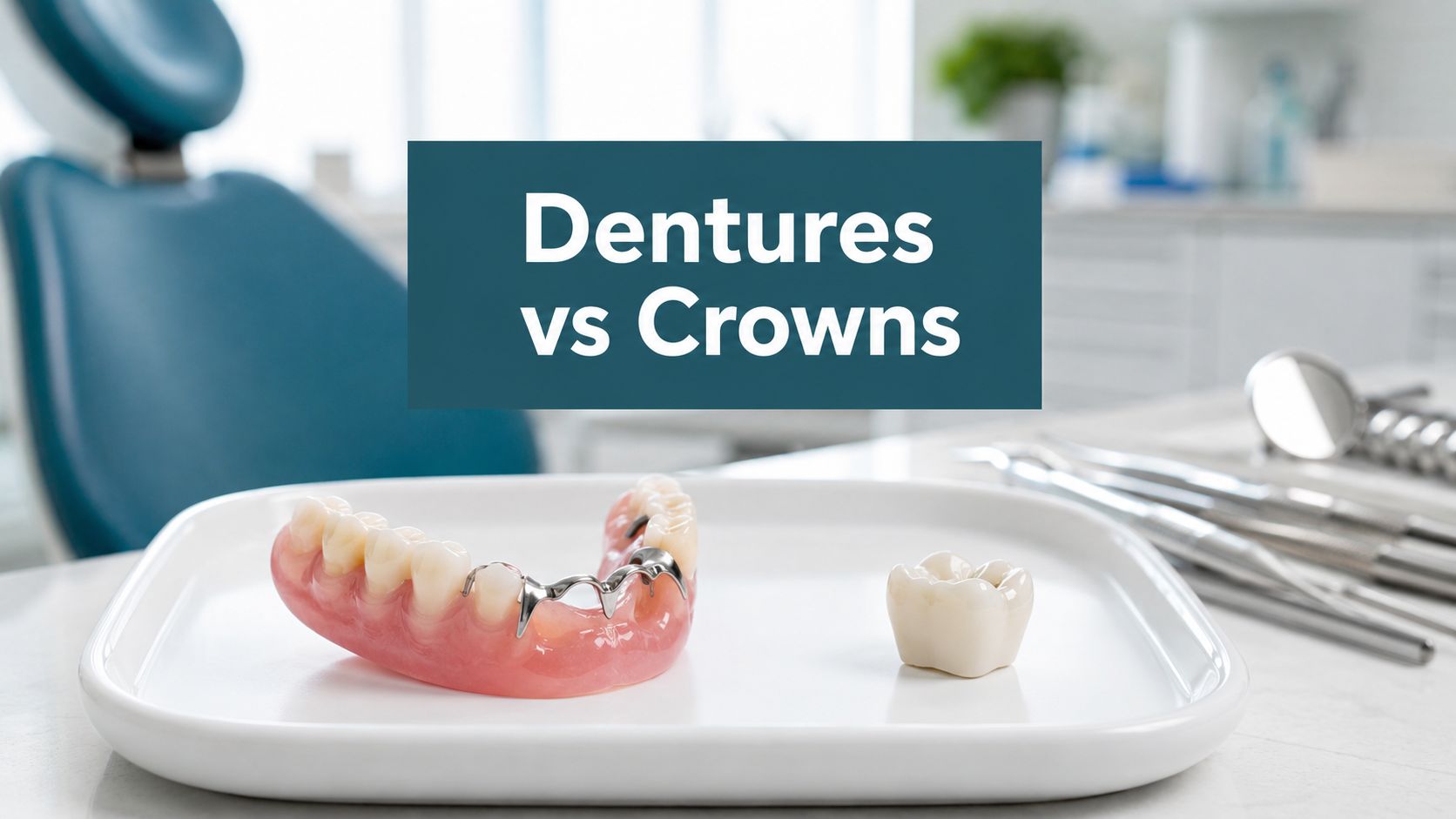
The chair is still warm from the last patient when the question lands. A cracked tooth, a missing tooth, a second opinion, and two very different plans, one trying to save what's left, the other trying to replace what's already gone. That's the heart of dentures vs crowns, and for patients in Amanda, OH, Lancaster, OH, Circleville, OH, and Carroll, OH, the right answer usually comes down to one thing, whether the tooth is still worth saving.
| Criterion | Crown | Denture |
|---|---|---|
| What it does | Covers and protects a damaged tooth | Replaces one or more missing teeth |
| Feel in the mouth | Fixed, more like a natural tooth | Removable, more noticeable day to day |
| Chewing | Stronger bite on a salvageable tooth | Less natural bite, especially with full dentures |
| Cleaning | Brush and floss like a tooth | Remove and clean separately |
| Best use case | A tooth still has a healthy root | Teeth are already missing or non-restorable |
Table of Contents
- What Most Patients Are Really Trying to Decide
- What Crowns and Dentures Are
- Head-to-Head Comparison on the Criteria That Matter
- Cost, Longevity, and the Long-Term Math
- When a Crown Is the Clear Winner
- The Triage Call Most Guides Skip
- What to Expect at Amanda Family Dental
- Your Next Step and Common Questions
What Most Patients Are Really Trying to Decide
A patient usually doesn't walk in asking for a lecture on materials. They sit down because something hurts, something broke, or something is missing, and they want to know whether the tooth can still be saved or whether it's time to move on. That's the practical version of dentures vs crowns, and it's the version that matters.
Saving the tooth or replacing it
A crown is a preservation decision. It makes sense when the tooth still has enough healthy structure and root support to carry on with help. A denture is a replacement decision. It makes sense when the tooth or teeth are already gone, or when what's left can't be trusted long term.
That's why the better question isn't “Which is better?” It's “Is this tooth still worth saving?” The answer changes the whole treatment path, including whether the patient needs tooth extraction, a denture, an implant, or a crown that lets the natural tooth keep doing its job.
For patients comparing options in the Amanda area, that triage mindset is the difference between a short-term fix and a stable plan. A helpful resource for office communication and patient routing is try fonea for your practice, especially when someone is calling with pain and needs quick direction before the visit.
The missing-tooth side of the decision is just as important, and Amanda Family Dental's missing tooth solutions fit into that broader replacement discussion. Patients often come in thinking they need one specific treatment, when the decision is still ahead of them.
Practical rule: if the tooth still has a strong root and enough structure, saving it usually beats replacing it.
What Crowns and Dentures Are
A dental crown is a custom cap that covers a damaged, decayed, or weakened tooth. It goes over the tooth that's still there, so the patient keeps the root and the tooth stays fixed in place. In the mouth, it looks and functions like the visible part of a tooth rather than a separate appliance.
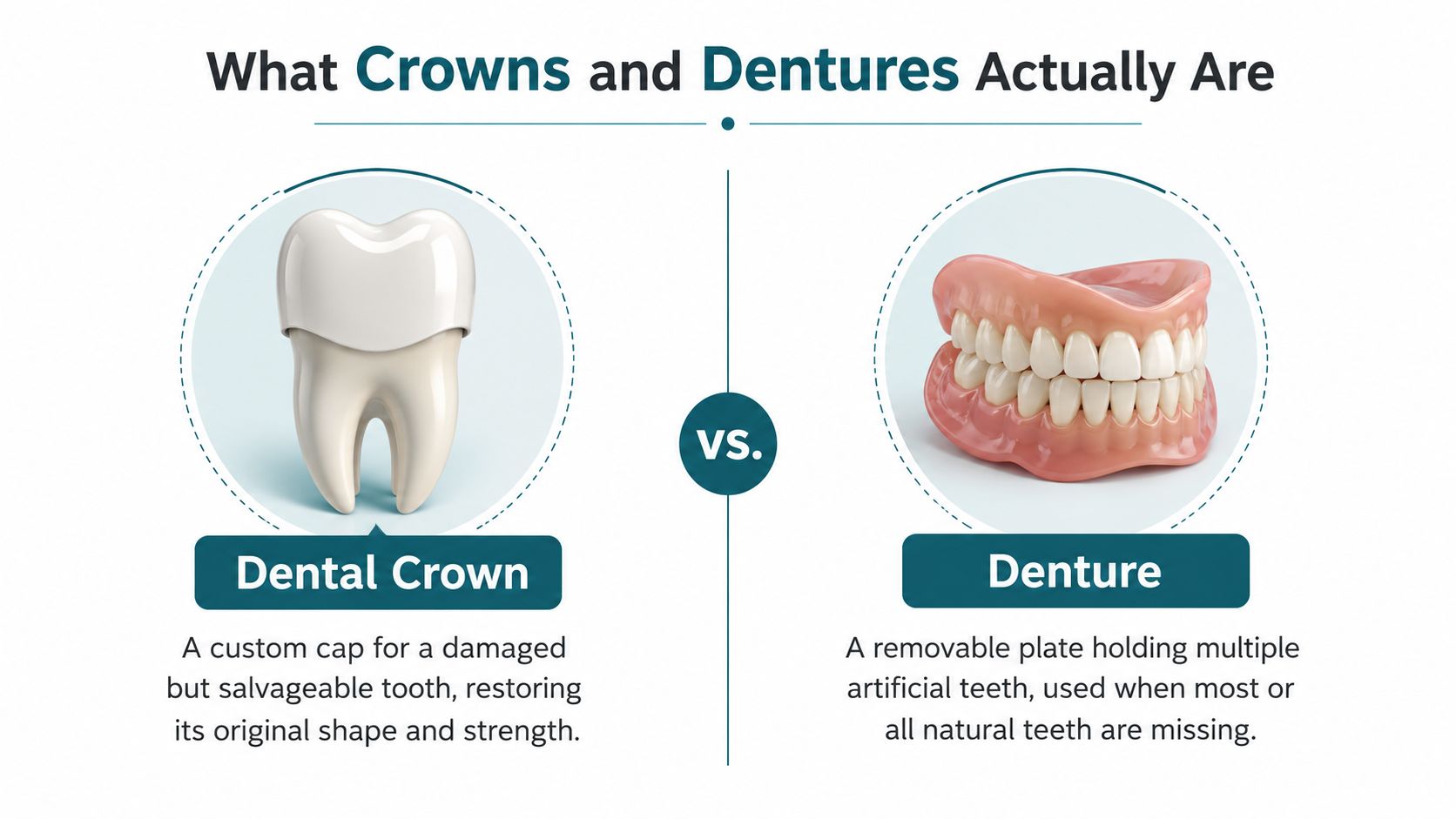
A denture works differently. It replaces one or more missing teeth and may be partial or full-arch. It's removable, so patients take it out for cleaning and handling. A denture fills in what's missing, but it does not feel like a natural tooth in the same way a crown on a healthy root does.
What patients usually feel
Crowns feel like a repaired tooth because they are anchored to a tooth that's already in place. Dentures feel like a prosthetic, which is exactly what they are. Some patients adapt quickly, while others never love the sensation of removing and reinserting a dental appliance every day.
The material choice also matters. Crowns are commonly made from zirconia, E.max, or porcelain fused to metal, and each option has its own balance of strength, appearance, and how much tooth structure it covers. That choice affects how the restoration looks at the edge of the gum, how it handles biting force, and how closely it blends with the rest of the smile.
At Amanda Family Dental, tooth-colored options are used when the goal is to match natural dentition closely. That matters in the front of the mouth and still matters in the back, because patients do not want a restoration that calls attention to itself every time they smile or laugh. For patients weighing a removable option alongside a fixed one, Amanda Family Dental's denture and implant options are part of that same conversation.
The simplest memory hook is the one patients usually keep. Crowns save teeth, dentures replace them.
Head-to-Head Comparison on the Criteria That Matter
Patients do not live in a lab. They live at dinner, in conversations, and in photos. So the core comparison is chewing, comfort, cleaning, and how often the treatment needs attention. Both options address the problem, but they do it through different mechanisms: one preserves what is already there, the other replaces what is missing.
Dentures vs Crowns at a Glance
| Criterion | Crown | Denture |
|---|---|---|
| Durability | A tooth-supported single crown study reported 89.9% survival at 5 years, 80.9% at 10 years, 70.5% at 15 years, and 61.8% at 20 years PMC study | Depends heavily on fit, support, and design |
| Comfort | Fixed to the tooth, so it feels more natural | Removable, more aware of in daily use |
| Chewing | Better for biting and chewing on a preserved tooth | Less natural, especially with full dentures |
| Maintenance | Brush and floss around it like a tooth | Remove, clean, and maintain separately |
| Aesthetics | Blends well when tooth-colored materials are used | Can look good, but movement can be noticeable |
| Neighboring teeth | Does not replace missing teeth, so it preserves the tooth being treated | Can place more functional demand on remaining teeth |
A separate prospective comparison found single-piece implant-supported crowns produced higher masticatory performance than conventional three-unit fixed prostheses at all measured points, reaching 35.7% vs 28.3% at 12 months PMC study. That finding is about fixed crown-based treatment, but it explains why preserving or replacing support with a fixed option usually gives patients a more dependable chewing experience than a removable prosthesis.
How that plays out in real life
A crown lets a patient bite into an apple without giving the restoration much thought. A denture can still restore function, but it usually asks for more adaptation, more maintenance, and more awareness during meals and speech. That difference matters in daily life, because the better option is the one a patient can live with comfortably, not just the one that looks fine in the chair.
For patients looking at fixed tooth replacement options, Amanda Family Dental's dentures and implants page sits in the same decision space because implants may belong in the conversation when extraction is already on the table and a removable option feels like too much compromise.
Practical takeaway: if the tooth can be saved, a crown usually gives a more natural daily experience than a removable denture.
Cost, Longevity, and the Long-Term Math
A cheap first visit can turn into a costly habit if the treatment keeps needing attention. Patients should look past the first invoice and ask what the mouth will demand later, because repeated replacements, relines, and adjustments can erase the savings fast. That is the math behind dentures versus crowns.
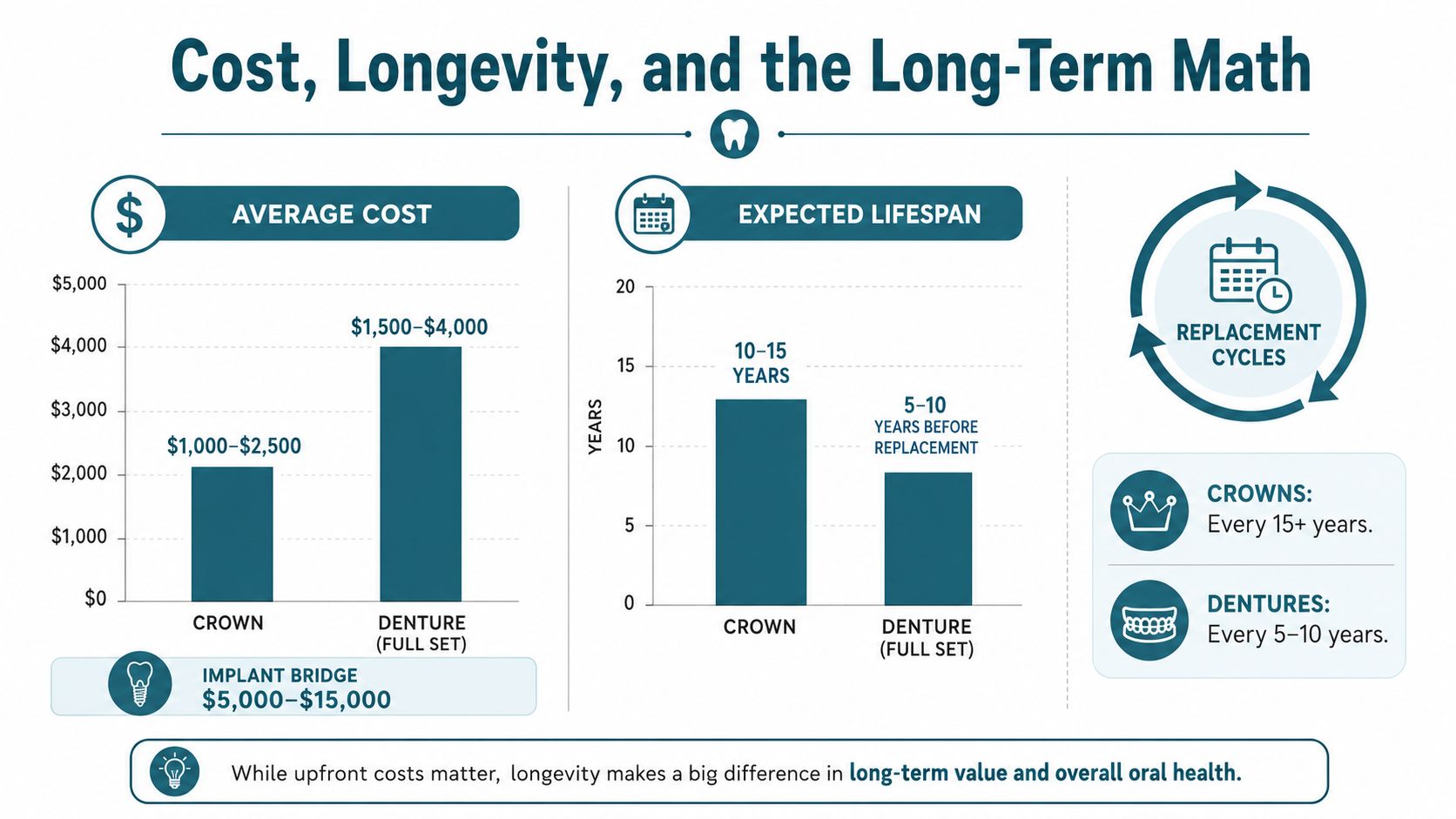
The maintenance burden is different too. Full dentures can restore only about 50 to 70% of natural bite force, conventional dentures often need replacement in 5 to 8 years, and crowns commonly last 10 to 15 years with proper care how long dental crowns last MedBridge second opinion. Those numbers do not decide every case, but they make the long-term trade-off easier to see.
The part most patients miss
A crown is usually a focused investment in one tooth. A denture is a wider replacement plan, and the mouth keeps changing, so the appliance has to keep up with those changes. That is why the cheaper path at the start is often the one that asks for more spending later.
The question is how much tooth can still be saved without chasing the same problem over and over. If the tooth has enough healthy structure to hold a crown, that usually gives the patient better day-to-day value. If the tooth is already beyond repair, extraction and a denture or implant plan may make more sense over time than paying to rescue a tooth that will keep failing. That is the long-term picture families should be looking at.
For families in Amanda and the surrounding communities, the payment conversation matters too. Amanda Family Dental supports flexible payment plans and the Power Plan Membership, which can make either option easier to manage when a household budget is part of the decision.
For a practical look at crown durability, how long dental crowns last is useful reading for patients who want fewer surprises before they commit.
When a Crown Is the Clear Winner
A crown is the right answer when the tooth is still salvageable and the goal is to keep it. That usually means the root is healthy enough, the surrounding support is reasonable, and the tooth can still carry a restoration without turning into a repeat problem. In that situation, a crown is a repair, not a compromise.
The situations that usually point to a crown
A crown often makes sense after a large cavity, a cracked tooth after root canal treatment, or a tooth weakened by a large old filling. Those teeth may look bad, but they're still part of the natural bite, and preserving them often gives patients the most stable result.
Peer-reviewed research supports that approach. One systematic review reported an overall survival rate of 97.9% after a mean follow-up of 6.44 years for ceramic crowns and fixed partial dentures, and it found full crowns outperformed partial crowns on technical clinical performance, 93% vs 64% PubMed review. That's the kind of reliability that matters when a patient wants a fixed solution that doesn't demand constant attention.
What a good crown candidate usually looks like
- Healthy root support: the tooth still has a foundation worth preserving.
- Restorable structure: enough tooth remains above and below the gumline to hold the crown.
- Controlled surrounding tissues: gum and bone support are not in obvious collapse.
- Single-tooth problem: one tooth needs rebuilding, not a full replacement plan.
Dr. Alyssa Jenkins and the Amanda Family Dental team evaluate each tooth with digital x-rays and a personalized plan before recommending this path for patients in Lancaster, Circleville, and Carroll. That matters because the crown decision should be based on what's left, not just on what looks broken from the outside.
The Triage Call Most Guides Skip
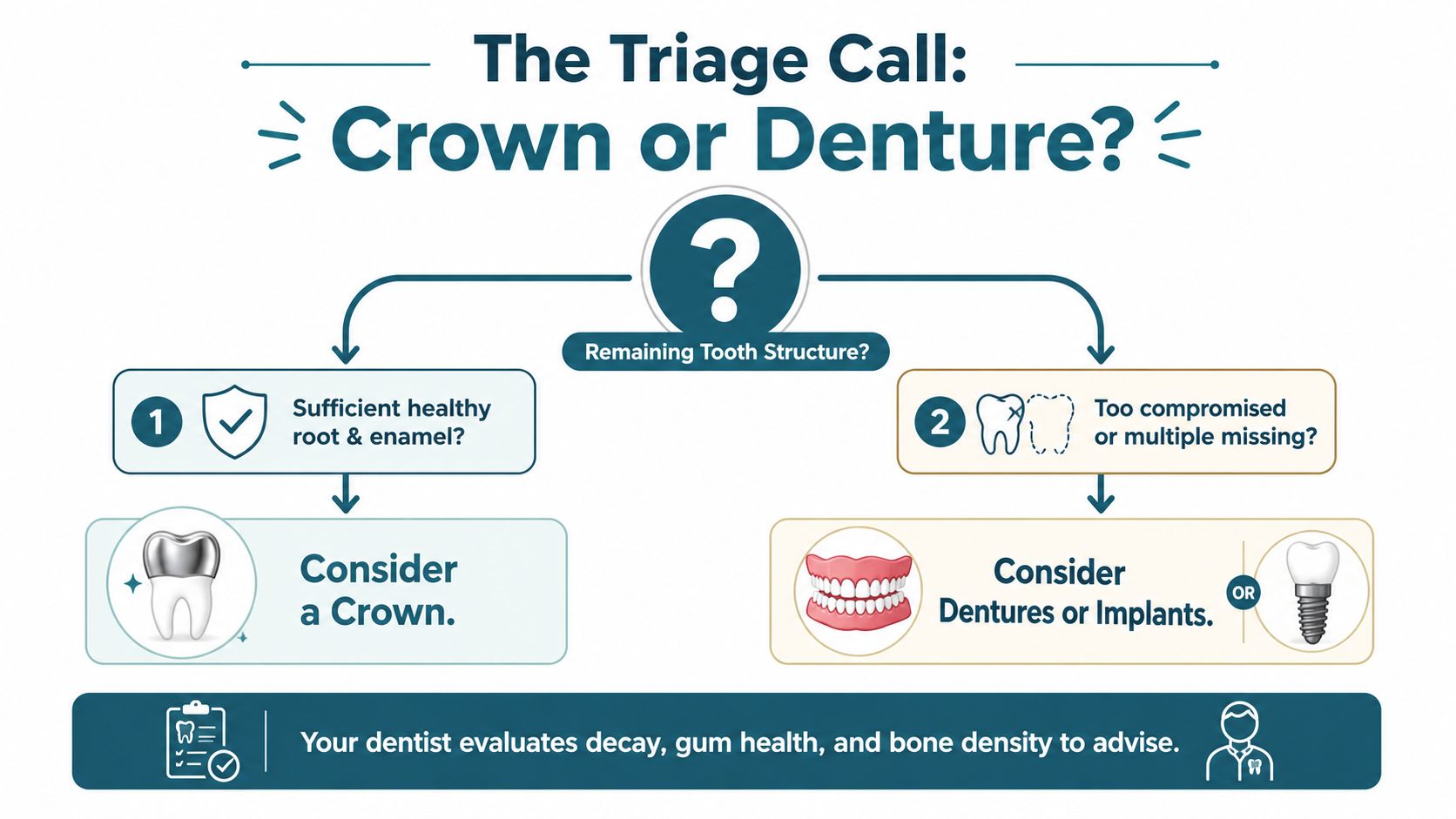
The key question is not whether a crown or denture sounds nicer. It's whether the tooth can survive long enough for a crown to be worth the effort. If the remaining structure is too compromised, saving it can turn into a cycle of repairs that ends in extraction anyway.
What pushes the decision toward extraction
Dentists look closely at root fracture, decay that extends too far below the gumline, major bone loss, and repeated failed restorations. Those are the warning signs that a crown may be asking too much from a tooth that's already on the edge.
A prosthetic that doesn't depend on a failing root changes the risk profile completely. Instead of trying to rescue a tooth that keeps breaking down, the plan shifts to replacement, which can be the smarter move when the tooth is no longer structurally dependable.
That's the part most comparison pages gloss over. Patients don't just need the label for the treatment, they need the decision rule behind it.
Simple decision rule: if the tooth can't reliably hold a crown, extraction plus denture or implant planning usually deserves serious consideration.
What to Expect at Amanda Family Dental
The visit starts with a real conversation, not a sales pitch. Patients from Amanda, Lancaster, Circleville, and Carroll can expect a new patient exam, digital x-rays, and a discussion about pain, function, appearance, and budget. From there, the team builds a personalized treatment plan instead of forcing every case into the same box.
The experience in plain terms
If a tooth can be saved, the plan may include a crown or another restorative treatment. If a tooth is already gone or non-restorable, the discussion shifts to dentures, dental implants, or extraction plus replacement planning. Patients with anxiety can also ask about sleep dentistry, which helps make longer or more difficult appointments easier to handle.
Amanda Family Dental also handles preventive, restorative, and cosmetic dentistry under one roof, so patients don't have to bounce between offices for cleaning and exams, dental x-rays, crowns, dentures, implants, or Invisalign. Same-day care is available when the schedule allows, which matters when a broken tooth turns into an urgent problem.
A family choosing between dentures vs crowns usually wants one thing above all else, clarity. They want to know what the mouth needs now, what it will need later, and how to keep the next problem from being bigger than the current one.
Your Next Step and Common Questions
The cleanest rule is still the most useful one. Save the tooth with a crown when the root and bone are healthy enough to support it. Choose a denture when multiple teeth are missing or the tooth can't be restored. Ask about implants when the patient wants a fixed long-term replacement and the mouth is ready for that path.
Patients looking for a practical next step can also read real feedback before booking, and 4squares Dentistry patient reviews are a reminder that trust matters as much as the treatment itself. At Amanda Family Dental, the goal is simple, give patients in Amanda and the surrounding Ohio communities a clear plan, not confusion.
Can a crown be placed on a denture? No, not in the usual sense. A crown is built to cover a tooth, while a denture replaces missing teeth.
Is a crown less painful than a denture? The procedures feel different, but the bigger issue is the condition being treated. A crown usually follows a damaged tooth, while a denture may follow extractions or a longer adjustment period.
What counts as a dental emergency in Amanda, OH? Severe pain, swelling, a broken tooth, or a tooth that's been knocked out should be treated as urgent and reviewed quickly by an emergency dentist.
Amanda Family Dental helps patients choose between crowns, dentures, and implants with straightforward guidance, digital x-rays, and care that fits real life. If a tooth hurts, breaks, or goes missing, schedule a visit with Amanda Family Dental and get a clear treatment plan before the problem gets worse.