

A lot of people start this search the same way. They notice a chip in a front tooth on a phone photo, a gap that seems more obvious than it used to, or staining that whitening doesn't fully fix. Then the comparisons begin: cosmetic bonding vs veneers, quick fix vs long-term investment, conservative treatment vs a bigger smile makeover.
For patients looking for a dentist in Amanda, OH, or searching for a cosmetic dentist near me from Lancaster, Circleville, or Carroll, Ohio, the question usually isn't just which treatment looks better. It's which option fits real life. Budget matters. Coffee habits matter. Wedding timelines matter. So does preserving natural tooth structure. This guide is built around those practical decisions, with clear explanations and a local, patient-centered perspective.
Table of Contents
- Your Guide to a Confident Smile in Amanda OH
- What Is Cosmetic Bonding
- What Are Porcelain Veneers
- Bonding vs Veneers a Side by Side Comparison
- Durability Longevity and Long Term Care
- Which Cosmetic Treatment Is Right for You
- Your Smile Makeover Journey at Amanda Family Dental
- Frequently Asked Questions About Cosmetic Dentistry
Your Guide to a Confident Smile in Amanda OH
A patient might walk into a local dental office in Amanda, OH covering their mouth when they laugh. Another might be preparing for senior photos, a job interview, or a family event in Lancaster, OH and finally deciding it's time to address a chipped or uneven front tooth. These concerns may seem small on paper, but they can affect confidence every day.
Cosmetic concerns also overlap with function more often than people realize. A worn edge can make a tooth look shorter. A rough chip can catch on the lip. Old staining can make teeth appear unhealthy even when they're otherwise sound. For many families searching for a dentist near me, the goal isn't perfection. It's a smile that feels natural, healthy, and comfortable to show.
Here's a quick comparison before getting into the details:
| Feature | Cosmetic Bonding | Porcelain Veneers |
|---|---|---|
| Main use | Small chips, minor gaps, localized shape issues | Broader smile changes across one or more front teeth |
| Tooth preparation | Usually little to no enamel removal | Requires enamel removal |
| Visits | Usually one visit | Usually two or more visits |
| Material | Composite resin | Porcelain |
| Upfront cost | Lower | Higher |
| Long-term stain resistance | Lower | Higher |
| Best fit | Conservative cosmetic touch-ups | Larger, longer-lasting smile redesign |
Why this choice feels difficult
Both options can improve a smile. That's why online searches often feel confusing. One article makes bonding sound like the obvious budget-friendly choice. Another makes veneers sound like the only treatment worth considering. In real practice, both have a place.
The right answer depends on what needs to be corrected, how long the result needs to last, and how a patient lives day to day.
Someone in Circleville, OH who wants to fix one small chip before an upcoming event may be an excellent candidate for bonding. Someone in Carroll, OH who wants to improve multiple front teeth and avoid frequent touch-ups may be better served by veneers.
What matters most in a real decision
Patients usually narrow this choice by looking at four things:
- Appearance goals whether the concern is a single tooth or a full smile line
- Tooth preservation especially for patients who want the most conservative option possible
- Maintenance tolerance because some people don't mind periodic touch-ups and others want fewer future repairs
- Lifestyle habits including coffee, tea, and red wine use
That practical lens is what makes cosmetic bonding vs veneers easier to understand. It turns an abstract comparison into a personal decision.
What Is Cosmetic Bonding
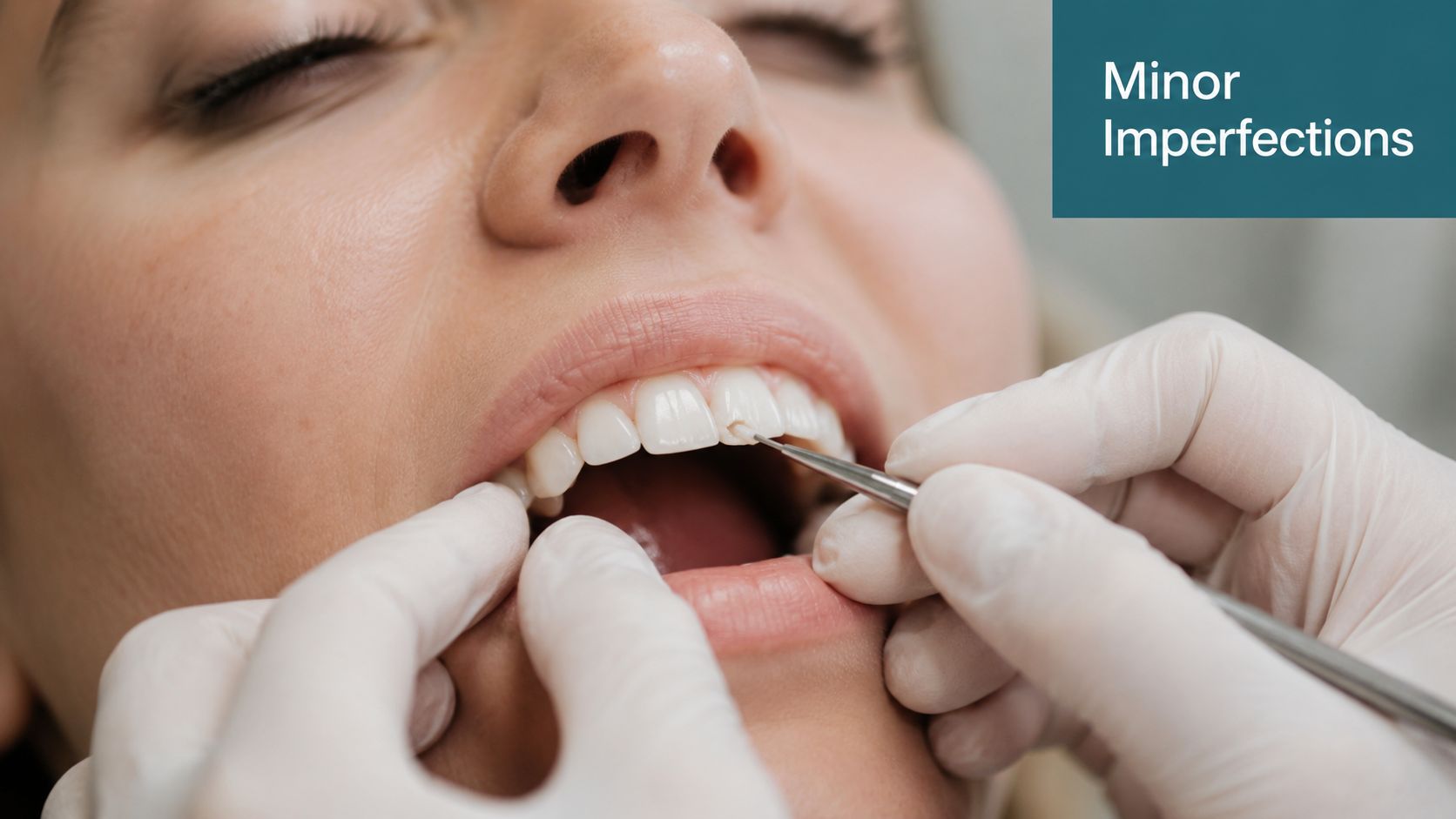
Cosmetic bonding is a conservative cosmetic treatment that uses tooth-colored composite resin to improve the shape, contour, or color of a tooth. The material is placed directly onto the tooth, shaped by the dentist, hardened with a curing light, and polished so it blends with the surrounding enamel.
It helps to think of bonding as sculpting on the tooth. The dentist adds material where it's needed, rather than covering the whole front surface with a separate shell. That makes bonding especially useful for a small chip, a narrow gap, a worn corner, or a tooth that needs a subtle shape correction.
How bonding works
Bonding is an additive procedure. The surface of the tooth is prepared so the resin can attach microscopically to enamel, and nearly all natural tooth structure is preserved. That's one of the biggest reasons patients choose it.
A typical bonding appointment is straightforward:
- Shade matching so the composite blends with nearby teeth.
- Surface preparation to help the resin bond securely.
- Placement and shaping to rebuild or refine the tooth.
- Curing and polishing to create a smooth, natural finish.
For many people looking for fast cosmetic dentistry in Amanda or nearby communities, the single-visit convenience is a major advantage. Patients who want to learn more about the procedure itself can review Amanda Family Dental's dental bonding procedure page.
When bonding works well
Bonding is often a good match for:
- Small chips on front teeth
- Minor spacing where a gap doesn't require orthodontic treatment
- Subtle reshaping of a tooth edge or corner
- Targeted repairs when one tooth stands out more than the rest
Clinical reality: Bonding is often the most conservative way to improve a tooth's appearance when the underlying issue is small and localized.
There is a trade-off, though. According to Shedd Family Dental's bonding and veneers comparison, bonding typically lasts 3 to 10 years, has a 5-year revision rate of 38%, and stain return occurs within 24 months for 41% of patients. That doesn't mean bonding is a poor treatment. It means it works best when patients understand that maintenance is part of the value equation.
What Are Porcelain Veneers
Porcelain veneers are thin ceramic coverings bonded to the front of teeth to change how those teeth look in a very controlled way. In practice, I recommend them for patients who want more than a small touch-up. They are often a better fit when color, shape, size, and symmetry all need attention at the same time.
For many patients in Amanda, this conversation starts with a real-life question. You may like your smile overall, but still notice several front teeth that look worn, uneven, darker than the others, or slightly out of balance in photos. Veneers can address those concerns together, with a treatment plan built around the full smile instead of one isolated spot.
How veneers differ from bonding
Veneers require careful preparation of the tooth surface so the porcelain sits naturally and does not look bulky. That means removing a small amount of enamel before the final veneer is made and bonded into place. Once that enamel is removed, the decision is permanent, so this option deserves thoughtful planning.
The process also takes more than one appointment. We evaluate the smile, prepare the teeth, take impressions or digital scans, and place the veneers after they are custom fabricated. Patients who want a closer look at each step can read how veneers work at Amanda Family Dental.
Veneers involve a bigger commitment than bonding, both in cost and in the amount of tooth structure we change.
Where veneers make the most sense
Veneers are often the stronger choice for patients dealing with several cosmetic concerns across the front teeth, such as:
- Stubborn discoloration that whitening cannot improve enough
- Multiple chipped or worn teeth
- Noticeable differences in shape or size
- Minor unevenness where the teeth look misaligned, even if the bite does not need orthodontic treatment
This is one reason veneers appeal to patients who want a more coordinated result. Instead of correcting one area at a time, we can plan the visible front teeth together so the smile looks balanced from side to side.
The main trade-off
Porcelain has two practical advantages many patients care about. It holds its polish well, and it resists staining better than composite resin.
The trade-off is conservation. Bonding usually preserves more natural tooth structure, while veneers usually provide a broader and more stable cosmetic change.
A patient with one small chip may do very well with bonding and avoid unnecessary treatment. A patient who has been hiding several front teeth in pictures may get a more predictable result from veneers. The right answer depends on what bothers you, how long you want the result to last, and how much treatment you are comfortable committing to.
Bonding vs Veneers a Side by Side Comparison
A patient in Amanda might walk in with one small chip and want it fixed before a family event. Another may be tired of hiding several front teeth in photos and want a more coordinated change. Those are two very different goals, and they should not lead to the same recommendation.
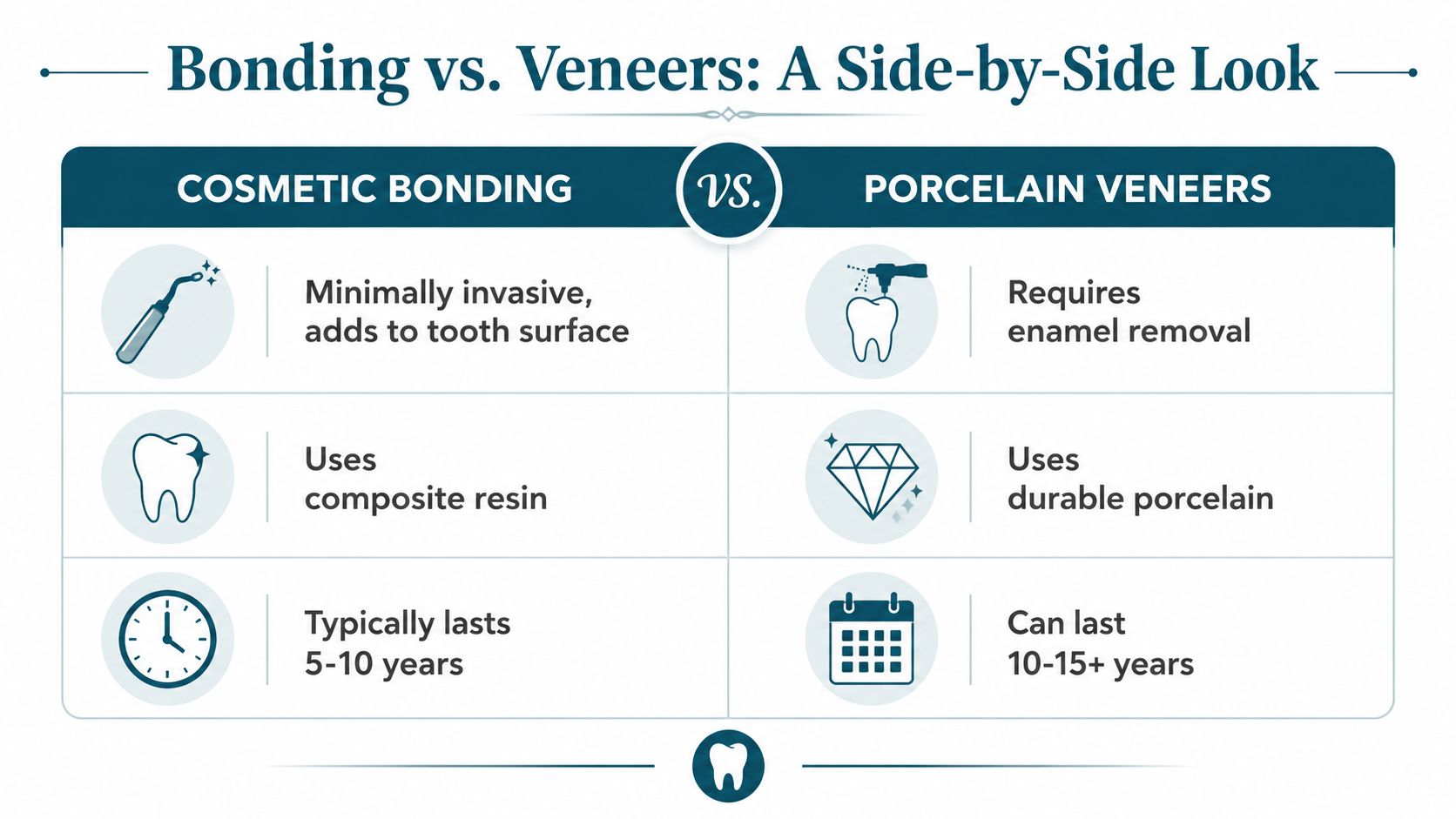
The clearest way to compare cosmetic bonding and veneers is to look at how each option fits real life: how much treatment is involved, how broad the cosmetic change needs to be, and what kind of maintenance you are comfortable with over time.
Procedure and time commitment
Bonding is usually the simpler appointment. We place the composite directly on the tooth, shape it, and polish it during the visit. For a small chip, slight gap, or minor contour issue, that can be a very practical solution.
Veneers take more planning. The teeth are prepared, records are taken, and the final porcelain pieces are made before they are bonded into place. That process asks for more time and more commitment, but it also gives us more control if the goal is to improve several visible teeth in a balanced way.
Appearance and scope
Bonding works well for targeted repairs. It can blend nicely when the change is small and the surrounding tooth already has a good shape and color.
Veneers usually make more sense when the smile needs consistency across multiple front teeth. If color, width, length, and overall symmetry all need attention, porcelain gives us a stronger design tool. That matters for patients who want their whole smile to look more even, not just one tooth to look repaired.
| Decision factor | Bonding | Veneers |
|---|---|---|
| Best for | Small, isolated cosmetic fixes | Multi-tooth smile enhancement |
| Convenience | Faster | Slower |
| Tooth preservation | Higher | Lower |
| Uniformity across several teeth | More limited | Stronger |
| Future touch-ups | More likely | Less likely |
Upfront cost and long-term value
For many families in the Amanda area, cost is part of the decision, but it should be weighed alongside maintenance and expected lifespan. Bonding usually costs less at the start, which can make it a good fit for a limited repair or a patient who wants to stay conservative.
Veneers cost more because they involve custom lab work and a more involved process. Still, higher initial cost can make sense if you want a broader cosmetic change that stays stable longer. Patients who are comparing options often find it helpful to review realistic expectations about how long porcelain veneers can last with proper care.
In our office, the best choice usually becomes clearer once we match the treatment to the actual problem. A single chipped tooth, a worn edge from grinding, and a full front-smile redesign each call for a different standard. The right option is the one that fits your smile goals, your habits, and how much dentistry you want to commit to now versus later.
Durability Longevity and Long Term Care
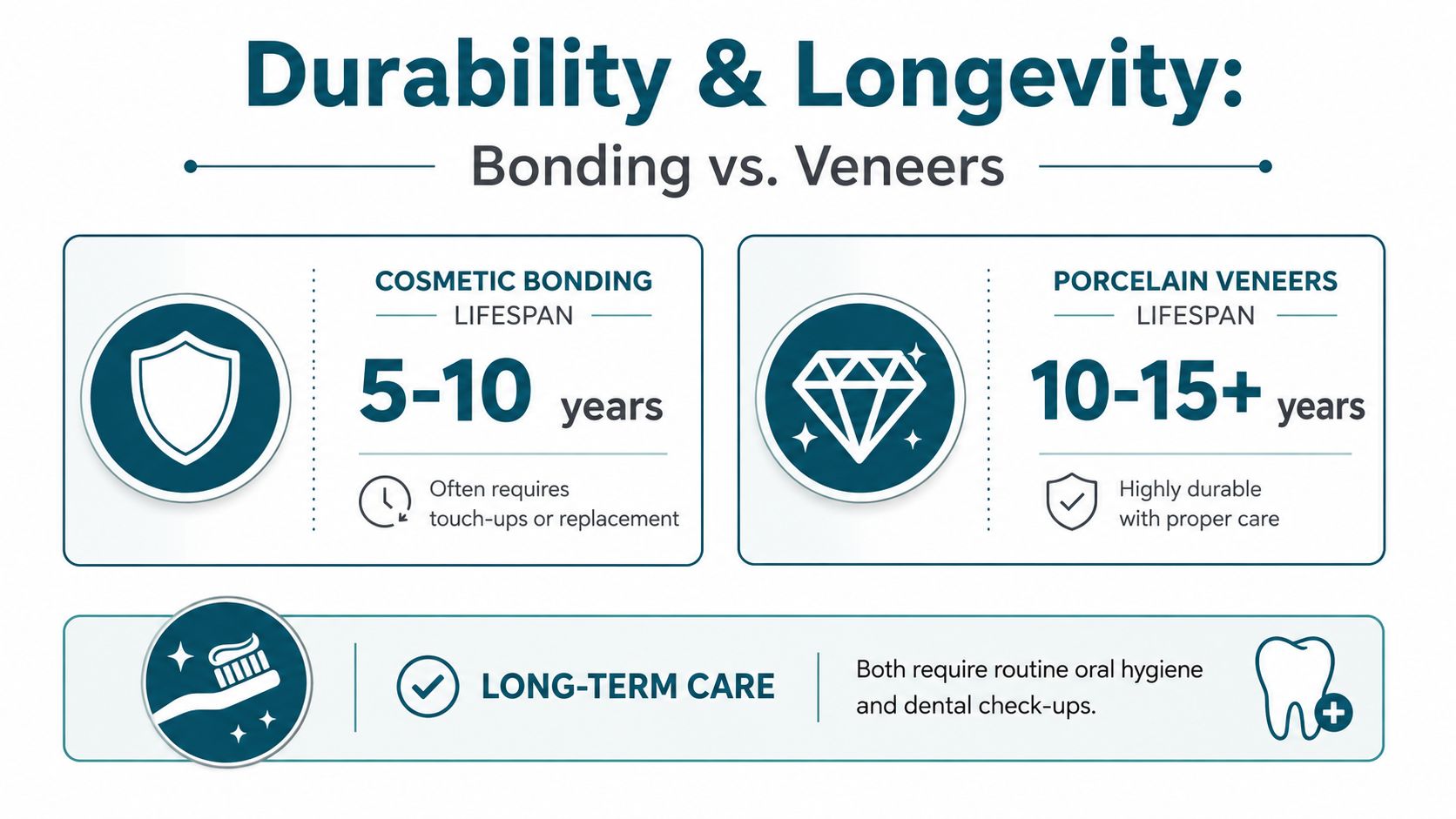
For many patients, this is the section that clarifies the decision. A cosmetic result isn't just about how it looks the week after treatment. It's about how it holds up to coffee, meals, brushing, polishing, and ordinary wear.
Early in that conversation, it helps to see the difference visually.
What the long-term data shows
Porcelain is a ceramic material. Composite bonding uses resin. That material difference shows up in survival, revision, and maintenance.
According to Dentistry in Redfern's clinical review summary, porcelain veneers have a 10-year survival rate of 95.5% and a 5-year revision rate of 9%, while composite bonding has a 10-year survival rate near 60% and a 5-year revision rate of 38%. That's a major gap in predictability.
This topic also comes up often when patients ask about aftercare and lifespan expectations, which is why many review resources such as Amanda Family Dental's page on how long veneers last focus on maintenance habits and realistic longevity.
A short video can help patients visualize those long-term differences in a practical way.
How lifestyle changes the answer
The choice largely depends on individual habits. A patient who drinks water most of the day and wants to repair one front tooth may do very well with bonding. A patient who drinks coffee every morning and red wine regularly is asking more from composite.
For patients who care about minimizing future maintenance, veneers usually offer the stronger long-term path. For patients who prioritize a conservative, lower-commitment treatment for a limited cosmetic issue, bonding still has an important role.
The more a smile is exposed to staining habits and repeated touch-up needs, the more porcelain starts to make sense.
Long-term care for both options
Both treatments still require basic dental care:
- Daily brushing and flossing to protect the teeth and gums around the cosmetic work
- Regular checkups and dental x-rays when needed to monitor the supporting tooth structure
- Care with hard objects because neither bonding nor veneers should be used to open packaging or bite ice
Durability is never just about the material. It's also about whether the treatment fits the patient's habits.
Which Cosmetic Treatment Is Right for You
The right treatment usually becomes clear during a consultation because the conversation shifts from “Which one is better?” to “What is this patient trying to fix?” A college student from Lancaster, OH with one chipped incisor after a sports accident has a very different plan than a working parent from Circleville, OH who wants to improve the color and symmetry of several front teeth before a major family event.
When bonding is usually the better fit
Bonding often makes more sense when the cosmetic issue is small and specific. It's especially practical when the patient wants a quicker solution and prefers to keep as much natural enamel untouched as possible.
Common examples include:
- A single chipped front tooth
- A small gap between teeth
- Minor shape asymmetry
- A patient testing a cosmetic change before considering something more involved later
For these cases, the conservative nature of bonding is a real strength. It can deliver a visible improvement without turning one small concern into a more extensive procedure.
When veneers often become the smarter choice
Veneers usually rise to the top when a patient wants a broader smile upgrade across multiple teeth, or when stain resistance matters a lot in everyday life.
According to My Dulce Dental's discussion of bonding versus veneers for stain management, daily coffee or red wine drinkers may need bonding touch-ups within 2 to 4 years, which can be much shorter than the theoretical lifespan patients often expect. That's one of the most important real-world filters in this decision.
Someone who wants a white, even smile but also drinks staining beverages every day may be happier planning for veneers from the start.
How a local patient journey usually looks
A patient from Carroll, OH might arrive thinking bonding and veneers are basically interchangeable. After an exam, photos, and a conversation about goals, the picture often sharpens quickly. If the patient dislikes one chipped corner, bonding may be enough. If the patient points to multiple concerns on several front teeth, veneers may better match the outcome they have in mind.
Another patient may start by asking about cosmetic dentistry and end up discussing other services first, such as a cleaning, restorative dentistry, or treating a painful tooth before elective cosmetic work. That's normal. Smile planning works best when it's built on healthy teeth and gums.
The decision also needs to respect timing and budget. Some patients want the most conservative fix right now. Others want a result designed to hold up for years with fewer aesthetic changes over time. Neither approach is wrong. The better choice is the one that fits the person, not the trend.
Your Smile Makeover Journey at Amanda Family Dental
A cosmetic consultation should answer practical questions, not create pressure. Patients generally want to know whether they're a candidate, how natural the result can look, what the process involves, and whether another option such as whitening, Invisalign, crowns, or restorative treatment should come first.

What happens at the first visit
At Amanda Family Dental, the process begins with a conversation about what the patient sees in the mirror and what they want to change. Then the clinical side follows. That may include a new patient exam, digital x-rays, photos, and a close look at enamel, bite, gum health, and existing dental work.
That matters because cosmetic treatment shouldn't be planned in isolation. If a tooth is cracked, decayed, or under heavy bite stress, the best cosmetic answer may not be the one a patient expected from an online search for a cosmetic dentist near me.
Questions patients often ask
A few questions come up almost every time:
- Will it look natural? A well-planned case should match the face, lips, and surrounding teeth rather than looking flat or overly bright.
- Will it hurt? Many cosmetic cases involve only mild discomfort, and the exact experience depends on the amount of preparation needed.
- Can the plan be personalized? Yes. Some patients are best served by bonding, others by veneers, and some by a combination of cosmetic and restorative treatments.
- What if there's another dental issue first? Sometimes a patient also needs a crown, a filling, routine dental care, or even urgent treatment before cosmetic work begins.
A good consultation narrows the choice. It doesn't oversell one treatment for every smile.
What patients can expect next
Once the exam is complete, the next steps usually include:
- Reviewing smile goals so the treatment aligns with what bothers the patient most.
- Comparing options clearly including benefits, limitations, and maintenance.
- Creating a treatment plan with sequencing, timing, and fee discussion.
- Scheduling care around work, family, and other dental needs.
Patients from Amanda, Lancaster, Circleville, and Carroll often say the hardest part was deciding to ask. Once the conversation starts, the choice usually becomes much easier.
Frequently Asked Questions About Cosmetic Dentistry
Is bonding or veneers better for longevity
For longevity, veneers usually have the advantage. According to Dr. Vigoren's discussion of cosmetic bonding and veneers, the median survival time for cosmetic bonding is approximately 6 years, while porcelain veneers often last 15 to 20 years.
Does bonding preserve more natural tooth structure
Yes. Bonding is generally the more conservative option because it adds material to the tooth instead of requiring the same kind of enamel reduction used for veneers.
Can cosmetic treatment be part of a bigger dental plan
Yes. Some patients combine cosmetic dentistry with cleaning and exams, restorative dentistry, or other care depending on their oral health needs.
Patients looking for a dentist in Amanda, OH, dentist in Lancaster, OH, dentist in Circleville, OH, or dentist in Carroll, OH often start with one question about their smile and end up with a clearer plan for their overall dental health. To talk through cosmetic bonding vs veneers with a local team, schedule a consultation with Amanda Family Dental.