


A patient in Lancaster loses a back molar, starts searching for dental implants near me, and quickly runs into a mess. One office recommends an implant right away. Another says bone grafting first. A third talks about full digital planning and a different material. The prices don't match, the timelines don't match, and the patient is left wondering whether the most expensive option must be the best one.
Usually, it isn't.
The best dental implants decision has less to do with a brand name and more to do with fit. The right implant plan depends on bone volume, gum health, bite pressure, healing capacity, timing after extraction, and whether the case involves one tooth or a full arch. That's the part many patients in Amanda, OH, Lancaster, OH, Circleville, OH, and Carroll, OH don't hear clearly enough when they're comparing treatment plans.
This is also why a patient looking for a dentist near me, an emergency dentist, or help after a tooth extraction often gets better answers from a careful implant consultation than from a quick online price comparison. Missing teeth affect chewing, speech, comfort, appearance, and jawbone support. Replacing them well matters.
Early on, it helps to compare the big categories side by side.
| Option | Best fit | Main trade-off | Typical goal |
|---|---|---|---|
| Single-tooth implant | One missing tooth with healthy neighboring teeth | Requires surgery and healing time | Replace one tooth without using adjacent teeth |
| Implant-supported bridge | Several missing teeth in one area | More planning than a regular bridge | Replace multiple teeth with fewer implant posts |
| Implant-retained denture | Patients missing many or all teeth and wanting more stability | Still involves maintenance and attachment wear | Improve denture hold and comfort |
| Full-arch fixed implant restoration | Patients wanting a non-removable full-arch solution | Higher complexity and stronger maintenance commitment | Restore an entire upper or lower arch |
Patients searching for a dentist in Amanda, OH or a dentist in Circleville, OH usually want a simple answer. The honest answer is still simple. The best implant is the one that matches the mouth that has to carry it for years.
Table of Contents
- What Patients Really Mean by the Best Dental Implants
- How Dental Implants Work and How They Differ From Other Options
- Comparing Implant Types, Systems, and Materials
- Who Is a Good Candidate for Dental Implants
- The Dental Implant Timeline From Consultation to Final Crown
- Dental Implant Costs, Insurance, and Payment Options
- Implants vs Dentures and Bridges for Local Patients
- What to Expect at Amanda Family Dental and How to Begin
What Patients Really Mean by the Best Dental Implants
The question isn't strictly “Which implant brand wins?” when searching for the best dental implants. It's, “Which option is least likely to fail, look fake, drain the budget, or turn into a long headache?”
That's a fair question.
A patient from Lancaster, OH comparing two implant quotes may see one treatment plan built around speed and another built around healing. One may include grafting. One may recommend a delayed approach after extraction. One may suggest a single implant, while another may propose a bridge or removable replacement. Those aren't random differences. They reflect different clinical judgments.
Best rarely means most expensive
Brand marketing has trained patients to think the label is everything. It isn't. Well-known systems such as Straumann, Nobel Biocare, and Zimmer are widely used, but the more important questions are these:
- Bone support: Is there enough bone width and height to hold an implant predictably?
- Gum condition: Are the gums healthy enough to support long-term stability?
- Bite force: Does the patient clench, grind, or overload back teeth?
- Timing after loss: Is the site clean and stable now, or does it need healing first?
- Maintenance habits: Will the patient return for follow-up care and keep the area clean?
Practical rule: A well-planned implant in the right mouth beats a trendy implant in the wrong case.
The real decision drivers
The treatment path changes depending on what's missing and what the tissues can support. A single front tooth is an esthetic case. A single molar is a force case. Several missing teeth in a row create a design problem. Full-arch treatment brings speech, bite balance, and long-term hygiene into the conversation.
A patient who recently needed an emergency dentist visit for a cracked or infected tooth may assume the fastest replacement is automatically the smartest one. It isn't always. Some sites need healing before placement. Some need grafting. Some need a different restoration altogether.
The strongest implant plan is the one that still makes sense five and ten years later, not just on surgery day.
That's why patients searching for a dentist in Carroll, OH or a dentist in Amanda, OH should focus less on slogans and more on case fit. Better planning usually means fewer surprises.
How Dental Implants Work and How They Differ From Other Options
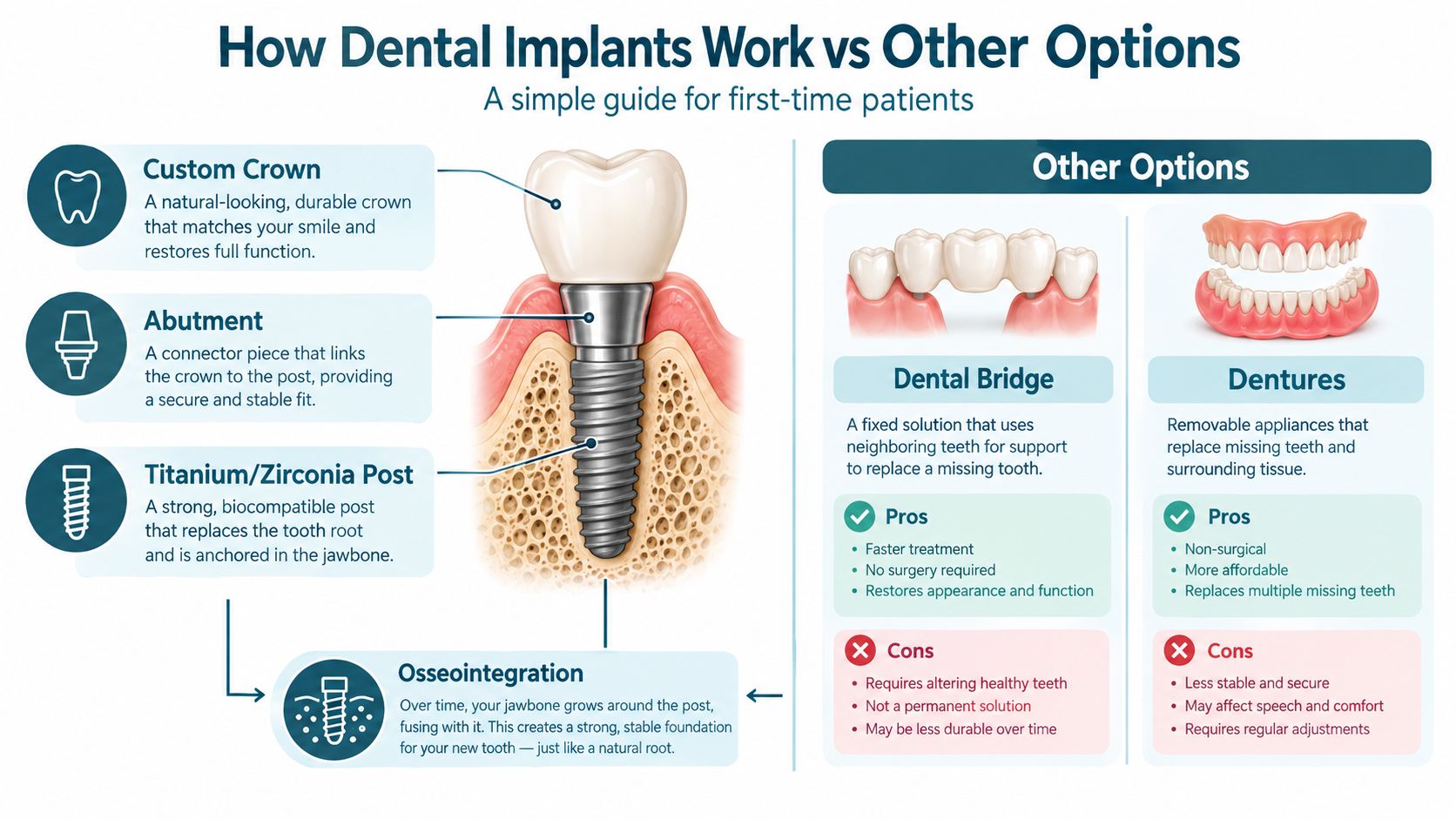
A dental implant replaces the root of a missing tooth. The implant post sits in the jawbone, an abutment connects the parts, and a custom crown sits on top. The result is a replacement tooth that's fixed in place rather than resting on the gums or hanging from neighboring teeth.
The concept is straightforward. The execution has to be precise.
The three parts patients should know
Think of an implant like a foundation, connector, and finished tooth.
- Implant post: This is usually made from titanium or zirconia and placed in the jawbone.
- Abutment: This small connector joins the implant to the visible restoration.
- Custom crown: This is the tooth-shaped part patients see when they smile and chew.
Why implants feel different
The key process is osseointegration, which means the bone bonds to the implant surface over time. In plain terms, the jaw treats the implant like a stable anchor. That's why implants don't move the way removable dentures can.
Modern long-term results are strong. A systematic review reported a 10-year implant-level survival estimate of 96.4% and another review of studies published from 2010 to 2020 reported a similar 10-year survival of 96.0% in contemporary cohorts, according to the Liverpool long-term implant review. That durability is a major reason implants remain a core option for single-tooth replacement.
How implants compare with bridges and dentures
A fixed bridge fills a gap by attaching to neighboring teeth. That can work well in the right case, but it usually means reshaping healthy adjacent teeth to support the restoration.
A removable denture sits on the gums and can replace several teeth or a full arch. It's less invasive up front, but it may feel bulkier and less secure.
Here's the plain-language comparison:
- Implant: Anchored in bone, fixed in place, no need to rely on nearby teeth
- Bridge: Fixed in place, but supported by adjacent teeth
- Denture: Removable and gum-supported
For patients looking for restorative dentistry, cosmetic dentist near me, or replacement after a missing tooth, implants stand apart because they restore from the root up. That root replacement matters for stability and function, not just appearance.
Comparing Implant Types, Systems, and Materials
Not all implants are placed the same way, and not all materials behave the same way. Patients shopping for the best dental implants usually get overwhelmed because offices mix together implant type, implant brand, and crown design as if they're the same decision. They aren't.
Dental Implant Types and Materials Compared
| Type | Placement | Best For | Material Options | Typical Candidacy |
|---|---|---|---|---|
| Endosteal | In the jawbone | Most single-tooth, multi-tooth, and many full-arch cases | Titanium, titanium-zirconium, zirconia | Patients with adequate bone or those willing to graft if needed |
| Subperiosteal | On top of the bone under the gum tissue | Select severe bone-loss cases when traditional bone placement isn't ideal | Usually metal framework with implant components | Patients with reduced bone who need an alternative to standard bone placement |
| Zygomatic | Anchored into the cheekbone in the upper jaw | Advanced upper-jaw bone loss | Typically titanium-based systems | Complex upper-arch cases requiring specialist-level planning |
Which type fits most patients
Endosteal implants are the standard choice. They go directly into the jawbone and cover most routine cases, from one missing premolar to implant-supported bridges and full-arch work.
Subperiosteal implants have a narrower role. They sit on top of the bone beneath the gum tissue and may be considered in selected cases with major bone loss, especially when conventional placement isn't practical.
Zygomatic implants are a specialty tool for severe upper-jaw atrophy. They're not a general option for average cases in Amanda, Lancaster, Circleville, or Carroll. They require advanced planning and are usually reserved for highly complex full-arch situations.
Patients should be cautious when a complex implant type gets pitched as a shortcut. Complex tools belong in complex cases.
Titanium vs zirconia
For material choice, titanium still has the strongest validation. A review found titanium and zirconia can show comparable osseointegration after surface treatment, but titanium has superior baseline osseointegration without surface treatment. In a 2023 clinical cohort of 637 implants, survival was 97.7% for titanium, 98.6% for titanium-zirconium, and 93.8% for zirconia, as reported in the comparative implant material review on PubMed.
That doesn't mean zirconia has no place. It can be appealing when a patient wants a metal-free option or when gum thickness and esthetics are major concerns. But if the question is which material has the deepest clinical track record, titanium wins.
Brand names matter less than planning
Straumann, Nobel Biocare, and Zimmer are all recognized systems. None of them can rescue poor case selection, sloppy bite design, or neglected maintenance.
What matters more:
- 3D planning
- Precise positioning
- Healthy gum tissue
- A restoration designed for the patient's bite
- Regular follow-up
Patients don't wear a brand logo in their mouths. They live with the result.
Who Is a Good Candidate for Dental Implants
Implants aren't just for young, perfectly healthy patients. Plenty of older adults make excellent candidates. Some younger adults don't. The right question isn't “Can this tooth be replaced with an implant?” It's “Will this implant stay healthy in this particular person?”
That's where honest screening matters.
The basics that have to be there
A good candidate usually has enough bone to support the implant, gum tissue that's free from active periodontal disease, and overall health that allows normal healing. If bone is lacking, grafting may be part of the plan. If gum disease is active, that needs treatment first.
Habits matter too. Smoking, poor home care, heavy grinding, and uncontrolled medical issues can all make an implant harder to protect long term.

Why certainty is often overstated
This part deserves more honesty than patients usually get. A 2025 systematic review found current models for predicting implant complications and survival have limited methodological quality and external validity, according to the review of prediction models for implant outcomes. In plain language, dentistry still doesn't have a perfect formula that can tell every patient exactly how an implant will behave in their individual mouth.
That same source noted that in a 20-year study, implant survival was 93.0%, and failure causes were almost evenly split between biological and mechanical reasons. That matters because it shifts the conversation away from brand worship and toward risk-adjusted decision-making.
The better question is not “Which implant is best?” It's “Which implant approach fits this anatomy, this bite, and this maintenance pattern?”
Timing and health status can change the answer
Immediate placement after extraction sounds appealing, but faster isn't always better. A 2025 retrospective analysis reported higher 72-month survival for delayed implants than immediate implants, 81.1% versus 53.2%, in the findings summarized by the Frontiers review on timing and medical status.
That same review also noted that prediabetic patients in the included studies showed implant survival comparable to healthy patients, but with poorer peri-implant tissue health. So survival alone doesn't tell the full story.
A thorough implant consultation should include:
- Digital X-rays and 3D CBCT imaging to map bone width, height, sinus space, and nerve position
- Gum evaluation to check for active inflammation or recession
- Bite analysis for clenching, wear, and force concentration
- Medical review to look at healing and inflammation risks
Age alone doesn't rule implants out. Jaw growth status matters for younger patients. For older adults, general health and maintenance commitment matter more.
The Dental Implant Timeline From Consultation to Final Crown
Most implant cases don't fail because the process is too long. They fail when someone tries to make the process too short.
What happens first
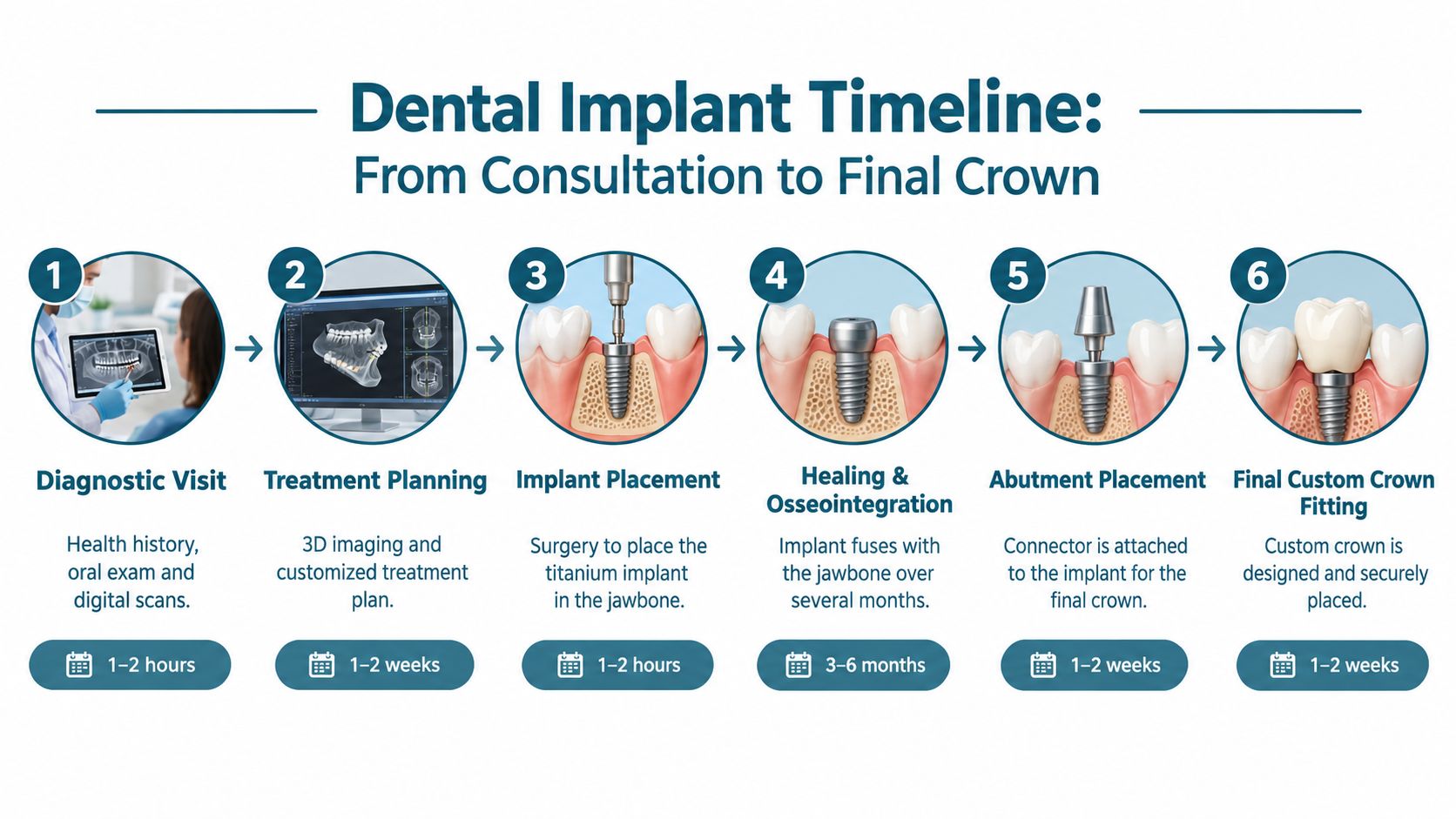
The first visit is a planning visit. The dentist reviews health history, examines the mouth, takes digital records, and uses 3D imaging to see the bone clearly. That's when decisions get made. Is the site ready now? Is grafting needed? Is the bite favorable? Is the case straightforward or more involved?
This visual gives patients a simple view of the sequence.
The middle phase most patients underestimate
Once the implant is placed, the jaw needs time to bond to it. That healing period often runs roughly three to six months in many routine cases, and grafting can extend it further. This is the part patients are often tempted to rush, especially after a recent extraction or when appearance is a concern.
For a deeper explanation of healing stages and why waiting matters, Amanda-area patients can review this guide on the dental implant healing timeline.
A short video can also make the sequence easier to picture.
The finish line
After healing, the final steps usually include uncovering the implant if needed, placing a healing abutment or final abutment, taking impressions or digital scans, and fitting the custom crown. Bite adjustments matter here. A crown that looks good but hits too hard can create trouble.
Full-arch treatment can move faster cosmetically. Some patients receive a temporary fixed prosthesis the same day. But even in those cases, the permanent restoration still comes later after the implants and tissues settle.
Dental Implant Costs, Insurance, and Payment Options
Implant quotes vary because implant treatment isn't one item. It's a series of parts, visits, materials, and clinical decisions bundled into one outcome.
What actually drives the price
A fair implant estimate may include the surgical placement, the implant component itself, the abutment, the final crown, imaging, lab work, follow-up visits, and any added procedures such as bone grafting or a sinus lift. Sedation can also affect the total.
That's why comparing one office's price to another without looking at what's included usually leads to bad comparisons.
For patients who want a local breakdown of what affects fees, this page on how much dental implants cost helps frame the discussion.
Insurance rarely pays the whole bill
Most dental plans don't make implants easy. Coverage is often partial, annual maximums can limit what gets paid in a given year, and some plans cover parts of treatment differently than others. Patients should expect to verify whether the plan contributes to the extraction, grafting, implant, abutment, or crown, because those pieces may be handled separately.
That doesn't mean treatment should be delayed blindly. It means the financial plan should be clear before treatment starts.
Implant Cost vs Alternatives 20-Year Comparison
| Treatment Option | Initial Cost Range | Maintenance/Repairs | Likely Replacements | Total 20-Year Estimate |
|---|---|---|---|---|
| Single dental implant | Higher upfront | Possible crown or component maintenance over time | Often fewer full replacements if well maintained | Often favorable long term despite higher starting cost |
| Fixed bridge | Lower to moderate upfront | Pontic wear, margin problems, possible decay on support teeth | More likely to need replacement during the long term | Can become costly if support teeth fail |
| Removable denture | Lowest upfront | Relines, repairs, fit changes, possible remakes | More frequent replacement cycle | Lower at first, but repeated upkeep adds up |
No precise universal fee chart belongs here because the actual cost turns on anatomy, materials, and whether preparation is needed. But the pattern is consistent. Bridges and dentures usually cost less to start. Implants often make more sense over the long run when they preserve neighboring teeth and create a fixed solution.
Patients without insurance often look at financing, health credit options, standard cards, or membership savings. Some practices, including Amanda Family Dental, also offer a Power Plan Membership that can help uninsured patients access planned care without putting off treatment that affects chewing, comfort, and bone support.
Implants vs Dentures and Bridges for Local Patients
Patients in Amanda, OH, Lancaster, OH, Circleville, OH, and Carroll, OH usually aren't choosing between abstract treatment categories. They're choosing how they want to eat, speak, clean, and live.
A single missing tooth calls for one kind of answer. A full arch with failing teeth calls for another.
Dental Implants vs Bridges vs Dentures
| Factor | Dental Implant | Fixed Bridge | Removable Denture |
|---|---|---|---|
| Support | Anchored in bone | Supported by neighboring teeth | Rests on gums |
| Effect on nearby teeth | Usually preserves them | Often requires reshaping support teeth | Doesn't rely on adjacent teeth the same way |
| Stability | Fixed and secure | Fixed | Can shift or loosen |
| Bone preservation | Helps maintain bone by loading the jaw | Doesn't replace the root in bone | Doesn't replace the root in bone |
| Cleaning | Requires daily brushing and detailed home care | Requires cleaning around bridge margins | Requires removal and cleaning outside the mouth |
| Lifestyle feel | Closest to a standalone tooth | Good in many cases, but not root-replacing | Usually the biggest adaptation |
Which option fits which situation
For a single missing molar, an implant usually makes the most sense when the bone and gums allow it. It replaces the missing tooth without cutting down healthy neighboring teeth.
For three adjacent missing teeth, an implant-supported bridge may be more practical than placing a separate implant for every space.
For full-arch tooth loss on a tighter budget, implant-retained overdentures often strike a useful middle ground. They give more hold than a conventional denture without the higher complexity of a fully fixed arch.
For patients who can't undergo surgery, a conventional denture or a bridge may still be the right move. Not every patient needs an implant to get relief and function back.
A good treatment plan doesn't force everyone into implants. It matches the restoration to the patient's health, anatomy, budget, and willingness to maintain it.
Patients comparing fixed and removable options can also review this guide on dental implants vs permanent dentures.
The plain trade-off
Implants usually offer the most natural feel and the best tooth-by-tooth replacement strategy. Bridges can be efficient in selected cases. Dentures remain valuable when surgery, anatomy, or finances limit other choices.
The right decision isn't ideological. It's practical.
What to Expect at Amanda Family Dental and How to Begin
The first implant visit should lower anxiety, not raise it. Patients who come in from Amanda, Lancaster, Circleville, or Carroll are usually trying to answer three things fast. What's wrong, what will fix it, and what will it take to get there?
A careful consultation answers those directly.
What the first visit usually includes
The visit typically starts with check-in, an exam, digital X-rays, and a conversation about symptoms, timing, and goals. If implants are being considered, 3D imaging helps map bone shape, available space, and nearby anatomy before any surgery gets scheduled.
The discussion should also cover practical concerns:
- Function: Is the patient trying to replace one chewing tooth or stabilize a full arch?
- Timing: Is this after a recent tooth extraction, or has the tooth been missing for years?
- Budget: Does the patient want phases, financing, or a lower-upfront alternative?
- Comfort: Would the patient prefer care coordinated with a surgeon or periodontist for placement?
What happens after the evaluation
If the case is a good fit, the next step is a written treatment plan with itemized phases. That may include grafting, referral for surgical placement, healing visits, and the final crown or prosthesis. Some patients need a straightforward single implant. Others need disease control first, especially if they came in because of pain, infection, or a broken tooth.
For people trying to research decisions well before booking, community discussion spaces can be useful when they're filtered carefully. Teams that study how people ask candid healthcare questions online sometimes use tools like Reddit ad management to understand what concerns real patients raise repeatedly. The useful takeaway isn't the marketing angle. It's that patients keep asking the same practical questions about healing time, cost, and whether they're candidates.
A clear next step for local patients
Amanda Family Dental serves patients looking for a dentist in Amanda, OH, a dentist in Lancaster, OH, a dentist in Circleville, OH, or a dentist in Carroll, OH who want straight answers about implants, restorative dentistry, cleaning and exams, emergency dental services, cosmetic dentistry, and long-term oral health. The office also evaluates when an implant is the right choice and when a bridge, denture, or phased treatment plan makes more sense.
That matters because patients don't need pressure. They need a plan they can understand and live with.
If a missing tooth is affecting chewing, confidence, or comfort, the next move is simple. Schedule a consultation, get the imaging and exam, and compare options based on anatomy, timing, and maintenance instead of guesswork.
Amanda Family Dental offers implant consultations, digital imaging, restorative treatment planning, and practical guidance for patients deciding between implants, bridges, and dentures. Patients in Amanda, Lancaster, Circleville, and Carroll who want clear answers about missing teeth, healing, and next steps can visit Amanda Family Dental to request an appointment and start with a personalized evaluation.