


A lot of people land in the same spot. They whiten their teeth, admire the brighter shade in the mirror, then take a sip of cold water and feel a quick, sharp zing. It can be unsettling, especially for a dentist near me because they want cosmetic results without trading comfort for them.
That reaction is common, and in most cases it's temporary. Teeth whitening works by moving whitening ingredients into the tooth structure, so some sensitivity can happen along the way. For families looking for a dentist in Amanda, OH, or a dentist in Lancaster, OH, Circleville, OH, or Carroll, OH, it helps to know that this doesn't automatically mean anything has gone wrong. It usually means the tooth is reacting to the whitening process in a way that can be managed.
Patients often ask why does teeth whitening cause sensitivity if the goal is only to lift stains. The short answer is that whitening reaches deeper than the surface. The longer answer involves tooth anatomy, the way peroxide moves, and why some teeth are naturally more reactive than others.
That's where clear guidance matters. A comfort-focused dental team can look at existing sensitivity, gum recession, old fillings, and the kind of whitening being used before recommending a plan. Amanda-area patients who want a fuller overview of common reactions can also review these teeth whitening side effects before deciding on treatment.
Table of Contents
- Introduction to Whitening Sensitivity and Your Comfort in Amanda
- How Your Teeth Are Built to Feel Sensation
- Why Whitening Triggers Sensitivity Inside Your Tooth
- Who Feels Sensitivity Most and Why Risk Varies
- How Long Whitening Sensitivity Typically Lasts
- How Amanda Family Dental Prevents and Eases Whitening Sensitivity
- Get Comfortable Whitening Results Close to Home
Introduction to Whitening Sensitivity and Your Comfort in Amanda
A patient may start with something simple. Coffee stains have built up, a wedding or job interview is coming up, and whitening feels like an easy confidence boost. Then after the first treatment, there's that familiar flash of discomfort when breathing in cool air or drinking something cold.
That experience can feel surprising because whitening seems like a surface treatment. In reality, the reason sensitivity happens is tied to what's under the enamel, not just what's on it. The good news is that the discomfort from whitening is usually short-lived, and the process can often be adjusted for people who already know they have touchy teeth.
What patients around Amanda usually want to know
They aren't asking for a chemistry lesson. They want practical answers.
They usually want to know:
- Is this normal: In many cases, yes. Whitening sensitivity is a common response.
- Is something damaged: Not usually. The typical whitening reaction is temporary and manageable.
- Can treatment be gentler: Often, yes. Strength, timing, and product choice all matter.
- Should existing sensitivity change the plan: Absolutely. Teeth with recession, exposed dentin, or certain restorations may need a more cautious approach.
For anyone comparing a cosmetic dentist near me with other types of dental care, it helps to choose an office that looks at the whole picture, not just the shade result. Whitening should fit into overall dental care, alongside cleaning and exams, new patient exams, and dental x-rays when needed to rule out cracks, decay, or gum problems that could make sensitivity worse.
Comfort matters as much as color
Patients in Amanda, Lancaster, Circleville, and Carroll, Ohio often want a brighter smile, but they also want to eat, drink, and talk comfortably the next day. That's a reasonable goal. A careful whitening plan can reduce unnecessary irritation and make the experience easier for people with busy schedules, family responsibilities, or dental anxiety.
Whitening sensitivity is usually a comfort issue, not a sign that the tooth has been permanently harmed.
That's why this topic matters even on a broader service level. Someone searching for a dentist in Circleville, OH or a dentist in Carroll, OH may be thinking about whitening today, but they may also need guidance on restorative dentistry, a tooth extraction, emergency dentist care, or even dental implants near me later. Understanding sensitivity starts with understanding how teeth are built to feel in the first place.
How Your Teeth Are Built to Feel Sensation
Teeth look solid from the outside, but they aren't built like little rocks. They're layered structures, and each layer has a different job. Once that anatomy makes sense, whitening sensitivity becomes much easier to understand.
The outer shield and the inner pathways
The outer layer is enamel. It's the hard shell people can see. Its job is protection. When enamel is doing that job well, it helps block a lot of the temperature and pressure changes that would otherwise bother the tooth.
Under enamel sits dentin. Dentin is less like a hard shield and more like a porous layer with countless tiny channels running through it. Those channels are called dentinal tubules.
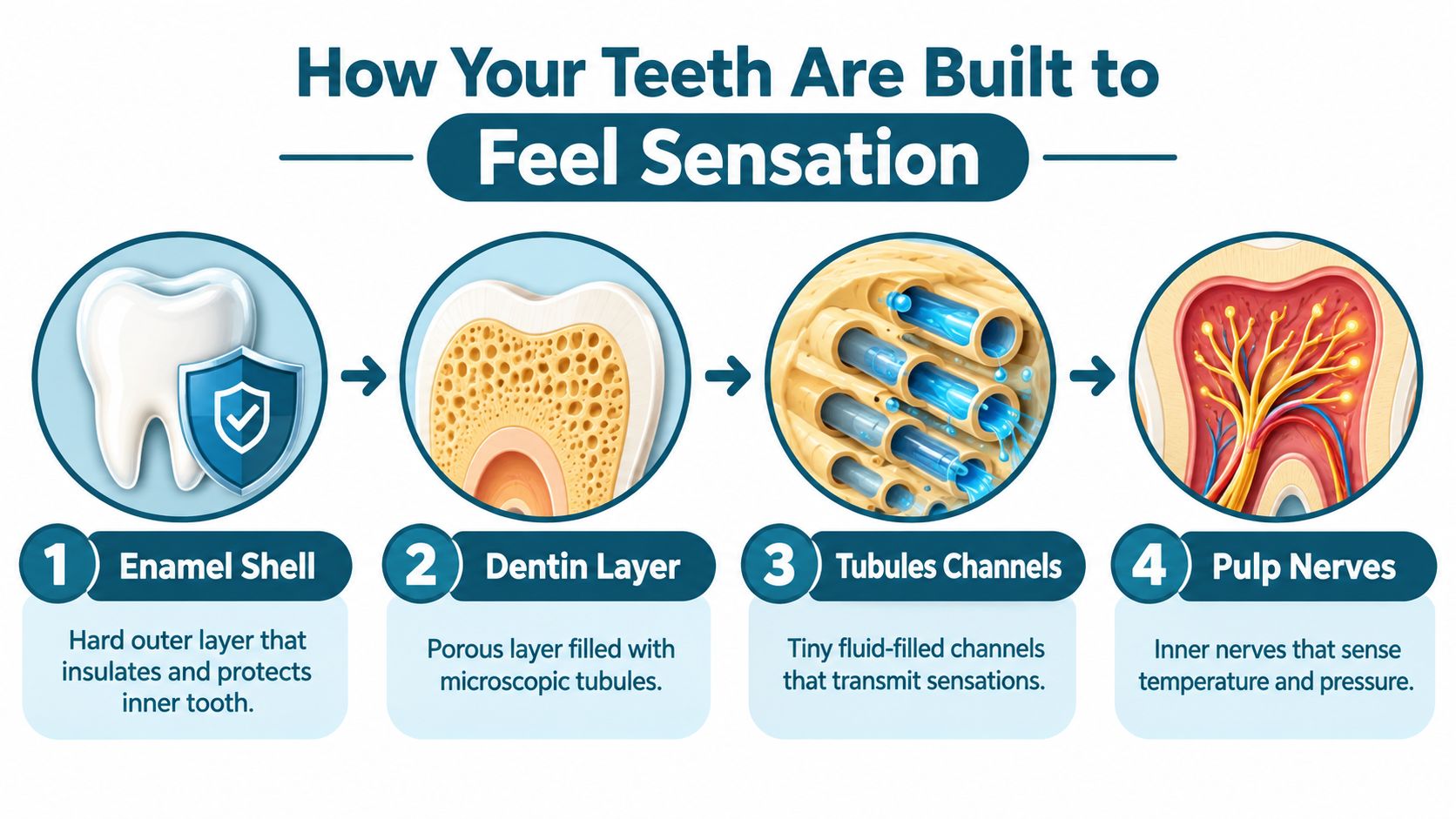
At the center of the tooth is the pulp. That's where the tooth's nerves and blood supply live. If enamel is the roof and walls, and dentin is the insulated space underneath, the pulp is the room where sensation is noticed.
Why some teeth feel more reactive than others
A healthy tooth has natural protection. But the system isn't the same for everyone. If a person has gum recession, worn enamel, or a spot where dentin is more exposed, the tooth has less insulation. That means normal triggers, such as cold water or air, can be felt more easily.
A simple way to picture it is this:
- Enamel acts like a coat.
- Dentin acts like a sponge full of tiny tunnels.
- Pulp is where the nerve response happens.
When the coat is thinner, or when the tiny tunnels are easier to affect, sensations travel faster.
The tooth is designed to send warning signals
Sensitivity is frustrating, but it has a purpose. Teeth use sensation to report that something has changed. Sometimes that change is harmless and temporary, such as whitening-related irritation. Other times it can point to a crack, cavity, exposed root, or a failing filling.
That's why a patient with ongoing discomfort shouldn't assume whitening is the only explanation.
Practical rule: A brief zing across several teeth after whitening usually behaves differently from pain in one specific tooth, which deserves a closer look.
This anatomy also explains why cosmetic concerns and general oral health overlap. A person may start out searching for teeth whitening, then realize they need an exam first because the teeth already react to cold or sweets. The same office that handles cosmetic dentistry should also be able to evaluate whether preventive or restorative dentistry comes first.
Why Whitening Triggers Sensitivity Inside Your Tooth
Whitening sensitivity usually comes from two mechanisms happening inside the tooth. Many explanations stop after saying peroxide irritates the nerve. That's part of the story, but it isn't the whole story.
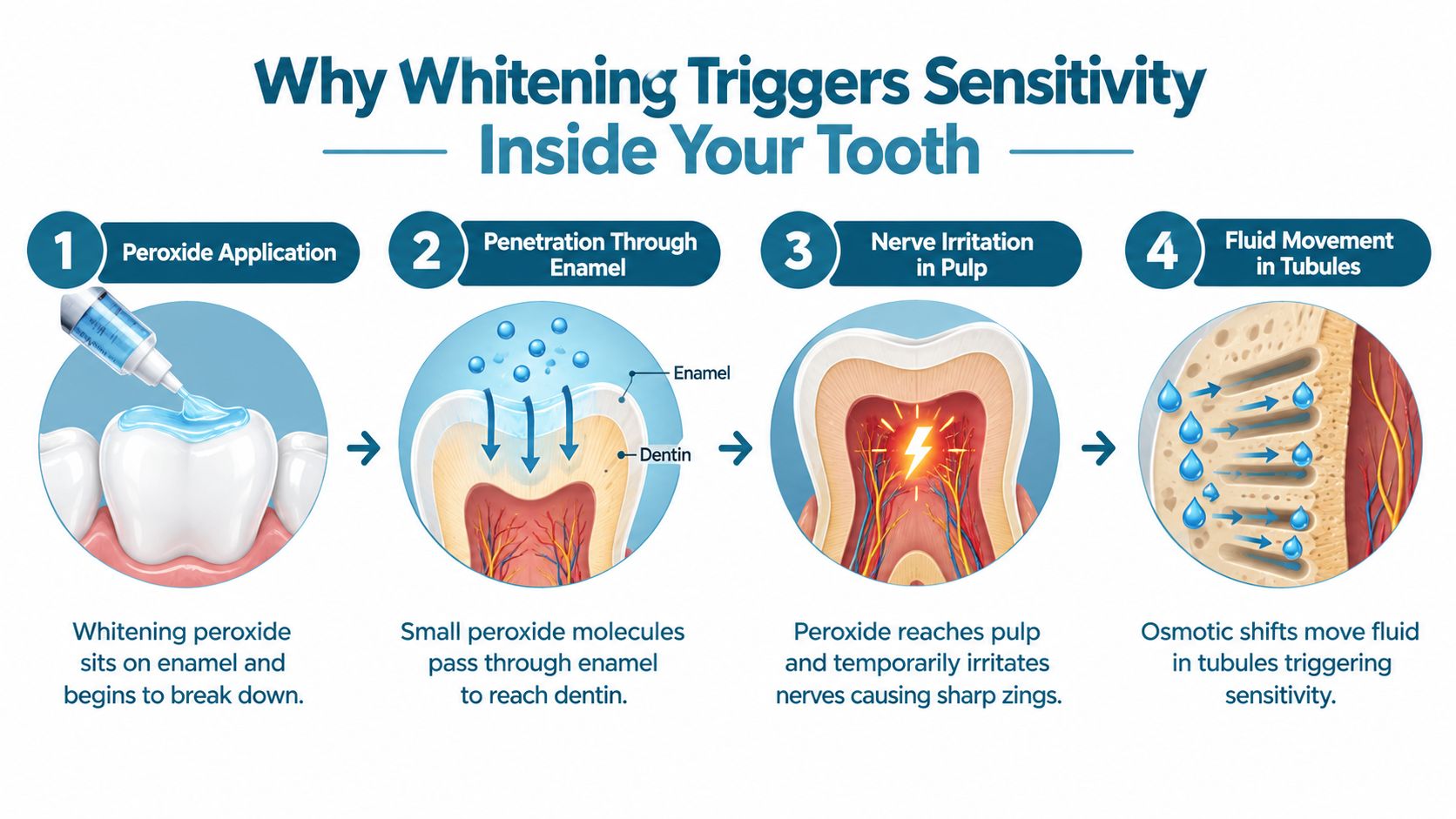
Mechanism one involves peroxide reaching the inner tooth
Hydrogen peroxide whitening products can cause sensitivity because the peroxide penetrates enamel and reaches dentin and the pulp, triggering a reversible inflammatory response. The European Commission's scientific review states that increased tooth sensitivity has been observed in up to two-thirds of patients in various studies, usually starting at the beginning of treatment and lasting only a few days (European Commission review on tooth-whitening products).
That's the first major pathway. The whitening ingredient doesn't just sit on the surface stain. It moves inward. Once it reaches the deeper layers, the pulp can react with temporary irritation.
To make that sequence easier to visualize:
A helpful visual explanation appears here:
Whitening sensitivity is usually a reversible pulp response. It feels sharp and annoying, but it typically doesn't mean the tooth has suffered permanent damage from a properly managed whitening treatment.
Mechanism two involves fluid moving in dentinal tubules
There's also a second pathway that helps explain the quick, electric kind of sensitivity some people describe. Whitening agents can increase dentin permeability or expose microscopic tubules, and the resulting fluid movement stimulates A-delta nerve fibers through the hydrodynamic mechanism, which is the dominant model for dentin hypersensitivity. Independent clinical reviews also describe this as a reversible pulp response in which higher peroxide concentration drives faster penetration into enamel and dentin, releasing more free radicals and increasing the likelihood of sharp sensitivity, while lower-concentration hydrogen peroxide protocols are associated with less tooth sensitivity and still produce measurable color change (clinical review of sensitivity after whitening management).
In plain language, the tiny channels in dentin contain fluid. If whitening makes those channels easier to affect, that fluid can shift. The nerve system reads that movement as pain or a zing.
Why the sensation can feel sudden
This is why people often say the discomfort isn't a dull ache at first. It can feel fast, bright, and pinpointed. A sip of cold water, a blast of air, or even talking outdoors on a chilly day can set it off.
For readers who want another patient-friendly explanation of related cosmetic sensitivity, this overview of sensitive teeth after cosmetic dentistry from Ringway Dental adds helpful context.
The key takeaway is that whitening can trigger sensitivity in two ways at once. It can temporarily irritate the pulp, and it can also make the tooth's microscopic channels more reactive. That combination is why some people feel nothing, some feel mild tingling, and some feel stronger zings.
Who Feels Sensitivity Most and Why Risk Varies
Not everyone has the same whitening experience. Two people can use whitening products and get very different comfort levels, even if both are generally healthy. That difference usually comes down to exposure level and baseline sensitivity.
Strength and contact time change the odds
Clinical evidence shows a strong concentration effect. In a recent review, tooth-sensitivity risk was 44% with 6% hydrogen peroxide versus 74% with 35% hydrogen peroxide, and the ADA notes that higher concentrations, longer contact time, and light activation can increase sensitivity because they raise peroxide exposure and pulp irritation (ADA whitening overview).
That matters because people often assume stronger whitening is better whitening. In practice, stronger isn't always smarter, especially for a patient who already winces with cold drinks or has a history of sensitivity after cleaning and exams or home whitening products.
Whitening Strength and Sensitivity Risk Comparison
| Whitening Factor | Lower Exposure Option | Higher Exposure Option |
|---|---|---|
| Peroxide strength | Lower hydrogen peroxide concentration | Higher hydrogen peroxide concentration |
| Contact time | Shorter wear time | Longer wear time |
| Delivery style | Conservative protocol with monitoring | More aggressive protocol |
| Sensitivity likelihood | Lower relative risk in the reviewed evidence | Higher relative risk in the reviewed evidence |
| Expected tradeoff | Gentler approach with measurable color change | Greater chance of sharp sensitivity |
Baseline tooth condition matters too
A second group is more vulnerable before whitening even begins. A major underserved angle in patient education is that many explanations stop at pulp irritation, but fewer explain who is most vulnerable and why. The best-supported risk factors include higher peroxide concentration, longer contact time, and restorative work such as adhesive fillings. The ADA also notes sensitivity can happen with all bleaching forms and can affect up to two-thirds of users early in treatment. Older clinical data suggest people with gingival recession are more likely to report sensitivity during home whitening, and general dentin hypersensitivity is associated with at-home whitening use (review on bleaching sensitivity risk factors).
People with these factors often need more caution:
- Gingival recession: Root surfaces and exposed dentin tend to react more quickly.
- Baseline dentin hypersensitivity: If teeth already tingle, whitening may amplify it.
- Adhesive fillings or other restorations: Restored teeth may not respond the same way as untouched enamel.
- Longer wear habits at home: More time in contact can mean more irritation.
A lower-strength, shorter-contact plan often makes more sense for someone with existing sensitivity than a standard one-size-fits-all whitening routine.
This is one reason cosmetic care shouldn't be separated from general evaluation. A patient may think they only need whitening, but a proper check may reveal recession, failing margins, or a tooth that would be better treated first with restorative dentistry or other care.
How Long Whitening Sensitivity Typically Lasts
For many people, whitening sensitivity follows a short pattern. It often starts early, feels most noticeable while whitening is actively happening, and then fades after treatment pauses or ends.
The usual timing
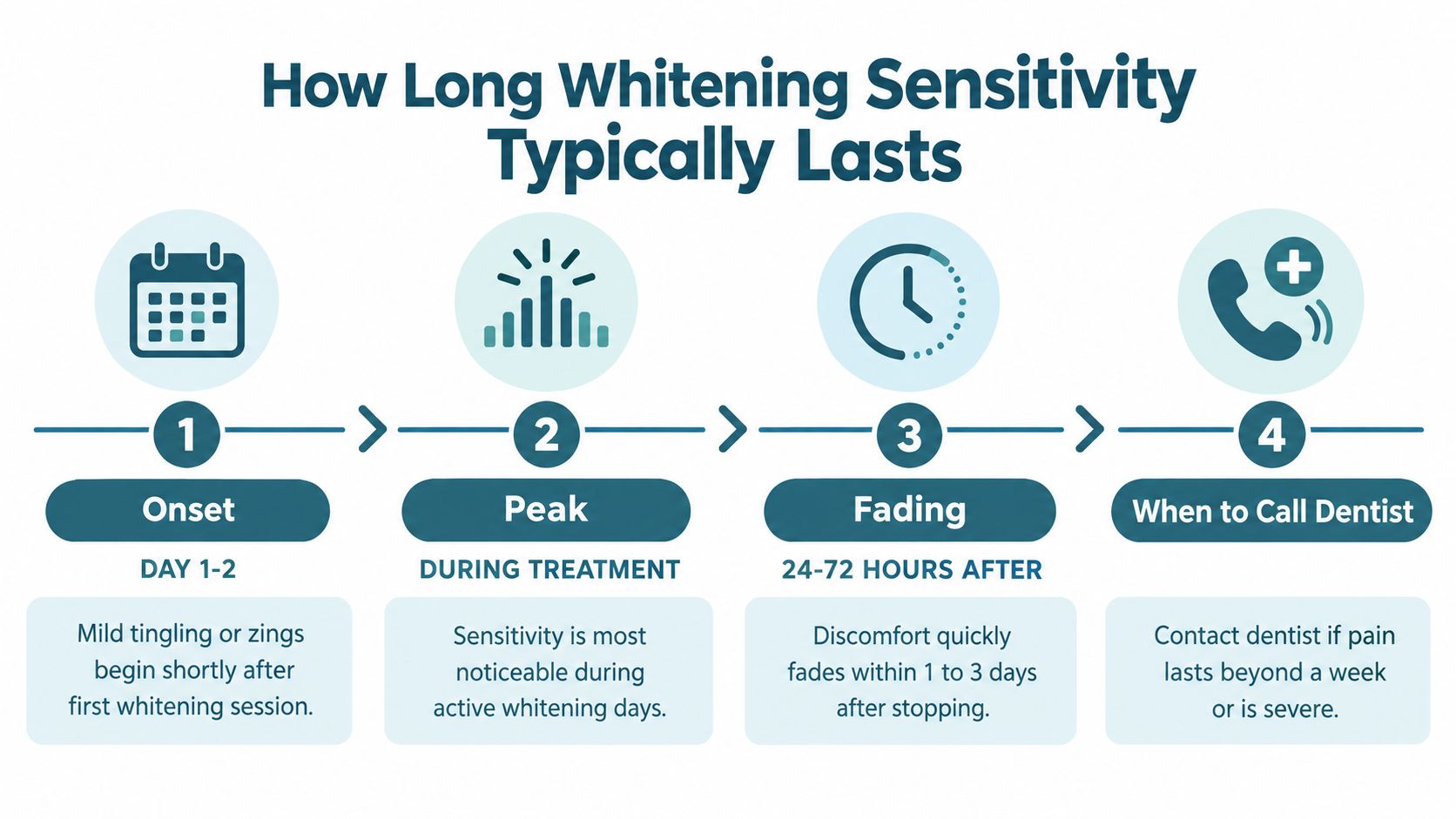
The European Commission review noted earlier reports that sensitivity usually starts at the beginning of treatment and lasts only a few days. That's why the first sessions often tell the story. If teeth are going to react, they often react early rather than weeks later.
Patients can think of the timeline in three parts:
- Early onset: Mild zings may begin shortly after starting whitening.
- Active treatment period: Sensitivity can feel more obvious during the days whitening is being used.
- Recovery: Teeth typically settle down after stopping or spacing treatment.
Patients wondering how shade results and maintenance fit into treatment timing can also review this guide on how long professional whitening lasts.
What's usually normal and what isn't
Brief cold sensitivity across several teeth is usually more reassuring than lingering pain in one spot. Whitening tends to create a generalized reaction, not a deep, persistent problem in a single tooth.
A dentist should take a closer look if the discomfort doesn't settle, feels intense, or seems tied to one specific area. That can point to something whitening didn't cause, such as a cavity, crack, gum recession, or another condition that needs attention.
Practical planning for treatment days
This timing matters for real life. People often whiten before photos, celebrations, presentations, or travel. If a patient already knows their teeth are reactive, it helps to avoid starting a whitening cycle right before an important event. A slower schedule may be more comfortable and more predictable.
If a patient wants brighter teeth for a deadline, comfort planning should be part of the schedule, not an afterthought.
How Amanda Family Dental Prevents and Eases Whitening Sensitivity
The best way to handle whitening sensitivity is to plan for it before it starts. Once a patient knows that concentration, wear time, and existing sensitivity all matter, the goal becomes simple. Reduce unnecessary exposure while still getting a meaningful cosmetic result.
Start with the right protocol
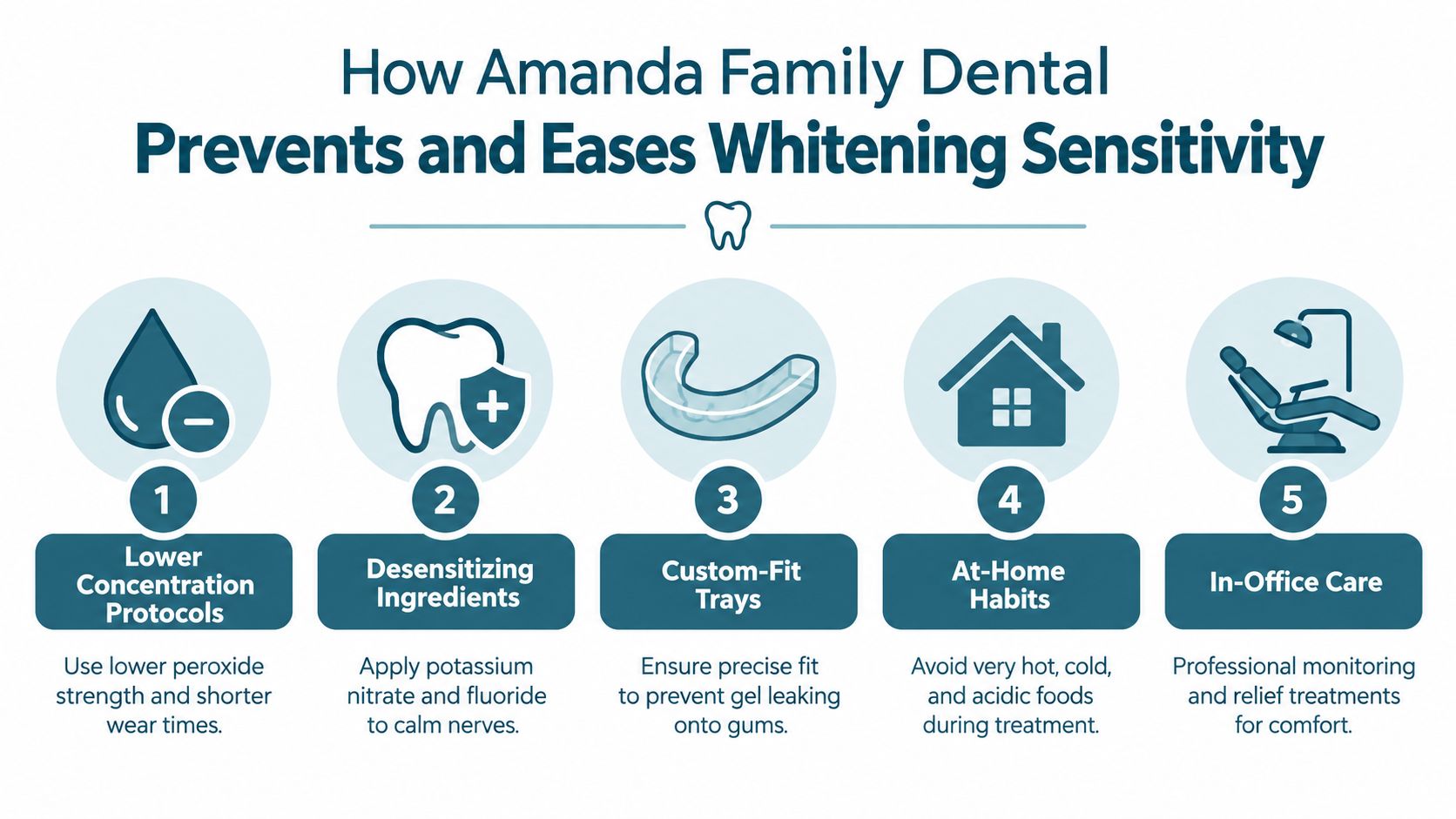
A gentler protocol often begins with lower peroxide strength and shorter contact time. That doesn't mean no result. As noted earlier, lower-concentration hydrogen peroxide protocols are associated with less sensitivity while still producing measurable color change.
Other practical choices can also help:
- Custom-fit trays: A better fit can keep whitening gel where it belongs and reduce irritation along the gums.
- Spacing treatments: Back-to-back whitening days may be harder on sensitive teeth than a paced schedule.
- Food and drink choices: During active whitening, avoiding very hot, very cold, and acidic items can reduce triggers.
Calming the tooth before and after whitening
Desensitizing support matters, especially for people who already know their teeth run sensitive. Potassium nitrate and fluoride are commonly used to calm the nerve response and support comfort during whitening care. Soft brushing, room-temperature drinks, and a pause in treatment if zings increase can also help.
A patient doesn't need to guess through this alone. The page on teeth whitening for sensitive teeth outlines ways whitening plans can be adjusted when comfort is a priority.
What a comfort-focused visit can include
In a clinical setting, whitening should begin with evaluation, not just product selection. That may include:
- New patient exams: To identify recession, cavities, worn areas, or restorations that may change the plan.
- Digital X-rays: When needed to rule out hidden issues that could mimic whitening pain.
- Personalized treatment plans: Matching whitening strength and timing to the patient's starting point.
- Broader care options: If the issue turns out to be decay, a crack, or an exposed root, the solution may involve something other than whitening.
Amanda Family Dental offers professional whitening and states that desensitizing treatments can be incorporated for patients prone to sensitivity, with whitening gel concentration adjusted for sensitive teeth as needed.
Comfort improves when whitening is treated like personalized dental care, not a one-size-fits-all beauty product.
That same careful thinking applies across services. A patient searching for a dentist in Amanda, OH may arrive for whitening and later need emergency dental services, tooth extraction, crowns, or dental implants near me. A practice that looks at overall tooth health first helps prevent cosmetic treatment from covering up a problem that needs direct treatment.
Get Comfortable Whitening Results Close to Home
The answer to why does teeth whitening cause sensitivity is more reassuring once the biology is clear. Whitening can temporarily irritate the pulp, and it can also make the dentinal tubules more reactive. That combination explains the quick zings many people notice, especially early in treatment.
The next question is usually what to do with that information. For patients in Amanda, Lancaster, Circleville, and Carroll, Ohio, the practical answer is to choose whitening based on risk, not just speed. Lower exposure, better tray fit, careful screening, and a plan for pre-existing sensitivity can make a noticeable difference in comfort.
Why local evaluation makes a difference
A person searching for a dentist near me or cosmetic dentist near me isn't only looking for a whiter smile. They're usually looking for clarity. They want to know if their teeth are good candidates for whitening, whether existing sensitivity changes the plan, and what to expect if they've had fillings, recession, or recent dental work.
That same office should also be prepared if the concern turns out not to be cosmetic at all. Sometimes tooth pain points toward restorative dentistry, emergency dentist care, or another treatment path rather than whitening.
A confident smile should still feel comfortable
Whitening works best when comfort and oral health stay part of the conversation. A brighter smile can support confidence, photos, work, and everyday interactions. But it shouldn't come at the cost of avoidable pain.
For readers who want a broader look at professional treatment settings, this in-office teeth whitening overview from Paul L. Gregory, DDS offers added background on how office-based whitening is typically approached.
A thoughtful whitening plan can help protect comfort, preserve function, and support the kind of smile patients enjoy showing.
Patients in Amanda, Lancaster, Circleville, and Carroll can turn to Amanda Family Dental for dental care that includes new patient exams, digital X-rays, personalized whitening guidance, and solutions for sensitivity concerns before treatment starts. Whether the goal is a brighter smile, relief from discomfort, or a full cosmetic and restorative plan, the office can help patients choose a safer, more comfortable path forward.