

Invisalign clear retainers are custom-made, clear plastic appliances worn after Invisalign aligner treatment to hold teeth in their corrected positions, unlike aligners, which are designed to move teeth. Long-term nightly wear is common, but the right schedule is individualized; a survey found that 70.2% of Australian general dentists wanted the treating orthodontist to communicate each patient's specific retention protocol.
Someone finishing a final aligner may feel ready to put orthodontic treatment behind them. Then a clear retainer arrives, bringing practical questions: how often should it be worn, what happens after a few missed nights, and when does a tight fit mean something needs attention?
For patients in Amanda, Lancaster, Circleville, and Carroll, Ohio, the useful answer is that retention is part of maintaining the result, not a one-time final step. Amanda Family Dental can help patients understand the transition from aligners to retainers and get guidance when fit or wear routines become a concern.
Table of Contents
- Your Smile After Invisalign Treatment
- What Invisalign Clear Retainers Are
- Benefits and Limitations of Clear Retainers
- How to Clean and Care for Your Retainer
- Common Misconceptions About Retainer Wear
- When to Replace Your Retainer or Call Your Dentist
- Trusted Retainer Care at Amanda Family Dental
Your Smile After Invisalign Treatment
A patient finishes Invisalign, sees straighter teeth, and expects the trays to be done for good. At the final appointment, the dentist provides a clear retainer and explains that it has a different job from the aligners. The active tooth movement is over, but keeping the teeth in their new positions still takes attention.
Teeth can shift after orthodontic treatment. A retainer helps hold them in place, so skipping it indefinitely can put the alignment at risk. This is why a retainer isn't an optional cosmetic accessory. It's the maintenance phase of treatment, with a wear schedule that should come from the treating dentist or orthodontist.
The transition can feel simpler when patients know what to expect. The Invisalign treatment timeline can help clarify how aligner treatment and the retention phase fit together. At the end of treatment, patients should leave with instructions on how and when to wear the retainer, along with a plan for follow-up if the appliance feels different or no longer fits as expected.
Retention is personalized
There isn't one schedule that suits every patient. The American Association of Orthodontists says patients receive individualized instructions about when and how long to wear retainers, and that long-term nighttime wear is common. Patients should follow the schedule their dentist or orthodontist provides instead of adopting a generic routine from a friend or an online post. The AAO's guidance on retainer care explains why consistent wear is part of protecting tooth position.
Patients who complete treatment elsewhere may not have easy access to their original orthodontic team. Families managing an adolescent's routine, or adults who have missed several nights, may also need a clear next step. A local fit check can help determine whether the retainer still seats properly and whether the clinician should adjust the instructions.
What Invisalign Clear Retainers Are
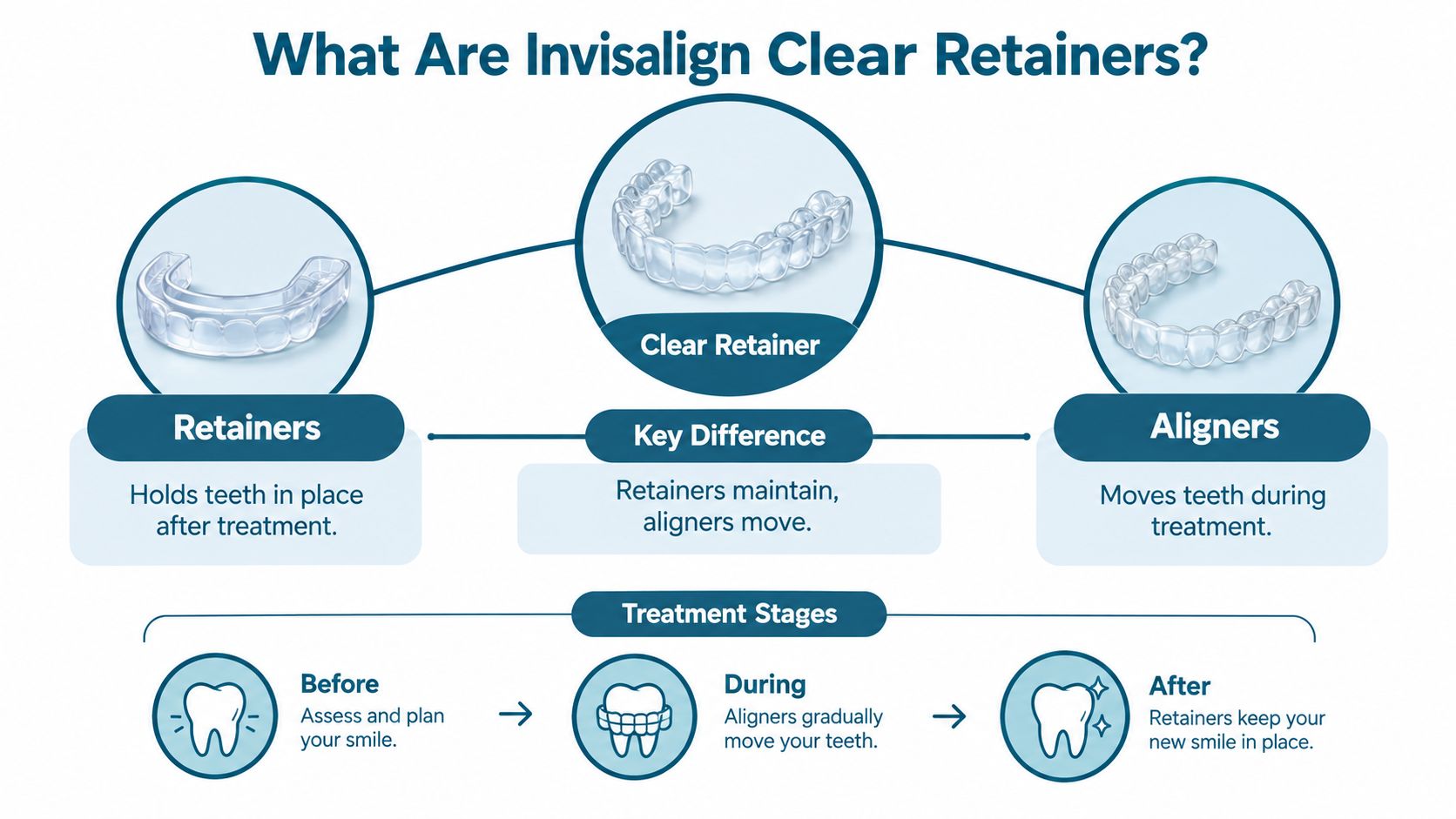
An aligner and a retainer can look like similar clear trays, but they serve different purposes. Aligners move teeth during active treatment. Retainers hold teeth in place after treatment. A patient may wear a series of aligners that guide teeth gradually, then switch to a retainer designed to maintain the result rather than continue that planned movement.
A simple comparison helps: aligners are like a construction crew making a change, while retainers help keep the finished structure in place. That distinction matters because a retainer isn't meant to replace an aligner or serve as a do-it-yourself correction if teeth begin to shift.
How the clear design holds teeth
Vacuum-formed clear retainers, a design category used for many transparent orthodontic retainers, fit closely over the teeth and nearby surfaces. A systematic review found stronger control of incisor irregularity with these retainers than with Hawley retainers, which use a visible wire across the front teeth. The review identified close adaptation over teeth and adjacent surfaces as a likely reason the clear design distributes retention forces across the arch rather than concentrating them in a labial wire. The systematic review of clear and Hawley retainers also found insufficient evidence that one specific wear-duration schedule provides excellent long-term stability.
Clear retainers appeal to many patients because they're discreet and removable. Hawley retainers are another removable option, with a plastic or acrylic base and a wire that's more noticeable. The appropriate type depends on the patient's treatment and clinical needs, so a clear tray isn't automatically the right choice for everyone.
Patients considering the active phase can learn more about how Invisalign treatment works. Understanding the difference between moving teeth and retaining their position makes it easier to follow the instructions for each stage.
Benefits and Limitations of Clear Retainers
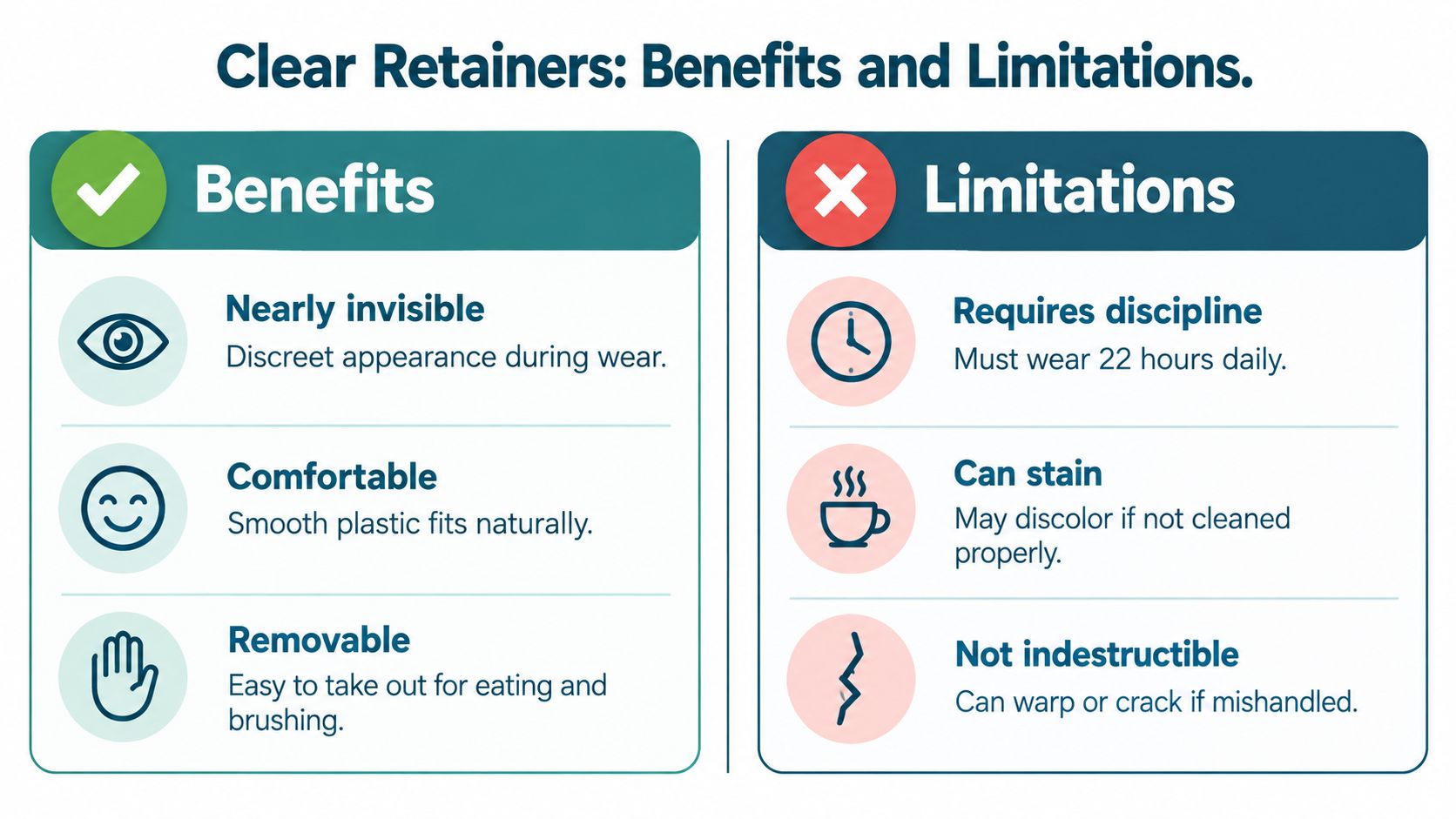
Clear retainers offer a discreet way to maintain alignment. Their close fit can help control tooth position, and patients can remove them for eating and cleaning. Those features make them convenient for many people who prefer not to have a visible wire across their front teeth.
The benefit depends on proper use and fit, though. A tray that isn't worn as prescribed may not provide the intended support. And a clear retainer isn't indestructible: it can crack, warp, or lose some of its holding force as the material flexes repeatedly.
Fit and material matter
“Clear” doesn't describe one standardized material. In an independent laboratory comparison, tested maximum flexural strengths ranged from 59.57 MPa for PET to 70.50 MPa for one polyurethane formulation. After 400 insertion-removal cycles, which the investigators estimated as approximately 67 days at six cycles per day, all tested groups showed an average force reduction of 18–22%. These findings help explain why a retainer may gradually lose active retention even when it has no obvious crack. The laboratory comparison of clear retainer materials highlights how composition, thickness, and repeated flexing can affect performance.
Manufacturer claims about strength should also be understood in context. Invisalign describes Vivera retainers as 30% stronger and twice as durable as other leading clear-retainer materials, but the durability claim concerns resistance to cracking or breakage. It doesn't guarantee that teeth will remain stable, and the company says Vivera retainers aren't cleared to treat bruxism. Invisalign's Vivera retainer information is relevant for product details, but patients who grind or clench should ask a dental professional about appropriate care rather than treating a retainer as a grinding appliance.
A clear tray can also feel comfortable while fitting less effectively than before. A 12-month cohort study found broadly similar retention outcomes between customized clear and wrap-around retainers, while irritation and speech discomfort affected patient experience. For jaw discomfort or questions about bite-related treatment, this resource on when bite adjustment helps jaw pain offers additional context.
How to Clean and Care for Your Retainer
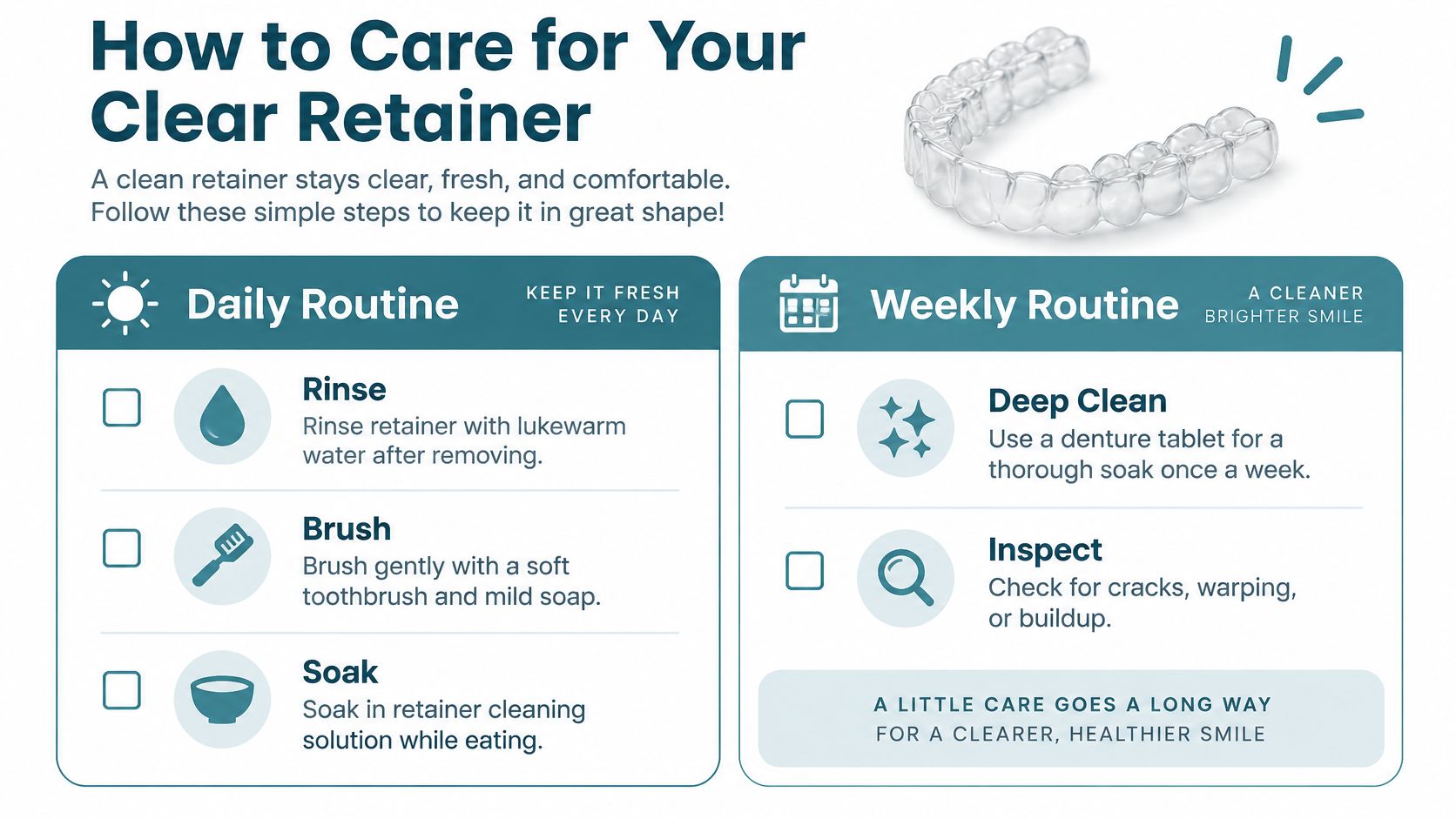
A clear retainer sits against the teeth, so regular cleaning helps keep it fresh and clear. Patients can use a simple routine: rinse it whenever it comes out, clean it gently, and store it safely when it isn't being worn. Heat is the main avoidable hazard because it can distort the plastic and change the fit.
A practical cleaning routine
The American Association of Orthodontists recommends rinsing a retainer in lukewarm water whenever it's removed and brushing it daily with a dedicated toothbrush and dish soap. Avoid toothpaste, which may be too abrasive for the appliance. For a weekly clean, use a retainer-cleaning tablet or solution for 10 to 20 minutes, following the product directions. The AAO's retainer-cleaning instructions offer a straightforward routine.
Patients who use Invisalign Cleaning Crystals can follow the manufacturer's steps: rinse the retainer, submerge it in enough warm water, add one packet, agitate for 20 seconds, let it stand for at least 15 minutes, agitate again for 20 seconds, and rinse thoroughly. The water should be warm, not hot. The Invisalign Cleaning Crystals instructions provide the product-specific process.
Keep the appliance safe
Hot water, a hot vehicle, or another heat source can warp the plastic. Don't chew on the retainer, and don't try to reshape it at home. When it's out of the mouth, keep it in its case rather than wrapping it in a napkin, where it could be accidentally discarded.
Patients can remove the retainer from both sides rather than repeatedly levering it from one spot. If it rocks, no longer seats fully, or takes unusual pressure to put on, a fit assessment is safer than forcing it into place. More everyday advice is available in this guide to caring for Invisalign aligners, though retainer instructions from the treating clinician should take priority.
Common Misconceptions About Retainer Wear
“Wear it forever” can sound like a rigid instruction, but it's better understood as long-term maintenance rather than one unchanging schedule. Long-term nighttime wear is common, while the exact instructions depend on the patient's case and the clinician's judgment. The treating dentist or orthodontist should explain how wear changes over time, if it changes at all.
That need for individualized guidance matters. In a survey of Australian general dentists, 70.2% wanted the treating orthodontist to communicate the patient's specific retention protocol. A retainer plan works best when the patient knows what to do, not when the schedule is left to guesswork.
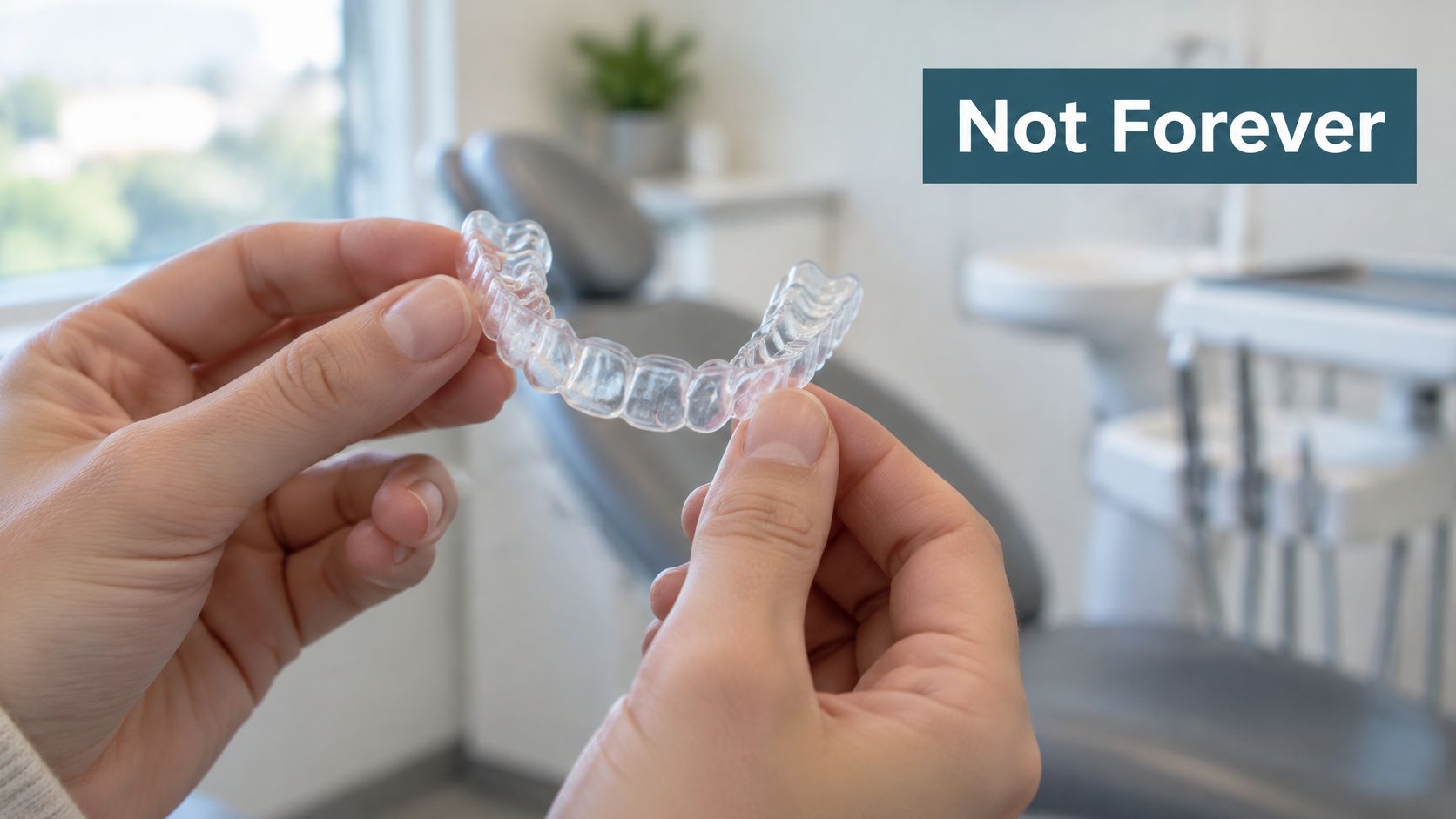
A strong retainer isn't a guarantee
A product's resistance to cracking doesn't ensure that teeth will stay in position. Retention still depends on consistent use, a suitable fit, and professional follow-up. The systematic review of retainers found insufficient evidence that a single wear-duration schedule guarantees excellent long-term stability, so patients should rely on their own clinician's directions rather than a universal promise.
Another common question is what to do after missing several nights. The retainer may feel tighter if teeth have moved. Patients shouldn't force it into place if it causes pain or won't seat properly; they should contact a dentist or orthodontist for advice.
Staining alone may not mean a retainer has failed, but persistent odor, distortion, sharp edges, cracks, or a changed fit deserve attention. A comfortable feel doesn't always mean the appliance still holds teeth as intended, especially if the material has fatigued or the teeth have moved.
When to Replace Your Retainer or Call Your Dentist
A retainer needs professional attention if it has a visible crack, is warped, has a sharp edge, rocks against the teeth, or no longer seats fully. Unusual pressure to put it on is another reason to pause and ask for guidance rather than forcing the appliance. Even damage that seems minor can affect how well the retainer holds teeth.
A lost retainer should also prompt a call. The same applies if a pet has chewed it, if it has developed an odor or cloudy appearance that cleaning doesn't resolve, or if its shape has changed. The American Association of Orthodontists advises replacing cracked, warped, or lost retainers promptly and keeping a backup when recommended. The AAO family orthodontic health guide explains why damaged appliances should be addressed rather than worn indefinitely.
Don't repair a retainer with heat
Hot water won't restore a retainer's shape. It can distort the plastic further, leaving the appliance less suitable for the teeth. Patients also shouldn't keep wearing an appliance with a split, sharp edge, or obvious distortion.
If a retainer feels tight after missed wear, the dentist can assess whether it still fits and whether tooth movement has occurred. A prompt check can help address a small fit issue before it becomes a more involved orthodontic concern. Patients in Amanda, Lancaster, Circleville, or Carroll, Ohio, can contact Amanda Family Dental to ask about a retainer fit check or replacement evaluation.
Trusted Retainer Care at Amanda Family Dental
A retainer check can help answer practical questions: does the appliance still fit, should the wear schedule be reviewed, or is a replacement needed? At Amanda Family Dental, Dr. Alyssa Jenkins and the team provide patient-focused care for people in Amanda, Lancaster, Circleville, and Carroll, Ohio. Patients can expect a comfortable assessment and clear recommendations based on the appliance and their oral health.
The practice also offers new patient exams, digital X-rays, and personalized treatment plans. Regular dental visits remain important during retention because retainers don't replace exams for concerns such as tooth decay, gum problems, or jaw pain. Amanda Family Dental provides preventive and restorative care alongside Invisalign treatment, giving patients a local place to discuss ongoing dental needs.
Patients who have completed Invisalign elsewhere can still seek guidance if a retainer is lost, damaged, or no longer fits as expected. Clear instructions and timely follow-up can make long-term maintenance easier to manage.
Patients in Amanda, Lancaster, Circleville, and Carroll can contact Amanda Family Dental for a retainer fit check, replacement evaluation, or new patient exam. Schedule an appointment or request a consultation to get practical guidance for keeping an Invisalign smile on track.