

A new veneer patient often reaches the bathroom mirror that evening, smiles, and then pauses. Is brushing safe? Can coffee stain the new surface? What happens if the bite feels slightly different? These questions are common, whether the patient lives in Amanda, Lancaster, Circleville, or Carroll, Ohio.
Learning how to care for veneers means protecting more than the visible ceramic or composite. Daily habits also protect the natural tooth, bonding margins, gum tissue, and bite underneath. Amanda Family Dental provides cosmetic, preventive, and restorative dental care for local patients who want clear guidance before a small concern becomes a painful dental emergency.
Table of Contents
- Why Veneer Care Starts the Day You Leave the Chair
- Daily Brushing and Flossing Around Veneers
- Products to Use and Skip With Veneers
- Food, Drinks, and Habits That Quietly Wear Veneers Down
- Nighttime Grinding, Clenching, and the Role of a Night Guard
- Warning Signs Worth Calling the Dentist About
- Repair, Replacement, and When Veneers Need a Second Look
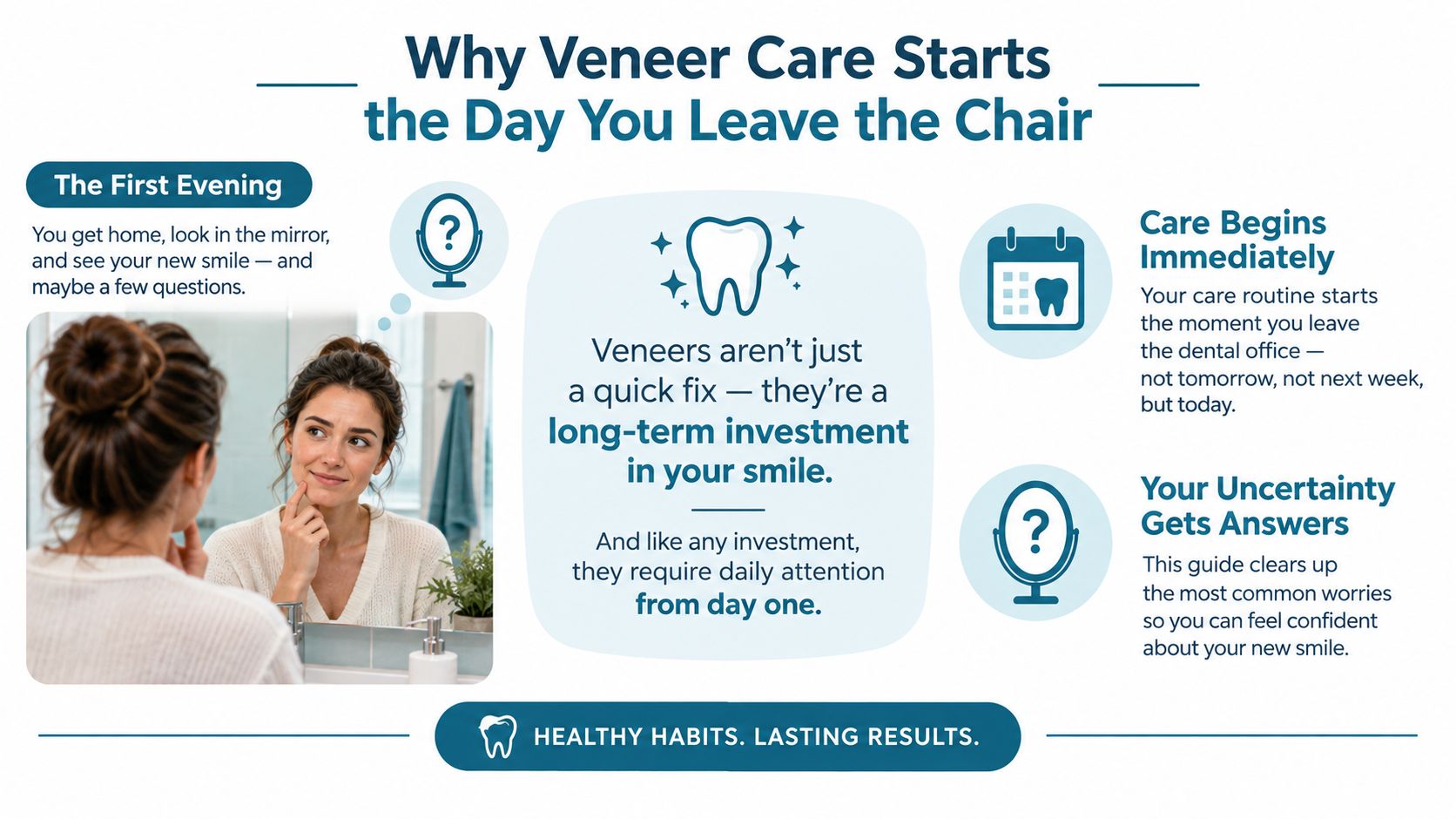
Why Veneer Care Starts the Day You Leave the Chair
A patient leaving a veneer appointment may expect the main responsibility to be over. The smile looks finished, the color is selected, and the restorations feel smooth. Then dinner arrives, the tongue notices a new edge, and ordinary choices suddenly seem uncertain.
That first evening is a useful reminder that veneers are long-term restorations, not maintenance-free coverings. Their appearance and function depend on plaque control, bite forces, food habits, and professional monitoring. A veneer can remain attractive for many years, but the tooth and gum around it still need ordinary preventive care.
A 2021 systematic review of 25 clinical studies involving 6,500 porcelain laminate veneers estimated a 95.5% cumulative survival rate at 10 years. The same review estimated 10-year survival at 96.3% when fracture was considered, 99.2% for debonding, 99.3% for secondary decay, and 99.0% for cases requiring root-canal treatment (systematic review of porcelain laminate veneer outcomes). Those figures describe clinical studies, not a promise for every smile.
The first evening should be simple
A new patient can make the transition easier by following the office's specific aftercare advice, avoiding unnecessary force, and paying attention to how the bite feels. A quick phone call to the dental office can resolve uncertainty about brushing, sensitivity, or an edge that feels unfamiliar.
The dental team can also document the starting shade, margin appearance, fit, and bite. That baseline makes future changes easier to identify. A patient considering a different material can also review how a composite bonding repairable option compares with porcelain before treatment decisions are finalized.
Practical rule: A veneer that looks fine from across the room can still need attention at the gumline, margin, or bite.
Porcelain and composite require different maintenance expectations. Porcelain is vulnerable to fracture and debonding under excessive force, while composite is more likely to need polishing, repair, or attention to surface staining and wear. Patient behavior often determines whether either material stays attractive and comfortable.
Daily Brushing and Flossing Around Veneers
The most reliable veneer routine resembles good preventive dental care, with extra care around the margins. The goal isn't to scrub harder. It's to remove plaque consistently without scratching the restoration or pulling aggressively against its edge.
The American Dental Association advises people with veneers to brush twice daily with fluoride toothpaste and clean between the teeth every day. The ADA also explains that cavities can develop under or around a veneer, so cleaning protects both exposed tooth structure and the bonding margins (American Dental Association guidance on veneers).
A calm morning and evening rhythm
Choose a soft-bristled toothbrush. A manual brush with a moderate head or a powered brush with a gentle setting can clean effectively. Hold the bristles at about a 45-degree angle toward the gumline and use small, controlled circles rather than pressing back and forth.
Use fluoride toothpaste without aggressive abrasives. Fluoride helps protect the natural tooth near the veneer. Whitening powders, charcoal products, and gritty pastes can dull a cosmetic surface or affect the appearance of margins over time.
Clean between teeth once daily. Slide floss gently through the contact instead of snapping it downward. Curve it around each tooth and guide it along the gumline. A water flosser or interdental brush can help patients who struggle with string floss, but the device should be used gently.
Rinse if the dental team recommends it. An alcohol-free mouthwash may feel more comfortable around sensitive gum tissue. It supplements brushing and interdental cleaning rather than replacing either one.
A patient with a new veneer may notice mild unfamiliarity as the tongue adjusts. That sensation shouldn't lead to vigorous brushing or repeated picking at the edge. If a margin catches floss, feels sharp, or remains uncomfortable, the office should evaluate it rather than asking the patient to force the floss through.
The proper brushing technique can help patients refine the angle, pressure, and motion used around veneer margins. The same technique also protects natural teeth that weren't treated.
Products to Use and Skip With Veneers
A product can feel clean without being kind to a veneer. The label may promise whitening, polishing, or stain removal, but stronger abrasives can change surface gloss and make a restoration appear less even beside natural teeth.
Patient-awareness data showed that only 6% of veneered participants knew the full set of post-cementation precautions, including a soft brush, floss, non-abrasive toothpaste, and alcohol-free mouthwash. The same report found that 85% didn't attend regular follow-up (study of patient awareness and veneer follow-up). Clear product choices matter because many patients don't receive or retain detailed aftercare guidance.
Product Choices for Veneer Patients
| Category | Use With Confidence | Use With Caution | Avoid |
|---|---|---|---|
| Toothpaste | Fluoride toothpaste labeled non-abrasive or safe for cosmetic restorations | Whitening toothpaste, especially if it feels gritty | Charcoal powders, highly abrasive powders, and aggressive polishing pastes |
| Toothbrush | Soft-bristled manual brush or gentle powered brush | Hard pressure or a worn brush | Hard bristles and forceful scrubbing |
| Interdental cleaning | Floss, a water flosser, or an appropriately sized interdental brush | Strong water pressure or snapping floss at a margin | Pulling floss sharply against a veneer edge |
| Mouthwash | Alcohol-free mouthwash when appropriate for the patient | Products that cause dryness or irritation | Any rinse that replaces brushing and cleaning between teeth |
| Whitening | Professional planning before veneers are fabricated | Supervised whitening of natural teeth after veneers | Unapproved home bleaching, strips, or kits used to change veneer color |
Why whitening products cause confusion
Ceramic color doesn't bleach. Whitening a natural tooth beside a veneer can create a shade mismatch, while abrasive products can affect the surface finish without brightening the ceramic itself. Patients who want a lighter smile should discuss whitening before veneer fabrication or ask the dentist to evaluate the existing shade.
The right timing for mouthwash can help patients organize rinsing without washing away the benefits of toothpaste immediately after brushing. Any new powder, paste, bleaching product, or social-media trend should be reviewed by the dental office first.
Food, Drinks, and Habits That Quietly Wear Veneers Down
“Be careful with hard foods” is useful advice, but force matters more than a simple food list. A veneer is exposed to pressure when a patient bites an ice cube, crunches an unpopped popcorn kernel, tears crusty bread, or uses the front teeth to open packaging.
Coffee, tea, and red wine can also affect the appearance of the margins and surrounding natural teeth. Rinsing with water after a staining drink and using a straw when practical can reduce contact, but these habits don't replace daily brushing or professional cleaning.

Small swaps preserve normal life
Patients in Amanda and nearby Ohio communities shouldn't have to treat every meal as a risk assessment. Firm foods can be cut into smaller pieces and chewed with the back teeth. Ice can be replaced with a cold drink, popcorn can be eaten after checking for hard kernels, and tough packaging can be opened with scissors.
Nail biting, pen chewing, and holding objects between the teeth create repeated forces that may be easy to ignore until a chip appears. These habits can also affect composite veneers through gradual wear and surface changes.
A useful test: If an object isn't designed for eating, the teeth shouldn't be used to grip, cut, or open it.
Patients who smoke, clench, or frequently consume dark beverages may need more individualized advice. A dental review can distinguish surface discoloration from a problem at the margin, where plaque and inflammation can affect the natural tooth.
Nighttime Grinding, Clenching, and the Role of a Night Guard
A patient may grind without realizing it. A partner might hear sounds during sleep, or the patient may wake with jaw soreness, headaches, flattened edges, or sensitive teeth. Some people have no obvious symptoms until a veneer fractures or debonds.
A 2024 retrospective study of E-max ceramic veneers found that 89.3% showed no major change, including marginal staining, debonding, or chipping. The documented failures were mainly fracture and debonding, and prior evidence linked bruxism with increased failure risk (retrospective study of E-max ceramic veneers).
Fit matters more than convenience
A professionally evaluated night guard can be appropriate for diagnosed or suspected grinding. The dental team considers the patient's bite, restoration design, symptoms, and material before selecting and adjusting the appliance.
Online and pharmacy boil-and-bite guards aren't automatically equivalent. A poor fit can feel bulky, alter contacts, irritate tissue, or fail to protect the areas that receive the greatest force. Patients who wake with soreness or learn that a partner hears grinding should schedule an assessment rather than choosing an appliance solely from an online listing.
The teeth-grinding solutions available through a dental office can be discussed alongside comfort-focused and sleep dentistry options. An anxious patient in Amanda, Lancaster, Circleville, or Carroll can ask questions before any appliance is made.
A night guard doesn't make a veneer indestructible. It can, however, form part of a broader plan that includes bite evaluation, daily hygiene, and prompt attention to chips or changes.
Warning Signs Worth Calling the Dentist About
A veneer problem rarely announces itself as a dramatic emergency at first. A patient may notice a rough edge while brushing, a faint change in the way floss passes, or a darkened line that wasn't visible before. Those details deserve attention because the visible veneer may not reveal what is happening at the margin or underneath it.
Changes that should prompt a call
A chip or rough edge: Stop testing it with the tongue or fingernail. A dentist can determine whether the defect affects only the veneer or also the tooth beneath it.
A loose or moving veneer: Avoid chewing on that side and contact the office promptly. A detached piece should be preserved in a clean container and brought to the appointment.
New sensitivity: Hot, cold, sweet, or biting sensitivity may have a simple explanation, but persistent or worsening symptoms need evaluation.
Margin darkening or staining: A dark line can reflect surface staining, cement changes, plaque retention, recession, or decay. Only an examination can separate those possibilities.
Bleeding, swelling, bad breath, or tenderness: Gum changes around one veneered tooth may signal plaque accumulation or inflammation. The veneer surface can look intact while the surrounding tissue needs care.
Household glue is not a repair material. Over-the-counter bonding kits can contaminate the surface, alter the fit, and make professional rebonding more difficult. A patient who loses a veneer should keep the piece safe, avoid trying to reattach it, protect the tooth from extreme temperatures, and call the dental office.
If a veneer changes, the safest first step is a phone call, not a home repair.
What a maintenance visit checks
Routine visits aren't cosmetic polishing appointments. The dentist and hygienist examine the veneer margins, gumline, bite, contact areas, plaque retention, food impaction, recession, marginal staining, and signs of secondary decay. The dentist may also assess whether a bite change is concentrating force on one restoration.
Professional cleaning should use methods appropriate for the restoration. Non-abrasive polishing materials and gentle scaling around cosmetic margins help remove deposits without treating the veneer like ordinary enamel. Digital dental X-rays may be indicated when the clinician needs to assess the tooth structure or areas that cannot be seen directly.
Many patients benefit from a six-month checkup rhythm, while patients with grinding, gum inflammation, decay risk, difficult-to-clean margins, or a history of veneer complications may need a different recall schedule. The appropriate interval depends on the patient rather than the appearance of the smile alone.
A 10-year prospective clinical trial involving 87 veneers on 25 patients found that 92% were clinically acceptable at the five-year review, compared with 64% at 10 years. The study reported porcelain fractures in 11% of restorations and large marginal defects in 20% of failures or problems, while only 4% required replacement at the 10-year recall (10-year clinical trial of porcelain veneers). The findings support early repair and monitoring, since a complication doesn't always mean the entire veneer must be replaced.
Patients who feel nervous about calling can ask for reassurance. A same-day evaluation may be available for a loose veneer, sharp chip, or sudden sensitivity, and an early appointment often gives the dental team more conservative options.
Repair, Replacement, and When Veneers Need a Second Look
A chipped veneer doesn't always require a complete redo. The correct response depends on the size and location of the defect, the condition of the tooth, the stability of the bond, and the patient's bite.
A small edge chip may be treated with a composite repair or careful contouring. A stained margin may respond to professional cleaning or polishing when the underlying tooth and bond remain healthy. An intact veneer that has debonded may be a candidate for professional rebonding after the dentist checks the surfaces and fit.
Replacement becomes more likely when a large fracture, recurrent decay, root problem, unstable tooth, or compromised bond prevents a predictable repair. A calm evaluation helps separate a repairable inconvenience from a problem that needs broader restorative treatment, such as a crown, root canal, tooth extraction, or dental implant.
Long-term reviews show that outcomes vary by material, preparation, bonding conditions, follow-up, and patient behavior. One pooled group reported survival estimates of 94.4% at five years, 93.5% at 10 years, 85.74% at 15 years, and 82.93% at 20 years. Another reported 98% at five years, 96% at 10 years, 91% at 15 years, and 91% at 20 years (long-term review of veneer survival). Veneers can last a long time, but they remain restorations that may eventually need repair or replacement.
A practical bathroom-mirror checklist
- Brush gently twice daily with fluoride toothpaste and a soft brush.
- Clean between teeth daily with floss, a water flosser, or an interdental brush.
- Use an alcohol-free rinse when appropriate for gum comfort.
- Wear a professionally evaluated night guard when grinding or clenching is present.
- Keep regular checkups and cleanings, often around a six-month rhythm unless the dentist recommends otherwise.
- Avoid ice, nail biting, hard objects, and using teeth as tools.
- Don't skip appointments because the veneer looks fine from the outside.
Amanda Family Dental can evaluate veneers, provide new patient exams and digital X-rays when indicated, and create personalized cosmetic or restorative plans for patients in Amanda, Lancaster, Circleville, and Carroll, Ohio.
Patients who want help with how to care for veneers, a veneer evaluation, cosmetic dentistry, restorative treatment, or related dental concerns can visit Amanda Family Dental to request a consultation. The team can review comfort, bite, gum health, and home-care habits, then help determine whether routine maintenance, repair, or a broader treatment plan is appropriate.