

You're standing in a pharmacy aisle comparing whitening strips, pens, LED kits, and tubes of teeth whitening gel. One label promises fast results, another advertises a lower peroxide percentage, and none explains whether the product suits your enamel, gums, fillings, or existing sensitivity. Patients in Amanda, Lancaster, Circleville, and Carroll often begin with that same uncertainty when they want a brighter smile without creating a new dental problem.
Professional whitening starts with a different question: what will brighten this particular smile safely and evenly? A dentist can assess the cause of discoloration, check for cavities or gum inflammation, identify restorations that won't bleach, and recommend a treatment schedule that fits your goals. Amanda Family Dental provides cosmetic and general dental care for patients searching for a dentist near me, a dentist in Amanda, OH, or dental care close to Lancaster, Circleville, and Carroll.
Table of Contents
- Navigating Your Teeth Whitening Options
- Understanding Whitening Gel Ingredients and Concentrations
- Comparing In-Office Treatments and Custom Take-Home Trays
- Evaluating Safety and Managing Tooth Sensitivity
- What to Expect at Amanda Family Dental
- Taking the Next Step Toward a Brighter Smile
Navigating Your Teeth Whitening Options
A patient preparing for a wedding in Circleville may want a visible change quickly. Another patient from Carroll may prefer gradual whitening at home because cold sensitivity has made previous products uncomfortable. Both patients may ask for the strongest gel available, but the highest peroxide percentage isn't automatically the best choice.
Store-bought products can be convenient, yet generic strips and trays must fit many different smiles. A poor fit may leave some areas untouched while allowing gel to contact the gums. Uneven coverage, irritation, and disappointment often follow when patients extend the wearing time or repeat applications to force a faster result.
Professional teeth whitening gel offers more control because treatment can be matched to the patient's enamel, staining, tray fit, and tolerance. The clinician also determines whether whitening is appropriate before treatment begins. A cavity, cracked tooth, exposed root, or inflamed gum can make bleaching uncomfortable and may require attention first.
Practical rule: A whitening product should be chosen by its active ingredient, formulation, application time, and supervision, not by the front-label percentage alone.
Patients comparing options can review this guide to the best teeth-whitening options before scheduling a consultation. The useful goal isn't a lighter shade alone. It's a natural-looking, even result that protects comfort and preserves realistic expectations.
Amanda Family Dental is one local option for patients considering professional whitening in Amanda, Ohio, and nearby communities. A consultation can clarify whether bleaching is suitable or whether cosmetic dentistry, restorative treatment, or a cleaning and exam would better address the concern.
Understanding Whitening Gel Ingredients and Concentrations
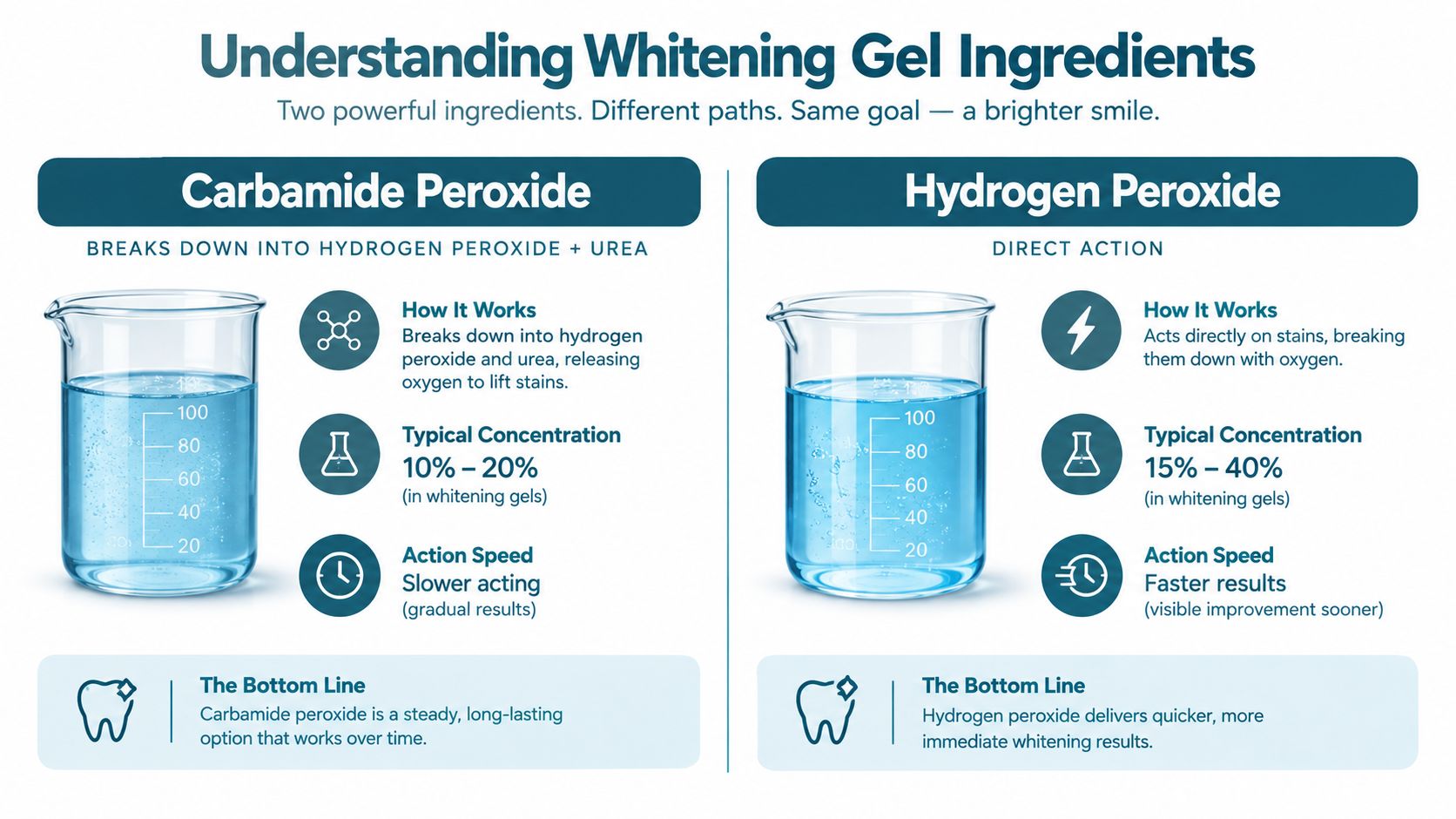
Hydrogen peroxide and carbamide peroxide are the two main bleaching agents in teeth whitening gel. Both break down chromogens, the darker compounds associated with tooth discoloration, but they release peroxide differently. Hydrogen peroxide acts more quickly. Carbamide peroxide breaks down gradually, releasing hydrogen peroxide over a longer period. Dental research explains the difference between these peroxide systems.
The release pattern helps determine how a clinician uses each gel. Faster-acting hydrogen peroxide may suit a supervised in-office appointment when a patient wants a quicker visible change. Carbamide peroxide is commonly used in take-home trays because its slower release supports longer contact with the teeth. The gel's pH and other formulation details also affect comfort, so peroxide percentage should not be considered in isolation.
Why percentages can mislead
Patients sometimes compare percentages as though they describe the same material. They do not. A common conversion treats carbamide peroxide as approximately one-third equivalent to hydrogen peroxide, so 18% carbamide peroxide is roughly equivalent to 6% hydrogen peroxide. A commonly used professional take-home formulation contains 10% carbamide peroxide, while dentist-provided trays may use approximately 10% to 16% carbamide peroxide. These figures are discussed in the Australian Dental Association's policy statement on whitening ingredient concentration and professional use.
The comparison provides context, not a guarantee of equal results. Application time, treatment frequency, tray fit, stain type, enamel condition, gel pH, and formulation all influence the response. A lower concentration used with an accurate tray and suitable schedule may be safer and more effective for a particular patient than a stronger gel used too aggressively.
What the evidence says about strong gels
A 2024 systematic review comparing 37% carbamide peroxide with 35% hydrogen peroxide for in-office bleaching found statistically similar color changes after treatment and at 3- and 6-month follow-ups, particularly after more than two bleaching sessions. This challenges the assumption that faster peroxide release always produces better whitening. The review's results are available in the same systematic analysis of peroxide bleaching protocols cited above.
Patients should follow the prescribed amount and wearing time rather than treating concentration as a race. Professional supervision helps match the gel, pH, tray or isolation method, and schedule to the patient's teeth and tolerance. The appropriate formulation balances speed, shade change, comfort, and control.
Patients concerned about discomfort should also review why teeth whitening can cause sensitivity, including what sensations to monitor before treatment begins.
Comparing In-Office Treatments and Custom Take-Home Trays
In-office whitening and custom take-home trays solve different problems. A patient with a near-term event may value speed and professional isolation. Someone with a flexible timeline may prefer gradual treatment that can be paused if the teeth become uncomfortable.
In-office treatments commonly use hydrogen peroxide concentrations of about 15% to 43%. Professional bleaching may produce visible results after one appointment, with reported brightening of roughly 3 to 8 shades during a 30- to 60-minute session, although the result varies by stain type and individual response. The American Dental Association's whitening guidance explains the common effects and clinical considerations.
Custom trays provide a different kind of control. A dentist designs the trays to fit the patient's teeth, then selects the gel and wearing schedule. The slower process can be useful for patients who want to manage the pace, reduce unnecessary gum contact, or make gradual changes before an event.
| Feature | In-Office Whitening | Custom Take-Home Trays |
|---|---|---|
| Speed | Designed for a concentrated appointment and faster visible change | Gradual brightening over a prescribed schedule |
| Supervision | The dental team applies the gel and protects the gums during treatment | The patient applies the gel at home after professional instructions |
| Control | Useful when a patient wants a scheduled, immediate cosmetic treatment | Useful when a patient wants to adjust the pace within clinical guidance |
| Sensitivity considerations | Higher concentration may shorten treatment time but can increase sensitivity risk | Slower-release carbamide peroxide may support longer contact and controlled use |
| Fit | The team manages isolation and application during the appointment | Custom trays help keep gel positioned over the teeth |
| Maintenance | May require a separate maintenance plan | Trays can support future dentist-guided touch-ups when appropriate |
A wedding in Circleville, an upcoming family gathering in Lancaster, or a professional milestone may make in-office treatment appealing. A patient with a history of sensitivity may prefer take-home trays, particularly when the dentist can modify the schedule and check the response.
Neither option changes the intrinsic color of crowns, veneers, fillings, or other restorations. The choice should follow an examination, not just a calendar deadline.
Evaluating Safety and Managing Tooth Sensitivity
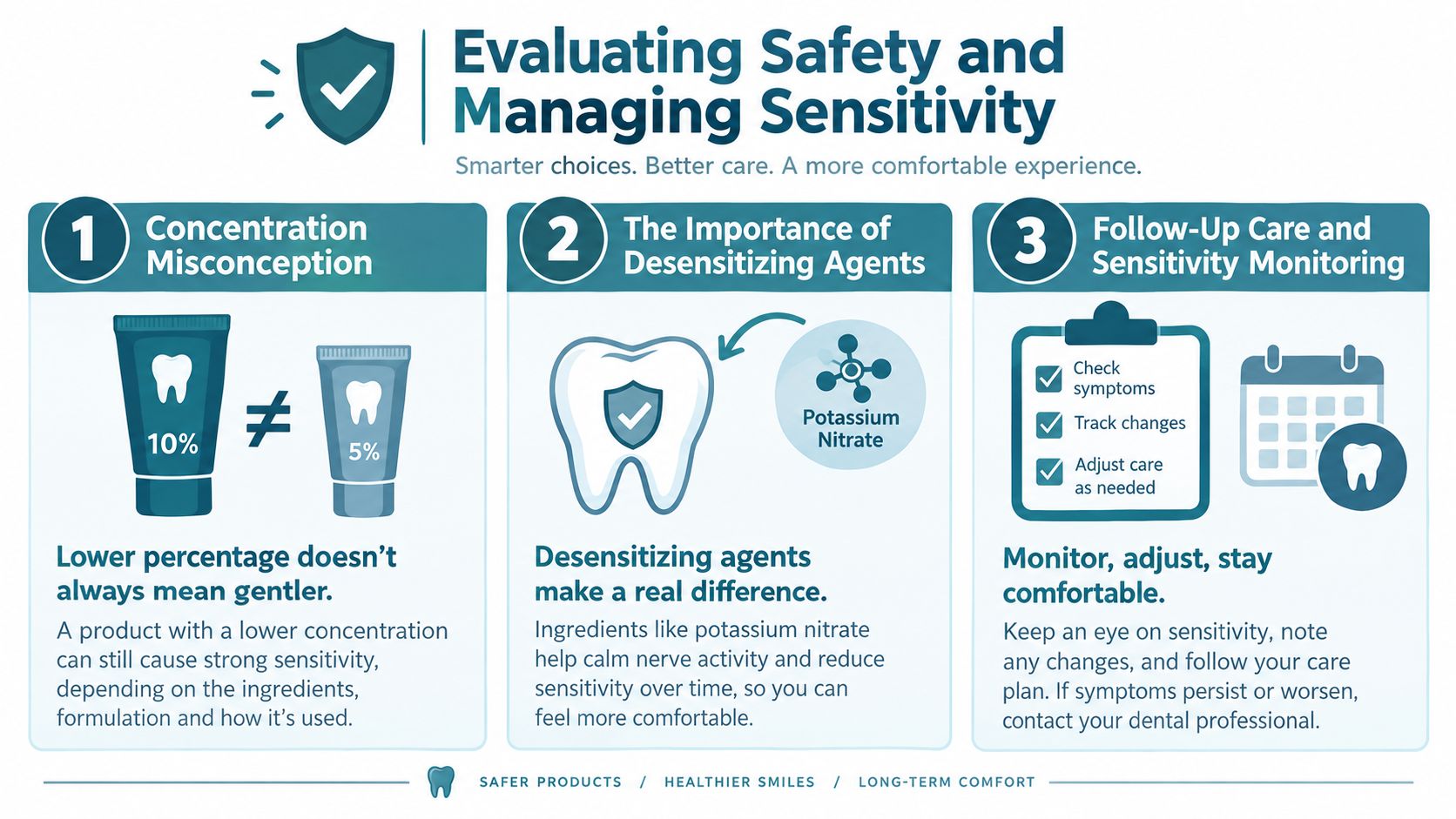
A gel with less peroxide can still cause discomfort. Gel pH and formulation also influence sensitivity and enamel response. A 2025 scoping review found that acidic gels were associated with greater sensitivity in some clinical trials. Laboratory studies consistently linked acidic pH, meaning below 7, with more enamel-surface alteration and greater hydrogen-peroxide penetration. The evidence remains limited, but patients should ask about the full formulation rather than judging safety by peroxide concentration alone. The findings are discussed in the review of whitening-gel pH, formulation, and enamel effects.
Temporary sensitivity is common. A 2025 study reported that it affects approximately 43% to 80% of peroxide-whitening users. Patients with a history of discomfort can read about teeth whitening for sensitive teeth before choosing a gel concentration. A dentist can also adjust the amount, contact time, or treatment schedule. Sharp pain, persistent pain, or gum burning calls for a pause and dental review rather than pushing on.
Oral health comes before cosmetic treatment
Whitening can aggravate an untreated dental problem. Before using a bleaching product, a dentist should check for:
- Cavities or cracks: Bleaching may trigger sharp discomfort when tooth structure is compromised.
- Exposed roots: Receding gums can expose areas that respond differently from enamel.
- Gum inflammation: Irritated tissue is more vulnerable to peroxide contact.
- Poorly fitting trays: Excess gel may reach the gums instead of remaining on the tooth surfaces.
- Existing restorations: Crowns, veneers, fillings, and sealants will not lighten like natural enamel.
The American Dental Association's discussion of whitening safety identifies temporary tooth sensitivity and gum irritation as the most consistently reported short-term effects of vital-tooth whitening. Using the prescribed amount, exposure time, and frequency helps reduce preventable problems.
Why restoration planning matters
Whitening primarily changes natural tooth structure. It does not reliably alter the intrinsic shade of a crown, veneer, filling, or other restoration, so an existing mismatch may become more visible afterward.
Peroxide can also affect enamel surface properties with aggressive concentration, duration, frequency, or brushing immediately afterward. One study reported an approximately 18.3% reduction in microhardness after using 35% hydrogen peroxide, but that result applies to the study conditions, not every clinical treatment. Avoid abrasive brushing immediately after whitening, and stop treatment if sensitivity continues. The ADA News review of enamel, restorations, and whitening risks provides further clinical context.
What to Expect at Amanda Family Dental
A whitening consultation should feel like a dental appointment, not a product demonstration. Patients from Amanda, Lancaster, Circleville, and Carroll can expect the team to discuss the desired shade, examine the teeth and gums, and identify factors that may affect the result.
The appointment starts with diagnosis
A new patient exam may include digital X-rays when clinically appropriate, an evaluation of enamel and gum health, and a review of fillings, crowns, veneers, or other restorative work. This step is essential because whitening can only lighten natural tooth structure, and tooth pain may signal a condition that cosmetic treatment won't solve.
The dentist then discusses the treatment route. In-office whitening may suit a patient who wants a supervised appointment, while custom take-home trays may suit someone who prefers a measured pace. If the patient has significant discoloration, dental implants, visible restorations, or other cosmetic concerns, restorative dentistry or a broader cosmetic plan may be more appropriate than whitening alone.
Amanda Family Dental's treatment planning also fits into a wider dental-care relationship. Patients may need cleaning and exams before bleaching, dental X-rays for a painful tooth, or emergency dental services when discomfort is sudden. Someone searching for a cosmetic dentist near me may still benefit from a complete oral-health assessment first.
A patient who wants broader context on practice operations and clinical support can also review MedicalVirtual's information on dental staffing. The resource offers background on how dental teams organize patient-facing care and office support.
The following video provides another visual introduction to the consultation and whitening experience.
Instructions continue after treatment
Patients using custom trays receive instructions for the amount of teeth whitening gel, placement, wearing time, and treatment frequency. Patients receiving in-office care receive guidance on sensitivity, food and drink choices, and when to contact the office.
The same visit can also reveal unrelated needs, such as a tooth extraction, dental implants near me, or treatment for a damaged tooth. Addressing those concerns supports a healthier foundation for cosmetic care and helps the final smile look more balanced.
Taking the Next Step Toward a Brighter Smile
A brighter smile should support confidence without sacrificing comfort or oral health. Professional whitening gives patients a way to address discoloration with an examination, a defined schedule, and realistic planning around natural teeth and existing restorations.
The long-term benefit isn't just a lighter shade. Patients become more aware of the habits and conditions that affect their smiles, receive guidance before sensitivity becomes severe, and can coordinate whitening with veneers, fillings, crowns, or dental implants when appropriate. A local cosmetic dentist can also reassess the plan as the patient's dental history changes.
Patients comparing local providers may find broader guidance in Netco Design LLC's resource on ranking dental clinics, although choosing a dental office should ultimately depend on clinical communication, services, accessibility, and the quality of the patient experience.
Amanda Family Dental serves patients seeking a dentist in Amanda, OH, as well as families traveling from Lancaster, Circleville, and Carroll. The practice offers preventive dental care, restorative treatments, cosmetic dentistry, professional teeth whitening, dental implants, and emergency dental services, allowing whitening decisions to be made within a complete oral-health plan.
Schedule a consultation with Amanda Family Dental to discuss teeth whitening gel, sensitivity concerns, existing restorations, or other cosmetic goals. The team can provide an exam, digital X-rays when appropriate, personalized treatment planning, and guidance on whether in-office whitening or custom take-home trays fit your smile.