

A parent notices a small dark spot on a child's tooth while helping with bedtime brushing. The worry is immediate: can better food choices and natural habits stop the problem from growing? Families searching for how to prevent cavities naturally often want practical steps that feel safe, simple, and realistic, without confusing “natural” with “untested.”
Amanda Family Dental supports families in Amanda, Lancaster, Circleville, and Carroll, Ohio with preventive dental care, examinations, and treatment when home habits aren't enough. The key is balance: daily routines can lower cavity risk, while professional care can identify early damage and protect teeth that need more support.
Table of Contents
- Your Guide to Natural Cavity Prevention
- Daily Habits That Keep Cavities at Bay
- Smart Eating Choices to Reduce Cavity Risk
- Natural Agents vs. Professional Treatments
- Tailoring Prevention for Kids and High-Risk Cases
- What to Expect at Amanda Family Dental
- Take the Next Step Toward a Healthier Smile
Your Guide to Natural Cavity Prevention
Cavities develop when plaque bacteria use sugars from foods and drinks to produce acids. Those acids gradually weaken enamel, the hard outer layer of a tooth. The World Health Organization's guidance on sugars and dental caries identifies free sugars as the most common risk factor and says dental caries affects about 2.5 billion people worldwide.
“Natural prevention” works best when it supports the mouth's normal defenses. Saliva helps wash away food and neutralize acids, while consistent cleaning removes plaque before it can remain on teeth. Drinking water, reducing frequent sugar exposure, and choosing sugar-free products can all fit into a practical home routine.
A realistic prevention plan
Families can start with four priorities:
- Clean plaque consistently: Brush every morning and evening, then clean between teeth daily.
- Reduce sugar frequency: Keep sweet foods and drinks with meals instead of allowing repeated sipping or grazing.
- Support saliva: Drink water regularly and consider sugar-free gum when appropriate.
- Recognize warning signs: Dark spots, sensitivity, pain, swelling, or a visible hole deserve a dental examination.
The WHO recommends keeping free sugars below 10% of total energy intake, with an ideal target below 5%, to reduce cavity risk across the life course. The same guidance recommends brushing twice daily with fluoride toothpaste containing 1,000 to 1,500 ppm fluoride, because fluoride helps protect enamel against repeated acid attacks.
Families that want a deeper explanation of the decay process can review what causes tooth decay. Natural steps can make a meaningful difference, but they can't close an established cavity. Early professional guidance gives a child or adult a better chance of managing small changes before they become painful.
Daily Habits That Keep Cavities at Bay
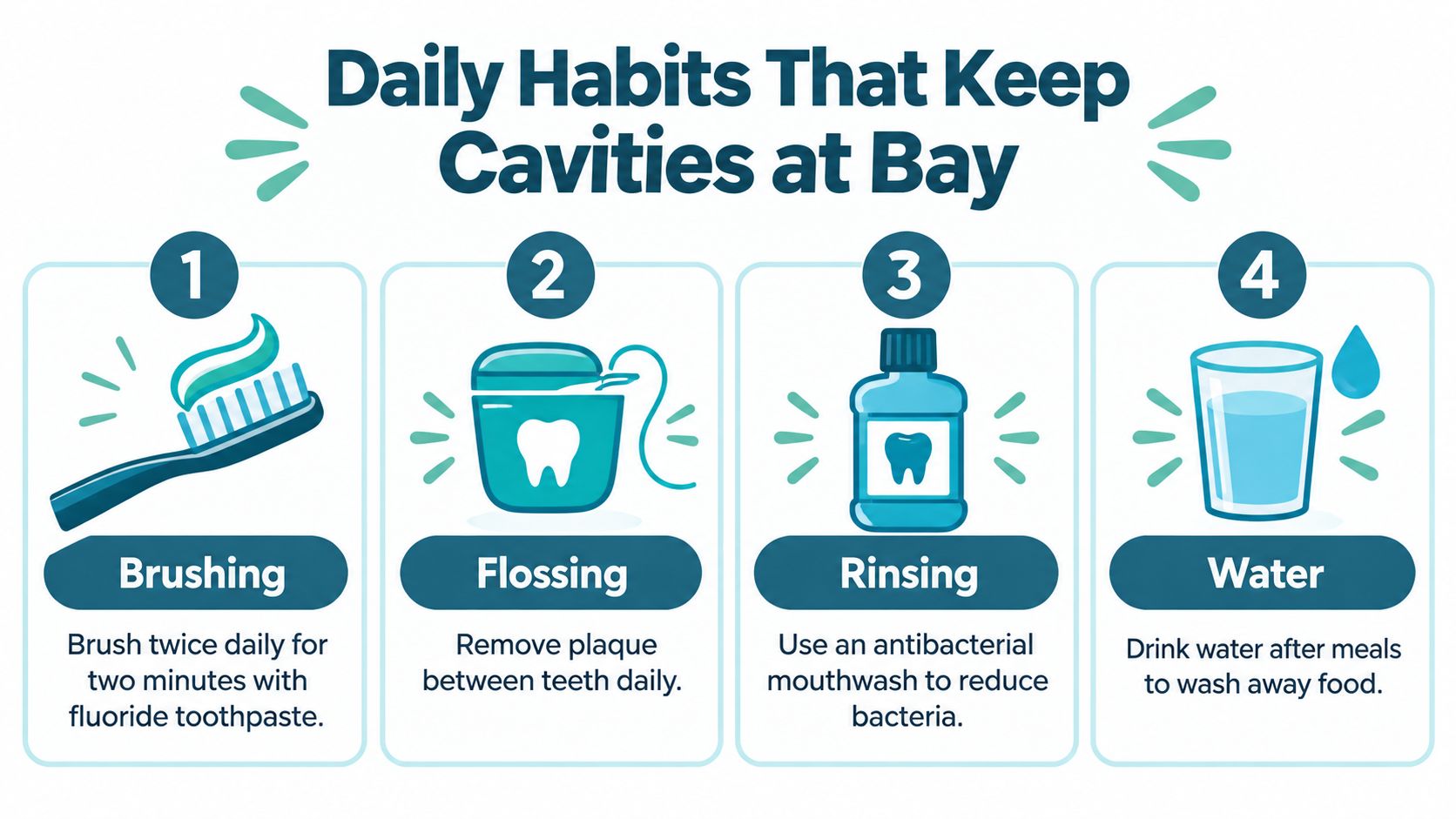
The most dependable home routine is consistent, gentle, and complete. The American Dental Association recommends brushing with fluoride toothpaste for two minutes twice a day and cleaning between teeth daily, as outlined in its guidance on optimal oral health habits.
A simple morning and evening routine
A soft-bristled toothbrush should reach the outer, inner, and chewing surfaces of every tooth. The brush should angle gently toward the gumline, where plaque often collects. Hard scrubbing doesn't clean better and may irritate the gums, so small, controlled movements are preferable.
Floss or use an interdental cleaner once daily. The cleaner should slide gently between teeth and curve around each tooth rather than snapping into the gums. Children may need supervision until they can reliably reach the back teeth and spaces between them.
The tongue can also hold bacteria and food residue. Gentle tongue brushing may improve mouth cleanliness, but it doesn't replace toothbrushing or interdental cleaning.
Practical rule: A fluoride-free product can be part of a family's preferences, but it shouldn't be presented as equivalent to fluoride for cavity prevention.
Some households add an alcohol-free rinse or sugar-free gum after meals. Xylitol-containing products may help as an adjunct, yet they're not a substitute for brushing, flossing, or professional care. A plain-language resource covering mouthwash tongue scraping flossing can help families compare these parts of an oral hygiene routine.
The proper brushing technique also matters when a patient has braces, crowded teeth, sensitive gums, or a history of decay.
The following video provides another visual reminder of everyday oral hygiene practices.
Smart Eating Choices to Reduce Cavity Risk
Sugar amount matters, but sugar frequency often matters more. Each exposure gives plaque bacteria another opportunity to produce acids. A review of the relationship between sugar and caries reported that frequency can be a stronger determinant than quantity, including a nursery-home study in which children eating sugar 4 ± 5 times per day had 4.7 times higher odds of a high caries increment over one year than children eating it 1 ± 2.9 times per day. These figures and the frequency-first approach are detailed in the WHO review of diet and dental caries.
Change the timing first
A child who drinks a sweet beverage slowly throughout the afternoon may expose teeth repeatedly. Having a sweet food with a meal, followed by water, creates a more manageable pattern than sipping or snacking continuously.
Useful changes include:
- Replace sugary drinks: Choose water for routine hydration, especially between meals.
- Group sweet foods: Keep desserts and sweet snacks with meals rather than spreading them across the day.
- Check sticky foods: Foods that cling to pits and grooves can remain in contact with teeth longer.
- Choose balanced snacks: Cheese, nuts, plain foods, and fresh vegetables can be easier on teeth than sugary, sticky snacks.
- Use fluoride consistently: The review notes that appropriate fluoride toothbrushing can make the sugar-caries association much weaker or nearly absent.
Water helps rinse food residue and supports saliva, but it doesn't erase the need for cleaning. Community water fluoridation also has a long public-health record. The CDC reports that water fluoridated at the recommended U.S. Public Health Service level reduces dental caries by about 25% in children and adults, and that 62.8% of the U.S. population had access to fluoridated water in 2022, as reported in its community water fluoridation data.
Nutrition supports general tooth structure too, but supplements shouldn't be treated as cavity medicine. Families reviewing the role of calcium and vitamin D3 can consult this Daily Powers calcium and vitamin D3 guide and discuss individual dietary needs with an appropriate health professional.
Natural Agents vs. Professional Treatments
Xylitol gum and lozenges can be useful after meals when brushing isn't immediately possible. A systematic review and meta-analysis found that xylitol reduced DMF or dmf scores compared with controls, with a standardized mean difference of -1.09, and reported a reduction of -1.87 compared with fluoride varnish. The evidence is encouraging, but the same review found that reductions in mutans streptococci weren't consistently significant across every comparison. The full findings are available in the systematic review of xylitol for caries prevention.
Natural products therefore fit best as additions, not replacements. Professional treatments protect surfaces and strengthen enamel in ways that gum or dietary changes can't fully duplicate.
| Option | How It Works | Best For | Evidence Strength |
|---|---|---|---|
| Xylitol gum or lozenges | Provides a non-cariogenic sweetener and may support saliva flow after meals | Patients seeking an adjunct to diet and cleaning | Helpful evidence, with benefits that vary across comparisons |
| Fluoride toothpaste | Supports enamel repair and resistance to acid damage during regular brushing | Most children and adults, based on individual needs | Strong, established prevention strategy |
| Fluoride varnish | Places concentrated fluoride directly on vulnerable tooth surfaces | Children and patients with elevated cavity risk | CDC reports a reduction of cavities in primary teeth by one-third |
| Pit-and-fissure sealants | Covers deep grooves where plaque and food collect | Back teeth that are difficult to clean | CDC reports that sealants prevent 80% of cavities in back teeth, as summarized in its cavity prevention guidance |
| Professional cleaning and examination | Removes deposits and identifies early changes | Patients of all ages, with timing based on risk | Essential for monitoring and personalized prevention |
Evidence summarized by NCBI reports that fluoride varnish applied twice yearly is the optimal frequency in the reviewed guidance, with preventive fractions of 37% for primary-teeth caries after three years and 43% for coronal caries in permanent teeth after three years. Those findings appear in the NCBI evidence summary on fluoride varnish.
Tailoring Prevention for Kids and High-Risk Cases
A single routine won't fit every mouth. Children with newly erupting molars, adults with dry mouth, patients wearing braces, and anyone with repeated cavities may need more targeted support.
Children and developing smiles
Parents can make brushing easier by using a child-sized brush, a timer, and supervised practice. An electric toothbrush may help a child reach surfaces more consistently, but technique and regular use matter more than the type of brush.
Back teeth deserve particular attention because their grooves can collect plaque. An evidence-based guideline from the American Academy of Pediatric Dentistry reports that, in a population with 30% baseline risk, 196 carious lesions would be prevented per 1,000 sealant applications, as shown in the AAPD evidence-based sealant guideline. Families can learn more about preventive protection through pediatric dental sealants.
Parents may also confuse normal toddler or preschool discomfort with decay. A family-friendly overview of 2 year molars symptoms can help distinguish common eruption concerns from signs that warrant an examination.
Dry mouth and braces
Reduced saliva can leave teeth less protected against acids. Water, sugar-free gum, and xylitol products may support comfort and saliva flow, while persistent dryness should prompt a conversation about medications, health conditions, and mouth breathing.
Braces create additional plaque-retention areas around brackets and wires. Interdental brushes, careful brushing around each attachment, and a dentist-recommended fluoride rinse may help, but a personalized cleaning demonstration is often more useful than adding products at random.
The practice serving families in Amanda, Lancaster, and Carroll can combine preventive education with cleaning and exams, digital x-rays, sealants, fluoride varnish, restorative dentistry, and emergency dental services when symptoms appear. Patients with tooth pain, swelling, or a damaged tooth shouldn't rely on natural methods alone.
What to Expect at Amanda Family Dental
A first visit can begin with a conversation rather than a procedure. The dental team asks about brushing, diet, dry mouth, dental anxiety, previous cavities, and preferences about fluoride or fluoride-free options. That information helps shape a plan around the patient instead of applying the same routine to every family.
A new patient exam may include digital x-rays when they're clinically appropriate. These images can help the dentist assess areas that aren't visible during a regular examination, while a cleaning removes deposits that home brushing and flossing may leave behind.
Care shaped around comfort
Dr. Alyssa Jenkins leads a local practice that offers preventive, pediatric, cosmetic, and restorative services for patients in Amanda, Lancaster, Circleville, and Carroll. Available care includes cleanings and exams, composite fillings, crowns, root canals, dentures, dental implants, professional teeth whitening, veneers, and Invisalign.
Patients who feel nervous about dentistry can ask about comfort-focused options, including sleep dentistry. The office also offers digital x-rays, mercury-free fillings, myofunctional therapy, and other services that may support a broader care plan.
A patient searching for a dentist near me, a dentist in Amanda, OH, or an emergency dentist can expect the team to review symptoms and explain suitable next steps. A patient exploring dental implants near me or a cosmetic dentist near me can receive a consultation focused on function, appearance, and oral health rather than a one-size-fits-all recommendation.
Take the Next Step Toward a Healthier Smile
Learning how to prevent cavities naturally starts with habits that families can repeat: careful brushing, daily interdental cleaning, water between meals, and less frequent sugar exposure. Xylitol may add support, particularly after meals, but it works best alongside evidence-based hygiene and professional monitoring.
A dental examination becomes especially important when a dark spot, sensitivity, persistent toothache, swelling, or a visible hole appears. Early assessment may allow a simpler response, while delayed care can lead to restorative treatment, a tooth extraction, or urgent dental services.
Families in Amanda, Lancaster, Circleville, and Carroll can seek preventive cleanings and exams, pediatric care, sealants, fluoride varnish, restorative dentistry, cosmetic dentistry, dental implants, and emergency dental care through one local office. A new patient exam with digital x-rays and a personalized plan can clarify which natural habits fit the patient's actual risk.
Schedule an appointment or request a consultation before a small concern becomes a painful interruption to eating, speaking, sleeping, or smiling.
Amanda Family Dental offers preventive cleanings and exams, pediatric care, sealants, fluoride varnish, restorative dentistry, and personalized guidance for families working to prevent cavities naturally. Visit Amanda Family Dental to request an appointment or consultation in Amanda, with care available for patients from Lancaster, Circleville, and Carroll.