

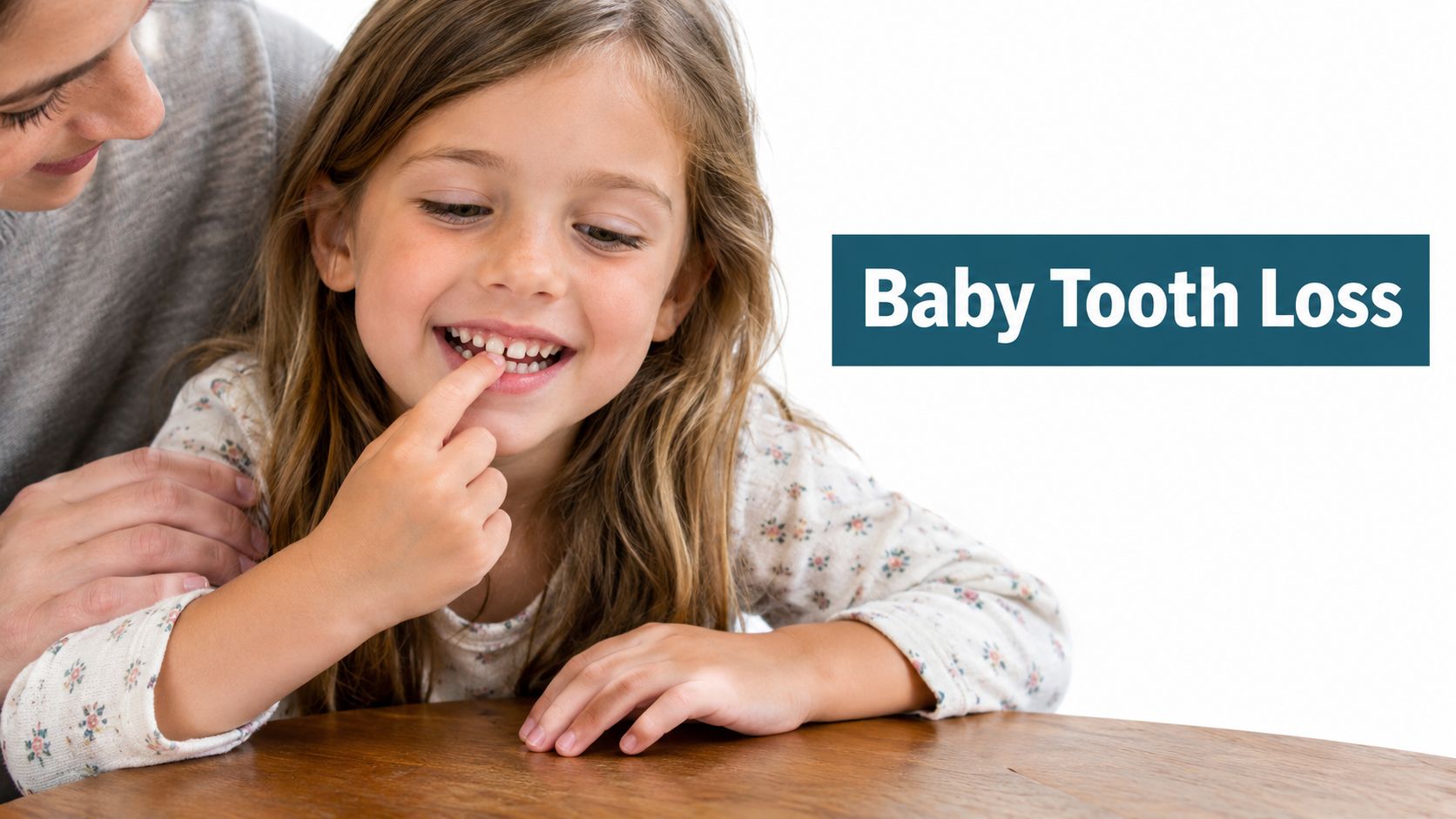
Most children start losing their baby teeth around age 6, and the process typically finishes by age 12. The first loose tooth is usually one of the lower front teeth, while the final baby teeth often remain until the preteen years.
A child may discover the change while eating breakfast, brushing in the bathroom, or showing a parent a tooth that suddenly moves. The moment can bring excitement, curiosity, and a little worry. Parents often ask whether the timing is normal, whether a loose tooth should be pulled, and when a dentist should check it.
For families looking for a dentist in Amanda, OH, or searching for a dentist near me in Lancaster, Circleville, or Carroll, understanding the normal pattern can make this milestone easier. Amanda Family Dental supports families with preventive dental care, child-focused visits, and guidance that helps parents feel prepared as baby teeth make room for permanent teeth.
Table of Contents
- The Wiggly Tooth Journey Begins
- Typical Ages and Timeline for Losing Baby Teeth
- Why Every Child's Timeline Is Different
- Comfort Care for Loose Teeth at Home
- When to Consult a Local Dentist
- Building a Healthy Dental Future in Amanda
The Wiggly Tooth Journey Begins
A child may run from the bathroom with a fingertip pressed to a lower front tooth. “It moved,” the child announces, while a parent leans in for a closer look. The tooth may only wiggle slightly at first, but that small movement often marks the beginning of a normal, multi-year change.
The first loose tooth can feel like a celebration and a problem at the same time. Children may look forward to a visit from the Tooth Fairy, while parents may wonder whether the tooth is loose enough, whether brushing will hurt, or whether a little blood is expected. Gentle reassurance helps. A baby tooth that becomes loose on its own is usually following the natural path toward replacement.
Baby teeth aren't just temporary decorations. They help children chew, speak, and maintain space while permanent teeth develop. As the permanent tooth moves into position, the baby tooth gradually loses the support that held it in place. The result is a tooth that moves more freely before it falls out.
A milestone worth handling calmly
A parent doesn't need to turn the first loose tooth into a dental emergency. Most children can continue eating, brushing, and playing normally, with some adjustment if the area feels tender. A child who feels nervous can be told that the tooth is making room for a stronger, permanent tooth, not that something is going wrong.
Practical rule: Let the tooth guide the process. Gentle wiggling is reasonable, but forceful pulling can create unnecessary discomfort.
The first wiggly tooth also creates a useful opportunity to build trust around dental visits. Families who establish a positive routine early often have more opportunities to ask questions about brushing, developing permanent teeth, and the appearance of the gums. Parents can review guidance about the appropriate age for a child's first dental appointment and keep regular visits part of the child's normal routine.
For families in Amanda, Lancaster, Circleville, and Carroll, a local dental office can provide reassurance without making a normal childhood event feel alarming. A calm explanation, a careful examination when needed, and comfort-focused communication can help a child see dental care as part of growing up.
Typical Ages and Timeline for Losing Baby Teeth
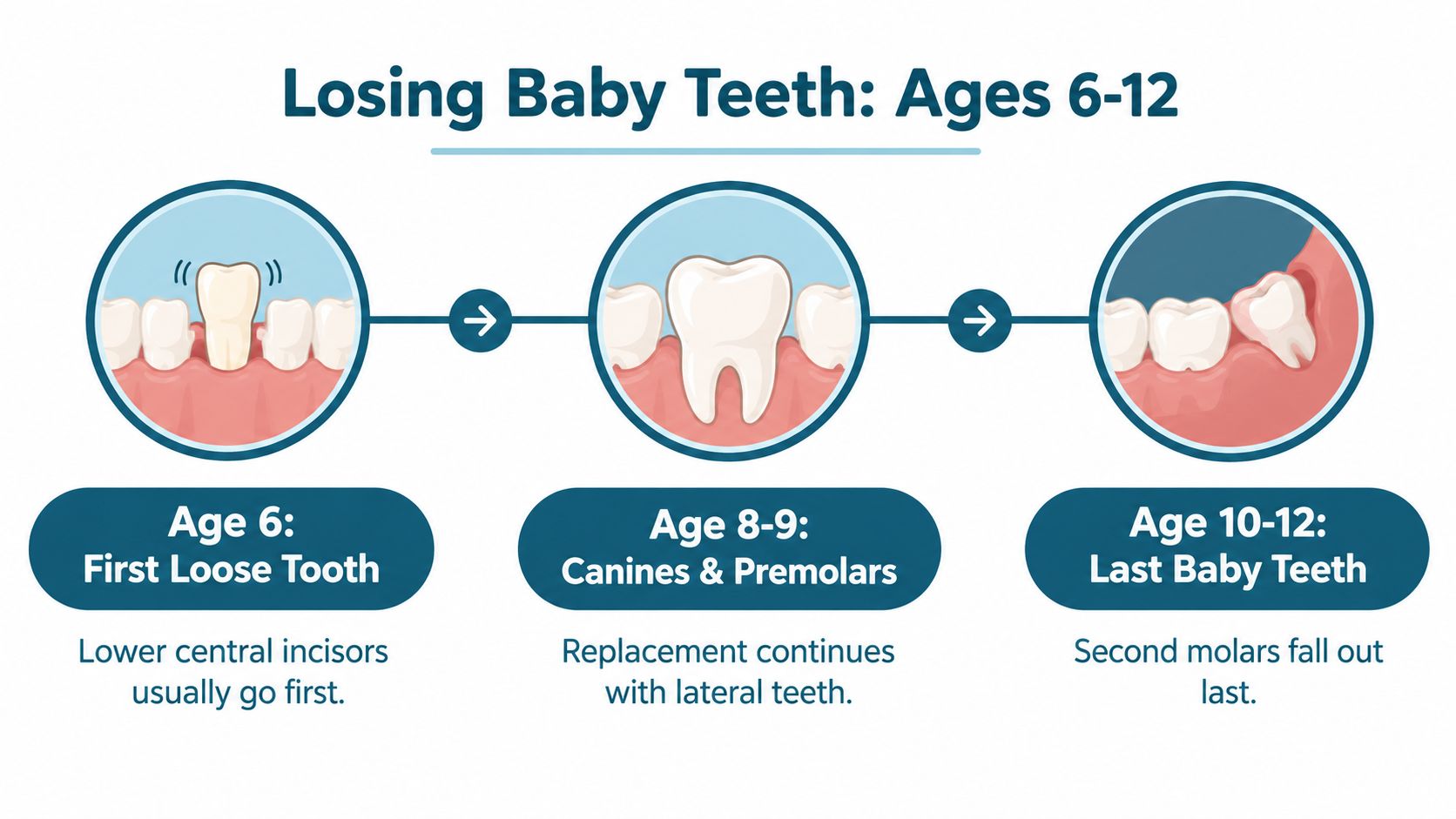
The typical pattern begins around age 6, although a child may start somewhat earlier or later. Mayo Clinic explains that baby teeth usually loosen and fall out at about age 6, while the process may not begin until about a year later for some children. This makes ages 6 to 7 a reasonable starting range rather than a fixed birthday. Mayo Clinic's guidance on baby teeth describes the transition as a gradual change linked to the arrival of permanent teeth.
The lower central incisors, the two front teeth at the bottom, commonly loosen first. The upper central incisors generally follow. A clinical reference from the National Center for Biotechnology Information places primary tooth shedding broadly between ages 6 and 12, with the final primary molars or canines often remaining until ages 10 to 12.
The sequence from front teeth to back teeth
The American Academy of Pediatric Dentistry eruption chart shows a general order for replacement. The central incisors are generally replaced at 6 to 7 years, lateral incisors at 7 to 8 years, first molars at 9 to 11 years, and canines and second molars at about 9 to 12 years. These ranges come from the pediatric dental eruption chart.
A simple way to understand the progression is:
- Front lower teeth: The lower central incisors commonly become loose first.
- Front upper and side teeth: Upper central incisors and lateral incisors follow as the front of the smile changes.
- Back teeth: First molars, canines, and second molars tend to be replaced later.
- Completion: The full transition commonly continues through the early adolescent years.
The back of the mouth may therefore contain baby teeth after the front teeth have already changed. That isn't automatically a concern. Molars are larger and serve a different role, so they often remain longer before permanent teeth take their place.
A short educational video can help children understand the process visually:
The important point is that baby teeth don't fall out all at once. Each tooth follows its own stage of loosening and replacement, and the overall process may stretch from early elementary school into the preteen years.
Why Every Child's Timeline Is Different
A dental chart offers a useful map, but it can't predict the exact morning a particular child's tooth will loosen. One child may lose a lower front tooth and then experience a long pause. Another may notice several changes close together. Both patterns can fit healthy development when the mouth is progressing normally.
The order often matters more than a precise calendar date. A child who begins with the lower front teeth and gradually moves toward the upper and back teeth may be following the expected pattern even if the timing differs from a classmate's. Comparing children too closely can create worry without providing useful information.
What normal variation can look like
A child may have a gap in the smile for a while before the permanent tooth appears. Another child may have a permanent tooth emerging while a baby tooth is still present. Some children are eager to touch every wiggly tooth, while others avoid moving it because the sensation feels unfamiliar.
These differences don't necessarily indicate a problem:
- A loose tooth can remain in place while the child waits for it to fall out naturally.
- A temporary gap can appear as the permanent tooth moves into position.
- The front teeth and back teeth don't have to change at the same pace.
- A child may have mild tenderness around a tooth that is nearly ready to come out.
Growth, family patterns, and the timing of earlier tooth development may contribute to differences, but parents don't need to identify the cause at home. The more practical question is whether the child has pain, swelling, injury, or a development pattern that seems significantly outside the usual sequence.
A calendar can suggest what may happen next. A dental examination shows what is happening in that child's mouth.
Regular checkups give a dentist the chance to observe the gums, the baby teeth, and the developing permanent teeth together. That broader view is more useful than judging one loose tooth in isolation. Parents in Amanda, Lancaster, Circleville, and Carroll can contact Amanda Family Dental when uncertainty is making the milestone stressful, especially if a child can't eat comfortably or a tooth appears stuck.
The goal isn't to make every child follow an identical schedule. The goal is to protect comfort, preserve healthy baby teeth until they're ready to be replaced, and identify unusual changes early.
Comfort Care for Loose Teeth at Home
Most loose teeth need patience rather than complicated treatment. Children can gently move a tooth with a clean finger or the tongue if doing so feels comfortable. Forceful pulling isn't necessary, and a tooth that isn't ready may cause more discomfort if an adult tries to remove it.
Food choices can make the day easier when the gum feels sensitive. Soft, cool foods such as yogurt or applesauce may be more comfortable than hard or sticky foods near the loose tooth. A child can return to a usual diet as comfort improves, while parents should continue to offer balanced meals and regular water.

Keep the area clean
Brushing still matters when a tooth is loose. Parents can help the child brush carefully around the tooth and gumline, using light pressure rather than skipping the area altogether. Careful cleaning reduces the chance that food will remain around a sensitive spot.
Families can also review ways to help prevent cavities in children so the new permanent teeth receive consistent care as they emerge. A loose baby tooth doesn't mean the rest of the mouth can be neglected. The surrounding teeth still need regular brushing, and children may need an adult's help to clean thoroughly.
Respond to discomfort sensibly
If the gum is mildly sore, a cool compress placed against the cheek for a short period may feel soothing. Parents who are considering an over-the-counter pain reliever should choose only a product suitable for the child's age and follow the product directions or advice from a healthcare professional. Dental offices can also help families decide whether discomfort sounds typical or deserves an appointment.
A small amount of tenderness after a naturally lost tooth can settle as the gum recovers. Heavy bleeding, persistent pain, facial swelling, or a tooth lost during an accident is different and warrants prompt professional guidance.
Parents can make the experience less intimidating by allowing the child to ask questions and choose soft foods temporarily. A calm response teaches the child that a loose tooth is manageable, while careful hygiene reinforces the habits needed for the permanent smile.
When to Consult a Local Dentist
Normal tooth loss usually involves a gradually loosening tooth, mild or no discomfort, and a predictable movement from front teeth toward the back of the mouth. A professional evaluation becomes more important when the timing is unusually early, the tooth is associated with injury, or the child has symptoms that don't fit a routine loose tooth.
The Cleveland Clinic's guidance on children losing teeth identifies several points that warrant dental evaluation. Losing a tooth before age 4 or having no tooth loss by age 8 to 9 can signal delayed eruption, crowding, or a developmental concern. These ranges aren't a diagnosis, but they give parents a practical reason to call.
Compare routine changes with warning signs
| Usually appropriate to monitor | Call a local dentist for guidance |
|---|---|
| A tooth becomes loose gradually | A tooth is lost after a fall, collision, or other injury |
| Mild tenderness near the loose tooth | Significant pain, swelling, or signs of infection |
| A temporary gap appears | No baby teeth have loosened by the expected evaluation range |
| The child can eat and brush with minor adjustments | A tooth stays loose with ongoing discomfort or appears stuck |
| The sequence generally moves from front teeth toward back teeth | The timing or order seems markedly unusual |
A permanent tooth can sometimes appear while the baby tooth is still present. Parents may notice a second row or a tooth emerging behind the lower front teeth. That appearance can be unsettling, but the dentist can determine whether the baby tooth is loosening normally or whether the area needs closer monitoring.
Injuries need a different response
A tooth knocked out during sports or play isn't the same as a baby tooth that naturally exfoliates. Parents shouldn't try to place a knocked-out baby tooth back into the socket. The developing permanent tooth underneath may be at risk, so the family should contact an emergency dentist or dental office promptly for instructions.
Amanda Family Dental can help families in Amanda, Lancaster, Circleville, and Carroll decide whether a concern needs routine care, an urgent visit, dental X-rays, or another form of evaluation. A child with severe pain or facial swelling shouldn't wait for the next routine cleaning and exam.
Building a Healthy Dental Future in Amanda
The first loose tooth is one visible part of a much larger process. Children are also learning how to brush consistently, tolerate dental examinations, describe discomfort, and care for a smile that will change repeatedly as they grow. These skills can influence how confidently they approach dental care later.
A preventive visit can include a new patient exam, a careful review of the teeth and gums, and dental X-rays when clinically appropriate. The dental team can monitor developing permanent teeth, discuss brushing technique, answer questions about spacing, and create a personalized treatment plan if a concern appears.
Local care that grows with the child
Amanda Family Dental provides family dental services in Amanda, OH, with care available to families traveling from Lancaster, Circleville, and Carroll, OH. Its services include preventive cleanings and exams, pediatric dentistry, fillings, crowns, root canals, and restorative options such as dentures and dental implants. That range allows a family to seek routine child care and discuss other needs, including a cosmetic dentist near me, dental implants near me, or a tooth extraction, through one local practice when appropriate.
Comfort matters, especially for children who feel uncertain about dental instruments or unfamiliar surroundings. Patient-focused explanations, digital X-rays, and clear treatment planning can make appointments easier to understand. Parents can also find additional guidance about children's dental health and use routine visits to reinforce healthy habits at home.
The practice's role isn't to make every child lose teeth on the same schedule. It is to help families recognize normal development, respond to discomfort, and address concerns before they become more difficult. A supportive relationship with a local dentist gives children a familiar place to turn as baby teeth give way to permanent teeth.
Amanda Family Dental offers pediatric dental visits, preventive cleanings and exams, digital X-rays, and personalized guidance for children moving through the baby-to-permanent-tooth transition. Families in Amanda, Lancaster, Circleville, and Carroll can visit Amanda Family Dental to schedule an appointment or request a consultation about a child's loose tooth, dental discomfort, or developing smile.