

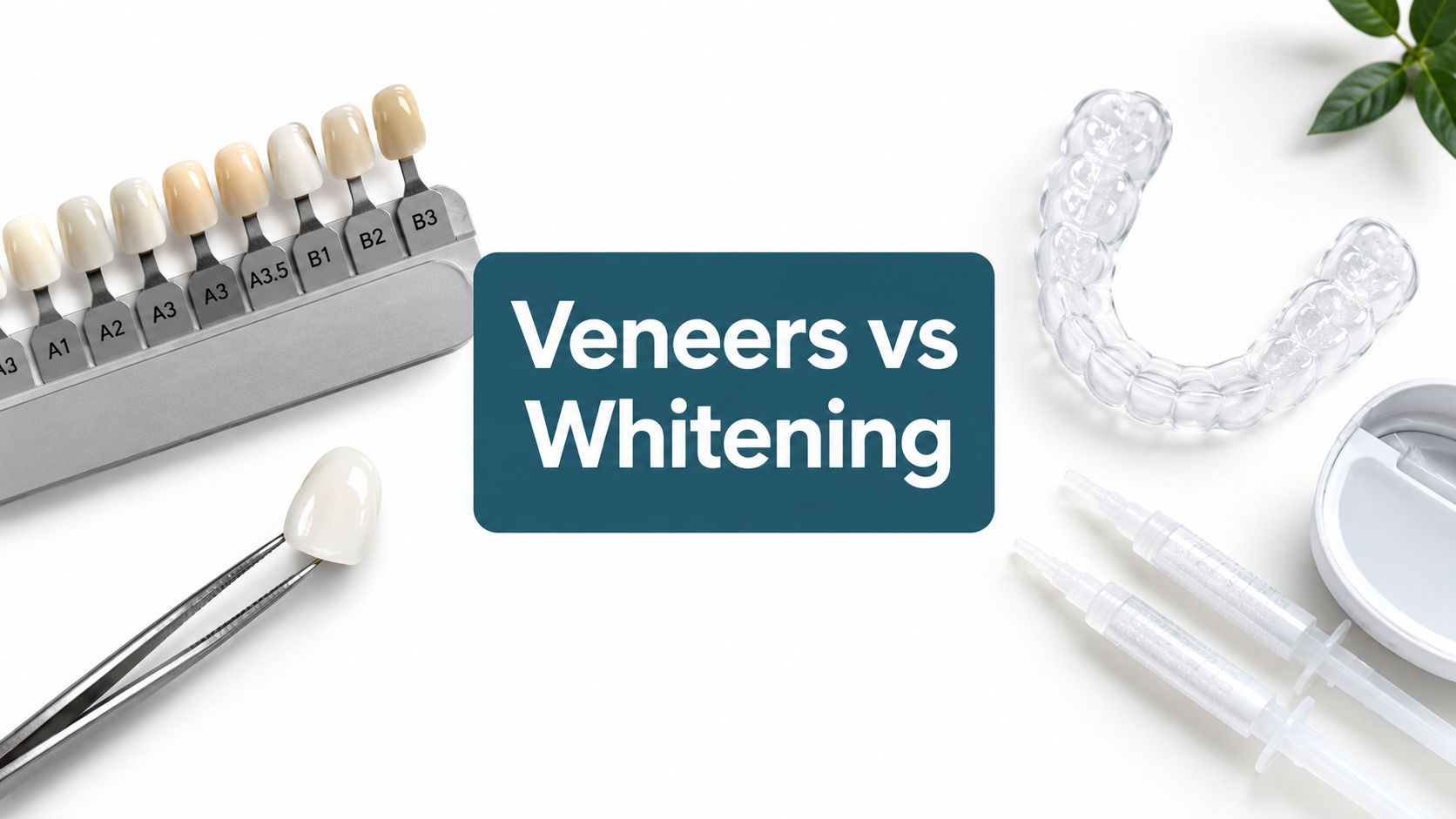
When a smile feels less bright than it used to, many people start with the same hesitation. They may cover their teeth in photos, avoid laughing freely, or wonder whether a cosmetic dentist near me can offer a natural-looking solution without an overly dramatic change. For patients searching for a dentist in Amanda, OH, or traveling from Lancaster, Circleville, or Carroll, the choice often comes down to two familiar options, veneers vs whitening.
Amanda Family Dental offers professional teeth whitening and porcelain veneers as part of its cosmetic dentistry services. The right option depends on whether the concern is mainly tooth color or whether the smile also needs changes to shape, surface, spacing, or damaged areas. A consultation can also identify whether preventive care, restorative dentistry, dental x-rays, or treatment for tooth decay should come before cosmetic work.
Table of Contents
- Finding Your Path to a Confident Smile in Amanda
- Understanding the Core Differences in Cosmetic Dentistry
- Professional Teeth Whitening for Natural Enamel
- Transforming Tooth Shape and Structure with Veneers
- Comparing Longevity, Investment, and Treatment Timelines
- Strategic Treatment Sequencing for Lasting Results
- Your Cosmetic Consultation at Amanda Family Dental
Finding Your Path to a Confident Smile in Amanda
A patient may arrive for a routine cleaning and mention that coffee stains have made the front teeth look dull. Another patient may have teeth that are already fairly white but chipped, uneven, or mismatched in shape. Both patients may search for “dentist near me,” yet they need different forms of care.
Whitening can be a sensible starting point when natural teeth are healthy and the primary concern is discoloration. Veneers can be more appropriate when the smile needs a new visible surface to improve several cosmetic features at once. Neither treatment is automatically better. Each solves a different problem.

Practical rule: If the teeth have the right shape but the wrong color, whitening may be enough. If the color, shape, edges, or spacing are all concerns, veneers deserve a closer evaluation.
The first appointment should focus on the condition of the teeth and gums, not just the shade a patient wants. A new patient exam can reveal cavities, gum inflammation, worn enamel, cracked teeth, or older restorations that affect the final cosmetic plan. Patients who also need a tooth extraction, dental implants near me, or emergency dental services should have those concerns addressed before beginning elective cosmetic treatment.
| Main concern | Treatment that may fit | What it changes |
|---|---|---|
| Stains on healthy natural teeth | Professional whitening | Tooth color |
| Chips, gaps, or uneven edges | Porcelain veneers | Shape, color, and visible surface |
| Existing crowns or fillings with a different shade | Individualized cosmetic planning | The relationship between natural teeth and restorations |
| Pain, decay, or damaged teeth | Restorative or emergency dental care first | Oral health and function |
For families in Amanda, Lancaster, Circleville, and Carroll, the goal isn't just a brighter photograph. The goal is a smile that looks balanced, remains comfortable, and supports normal chewing and speaking. A local dental team can help patients compare the short-term effect of whitening with the longer-term commitment involved in veneers.
Understanding the Core Differences in Cosmetic Dentistry
Whitening changes color. Veneers change the visible structure of a tooth. That distinction answers many of the questions patients ask during a cosmetic consultation.
Professional whitening uses a peroxide-based gel to lighten stains within or on the surface of natural enamel. It doesn't add material to a tooth, close a gap, rebuild a chipped edge, or make a short tooth appear longer. The result depends on the type of discoloration and the condition of the natural tooth.
A porcelain veneer is a thin, custom-made restoration bonded to the front of a tooth. It can alter the apparent color, width, length, contour, and surface texture. This makes veneers useful for concerns that bleaching can't address, including persistent discoloration, small gaps, chipped edges, and uneven tooth shapes.
Color correction and structural change
Whitening is limited to natural tooth structure. The American Dental Association explains that bleaching doesn't change the shade of crowns, veneers, or fillings, and its patient guidance on teeth whitening provides the relevant distinction. A patient with several restorations may therefore need a broader plan than a patient with intact enamel and external stains.
Veneers don't whiten the underlying tooth. Instead, they cover the visible front surface with a selected ceramic shade. This can make the appearance more uniform, but the process requires careful planning because the restoration becomes part of the smile's long-term design.
Matching the treatment to the concern
A patient with healthy, well-shaped teeth and stains from normal diet or aging may be a strong whitening candidate. A patient with a deep internal stain that doesn't respond to peroxide, a worn edge, or several mismatched front teeth may need a restorative-cosmetic option.
A systematic review describes porcelain laminate veneers as restorations that improve color, shape, and overall appearance, while whitening remains a color-focused procedure. The review also reports long-term veneer survival commonly above 90% at 10 years, as detailed in this systematic review of porcelain laminate veneers. That doesn't mean every veneer will last the same length of time. Bite forces, hygiene, grinding, diet, and follow-up care all matter.
Professional Teeth Whitening for Natural Enamel
Professional whitening is most useful when natural teeth are healthy and the main complaint is a dull or uneven shade. The dental team first checks for decay, gum problems, exposed roots, cracks, and sensitivity concerns. Whitening can make a healthy smile brighter, but it shouldn't be used to mask untreated disease.
Hydrogen peroxide and carbamide peroxide are the active ingredients most often used in professional systems. A review of whitening materials found that hydrogen peroxide concentrations around 25% to 35% can provide results comparable to higher concentrations while reducing sensitivity concerns, as discussed in this review of peroxide-based tooth whitening.
What the appointment involves
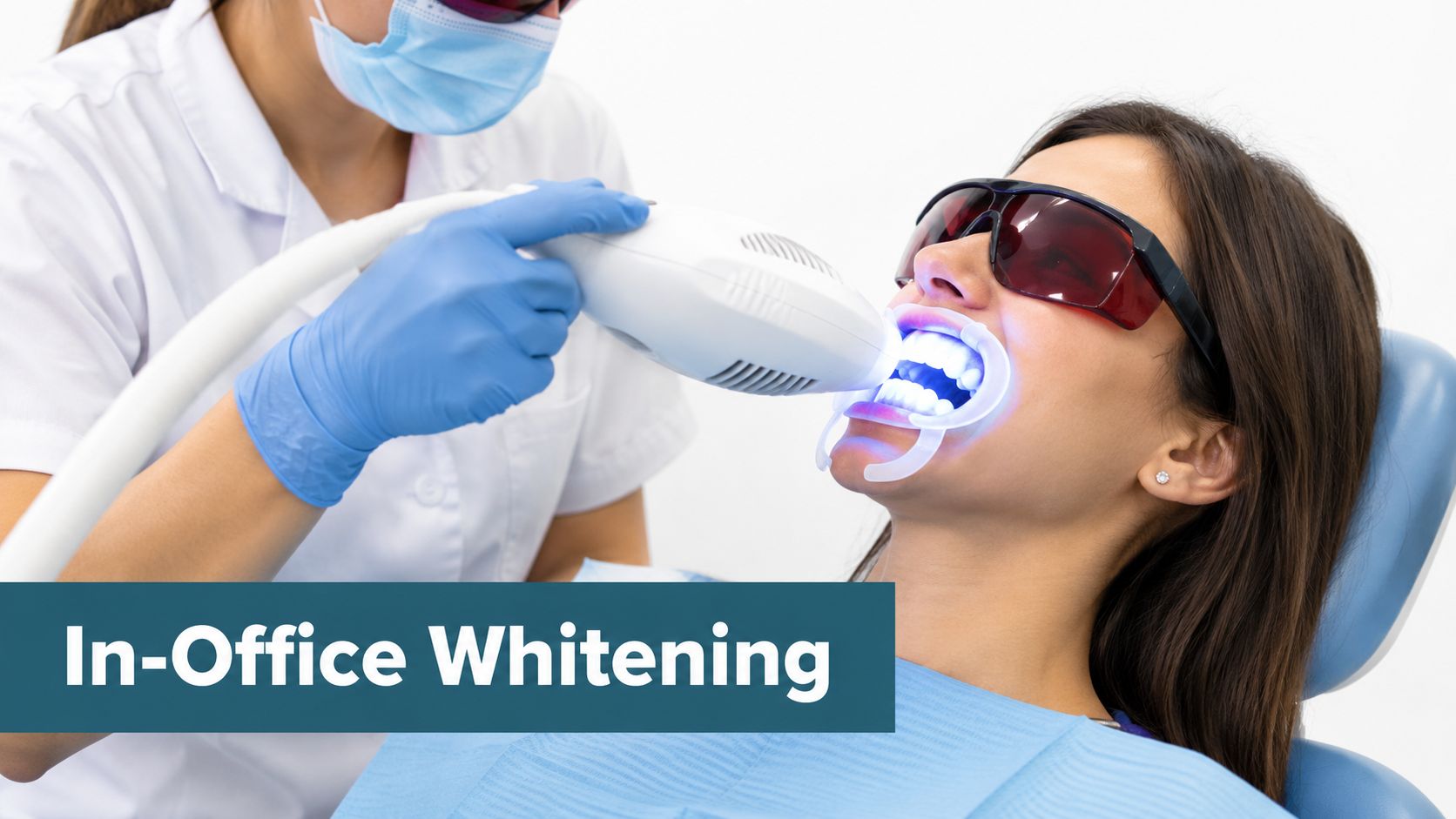
A typical whitening visit begins with an evaluation of the teeth and gums. The dental professional protects the soft tissues, applies the selected whitening material, and follows the manufacturer's timing and safety protocol. Some patients may also receive take-home trays or maintenance guidance, depending on the shade goal and sensitivity history.
Professional treatment commonly produces a 5 to 10 shade improvement, while consumer products often produce a more modest 1 to 3 shade change, according to the cited industry summary on professional whitening results and treatment statistics. Individual results vary, especially when discoloration comes from trauma, medication, enamel defects, or an existing restoration.
Patients who want to understand how to protect enamel while pursuing a brighter smile can review these safe enamel whitening methods. The most useful guidance is usually simple, use dentist-recommended products, follow wear instructions, and report significant sensitivity rather than trying to push through discomfort.
The restoration limitation
Whitening won't lighten porcelain veneers, crowns, or tooth-colored fillings. If natural teeth become brighter while existing dental work stays at its original shade, the smile may look less uniform. This issue matters especially when the visible teeth contain a mixture of natural enamel and restorations.
A consultation should therefore include a shade discussion before treatment. Patients can review professional teeth whitening options after an examination, particularly if they may later consider veneers. Whitening is minimally invasive and repeatable, but its benefit is limited when the concern involves tooth shape or fixed dental work.
Transforming Tooth Shape and Structure with Veneers
Veneers are designed for patients who want more than a color change. A custom porcelain restoration can cover a resistant stain, refine an uneven edge, reduce the appearance of a small gap, or create a more consistent shape across several front teeth.
The process begins with an examination, photographs or digital records, and a discussion of the desired result. The dental team evaluates the bite, gum line, enamel, existing fillings, and the way the teeth meet during chewing. This planning prevents a cosmetic design from creating avoidable problems with comfort or function.
A careful preparation process
Depending on the case, the dentist removes a limited amount of enamel to create room for the restoration and establish a stable margin. A systematic review reported preparation ranges of 0.2 to 0.5 millimeters for minimally invasive veneers, compared with 0.3 to 1.0 millimeters for conventional preparations, in its analysis of veneer techniques and outcomes. The figures come from this review of minimally invasive and ceramic veneers.
The exact preparation is case-specific. Some patients may qualify for very conservative treatment, while others need a different restoration because of enamel loss, bite pressure, or the extent of existing damage. Veneers aren't a substitute for treating active decay, gum disease, or severe structural weakness.
After preparation, the dentist records the tooth color and shape, and a laboratory creates the custom restorations. The final appointment focuses on checking fit, contour, speech, bite, and shade before bonding. Patients can learn more about the process through how veneers work.
What veneers can and can't do
Porcelain veneers may improve:
- Chipped or worn edges: The restoration can replace the visible contour of a damaged edge.
- Small spaces: Several veneers can create a more coordinated appearance when spacing is suitable for cosmetic treatment.
- Uneven shapes: Custom contours can make neighboring teeth look more balanced.
- Discoloration that resists whitening: A new ceramic surface can mask selected stains more predictably than bleaching.
Veneers don't make a tooth indestructible, and they don't remove the need for cleaning and exams. A patient who clenches, grinds, bites hard objects, or neglects oral hygiene may place extra stress on any cosmetic restoration. With proper care, porcelain veneers are often described as lasting 10 to 15 years, with some lasting more than 20 years, according to the cited clinical summary. They represent a higher-investment restorative-cosmetic treatment, not a temporary bleaching session.
Comparing Longevity, Investment, and Treatment Timelines
The financial and maintenance differences are important, but they shouldn't be separated from the clinical purpose of each treatment. Whitening is generally a lower-cost, repeatable cosmetic service. Veneers usually involve a larger investment per tooth because they require planning, custom fabrication, clinical preparation, and long-term maintenance.
The global teeth whitening market was valued at about $7.39 billion in 2025 and is projected to reach $10.35 billion by 2034, while the global dental veneer market was about $2.47 billion in 2024. The porcelain veneer segment is projected to reach $4.3 billion by 2030 from a 2021 base of $2.1 billion, according to this teeth whitening market analysis. These market figures help illustrate the difference in scale, but they don't determine which treatment is medically or cosmetically appropriate for an individual patient.
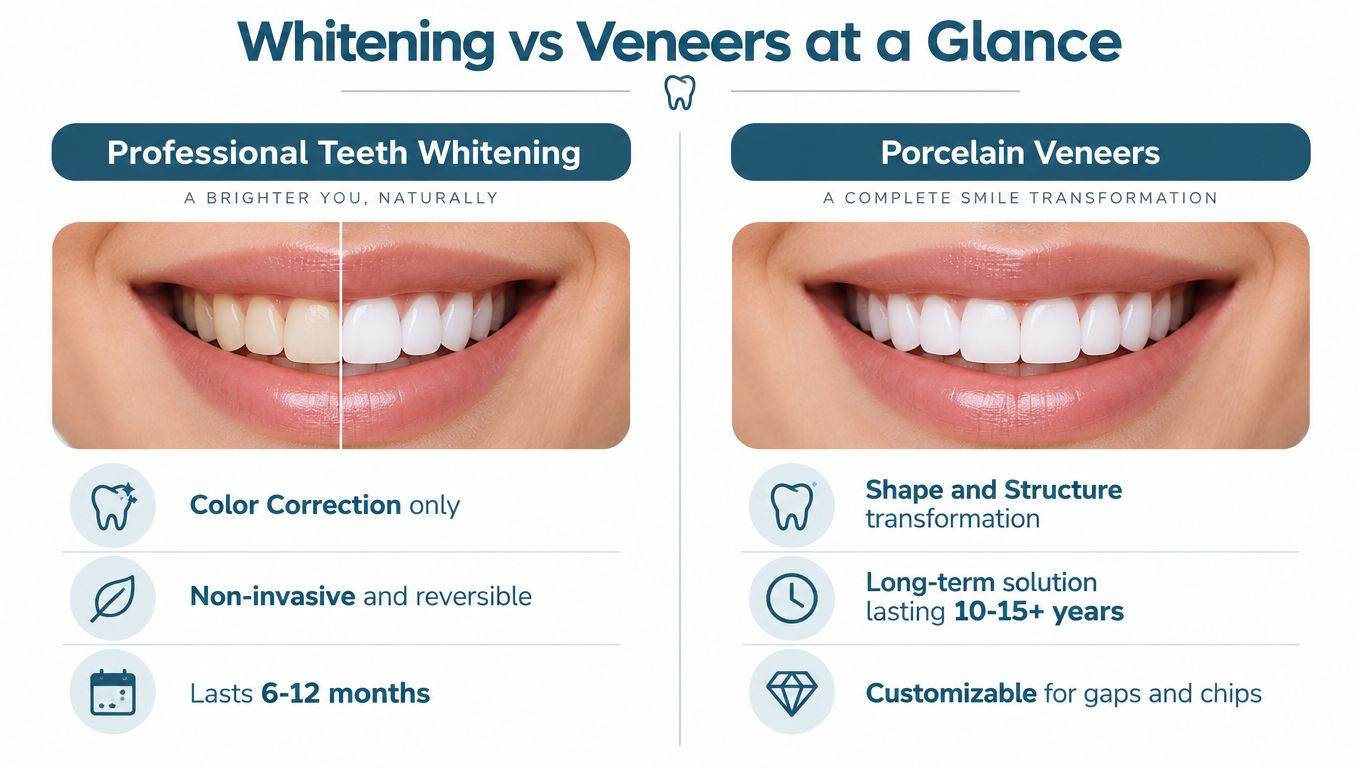
Whitening vs Veneers at a Glance
| Feature | Professional Whitening | Porcelain Veneers |
|---|---|---|
| Primary purpose | Changes the color of natural teeth | Changes color, shape, and visible surface |
| Tooth preparation | Non-invasive to the tooth structure | Usually requires enamel preparation |
| Typical clinical result | Professional whitening commonly produces a 5 to 10 shade improvement | Designed to create a custom shade and shape |
| Existing restorations | Doesn't lighten crowns, veneers, or fillings | Can be planned to coordinate with selected teeth |
| Maintenance | Temporary and may need repeat treatment every 6 to 24 months | Longer-term restoration that may eventually need replacement |
| Longevity | Repeatable cosmetic treatment | Often lasts 10 to 15 years, with some lasting more than 20 years |
| Best fit | Stains on otherwise suitable natural teeth | Chips, gaps, uneven edges, or resistant discoloration |
In-office whitening often ranges from $250 to $800 per session, while veneers commonly cost far more per tooth, according to the same market source. Actual fees depend on the number of teeth, the materials selected, preliminary treatment, and the dental practice's planning requirements. Patients considering the broader financial picture can review cosmetic dental treatment costs.
The trade-off patients should consider
Whitening offers a more accessible entry point and doesn't commit a patient to covering the tooth. Its limitation is that shade gradually changes over time, and it can't correct form. Veneers offer a more thorough result, but enamel preparation makes the decision more permanent and replacement planning matters over the long term.
Patients in Amanda, Lancaster, Circleville, and Carroll may also need to consider travel, appointment availability, emergency dental needs, and whether the smile has untreated health problems. A lower initial commitment isn't always the right choice if the desired result depends on changing shape, while a veneer isn't justified for simple surface staining.
Strategic Treatment Sequencing for Lasting Results
Patients who want both a brighter smile and veneers should usually discuss the order of treatment before either procedure begins. The key issue is shade matching. Whitening changes natural teeth, but porcelain keeps the shade selected when the veneers are made.
If veneers are placed first and natural teeth are whitened later, the natural teeth may become lighter than the restorations. The difference can be visible, especially when the veneers are next to untreated or lightly restored teeth. Replacing otherwise serviceable veneers only to match a later whitening choice can create unnecessary cost and restorative work.
Whitening first when both treatments are planned
When whitening is suitable, completing it first gives the dental team a stable, brighter baseline for shade selection. The patient then maintains that shade while the laboratory designs the veneers to coordinate with the natural teeth and the rest of the smile.
Independent dental guidance explains that veneers place a new porcelain surface over the tooth, while whitening changes existing tooth structure, and it explicitly discusses whether whitening should happen before veneers. The sequence isn't identical for every patient. Existing crowns, severe discoloration, sensitivity, enamel condition, and the number of planned veneers can change the recommendation.
Shade planning matters more than speed. A rushed order of treatment can produce an immediate result that becomes less harmonious when natural teeth change later.
Whitening also isn't always the first clinical step. A dentist may recommend cleaning and exams, treatment for decay, gum care, a root canal, or replacement of a failing restoration before evaluating the final cosmetic shade. Patients with missing teeth may need restorative planning that includes dental implants, dentures, or other options rather than whitening or veneers alone.
The long-term plan should account for maintenance. Whitening may be repeated as the natural teeth accumulate new staining, while veneers require consistent hygiene, bite protection when indicated, and eventual evaluation for repair or replacement. A consultation in Amanda can map those future changes before a patient commits to a shade or restoration design.
Your Cosmetic Consultation at Amanda Family Dental
A cosmetic consultation should feel like a conversation about health, appearance, comfort, and expectations. At Amanda Family Dental, Dr. Alyssa Jenkins and the team can evaluate the teeth and gums, review the patient's goals, and use digital x-rays and total health screening when clinically appropriate. That information helps distinguish a cosmetic concern from a problem that needs preventive, restorative, or emergency care first.
The consultation may include:
- New patient exams: A complete review can identify decay, gum concerns, worn enamel, cracks, or older dental work.
- Digital x-rays: These images can help assess areas that aren't visible during a visual examination.
- Personalized planning: The plan can compare whitening, veneers, bonding, crowns, Invisalign, or restorative options according to the smile's condition.
- Comfort-focused care: Patients with dental anxiety can ask about sleep dentistry and other ways to make treatment more manageable.
- Payment discussions: Flexible payment plans, including the Power Plan Membership, can be reviewed before treatment begins.

Patients searching for a dentist in Amanda, OH, can receive care close to home, while families traveling from Lancaster, Circleville, or Carroll can discuss preventive, cosmetic, restorative, and emergency dental services in the same practice. A patient researching Leaping Lemur Media dental marketing may also recognize how clearly a dental office explains its services online, but the clinical decision still belongs in an examination and consultation.
The most useful appointment ends with a specific recommendation, an explanation of alternatives, and a clear sequence for treatment. Whether the right choice is professional teeth whitening, porcelain veneers, dental bonding, a crown, tooth extraction, or dental implants near me, the plan should protect oral health while improving comfort, function, and confidence.
Amanda Family Dental provides professional teeth whitening, porcelain veneers, restorative dentistry, new patient exams, digital x-rays, and comfort-focused dental care for patients in Amanda, Lancaster, Circleville, and Carroll, Ohio. Schedule a cosmetic consultation to compare veneers vs whitening and establish the right shade and treatment sequence, then visit Amanda Family Dental to request an appointment.