

Porcelain veneers typically last 10 to 15 years, while composite veneers usually last 5 to 7 years. However, the actual lifespan is more personal than that, because veneer lifespan depends on the material, the bite, daily habits, and the quality of long-term care.
A lot of patients around Amanda and Lancaster start in the same place. They want a brighter, more even smile, but they also want an honest answer before making a cosmetic dentistry decision. Veneers can look beautiful and feel natural, but they aren't a set-it-and-forget-it treatment. They work best when the veneer choice matches the patient's goals and when ongoing care supports the result.
For families and adults searching for a cosmetic dentist near me, or a dentist in Amanda, OH, Lancaster, OH, Circleville, OH, or Carroll, OH, the most helpful conversation usually isn't just about how veneers look on day one. It's about how they hold up over time, what causes early failure, and what practical steps keep them looking and functioning well.
Table of Contents
- Your Guide to a Lasting Smile with Veneers in Amanda Ohio
- Porcelain vs Composite Veneers A Comparison
- Factors That Determine How Long Your Veneers Really Last
- How to Care for Veneers and Maximize Their Lifespan
- The Veneer Journey What to Expect at Amanda Family Dental
- Signs Veneers Need Replacement and Your Next Steps
- Frequently Asked Questions About Dental Veneers
Your Guide to a Lasting Smile with Veneers in Amanda Ohio
A patient usually isn't asking only one question when asking how long do veneers last. Deeper questions are often layered together. Will they still look natural in a few years? Will coffee stain them? What happens if someone clenches at night? Is porcelain worth the investment over composite?
Those are practical questions, and they matter. A patient choosing veneers isn't just choosing a cosmetic treatment. That patient is choosing a long-term plan for appearance, comfort, and maintenance. For anyone comparing options, it also helps to understand the financial side early, which is why many patients read about veneer cost considerations and treatment planning before they decide.
Why lifespan matters more than the headline number
Two patients can receive veneers on the same day and have very different outcomes. One protects the veneers, comes in for cleanings and exams, and manages clenching. The other chews ice, skips follow-up care, and doesn't address grinding. The veneers may be made from the same material, but they won't age the same way.
That is why a simple average only tells part of the story.
Practical rule: Veneers last longer when the case is planned around the patient's bite, habits, and maintenance routine, not just the shade and shape.
What patients in Amanda and nearby communities should know
For patients in Amanda, Lancaster, Circleville, and Carroll, Ohio, the most useful approach is a local one. Veneers aren't a one-appointment transaction followed by silence. They need review over time, just like crowns, fillings, and other restorative or cosmetic work.
A good veneer outcome supports more than appearance. It can improve confidence in photos, comfort when speaking, and the willingness to smile without covering the mouth. That makes longevity important for both cosmetic and everyday reasons.
Porcelain vs Composite Veneers A Comparison
A patient from Lancaster might sit in my chair and ask a very reasonable question: "Do I want the option that lasts longer, or the one that is easier to repair?" That is the porcelain versus composite conversation. Both can improve a smile. They differ in how they wear, how they look over time, and how much ongoing attention they usually need.
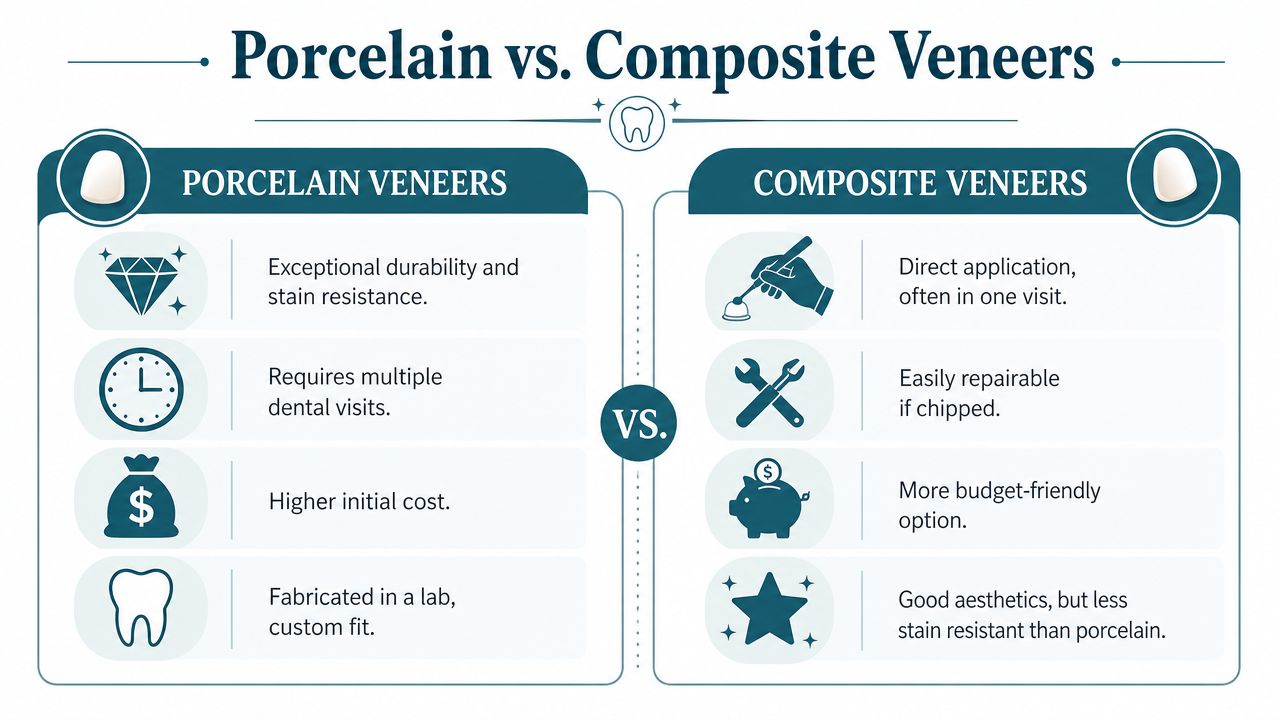
The quick side-by-side difference
The American Dental Association notes that porcelain veneers often last longer than direct composite veneers, with porcelain commonly lasting 10 years or more and composite generally having a shorter service life, as explained in the ADA's overview of veneers and cosmetic bonding.
| Veneer type | Typical lifespan | What patients usually like | Main trade-off |
|---|---|---|---|
| Porcelain | Often 10 years or longer | Better stain resistance, more lifelike translucency, stronger surface | Higher cost, more planning, lab fabrication |
| Composite | Commonly shorter-lived than porcelain | Faster treatment in many cases, easier chairside repair, lower upfront cost | More prone to staining, wear, and edge chipping |
Why porcelain tends to hold up better
Porcelain is usually the stronger long-term cosmetic choice for patients who want color stability and a polished look that still blends well years later. It resists staining better than composite, which matters if coffee, tea, red wine, or tobacco are part of daily life.
It also asks more of the planning phase. Tooth preparation, bite design, shade selection, and bonding technique all affect how well the veneers function over time. Patients who want to see that process more clearly can review how veneers are designed and placed.
At Amanda Family Dental, that planning matters even more for patients who grind, clench, or want a more conservative or holistic approach. Material choice should fit the mouth in front of us, not just a photo of the final smile.
Where composite veneers are a good fit
Composite veneers make sense for the right case. They can be a practical option for smaller cosmetic changes, younger patients who want to stay conservative, or someone who wants to improve a smile without committing to porcelain right away.
Repair is one of composite's advantages. If a small chip or rough edge develops, adjustment can often be done more easily than with porcelain. The trade-off is maintenance. Composite usually picks up stain sooner and can lose surface shine faster.
The better question to ask
Patients often start with price. I encourage them to start with goals and habits instead.
A patient from Amanda who wants the most natural long-term appearance and is willing to protect the work may be happiest with porcelain. A patient who wants a lower initial investment or a more reversible cosmetic step may prefer composite. Neither choice stands alone after placement. The best results come from a long-term relationship with a dentist who can monitor the bite, catch early wear, and make small adjustments before a minor issue turns into a replacement.
Factors That Determine How Long Your Veneers Really Last
Material matters, but daily function matters too. The veneer doesn't live in a display case. It has to survive coffee, chewing, brushing, stress, clenching, and every normal day that follows placement.
Bruxism changes the timeline fast
One of the biggest risks is bruxism, which means grinding or clenching the teeth. Unmanaged bruxism can reduce porcelain veneer longevity by 40 to 50%, cutting the expected lifespan from 15 years to approximately 7 to 8 years, based on this review of veneer wear with grinding.
That isn't a small difference. It changes treatment planning, material selection, and aftercare. A patient who grinds at night needs that issue addressed before anyone assumes a standard veneer lifespan applies.
Bite forces and everyday habits
Some veneer damage comes from obvious habits. Biting fingernails, chewing ice, opening packages with teeth, and crunching hard foods directly on veneered front teeth all increase stress.
Other problems are quieter:
- Clenching during sleep can create repeated pressure that a patient never notices.
- Uneven bite contact can overload one veneer while the others seem fine.
- Acid exposure from drinks or diet can affect the underlying tooth structure and margins.
- Aggressive brushing can wear at the edges and irritate gums around the restoration.
A veneer usually fails because of force, bonding problems, or damage at the margin. Time by itself isn't the only reason.
Holistic preferences still need a maintenance plan
Many health-conscious patients ask about fluoride-free toothpaste, gentler products, and non-abrasive routines. Those choices can fit into veneer care, but they should be discussed with a dentist instead of guessed at. If the underlying tooth is in a high-acid environment, protecting the tooth around the veneer becomes part of protecting the veneer itself.
That matters because veneer success doesn't rely only on the visible shell. It also depends on the enamel, the gumline, and the bonded edges staying healthy.
The dentist's role is bigger than placement day
A veneer case is not only cosmetic artistry. It is also bite analysis, case selection, and follow-up judgment. If a patient has edge-to-edge wear, crowding, old bonding, gum inflammation, or signs of nighttime grinding, those details can change the treatment recommendation.
For that reason, "how long do veneers last" is never answered well by a number alone. The better answer includes the condition of the teeth before treatment and the habits that continue after it.
How to Care for Veneers and Maximize Their Lifespan
Good veneers need good habits. Daily care doesn't have to be complicated, but it does need to be consistent.
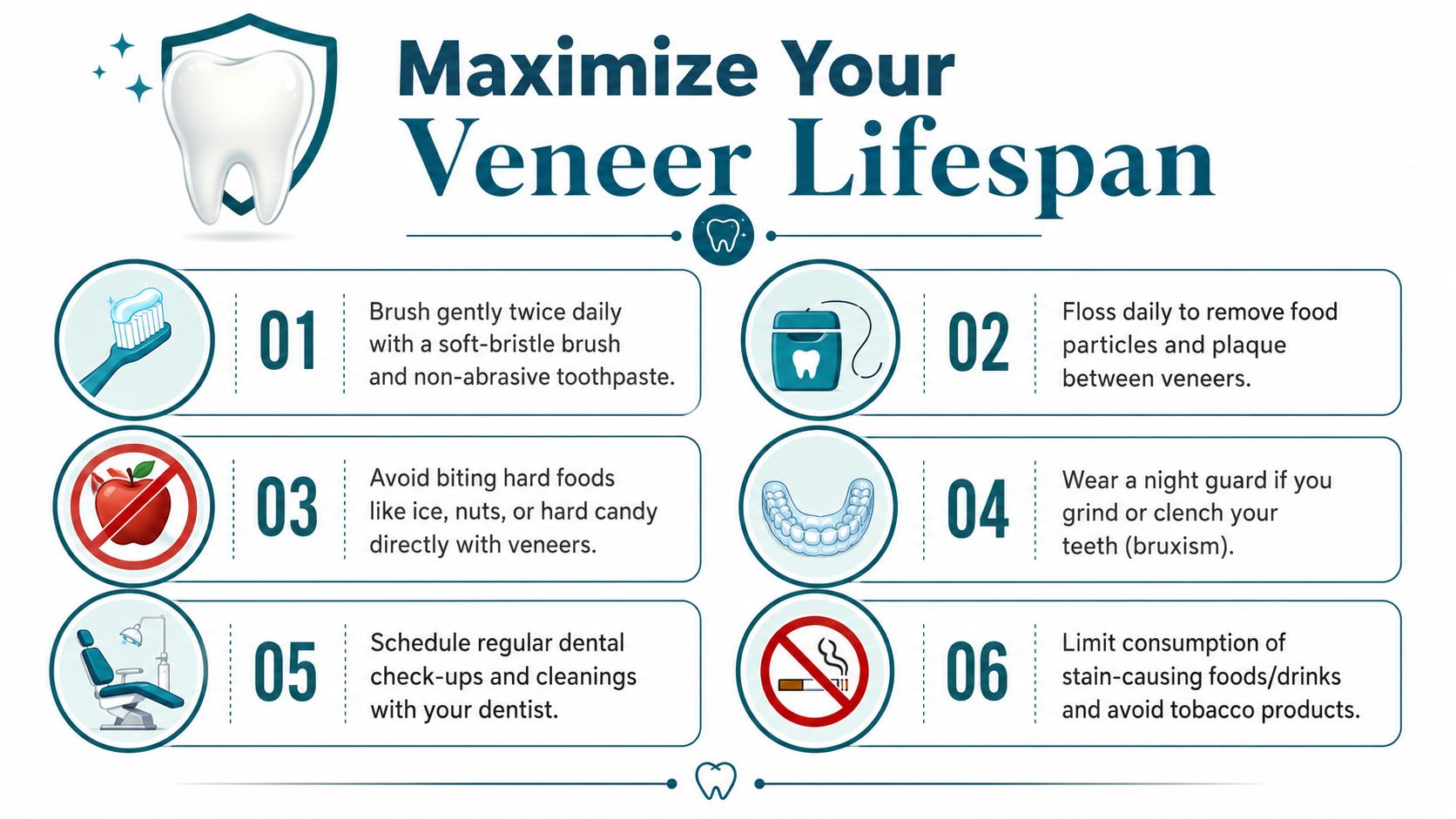
The habits that actually help
Patients usually protect veneers best when they keep the routine simple and repeatable:
- Brush gently with a soft-bristled toothbrush: The goal is to clean the tooth and gumline without scraping the surface or irritating the margins.
- Use a non-abrasive toothpaste: Whitening pastes and gritty products can be too harsh for veneer edges.
- Floss every day: Plaque at the margin is still a problem even if the front surface looks smooth and bright.
- Avoid biting hard objects with front teeth: Ice, hard candy, and package tearing are common reasons veneers chip.
- Wear a custom night guard if clenching is part of the picture: Protection during sleep matters more than most patients realize.
- Keep up with professional cleanings and exams: Veneers last longer when small problems are found early.
What doesn't work
A lot of veneer damage comes from habits patients assume are harmless. "It's only once" becomes a pattern. Biting a pen, tearing tape, or crunching ice can do real damage to a thin restoration.
Some patients also overdo home whitening products after veneers are placed. Veneers don't whiten the way natural teeth do, so aggressive whitening often creates mismatch frustration rather than a better result.
A short visual guide can help reinforce those basics:
Long-term care works better with regular follow-up
Patients searching for a dentist in Amanda, OH or a cosmetic dentist near me often focus first on placement. Follow-up matters just as much. Regular visits allow the dental team to watch for early edge wear, gum recession, bite changes, or signs that a night guard needs adjustment.
Amanda Family Dental provides routine exams, digital X-rays, preventive care, and cosmetic follow-up for patients who want ongoing oversight after veneers are placed.
The Veneer Journey What to Expect at Amanda Family Dental
A veneer consultation should feel organized, not rushed. Patients usually want a clear answer on candidacy, a realistic look at expected longevity, and a plan that fits both appearance goals and oral health.

The first visit focuses on fit, not pressure
The process starts with conversation and records. That includes the concerns the patient wants to fix, the shape and color goals, the bite, and whether there are signs of grinding, gum issues, or decay that should be handled first. Digital X-rays and a clinical exam help determine whether veneers are the right treatment or whether another cosmetic or restorative option would make more sense.
Long-term research shows porcelain veneers can remain successful well beyond the common rule of thumb. A systematic review reported cumulative survival of 93.5% at 10 years and 82.93% at 20 years in clinical follow-up, as detailed in this review of porcelain veneer survival outcomes.
Strong veneer results usually begin before the veneer is ever bonded. Case selection and bite planning do a lot of the heavy lifting.
Planning affects how the smile ages
Once the case is approved, the next step is planning the final look while protecting function. Shade, contour, edge length, and bite contact all matter. A smile can look stunning in a photo and still fail early if the bite isn't balanced.
That is one reason well-run systems matter in healthcare. Practices that invest in organization, communication, and follow-up are better positioned to monitor details over time. For readers interested in the operational side of patient communication and scheduling, this overview of how teams streamline dental practice operations gives useful context.
What patients from nearby communities can expect
For patients coming from Lancaster, Circleville, Carroll, or Amanda, the ideal veneer process is predictable:
- Evaluation and records: The teeth, gums, and bite are reviewed.
- Treatment planning: The smile design is matched to facial features and function.
- Preparation and impressions or scans: The veneers are planned with precision.
- Bonding and bite check: Fit and contact are verified carefully.
- Follow-up care: The restorations are monitored like any other long-term dental work.
Patients often feel more comfortable once they understand that veneers aren't just cosmetic shells. They are part of an ongoing dental relationship.
Signs Veneers Need Replacement and Your Next Steps
Most veneers don't fail all at once. They usually show signs first. Patients should pay attention if a veneer feels loose, develops a visible chip, shows staining at the edge, or no longer sits smoothly against the gumline.
Other warning signs include a rough surface, a crack, or discomfort when biting. Sometimes the issue is the veneer itself. Sometimes the veneer is fine, but the tooth underneath or the surrounding gum tissue needs attention.
When to schedule an exam
A prompt exam is the smart next step if any of these problems show up:
- A chip or crack appears: Even a small defect can get worse under normal chewing.
- The margin looks darker or stained: The edge may need to be checked for leakage or wear.
- The veneer feels loose: Bonding problems rarely improve on their own.
- The bite feels different: One high contact can create a chain reaction.
If a veneer has already come off, this guide on what to do when a veneer fell off can help a patient take the right immediate steps before being seen.
For patients in Amanda, Lancaster, Circleville, and Carroll, early evaluation usually means simpler solutions and less stress.
Frequently Asked Questions About Dental Veneers
A patient from Lancaster recently asked me a question I hear often. "If I get veneers, am I signing up for constant repairs?" The honest answer is that good veneers are not a one-time cosmetic purchase. They work best as part of a long-term plan between patient and dentist, especially if there is grinding, gum recession, or a preference for more conservative or patient-centered treatment choices.
Do veneers ruin your natural teeth
Veneers should protect and improve a smile, not sacrifice healthy tooth structure unnecessarily. Some cases require light reshaping of the front of the tooth, while others can be done more conservatively. The right approach depends on enamel thickness, bite position, and the result the patient wants.
Careful planning matters here. A rushed cosmetic case can create sensitivity or an unnatural look. A well-planned case keeps as much natural tooth as possible and gives the veneer a better foundation for long-term success.
Can teeth with veneers still get cavities
Yes. A veneer does not make the tooth immune to decay.
The front surface is covered, but the edges, the back of the tooth, and the area near the gums still need daily brushing, flossing, and regular exams. I pay close attention to this in patients from Amanda and Circleville who have dry mouth, frequent snacking, or recession around older dental work, because those factors can shorten the life of otherwise well-made veneers.
Can veneers be whitened later
No. Veneer material does not whiten like natural enamel.
That is why shade planning should happen before treatment starts. If a patient wants a brighter overall smile, whitening the natural teeth first usually gives a more even final result.
Do composite veneers need more upkeep
In many cases, yes. Composite veneers are more affordable upfront and easier to repair in the office, but they tend to stain, lose polish, and chip sooner than porcelain. Clinical guidance from the American Dental Association on veneers supports the general point that veneer materials differ in durability and maintenance needs, with direct resin options usually requiring more touch-ups over time.
That trade-off is not always a downside. For a patient who wants a more conservative option, or who is not ready for porcelain, composite can still be a reasonable choice if expectations are clear from the start.
Are veneers permanent
Veneers are a long-term restoration, not a lifetime guarantee. Once a tooth is prepared for a veneer, that tooth will usually need some form of ongoing coverage in the future.
I tell patients to think in terms of stewardship. The material matters, but so do bite checks, hygiene visits, and small adjustments before a small problem becomes a larger one. That partnership is one reason local follow-up care matters, especially for patients who clench or grind at night.
If veneers are being considered for the first time, or if an existing veneer is chipped, loose, worn, or no longer looks right, the next step is a professional evaluation. Amanda Family Dental serves patients in Amanda, Lancaster, Circleville, and Carroll, Ohio with exams, digital X-rays, personalized treatment planning, cosmetic dentistry, and ongoing care that supports long-term smile health.