

A lot of people start the same way. There's a tooth that's been bothering them, it's time for a cleaning, or a child needs a checkup, and the search begins with Dentist Near Me UnitedHealthcare. Then the confusion starts. A dental office appears in a directory, another appears on a booking site, and suddenly the main question isn't just who is nearby. It's whether that office takes the exact plan, what the visit will cost, and whether treatment will be covered the way the patient expects.
For families in Amanda, Lancaster, Circleville, and Carroll, Ohio, that confusion is common. Dental insurance can help, but only when the details are checked carefully. The easiest way to avoid surprises is to treat the search as two steps. First, find a nearby dentist who appears to participate with UnitedHealthcare. Second, verify the specific plan, service category, and billing process before booking care.
Table of Contents
- Your Guide to Using UnitedHealthcare for Dental Care
- How to Find a UHC Dentist in the Amanda Area
- Confirming Your Dentist is Truly In-Network with Your Plan
- Understanding Your Dental Coverage and Costs
- How Amanda Family Dental Supports UnitedHealthcare Patients
- Preparing for Your First Appointment
Your Guide to Using UnitedHealthcare for Dental Care
A parent calls our office looking for a cleaning before school starts. By the end of the conversation, the actual question usually is not whether we “take UnitedHealthcare.” It is whether the specific plan is in network here, what the visit is likely to cost, and whether anything needs preapproval before treatment begins.
That distinction matters. A patient in Amanda may want the closest office. A patient commuting from Lancaster may care more about hours. Families in Circleville or Carroll often need one practice that can handle preventive care, fillings, crowns, and urgent visits without sending them all over town. The best choice balances location, appointment availability, plan participation, and expected out-of-pocket cost.
Practical rule: A nearby office is only a good fit when the office participates with your exact plan and you understand how your benefits apply to the service you need.
UnitedHealthcare plans often treat preventive care differently from basic or major work. Cleanings, exams, and some other preventive services may be covered more generously, while fillings, crowns, root canals, dentures, or retainers can involve deductibles, waiting periods, annual maximums, or frequency limits. The smartest approach for patients is simple. Check the plan first, then match the appointment to the benefit.
That is why a search should lead to two follow-up steps before anything is booked. Confirm the office is in network for the exact UnitedHealthcare plan, and ask for a benefit check tied to the procedure being scheduled. A cleaning visit and a crown visit can look very different on the insurance side, even with the same carrier.
Patients who want a local office can start with our Amanda-area dentist page and then verify the details that affect the bill. UnitedHealthcare also provides member and provider support options through its dental contact resources, which can help with plan questions before the appointment.
Our office helps with that process every day. Patients should not have to guess what “accepted” means. Clear answers about network status, covered services, and likely patient responsibility make it much easier to schedule care with confidence.
How to Find a UHC Dentist in the Amanda Area
A good search starts with the insurer's own tools, not with guesswork.
Start with the official directory
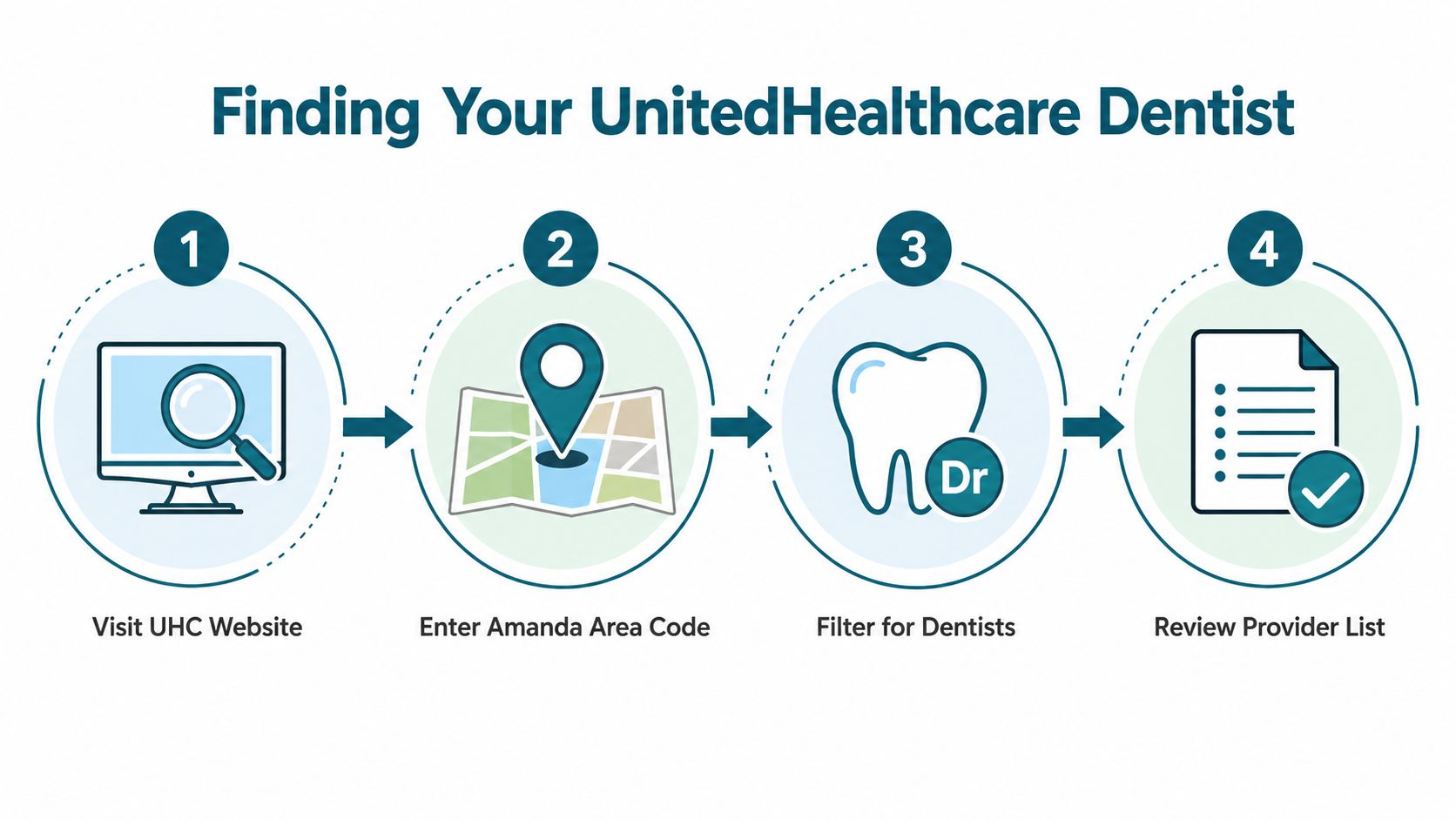
UnitedHealthcare members usually get the best starting point from the plan's provider directory. Search by ZIP code, town, or county, then filter for dentists. That gives a working list of nearby offices that may participate with the plan.
For patients in Amanda, OH, it also helps to widen the search area a bit. Many families naturally compare options in Lancaster, OH, Circleville, OH, and Carroll, OH based on commute, school schedules, and appointment availability. A broader local search often gives a better shortlist than checking only one town.
This quick overview can help with the first pass through the directory.
Use local search to narrow the list
After the directory, local intent matters. A patient isn't only looking for a name on an insurance list. The patient is usually comparing distance, office reputation, services offered, and whether the practice feels like a realistic long-term dental home.
Independent directory data from a major market shows how competitive this process can be. Some UnitedHealthcare in-network dentists appear as close as 2.5 miles, with multiple options within roughly 3 to 10.5 miles, according to Zocdoc's Boston UnitedHealthcare dentist listings. That example isn't about Ohio specifically, but it shows how modern insurance-based searches work. Patients compare proximity and network participation side by side.
A practical local search usually looks like this:
- Check the insurer directory first. That builds the initial list.
- Search for community-based dental offices nearby. A local page like dentist near me in Amanda can help a patient compare location and services in a more useful way than a bare directory listing.
- Review whether the office provides the needed care. A cleaning visit is different from looking for tooth extraction, crowns, dental implants near me, cosmetic dentistry, or an emergency dentist.
- Call before booking. The listing alone won't answer everything that matters.
Nearby matters. But for most patients, convenience only counts when the office also fits the plan and the type of treatment needed.
Confirming Your Dentist is Truly In-Network with Your Plan
A patient finds a dentist listed under UnitedHealthcare, books online, and assumes the insurance part is settled. Then the front desk asks for the plan name, group number, and member ID because the listing alone does not confirm how that specific policy will process claims.
Why a directory match is only the starting point
This is the part patients often do not see. UnitedHealthcare can have multiple dental products, employer-sponsored options, and plan rules that look similar on the card but bill differently in practice. An office may participate with one UHC dental network and not another. That is why our team always checks the exact plan details before we promise anything about benefits or patient cost.
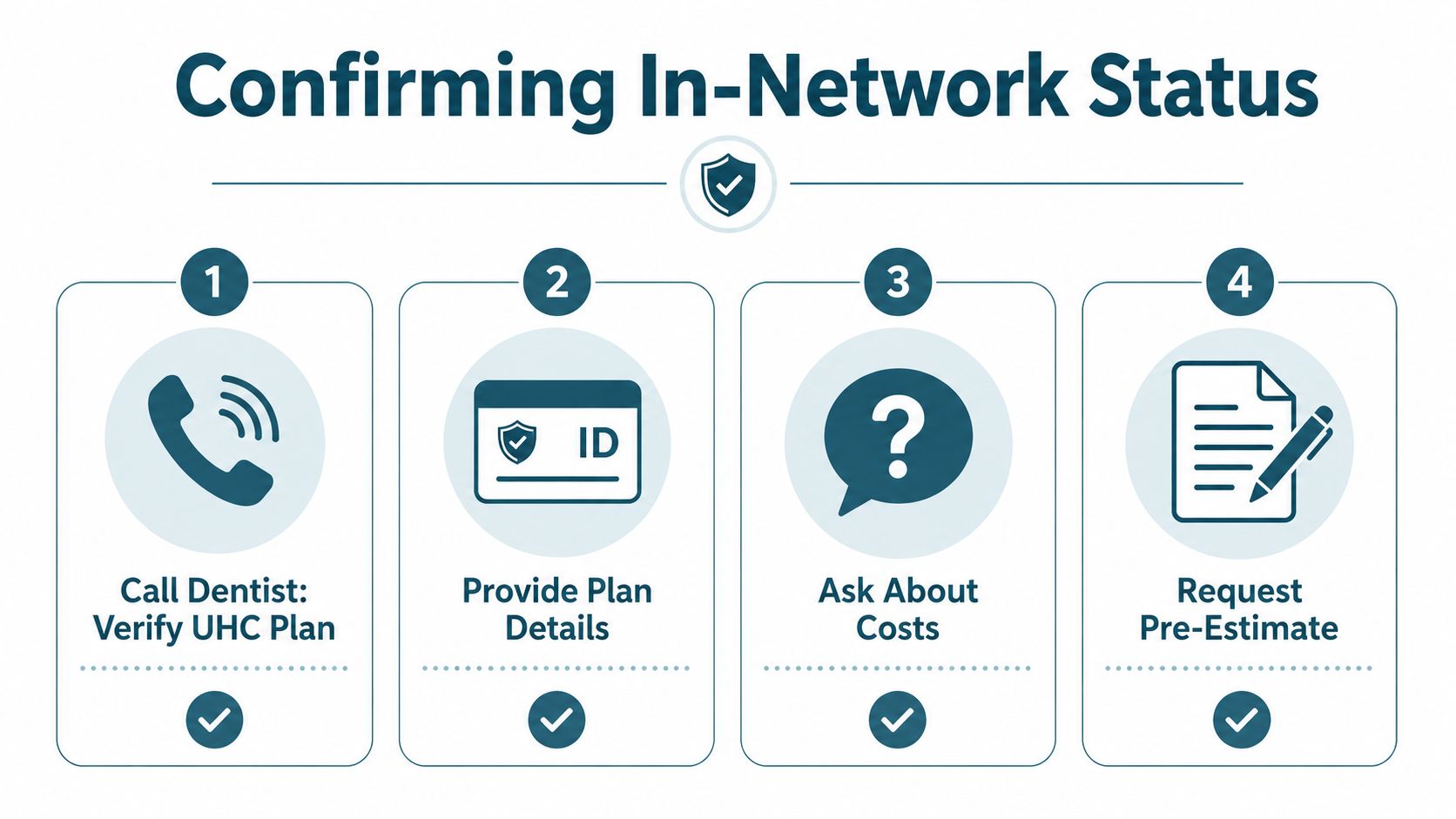
The safest approach is simple. Confirm the dentist appears in the insurer directory, then call the office and ask the staff to verify the specific plan listed on the card. If the visit involves more than a routine exam, ask whether the office can review benefits in advance for the planned service. That extra step helps catch mismatches before treatment starts, not after the claim comes back.
For larger cases, it also helps to ask whether the office can prepare a cost estimate ahead of time. Patients comparing payment options often find our guide to financing dental procedures and treatment costs useful when insurance covers only part of the work.
Questions to ask before you book
A short phone call can save a lot of confusion later.
- Can you check my exact UnitedHealthcare dental plan? Give the plan name, member ID, and employer if the coverage is through work.
- Are you in-network for this specific product, not just UHC in general? That wording matters.
- Are you accepting new patients with this plan right now? Participation and scheduling availability are separate issues.
- Can you estimate my share for the service I need? A cleaning, filling, crown, extraction, and implant can process very differently.
- Do you submit claims for me? Ask whether the office files electronically and whether any payment is due at the visit.
- Can you send a pre-treatment estimate for major work? That is often the best way to reduce surprise bills.
Patients should also keep their Explanation of Benefits and read it carefully after treatment. If EOB language feels confusing, this guide on deciphering medical EOBs can help you understand what the insurer paid, what was applied to your benefits, and what may still be your responsibility.
UnitedHealthcare also provides member and provider support contacts through its UnitedHealthcare Dental member and provider support information. If there is any doubt, ask the insurer and the dental office the same plan-specific question and compare the answers.
For anything beyond preventive care, "Do you take my insurance?" is not enough. Ask which plan you have, how the claim will be filed, and what your estimated out-of-pocket cost may be before the appointment.
Understanding Your Dental Coverage and Costs
Most dental confusion happens after a patient hears the word “covered.” Covered doesn't always mean fully paid.
How service categories affect your share
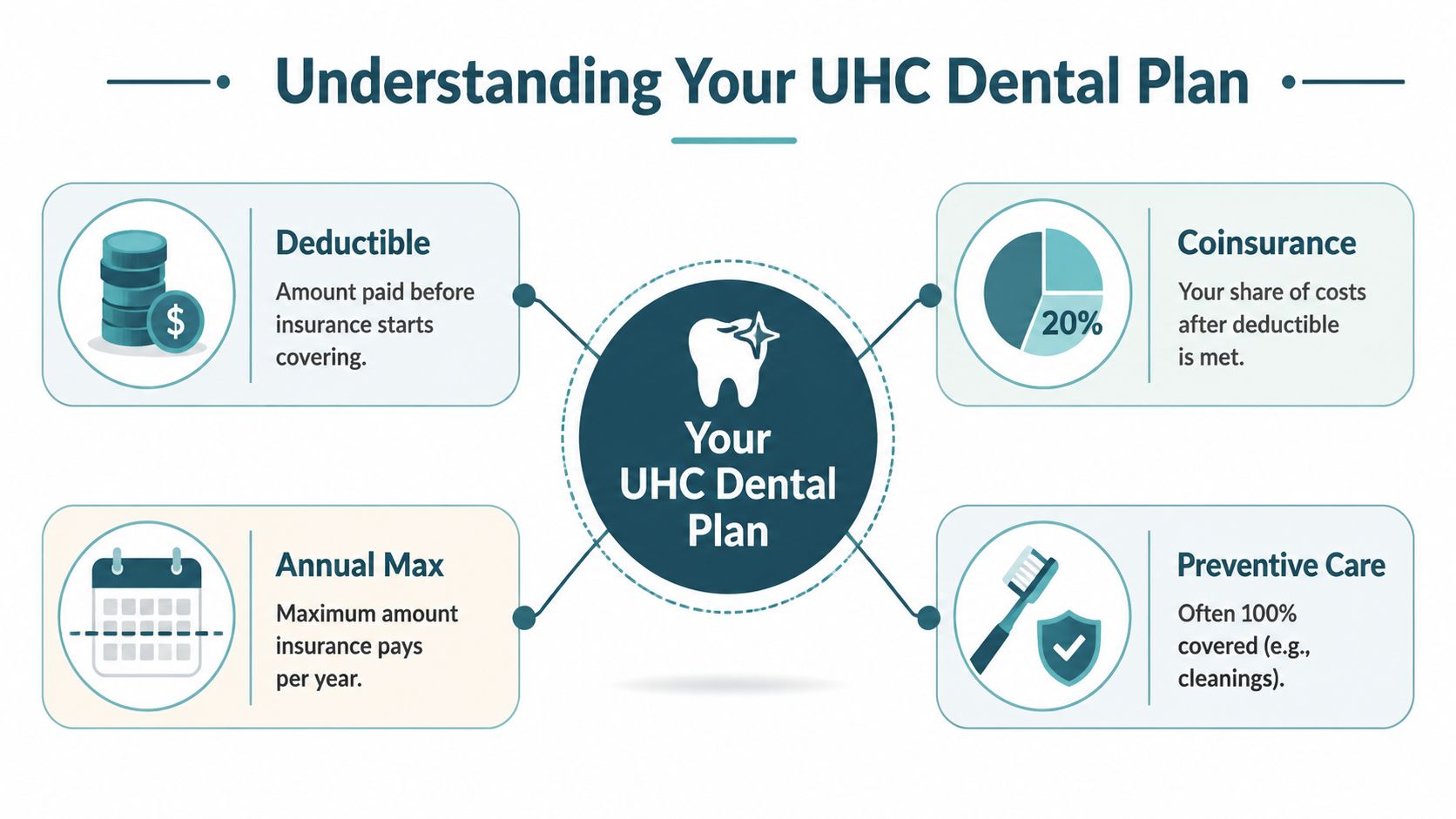
UnitedHealthcare dental plans often make the biggest distinction by service category. Preventive care is usually handled more generously than restorative or major work. That means a patient searching for a cleaning and exam may face a very different cost picture than a patient looking for a crown, implant, or tooth extraction.
Representative UHC-accepting provider information shows that major restorative services like crowns, extractions, and implants are often covered at 50 to 70%, according to Lakesuccess Dental Group's UnitedHealthcare coverage overview. That still leaves a meaningful patient share, especially on higher-cost procedures.
A useful way to think about it is this:
| Service type | What patients often need to verify |
|---|---|
| Preventive care | Whether cleanings, exams, or fluoride have a deductible or waiting period |
| Basic services | Whether fillings or emergency treatment trigger deductible or coinsurance rules |
| Major services | Whether crowns, implants, dentures, or similar procedures leave a larger patient balance |
Terms that matter before treatment starts
Three insurance terms affect most treatment discussions.
- Deductible means the amount the patient pays before certain insurance benefits begin.
- Coinsurance means the patient's share after the deductible rules are applied.
- Annual maximum means the cap on what the plan pays during the benefit period.
Those terms matter more than the office's marketing language. A nearby in-network dentist can still leave the patient with a significant balance if the needed treatment falls into a major category or if the annual maximum has already been used elsewhere.
Patients who want a clearer picture before treatment should ask for the CDT codes tied to the planned procedure and request a benefit check against those specific codes. That's often the cleanest way to estimate what the plan may pay.
For anyone who has trouble reading insurance paperwork afterward, this guide to deciphering medical EOBs can help make explanation-of-benefits statements easier to understand. It's especially useful when comparing what the office estimated versus what the insurer processed.
Patients who know they may need help with larger treatment costs can also review financing dental procedures before committing to care.
Key takeaway: Don't judge affordability by network status alone. Judge it by the procedure category, the plan terms, and the estimate attached to the actual treatment codes.
How Amanda Family Dental Supports UnitedHealthcare Patients
Many dental pages answer only one question. They tell patients where to go. They don't do much to explain what the plan may pay once the patient arrives.
What helpful insurance support looks like
That gap matters because UnitedHealthcare-related search pages often focus on provider lookup, while patients still need answers about plan type, service category, and likely out-of-pocket costs. UnitedHealthcare materials tied to member guidance and provider search emphasize that selecting a dentist is often tied to plan-specific verification rather than proximity alone, as reflected in UnitedHealthcare Texas dental member guidance.
A patient-friendly dental office closes that gap by doing the administrative work clearly and early. The most useful support usually includes:
- Benefit verification before treatment: Confirming what can be confirmed for the member's specific plan.
- Clear estimate discussions: Explaining what appears covered, what may be partially covered, and what still needs confirmation.
- Claim handling guidance: Letting the patient know whether the office files electronically and what payment may be expected at the visit.
- Procedure-specific planning: Giving extra attention to larger services like crowns, root canals, dentures, restorative care, or dental implants.
Where transparency makes the biggest difference
Transparency matters most when the treatment isn't routine. A preventive visit is usually more straightforward. A case involving tooth pain, restorative dentistry, cosmetic dentistry, or emergency dental services can raise more questions about coverage and timing.
The best offices don't rush past those questions. They explain the trade-offs. They tell patients when a pre-treatment estimate makes sense. They flag when cosmetic services may not follow the same insurance rules as medically necessary restorative care. They also make room for alternatives when a patient wants to spread costs out rather than delay needed treatment.
For families in Amanda, Lancaster, Circleville, and Carroll, that kind of support often matters more than a simple “we accept your insurance” statement. It gives patients a practical path from online search to informed appointment.
Preparing for Your First Appointment
Once the insurance side is checked, the first visit usually becomes much simpler.
What to bring and what to expect
Bring the basics. That usually means a photo ID, the dental insurance card, any requested new-patient forms, and a list of current concerns. If the appointment is about pain, a broken tooth, missing teeth, or cosmetic goals, it helps to mention that clearly when scheduling so the office can plan enough time.
At a typical new patient dental visit, patients can expect a conversation about symptoms, oral health history, and goals for treatment. Many offices also include digital X-rays, a clinical exam, and recommendations based on what the dentist finds. If the visit is for preventive dental care, the team may also discuss cleaning needs, follow-up timing, and whether any restorative care should be scheduled separately.
For patients who like appointment reminders by text, email, or phone, it's useful to choose an office that takes privacy seriously. This overview of implementing HIPAA-compliant messaging gives a good picture of why secure reminders matter in healthcare communication.
A simple next step
Patients who are due for preventive care may also want to review what happens during a standard cleaning appointment. This page on what a dental cleaning includes gives a helpful preview.
The biggest thing to remember is that preparation lowers stress. When the office has the insurance information in advance and the patient understands the reason for the visit, the appointment tends to feel much more straightforward. That's true whether someone is searching for a dentist in Amanda, OH, a dentist in Lancaster, OH, a dentist in Circleville, OH, or a dentist in Carroll, OH.
Patients looking for clear answers about Dentist Near Me UnitedHealthcare don't need more guesswork. They need a local office that makes insurance easier to understand and dental care easier to schedule. Amanda Family Dental serves families in Amanda, Lancaster, Circleville, and Carroll, Ohio with preventive, restorative, cosmetic, and emergency-focused care, along with straightforward help discussing treatment options and next steps. To schedule a visit or request a consultation, contact the office and ask about getting started as a new patient.