

A veneer can come off at the worst possible moment. It might happen during lunch, while brushing, or when someone catches a glimpse in the mirror and suddenly realizes a front tooth looks different. It's unsettling, especially when the first thought is whether the tooth is damaged, whether it hurts, and how fast it needs to be fixed.
The good news is that a fallen veneer is usually manageable with the right next steps. For patients searching for an emergency dentist near me, a cosmetic dentist near me, or a dentist in Amanda, OH, quick guidance matters just as much as treatment. Patients in Amanda, Lancaster, Circleville, and Carroll, Ohio often want the same answers right away. What should be done now, is it an emergency, and how does a dentist decide whether to reattach the veneer or replace it?
Table of Contents
- My Veneer Fell Off What Do I Do Right Now
- First Aid for a Fallen Veneer Before Your Dental Visit
- Understanding the Common Causes of Veneer Detachment
- How We Reattach or Replace Veneers at Amanda Family Dental
- Your Compassionate Care Visit in Amanda OH
- Your Veneer Questions Answered
My Veneer Fell Off What Do I Do Right Now
A common version of this call goes like this. Someone is eating, feels something small and hard, and suddenly realizes the veneer didn't chip. It came off whole. Panic usually follows before pain does.
That reaction makes sense, but the first few minutes should stay simple. Save the veneer if it's intact, and call a dentist promptly. Those two steps protect the most options.

The first two moves matter most
If the veneer is loose in the mouth, remove it carefully so it isn't swallowed or cracked. If it already came out, place it somewhere safe instead of wrapping it in a napkin and forgetting it on the table.
Then contact a dental office that handles urgent problems. Patients looking for emergency dental care in Amanda usually need reassurance as much as scheduling. A fallen veneer often feels dramatic, but many cases can be evaluated and managed without confusion once the tooth and the veneer are examined together.
Practical rule: If the veneer is intact, the tooth isn't badly damaged, and there's no major pain or bleeding, the situation is urgent but usually manageable.
When it feels more urgent
Some veneer problems need faster attention than others. A same-day call is especially important if:
- The tooth is very sensitive and air, cold drinks, or touch trigger discomfort.
- The exposed tooth feels sharp and is rubbing the lip or tongue.
- There was a hit to the mouth and the veneer came off after trauma.
- The tooth looks dark, broken, or decayed underneath the missing veneer.
For anyone unsure how urgent a dental issue is, general guidance on accessing emergency dental services can help frame what deserves prompt care versus what can wait a bit. That said, a veneer fell off for a reason. Even when the immediate situation seems calm, the underlying cause still needs a dentist's attention.
First Aid for a Fallen Veneer Before Your Dental Visit
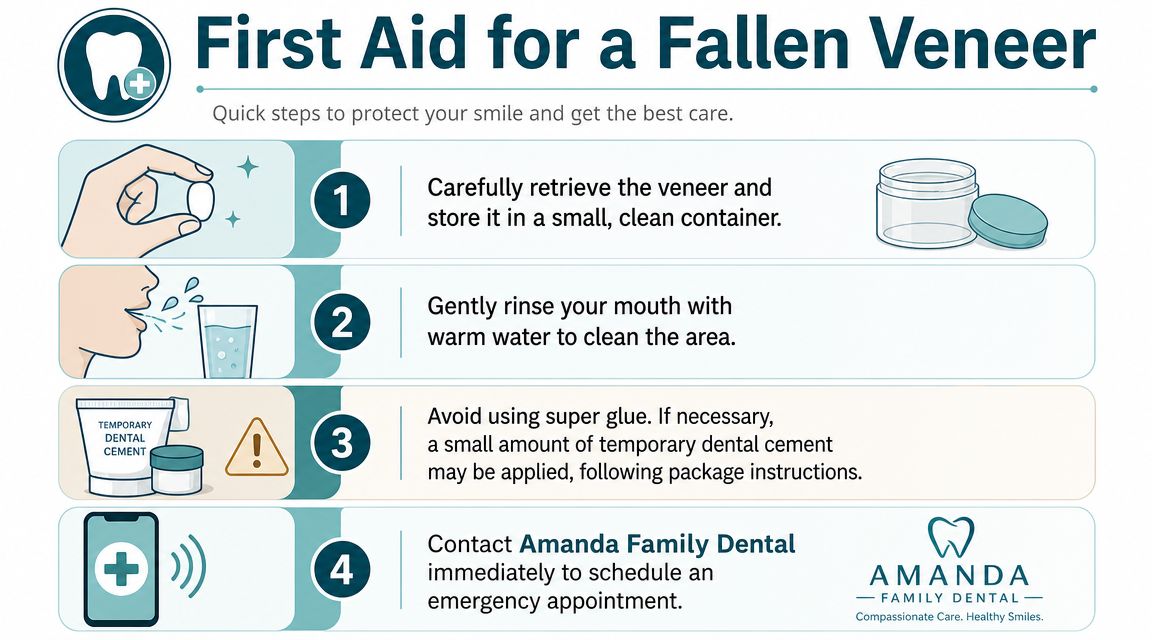
A fallen veneer doesn't need a home repair. It needs protection until the tooth can be checked professionally. The goal is to preserve the veneer, keep the tooth comfortable, and avoid making the final repair harder.
What to do before the appointment
Start with gentle handling. Veneers are thin, and the edges can chip if they're tossed into a pocket, purse, or plastic bag with other items.
- Pick up the veneer carefully. Hold it by the edges if possible.
- Rinse it gently with water. Don't scrub it.
- Store it in a clean, hard container. A small case or pill container works better than tissue alone.
- Rinse your mouth with warm water. This helps clear debris from the area.
- Eat on the other side if needed. Soft foods are easier on the exposed tooth.
Patients who want to understand how temporary coverings work while waiting for treatment can also review temporary veneer information, which gives helpful context for protecting prepared teeth.
What not to do
Most mistakes happen because someone is trying to solve the problem quickly before work, dinner, or an event. Those quick fixes often create bigger problems later.
- Don't use superglue. Household adhesives can contaminate the veneer and tooth.
- Don't force the veneer back on. If it isn't seating perfectly, pressure can crack it or irritate the tooth.
- Don't chew hard foods on that tooth. Crunchy and sticky foods can make sensitivity worse.
- Don't leave the veneer loose in a pocket or bag. It can fracture without much force.
If the veneer can still be reused, keeping it clean and unbroken gives the dentist more options. DIY glue usually does the opposite.
A small amount of temporary dental material from a pharmacy may help in select situations, but only as a short-term measure and only according to package directions. It isn't a substitute for proper bonding.
A visual walkthrough can also help patients who are stressed and trying to think clearly in the moment:
How to reduce sensitivity while waiting
Some teeth feel fine after a veneer comes off. Others react sharply to cold air or cold drinks because the prepared surface is more exposed.
A few simple measures usually help:
- Choose lukewarm foods and drinks instead of hot coffee or ice water.
- Use dental wax if the tooth feels rough and the tongue keeps rubbing it.
- Brush gently around the area so plaque doesn't build up.
- Call sooner if pain increases rather than trying to wait it out.
What works best is protecting the area without trying to permanently fix it at home.
Understanding the Common Causes of Veneer Detachment
A veneer usually doesn't come off for no reason. In most cases, the bond failed over time, the tooth changed underneath it, or the veneer was exposed to more force than it could handle repeatedly.
That's worth knowing because patients often blame themselves immediately. Sometimes habits do play a role, but detachment is often a mechanical or biological issue, not a sudden mystery.
Normal aging of the bond
Porcelain veneers are durable, but they aren't permanent. One clinical source reports a 5-year success rate above 95% and about 90% at 10 years for porcelain veneers, with typical porcelain longevity of 10 to 15 years when properly bonded and maintained, according to clinical guidance on veneer longevity and detachment causes.
That matters because a veneer fell off doesn't automatically mean anything was done wrong last week. Sometimes the adhesive layer ages. Chewing forces, temperature changes, and years of use all act on that bond.
Common reasons dentists look for
When a veneer detaches, several causes rise to the top quickly:
| Cause | Why it matters |
|---|---|
| Bruxism | Grinding and clenching place repeated force on the veneer and bonding layer. |
| Biting hard foods | Hard impacts can stress the edge or break the bond. |
| Decay under the veneer | The tooth structure changes, which can weaken support and seal. |
| Inadequate initial preparation | If the original setup or bonding conditions weren't ideal, the veneer may be more likely to loosen. |
The same clinical guidance identifies bruxism, biting hard foods, decay, and inadequate initial tooth preparation as common reasons veneers detach. Those causes are practical, not theoretical. They affect whether rebonding will hold.
A detached veneer is often a clue. It tells the dentist where to look, not just what to glue.
Force, trauma, and time
Another clinical summary reports that about 7.2% of patients with veneers experience some form of failure such as loosening or detachment, and notes that veneer failure often ties back to injury or blunt impact, higher-than-average bite force, fitment issues, and long-term breakdown of the adhesive layer, according to a clinical overview of why veneers loosen or fall off.
That figure helps put the problem in perspective. Veneer loss is not the norm, but it isn't rare enough to surprise a dentist either. The important question isn't only why it happened once. It's whether the cause is still present.
How We Reattach or Replace Veneers at Amanda Family Dental
When a veneer comes off, the decision isn't just “can it be stuck back on?” The main question is whether reattachment will last. A quick fix that ignores the cause usually turns into another failure.
That's why the appointment focuses on three things first. The condition of the veneer, the condition of the tooth, and the way the bite lands on that tooth.
When reattachment makes sense
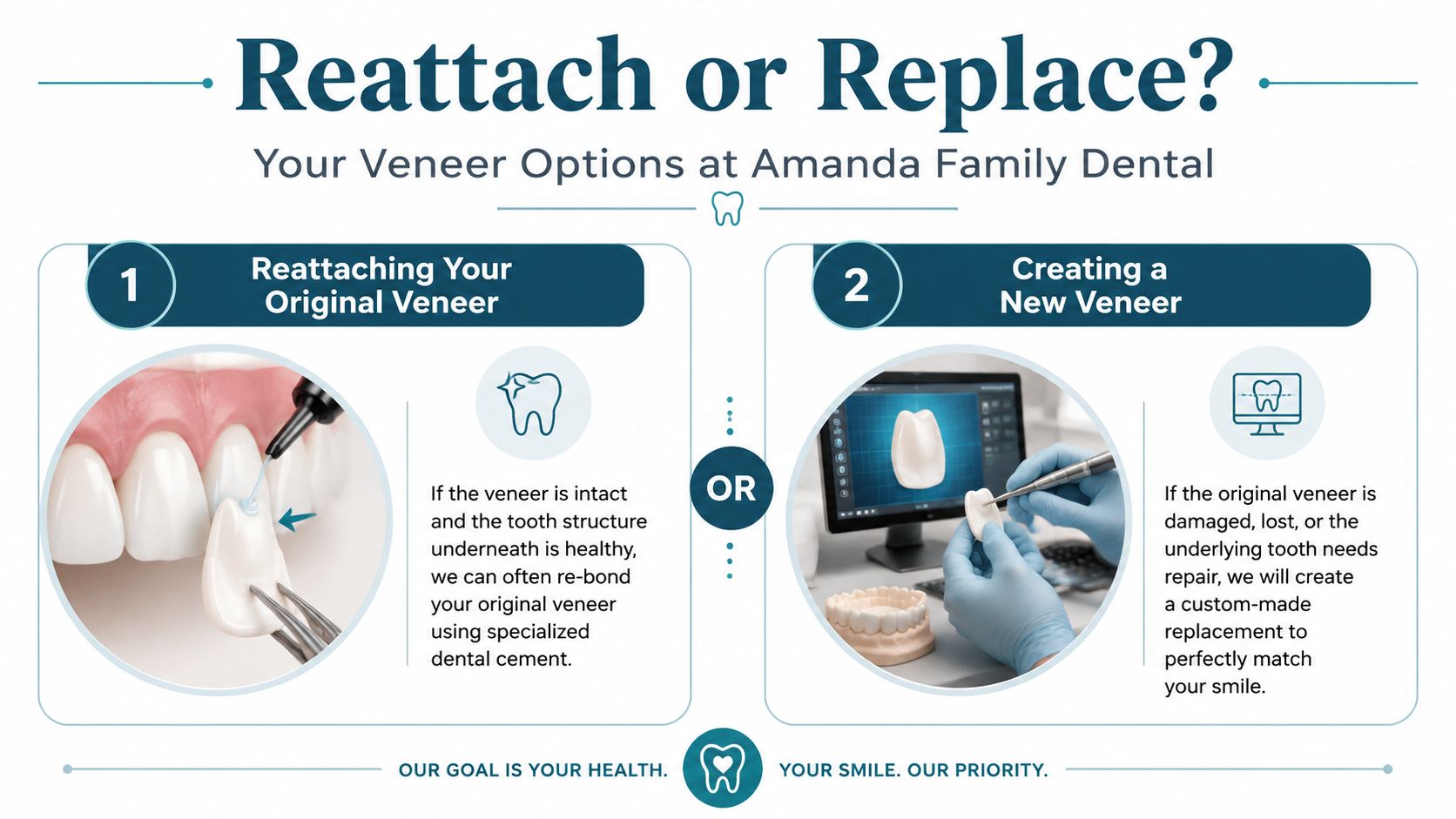
Rebonding the original veneer is often possible if the piece is intact and still fits the tooth accurately. The tooth underneath also needs to be suitable for bonding, which means no major decay, no major fracture, and no condition that would make the veneer unstable right away.
A dentist may consider reattachment when:
- The veneer is whole and not visibly cracked or distorted.
- The tooth structure is healthy enough to support bonding.
- The margins still match properly without obvious fit problems.
- The bite doesn't place heavy stress directly on that veneer.
In situations like that, cleaning away old cement and rebonding may be the most conservative path.
When replacement is the better choice
Sometimes keeping the old veneer isn't the smart move. If the veneer is chipped, warped, contaminated, or no longer fits correctly, replacement is more predictable. The same is true if the underlying tooth needs treatment before any cosmetic restoration goes back on.
A short comparison helps clarify the logic:
| Option | Usually considered when | Main goal |
|---|---|---|
| Reattach the original veneer | Veneer is intact and tooth is sound | Preserve what already fits and functions |
| Replace with a new veneer | Veneer is damaged, lost, poorly fitting, or the tooth changed | Restore appearance and bond quality with a new restoration |
| Choose a different restoration | Tooth structure is too compromised for another veneer | Improve long-term support and protection |
Patients sometimes ask about materials and bonding products after a veneer comes off. Basic context on dental cement and crown-style bonding concepts can help explain why professional reattachment is more precise than “gluing something back.”
Repeated debonding changes the conversation
If a veneer has come off more than once, the discussion should become broader. Clinical guidance notes that recurring veneer debonding can signal an occlusal problem, bruxism, underlying tooth decay, or an original bonding error, and that repeated re-cementing alone may miss the actual issue, according to guidance on what recurring veneer loss can mean.
That's one reason a careful cosmetic and restorative evaluation matters. For patients in Amanda, Lancaster, Circleville, and Carroll who are weighing veneer repair, replacement, or another form of restorative dentistry, Amanda Family Dental provides exams, digital X-rays, and treatment planning that help determine which option the tooth can support.
The durable choice isn't always the fastest one. If the bite, tooth, or original design is the real problem, correcting that matters more than simply rebonding the same veneer again.
Your Compassionate Care Visit in Amanda OH
Most patients arrive worried about two things. Whether the tooth can be fixed, and whether the visit will feel uncomfortable or rushed. A calm emergency visit should answer both.
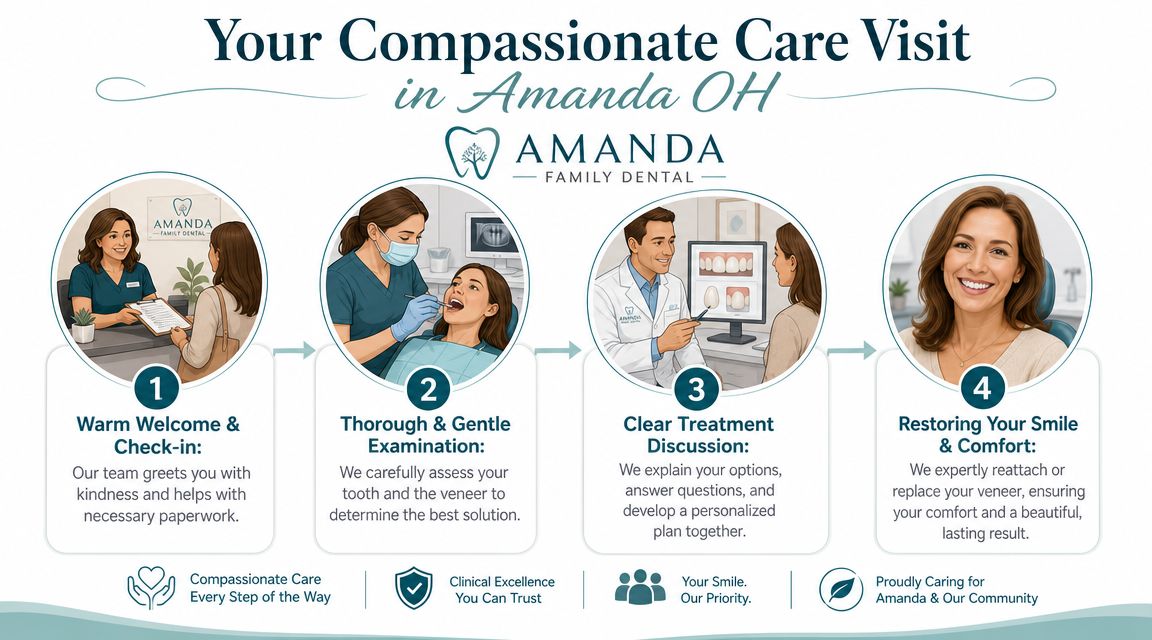
For a veneer problem, the appointment usually starts with a gentle look at the tooth itself and the veneer that came off. The clinical team checks for visible damage, sensitivity, signs of decay, and whether the restoration still appears usable.
What the visit usually includes
If more detail is needed, digital X-rays may be taken to look for problems that can't be confirmed from the surface alone. That can include decay at the margin, hidden structural concerns, or issues with the underlying tooth.
From there, the dentist discusses the findings in plain language. Patients should expect a direct explanation of what's restorable now, what should wait, and what option is likely to hold up better.
- A careful exam of the exposed tooth and the veneer
- Digital X-rays when indicated to check below the surface
- A discussion of treatment options that fits the tooth's condition
- A personalized plan for reattachment, replacement, or another restoration if needed
Why the experience matters
People often remember how a dental office made them feel during an unexpected problem. Clear communication, gentle handling, and a team that stays composed can lower stress right away. Broader healthcare writing on building compassionate healthcare teams helps explain why that matters so much to patients facing urgent care decisions.
For anyone looking for a dentist in Amanda, OH, or a dentist in Lancaster, OH, Circleville, OH, or Carroll, OH, the practical value of that approach is simple. It helps patients make a good decision when they're worried, uncomfortable, and trying to protect both oral health and appearance.
Your Veneer Questions Answered
Can superglue be used if a veneer fell off
No. Household glue can damage the veneer, interfere with proper fit, and make professional bonding more difficult. It can also trap debris against the tooth.
Is a fallen veneer a dental emergency
It's usually urgent rather than life-threatening. The level of urgency goes up if the tooth is painful, sharp, visibly damaged, or the veneer came off after an injury.
A veneer problem may not send someone to the hospital, but it shouldn't be ignored for long.
How can other veneers be protected
Prevention depends on the cause. If clenching or grinding is part of the picture, a nightguard may help. If hard foods or habits are the issue, avoiding chewing ice, biting pens, and using teeth as tools can reduce stress on veneers.
Routine dental care also matters. Cleanings, exams, and early evaluation of any looseness or edge changes can catch problems before a veneer fully detaches.
Is reattachment cheaper than replacement
Often, yes, but the actual cost depends on what the tooth and veneer look like at the appointment. A simple rebonding visit is different from a case that also involves decay treatment, a new veneer, or another restorative option. Insurance benefits and practice membership plans may also affect what a patient pays.
How long can someone wait
Sooner is better. Waiting can increase sensitivity, allow plaque to collect on the prepared tooth, and delay treatment if the veneer could have been reused. If the veneer is off, calling promptly is the safer decision.
For patients in Amanda, Lancaster, Circleville, and Carroll who are searching for a dentist near me after a veneer fell off, fast evaluation is the key step. The right treatment depends on the tooth, the veneer, and the reason it came loose.
If a veneer has come off and a clear next step is needed, Amanda Family Dental is available for patients seeking prompt dental care, emergency evaluation, cosmetic dentistry guidance, and restorative treatment planning in the Amanda area. Scheduling an appointment quickly can help protect the tooth, preserve the veneer when possible, and restore comfort and appearance with a plan that fits the situation.