

A lot of people searching for a dentist near me aren't just looking for a convenient address. They're looking for a dental office where they won't feel embarrassed, rushed, or overwhelmed. Some have been putting off a cleaning for years. Others need help with a painful tooth, a filling, or a tooth extraction, but anxiety has kept them from calling.
That's where nitrous oxide dentistry can change the whole experience. For many patients, it turns a tense visit into one that feels manageable, calm, and predictable. For families in Amanda, Lancaster, Circleville, and Carroll, Ohio, understanding how it works can make the first step much easier.
Table of Contents
- A Relaxing Dental Visit Is Possible in Amanda OH
- What Is Nitrous Oxide Dentistry
- Benefits of Choosing Nitrous Oxide for Your Dental Care
- What to Expect During Your Nitrous Oxide Appointment
- Nitrous Oxide Compared to Other Sedation Options
- Safety and Potential Side Effects
- Your Questions About Nitrous Oxide Answered
A Relaxing Dental Visit Is Possible in Amanda OH
A common story goes like this. A patient in Amanda or Lancaster knows a checkup is overdue, but every time the appointment gets close, the stress builds. The sounds. The anticipation. The worry about pain or bad news. That stress can keep a small problem from getting treated until it becomes a bigger one.
Nitrous oxide dentistry is often helpful in exactly that situation. It supports patients who want to stay awake and aware, but don't want every second of the visit to feel tense. That matters whether the visit is for cleaning and exams, a cavity, an emergency concern, or a discussion about cosmetic or restorative treatment.
Patients often look for signs that a dental office takes comfort seriously before they ever book. Online reviews can help, and practices that pay attention to patient feedback often use tools related to dental clinic review management so concerns are answered clearly and consistently. That kind of transparency matters to anxious patients because it shows whether a team communicates well.
For patients who already know dental fear is part of the problem, learning more about how to overcome fear of the dentist can make the first call feel less intimidating.
Many anxious patients don't need a dramatic solution. They need a calm environment, clear explanations, and a comfort option that keeps the visit within their control.
That's why this topic matters so much for families in Amanda, OH, as well as nearby Lancaster, OH, Circleville, OH, and Carroll, OH. A comfortable dental visit isn't wishful thinking. With the right planning, many people who once avoided care can sit through treatment more easily and leave feeling relieved instead of drained.
What Is Nitrous Oxide Dentistry
You arrive for a dental visit already tense. Your shoulders are tight, your mind is racing, and you are wondering whether you will be able to get through the appointment. Nitrous oxide dentistry is one way dentists help lower that sense of alarm while keeping you awake, aware, and able to respond.
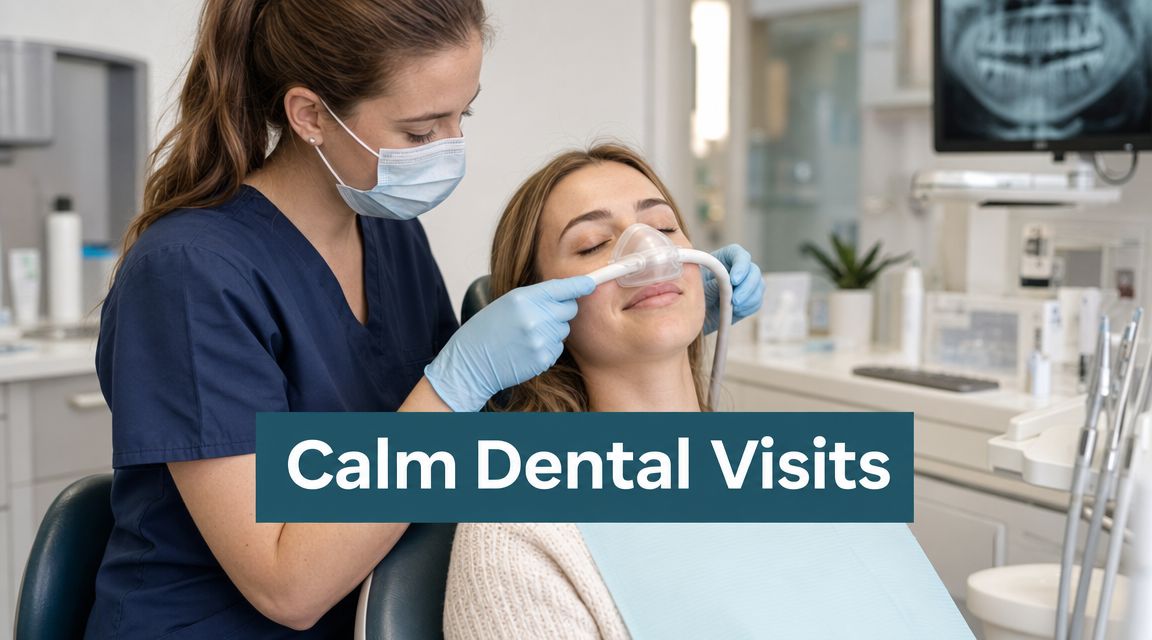
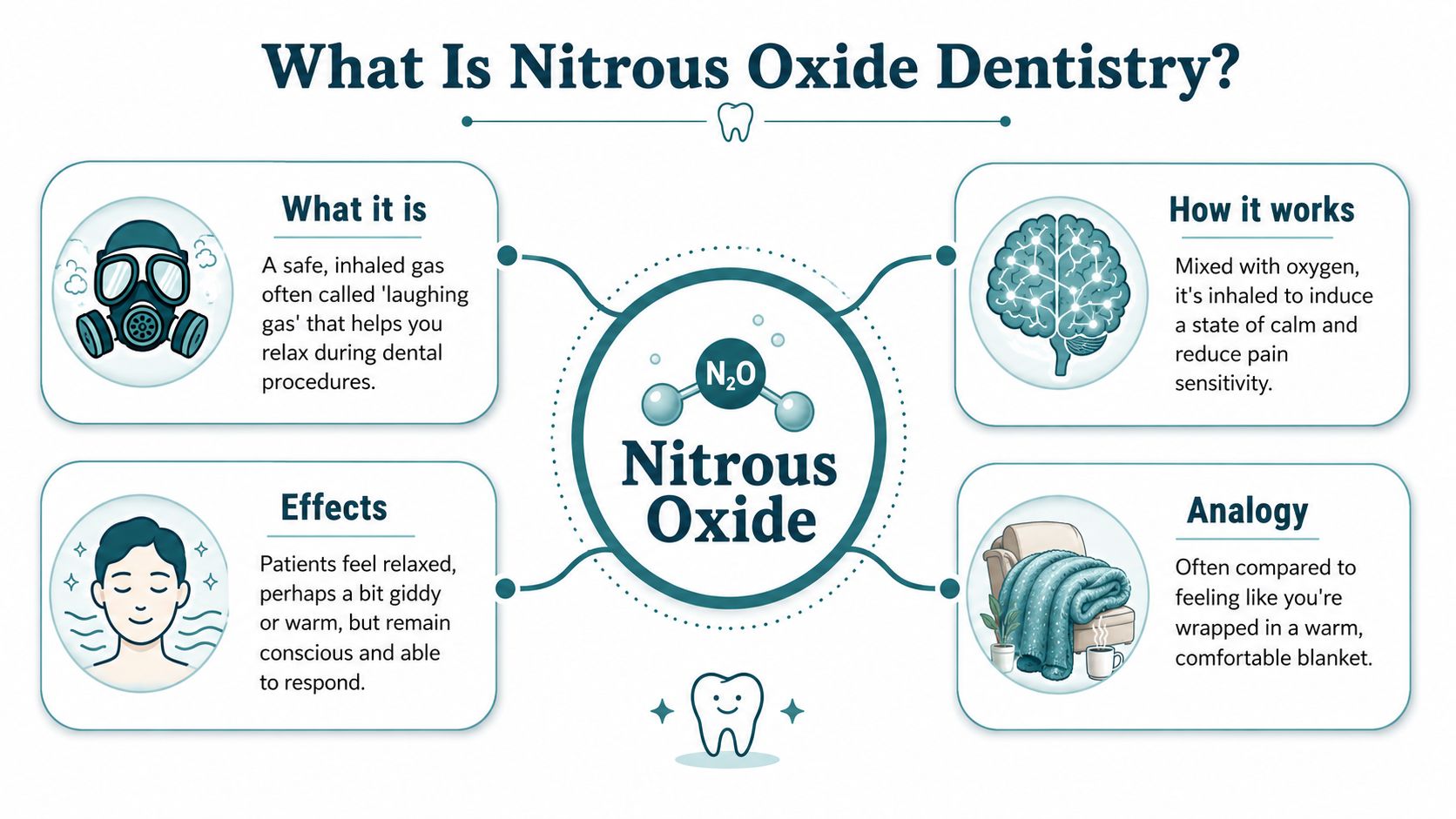
Nitrous oxide is a gentle gas mixed with oxygen and breathed through a small nose mask during treatment. Many patients know it as laughing gas, but its purpose is comfort. It helps the body settle down so routine dental care can feel manageable again.
For many anxious patients in Amanda, OH and nearby communities like Lancaster, OH, Circleville, OH, and Carroll, OH, that can be the difference between putting off care and finally getting started. At Amanda Family Dental, this option is part of a larger goal. Help people receive treatment without feeling trapped, panicked, or overwhelmed.
A familiar option with a long history
Nitrous oxide has been used in dentistry for generations. That history reassures many nervous patients because it is not an unusual comfort method or a last-resort measure. It is a well-known part of dental care that many people have used to make appointments feel easier.
If the word "sedation" makes you picture being fully asleep, then confusion often starts. Nitrous oxide does not usually make patients unconscious. It creates a calmer state where you can still hear, answer questions, and understand what is happening around you.
How it feels during a visit
Patients often describe the feeling in simple, everyday terms. The room seems less intense. Sounds and sensations bother them less. The appointment feels easier to tolerate because their body is no longer stuck in high alert.
Some people feel light, floaty, or mildly giddy. Others just notice that their breathing slows and their muscles loosen. Reactions vary, but the usual goal is the same. Reduce anxiety without taking away awareness.
Practical rule: Nitrous oxide is used to ease anxiety and improve comfort during treatment while the patient remains conscious.
This distinction is often the turning point for people who fear losing control. If you have delayed treatment because you worry about feeling helpless in the chair, nitrous oxide is often reassuring for one simple reason. You are still you, just calmer.
That is why many families see it as more than a clinical option. It helps make fear-free dental care feel possible close to home.
Benefits of Choosing Nitrous Oxide for Your Dental Care
A lot of patients do not ask for nitrous oxide because they want a different kind of dental visit. They ask because they want to get through the visit at all.
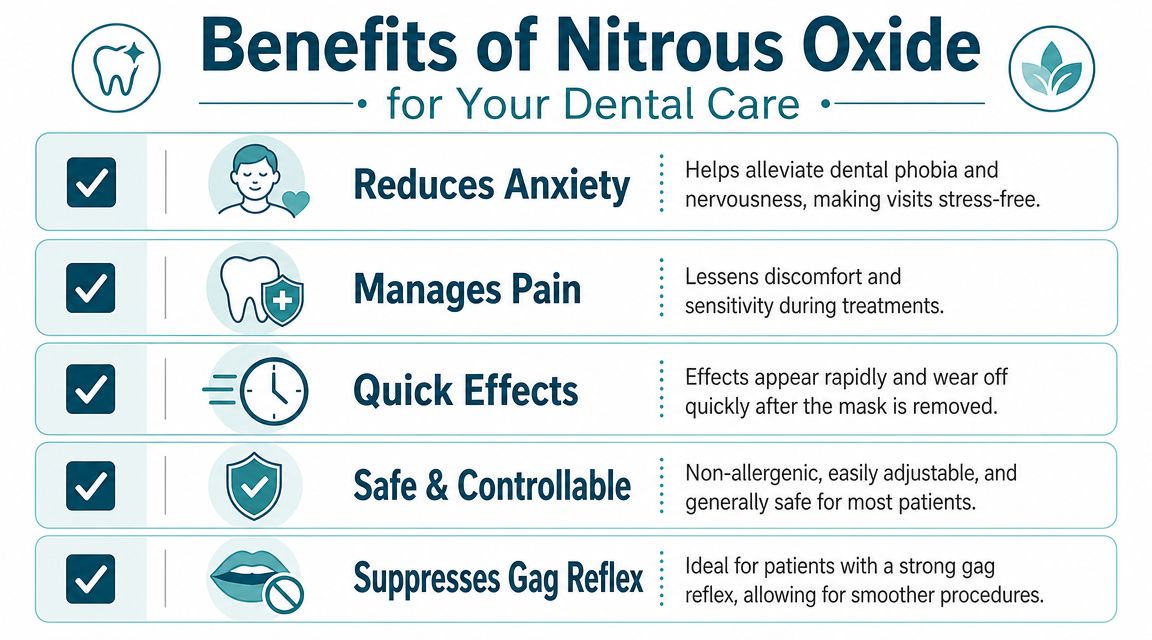
That distinction matters. If anxiety, a sensitive gag reflex, or the stress of a longer procedure has kept you from booking care, nitrous oxide can lower the hurdle enough for treatment to feel doable again. For many families in Amanda and nearby towns, that means less postponing, fewer dental flare-ups, and a better chance of fixing problems while they are still small.
Research supports that practical benefit. A 2021 systematic review and meta-analysis of 1,293 patients reported an overall nitrous oxide inhalation sedation success rate of 94.9% with a 95% confidence interval of 88.8% to 98.9%. In adults, the success rate was 99.9% with a 95% confidence interval of 97.7% to 100.0%, and in pediatric patients it was 91.9% with a 95% confidence interval of 82.5% to 98.2%. The difference between age groups was statistically significant with P = 0.002 (systematic review and meta-analysis).
Who often benefits most
Nitrous oxide is often a good fit for patients who need help settling their body and mind without losing the ability to cooperate during care.
- Anxious adults: People who have been putting off treatment, even when they know they should come in.
- Children who need reassurance: Young patients often do better when fear is lower and the visit feels less overwhelming.
- Patients with a strong gag reflex: Relaxation can make impressions, X-rays, and treatment easier to tolerate.
- People facing longer appointments: Time in the chair can feel more manageable when the body is not bracing the whole time.
- Patients returning after years away: Nitrous oxide can make that first visit back feel less intimidating.
Why patients often choose it
The appeal is simple. Patients want comfort that helps the appointment go better from beginning to end.
- Fast calming effect: Many patients notice relief quickly after they start breathing through the nose mask.
- Adjustable support: The dentist can adjust the amount gradually instead of relying on a fixed one-size-fits-all approach.
- Able to communicate: Patients can still answer questions, ask for a pause, and stay involved in their care.
- Quick return to normal: Many people feel much more clear-headed soon after the visit is over.
- Better follow-through on needed treatment: Patients who once canceled or delayed care are often more willing to complete fillings, cleanings, or even a tooth extraction appointment when anxiety feels under control.
That last point is often the biggest benefit of all. A cavity treated early is usually simpler than a toothache treated late. A cracked tooth checked now is easier to address than an emergency on a weekend.
Amanda Family Dental provides nitrous oxide as part of patient-centered care for families in Amanda and surrounding communities. For patients who feel nervous about calling, that local option can make fear-free dental care feel real, close, and possible.
What to Expect During Your Nitrous Oxide Appointment
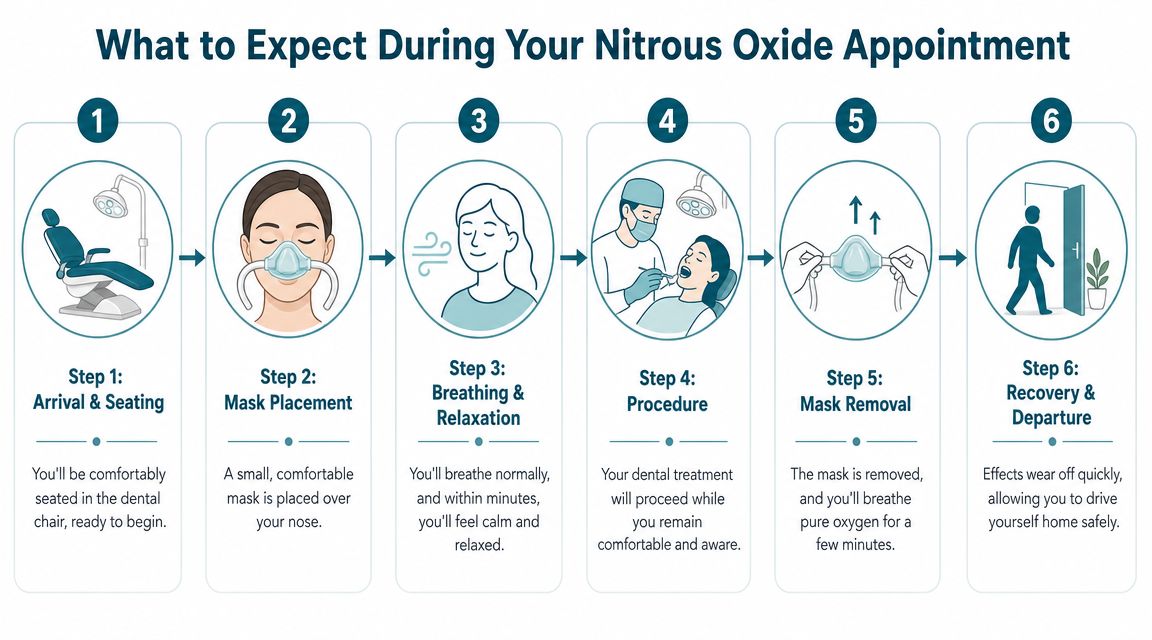
The unknown is often the scariest part of dental treatment. A step-by-step picture helps. Nitrous oxide appointments are typically simple, controlled, and much less dramatic than anxious patients expect.
A visual overview can help make the process feel more familiar.
The first few minutes in the chair
Once the patient is seated, a small mask is placed over the nose. The patient breathes normally. There's no need for complicated breathing techniques.
Clinical guidance describes nitrous oxide/oxygen sedation as a titrated mixture. Standard practice starts with 100% oxygen for 1 to 2 minutes, followed by nitrous oxide increases in 10% increments. Clinical anxiolysis and analgesia are often achieved around 30% to 40% nitrous oxide, and concentrations are generally kept at 50% or less because ventilation and cardiovascular function are usually unaffected at that level (clinical review on titration and dosing).
That word, titration, means gradual adjustment. Instead of giving a fixed amount and hoping it fits, the team increases the nitrous oxide little by little to find the level that helps the patient feel settled.
Patients who are nervous about treatment such as a tooth extraction often find this reassuring because it means comfort is adjusted thoughtfully, not rushed.
During treatment and after the mask comes off
Once the patient feels relaxed, treatment begins. Many describe a warm, floating, or calm sensation. Some notice mild tingling in the hands or feet. Others feel less concerned about what's happening around them.
The patient remains conscious. That's important. The patient can still hear instructions, answer questions, and let the team know if something needs attention.
Later in the visit, the process reverses. The nitrous oxide is stopped, and the patient breathes oxygen again for several minutes. The relaxed feeling fades quickly.
This video gives a simple look at the experience many patients are curious about.
Most patients are surprised by how ordinary the process feels. The mask goes on, the body relaxes, treatment happens, and the clear-headed feeling returns soon after.
That sequence is one reason nitrous oxide is popular for both routine and problem-focused care. A patient from Circleville or Carroll who has a busy day ahead often wants comfort without a drawn-out recovery. Nitrous oxide fits that need well.
Nitrous Oxide Compared to Other Sedation Options
Patients often ask a reasonable question. If nitrous oxide helps with anxiety, how is it different from other sedation methods?
The clearest answer is that nitrous oxide is usually a first-line comfort tool, not a replacement for deeper sedation. Pediatric guidance describes it as something typically kept at or below a 50% concentration to maintain consciousness and cooperation, which makes it useful for routine procedures while remaining different from deeper approaches used for more complex cases (AAPD guidance on nitrous oxide use).
That makes it a good fit for patients who want relief from anxiety but still want to remain awake, responsive, and able to recover quickly.
Dental Sedation Options at a Glance
| Feature | Nitrous Oxide (Laughing Gas) | Oral Sedation (Pill) |
|---|---|---|
| How it's given | Inhaled through a small nose mask during the visit | Taken by mouth before the appointment |
| Level of relaxation | Light to moderate relaxation while staying aware | Deeper relaxation for patients with stronger anxiety |
| Control during appointment | Adjusted throughout the visit as needed | Less flexible once taken |
| Recovery | Typically wears off quickly after the appointment | Recovery is longer and usually more lingering |
| Driving afterward | Often possible once the team confirms recovery | Usually requires a driver |
| Best fit | Mild to moderate anxiety, routine care, shorter recovery needs | Higher anxiety, longer or more involved visits |
How patients often decide
Nitrous oxide usually makes sense when the patient wants:
- More control: The patient stays aware and can communicate easily.
- A short recovery: Helpful for people managing work, school pickup, or errands.
- Support for moderate anxiety: Strong enough to take the edge off without going into deeper sedation.
Oral sedation may make more sense when the anxiety is stronger or when a patient has had difficulty getting through treatment with lighter support alone. Patients comparing these options may also want to learn more about sleep dentistry before deciding what fits their needs.
The best sedation choice depends on three things. Anxiety level, treatment complexity, and how much recovery time fits the patient's day.
For many people looking for a dentist in Circleville, OH or dentist in Carroll, OH, nitrous oxide lands in the middle ground they wanted all along. It's gentler than they feared, but more helpful than trying to “just get through it” without support.
Safety and Potential Side Effects
A lot of anxious patients ask the same question before they ever ask about comfort. Is it safe?
That is the right place to start. Nitrous oxide has been used in dentistry for many years, and its safety comes from something simple. The dentist controls it carefully, adjusts it gradually, and watches the patient the whole time. It is not a medication you take and then wait to see how it goes. It is more like a dimmer switch than an on-off button, which gives the team room to fine-tune how relaxed you feel during care.
For many people in Amanda, Lancaster, Circleville, and nearby towns, that level of control is what makes fear-free dental care feel possible. At Amanda Family Dental, the goal is not to push every patient toward the same solution. The goal is to choose a calm, appropriate option that fits the person sitting in the chair.
Why many patients feel reassured by nitrous oxide
Nitrous oxide is often considered one of the gentler sedation options because the patient continues to breathe on their own and can still respond to the dental team. If something feels too strong or too light, the level can be adjusted during the visit.
That flexibility matters.
It also helps that the effects usually fade quickly after the mask is removed and oxygen is given. Patients often like knowing the experience is not meant to linger for the rest of the day.
Possible side effects
Side effects can happen, and patients deserve a plain answer about that. The ones people are most likely to notice are nausea, dizziness, headache, or a floaty feeling that lasts a short time. These effects are usually temporary and improve after treatment ends.
Some patients are more likely to need extra caution. A careful health history helps the dental team decide whether nitrous oxide is a good fit, whether it should be adjusted, or whether a different comfort option would make more sense.
When another option may be a better fit
Nitrous oxide does not solve every kind of dental anxiety or every treatment challenge. Some children and adults need a different approach because of their medical history, their level of fear, or the type of procedure being planned.
That is a reassuring part of safe care, not a drawback. A thoughtful dentist does not use the same tool for everyone. A thoughtful dentist explains the options, answers questions clearly, and recommends the one that gives the patient the safest and calmest experience possible.
Your Questions About Nitrous Oxide Answered
Can someone drive home after nitrous oxide
In many cases, yes. Nitrous oxide is known for wearing off quickly after the mask is removed and oxygen is given. The dental team still checks that the patient feels normal and ready before leaving.
Is nitrous oxide used for children
Yes. It's commonly used in pediatric dentistry for selected children who need help relaxing and cooperating during care. As noted earlier, it works best as a first-line comfort tool for children who are appropriate candidates, not as a universal substitute for deeper anesthesia.
Does it replace numbing shots
Not usually. Nitrous oxide helps reduce fear and can raise comfort, but it doesn't replace local anesthetic when a procedure requires numbness. If a filling, extraction, or other treatment would normally need numbing, the dentist still uses that numbing medicine.
Nitrous oxide helps patients feel calmer about treatment. Local anesthetic helps block pain in the treatment area. Those are different jobs.
Is it only for major dental work
No. Some patients use it for treatment that sounds minor on paper but feels stressful in real life. That could include x-rays for a very anxious patient, a filling, a longer hygiene visit, or a visit after years away from the dentist. Dental anxiety doesn't have to be “serious enough” to deserve support.
Patients looking for a dentist in Amanda, OH, dentist in Lancaster, OH, or nearby care in Circleville and Carroll often feel better once they know comfort options are available. The most helpful next step is usually a conversation about anxiety level, health history, and the kind of appointment being planned.
Patients in Amanda, Lancaster, Circleville, and Carroll who have been delaying care because of stress or fear can contact Amanda Family Dental to ask whether nitrous oxide dentistry may be appropriate for an upcoming visit. A clear conversation about comfort options, treatment needs, and next steps can make scheduling feel much easier.